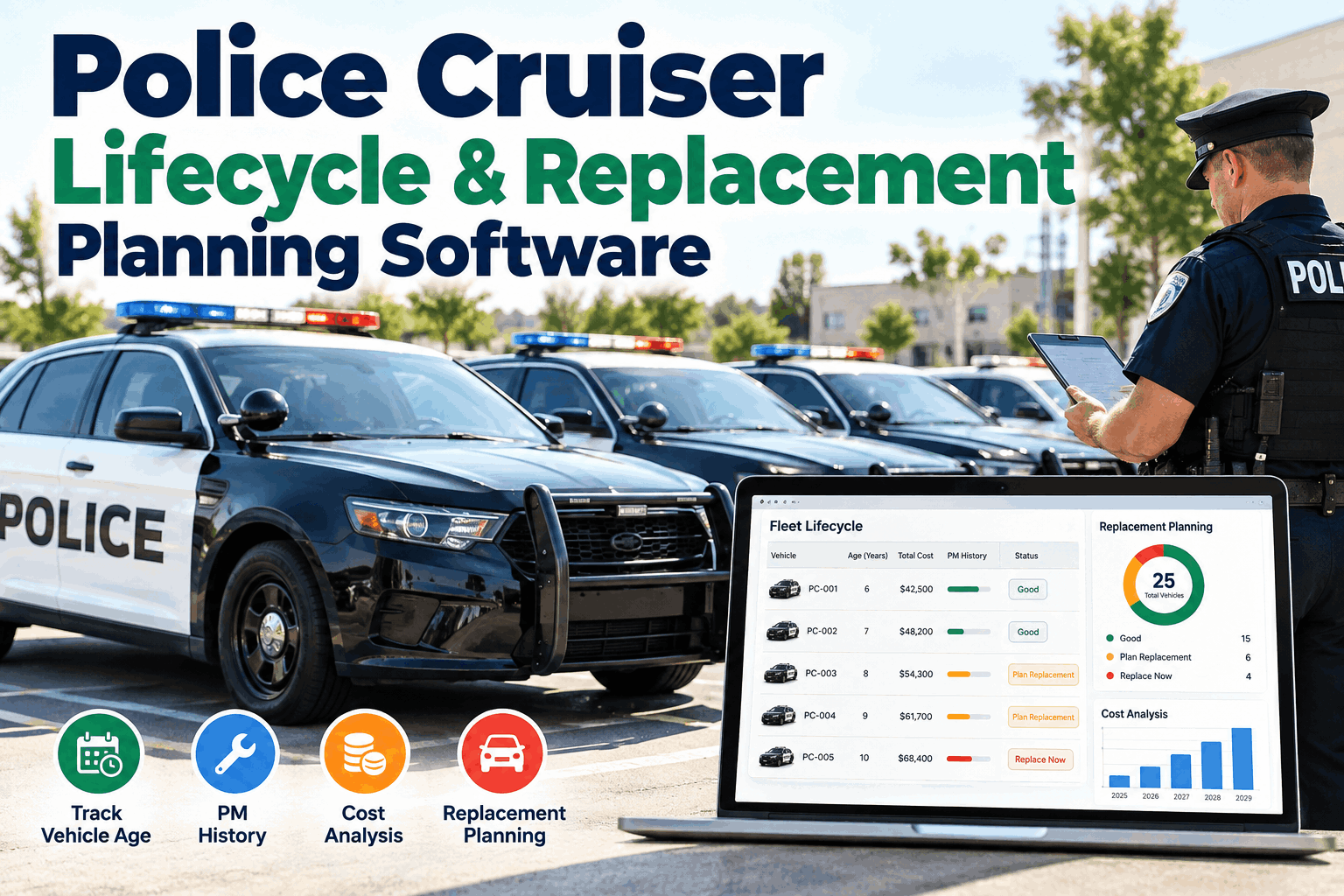
Every cruiser has a point where it quietly stops being worth fixing. Not a dramatic breakdown, just a slow accumulation of repair bills that starts to rival the cost of a payment on something new. Most departments feel that crossover happen before they can prove it happened, which makes the next budget request a guess instead of a case. See how FleetRabbit tracks the numbers that make that case for you.
Police Cruiser Lifecycle and Replacement Planning Software That Turns Age Into a Number
Track cost, mileage, engine hours and repair history by vehicle, and know exactly when a cruiser is costing more to keep than to replace.
The Curve Every Cruiser Follows
Repair cost and remaining value move in opposite directions as a cruiser ages, and at some point the two lines cross. Before that point, keeping the vehicle in service is usually the cheaper option. After it, every additional repair is money spent propping up a vehicle that's already worth less than what's being put into it. The hard part isn't understanding the idea, it's knowing exactly where that point sits for each individual cruiser, since two vehicles of the same model year can reach it years apart depending on how they were actually used.
Four Stages of a Patrol Vehicle's Life
New or newer, assigned to primary response duty, lowest repair frequency.
Still capable, but repair frequency starts climbing as major components age.
Administrative, training or reserve duty, lower-demand use that extends useful life.
Repair cost and reliability no longer justify keeping it in the fleet.
Know which stage every cruiser is actually in
Track cost, hours and repair frequency per vehicle instead of guessing by model year. Free for your first three vehicles.
What Should Actually Trigger a Replacement Decision
Age alone is a weak signal. A cruiser's real condition depends on how it was used, not just how long it's been in service, so a good replacement policy weighs several factors together rather than retiring everything at a fixed number of years.
A Fleet-Wide Replacement Forecast
Individual vehicle data only becomes a budget tool when it's rolled up across the whole fleet. Seeing which vehicles are approaching their replacement point, and when, turns next year's capital request into a forecast instead of a surprise.
Illustrative example. Your own forecast is built from your fleet's actual cost and usage data.
A Cost Ledger, by Vehicle
Illustrative structure. FleetRabbit populates this from your vehicle's real purchase, maintenance and work order records.
What FleetRabbit Gives a Department Planning Replacements
Frequently Asked Questions
Two cruisers of the same age can be in very different condition depending on assignment, idle time and driving pattern, so age by itself misses how a vehicle was actually used.
The point where a vehicle's cumulative repair cost starts to outweigh its remaining value, meaning it's costing more to keep in service than it would to replace.
Cruisers idle heavily on duty, so engine hours capture wear that mileage alone doesn't, giving a more accurate read on how much life a vehicle has left.
Yes. Rolling up cost and condition data across the fleet shows which vehicles are approaching replacement and when, which supports a forecast rather than a one-time ask.
Yes. Start free with three vehicles and scale up as the fleet grows.
Replace on Data, Not on Guesswork
Cost history, engine hours and condition tracked by vehicle, rolled up into a fleet-wide replacement forecast you can bring to any budget meeting.