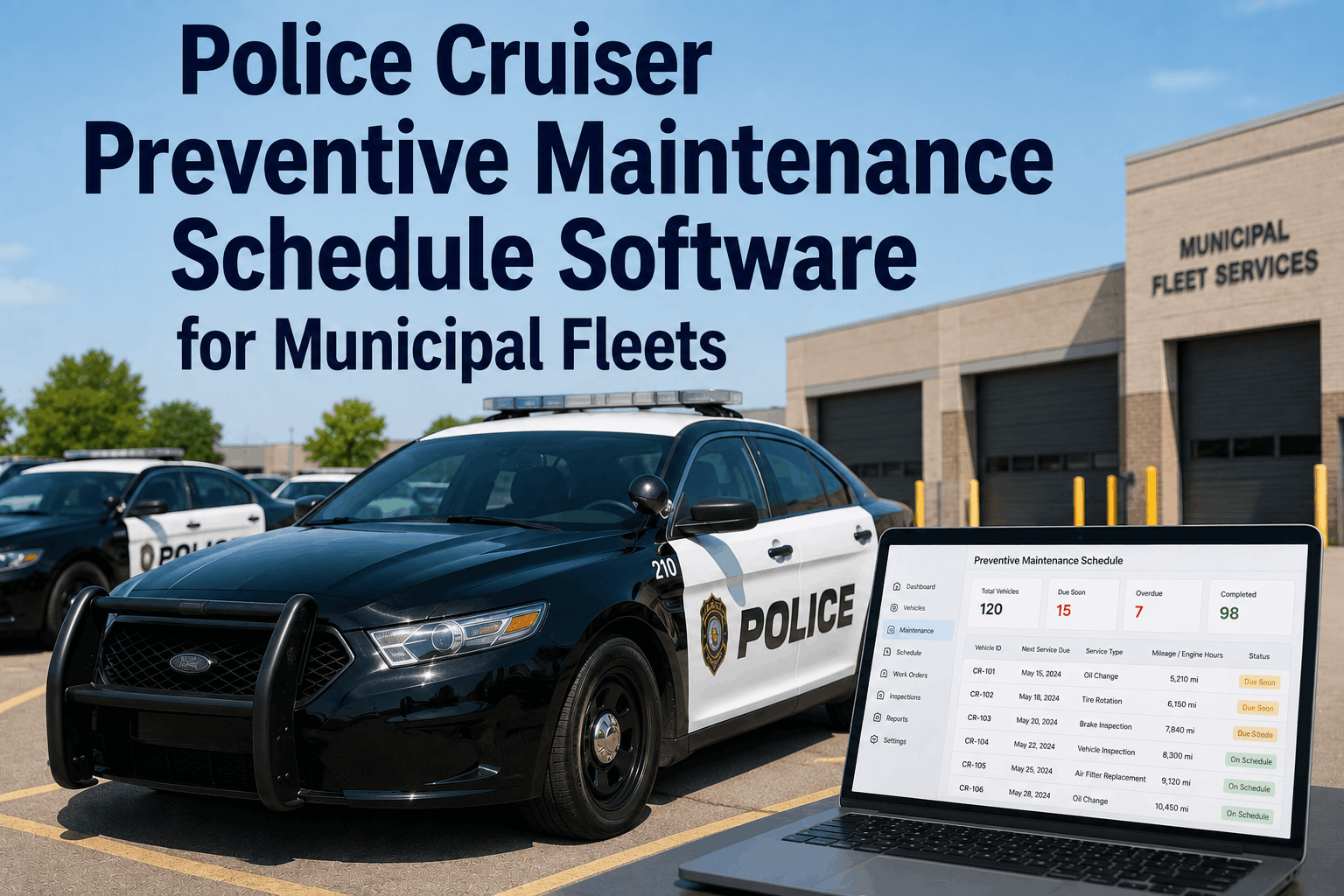
Most departments already have a preventive maintenance schedule written down somewhere — a binder, a spreadsheet, a whiteboard in the shop. The plan usually isn't the problem. The problem is that a written schedule doesn't send a reminder, doesn't flag a missed interval, and doesn't stop an officer from driving a unit that was due for service last week. A police cruiser preventive maintenance schedule only protects the fleet when something is actually watching the calendar and the odometer at the same time, which is exactly what agencies come to sign up for.
A patrol fleet's maintenance rhythm runs on more than one clock at once — a quick check every day, a deeper look once a week, and interval-based service layered underneath both.
Four Cadences, One Vehicle File
A workable schedule for a patrol unit isn't one list — it's four overlapping ones, each catching a different kind of problem before it becomes a breakdown or a failed inspection.
Daily — Pre-shift walk-around
A two-minute officer check before pulling out: lights, tires, fluid levels, and anything unusual left from the last shift. Fast, but it's the earliest point a small issue gets caught.
Weekly — Technician operational check
A more thorough check performed by shop staff, matching the widely used benchmark of a documented operational review at least once a week, or within 24 hours of an active run.
Monthly — Component-level inspection
Brake pad depth, belt condition, tire wear pattern, and battery load get a closer look than a walk-around allows, catching wear that builds slowly across weeks of patrol duty.
Interval-based — Oil, filters, and drivetrain service
Triggered by mileage, engine hours, or both, this is the tier where high-idle patrol duty and highway duty start to need genuinely different schedules.
Running all four tiers off one shared vehicle file — instead of a paper log for daily checks and a separate spreadsheet for interval service — is the difference between a schedule that exists and a schedule that gets followed. Departments that book a demo usually start by mapping their current four tiers into a single view for the first time.
Map your department's daily, weekly, and interval-based checks into one schedule before the next inspection cycle.
Patrol Duty And Highway Duty Don't Wear The Same
Classic fleet guidance for police vehicles has long split service intervals by how a vehicle is actually driven, not just by badge or department. A shorter mileage interval is standard for city patrol work, where low speeds and heavy idling put more strain per mile on the engine. A longer interval fits county or highway-pattern duty, where most miles are steady-speed and lower-strain. Several municipal fleets have also stretched intervals for patrol vehicles specifically after switching to full synthetic oil, citing the severity of stop-and-go, high-idle use as the reason to monitor more closely rather than service on a flat calendar date.
| Factor | High-idle patrol duty | Highway or admin duty |
|---|---|---|
| Typical driving pattern | Low speed, frequent idling, short trips | Steady speed, longer continuous runs |
| Primary wear driver | Engine hours and idle time | Total mileage |
| Best PM trigger | Engine hours, checked alongside mileage | Mileage, with a routine time-based backstop |
Departments running both patrol sedans and administrative vehicles off the same flat mileage schedule are almost always over-servicing one group and under-servicing the other. Splitting the trigger by vehicle class is a small configuration change that most agencies sign up to fix in their first week.
Keeping The Schedule Ready For DOT Review And NFPA-Style Documentation
A preventive maintenance schedule is only half the job. The other half is proving it was followed, since a state DOT audit or a council budget review will ask for records, not intentions. NFPA 1911 was written for emergency apparatus, but its documentation habits — every inspection logged, every result dated, every technician identified — are exactly what a defensible police cruiser PM program needs, even where the standard itself isn't a strict legal requirement for patrol sedans.
- Inspection record
- Date, technician, and result attached to the vehicle's file automatically at the moment the check is completed.
- Missed-interval flag
- Any unit that rolls past its due mileage or engine-hour threshold is marked before it goes back out on patrol.
- Exportable audit file
- A full service history pulled in one export, ready for a DOT review or a council question, instead of assembled overnight.
None of that requires a bigger shop staff. It requires the schedule and the proof of the schedule to live in the same place. Agencies that book a demo often bring their most recent audit request and watch how quickly the same pull would take with a connected schedule.
Why Engine Hours Belong Next To Mileage On Every Trigger
A patrol car can log a full year of hard service without covering unusual mileage, because so much of a shift happens at idle or under 25 mph rather than on the open road. A schedule built on mileage alone will let that unit run well past the point a duty-cycle-aware plan would have flagged it.
1 engine hour ≈ 33 miles of wear
the rough equivalence many departments now use to translate idle-heavy patrol time into a mileage-comparable service trigger
Setting both triggers side by side, and letting whichever one arrives first call the work order, closes that gap without adding a second manual process for the shop to track. It's a five-minute setting to review, and worth doing before it's the reason a unit fails inspection on mileage that looked fine on paper.
FleetRabbit runs your daily, weekly, monthly, and interval-based PM tiers off one connected schedule, with audit-ready records built in.
Frequently Asked Questions
What should a basic police cruiser PM schedule include.
At minimum, a daily pre-shift walk-around, a weekly technician operational check, a monthly component inspection, and interval-based service for oil, filters, brakes, and drivetrain components triggered by mileage or engine hours.
Should patrol vehicles use a shorter oil change interval than highway vehicles.
Generally yes. Vehicles that spend more time idling and driving at low speed put more strain on the engine per mile, which is why many fleets set a shorter interval for city patrol duty than for highway or administrative vehicles.
Is NFPA 1911 required for a police cruiser maintenance schedule.
NFPA 1911 is written for emergency apparatus, and applying it to lighter vehicles like patrol sedans is generally left to the authority having jurisdiction. Many police fleets still model their inspection cadence and documentation habits on it, alongside standard DOT roadworthiness rules.
Can engine-hour and mileage triggers run on the same vehicle.
Yes, and it's the recommended setup for patrol vehicles. Whichever threshold is reached first — mileage or engine hours — can generate the work order, so idle-heavy duty doesn't slip past a mileage-only schedule.
How does a digital schedule help during a DOT or council audit.
Every inspection, work order, and technician sign-off is attached to the vehicle's record automatically, so a full service history can be exported in minutes instead of reconstructed from paper logs under time pressure.