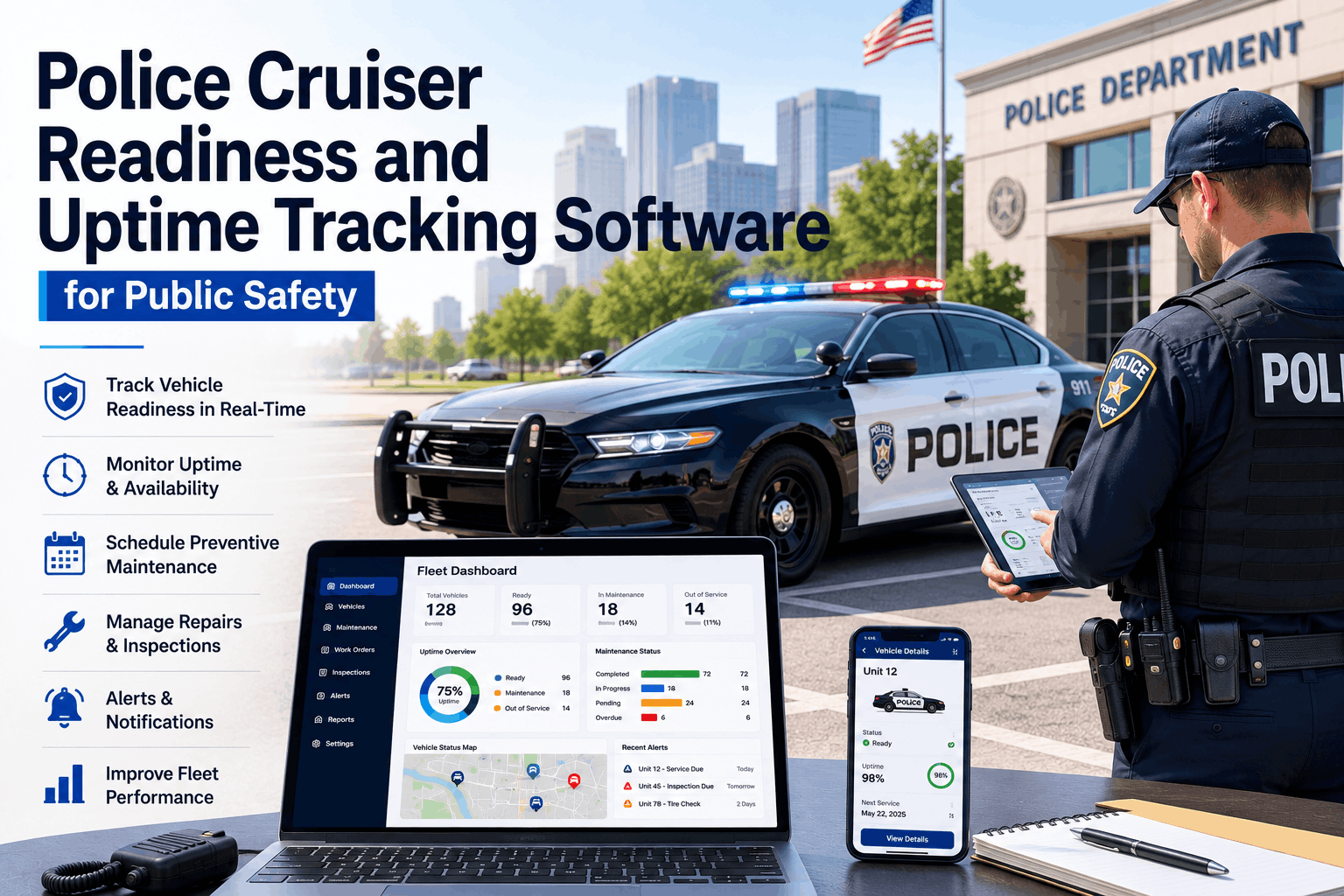
A patrol shift does not pause for a vehicle sitting in the shop. When a cruiser goes down mid-shift, a department is not just losing a vehicle, it is losing coverage on a beat, response time on a call, and a visible presence on the street. Police cruiser readiness tracking software closes that gap by pairing engine-hour based preventive maintenance with DOT-aligned inspection records and a live view of which units are pursuit-ready before the next shift briefing. FleetRabbit builds that system around how patrol vehicles are actually used, not how a delivery van or a box truck is used, and if your department is ready to see it firsthand you can book a demo anytime.
Why the Odometer Never Tells the Whole Story
Patrol vehicles do not wear like passenger cars. A cruiser idles at scenes, runs radar from a stationary position, holds a perimeter, and keeps the engine on to power lights, the laptop, and the radio during a traffic stop. That idle time never shows up as a mile on the dashboard, yet it drives real mechanical wear on the engine, transmission, and cooling system. A unit sitting at 60,000 miles on the odometer can carry closer to 150,000 miles of true wear once engine hours are converted. Departments that schedule preventive maintenance on mileage alone are working from the wrong number, which is exactly the gap that engine-hour scheduling in FleetRabbit is built to close for teams who sign up and connect their telematics feed.
Displayed mileage against engine-hour converted wear, calculated automatically from OBD data instead of an officer's end of shift log.
A Readiness Board Built for the Duty Roster, Not a Warehouse
Most fleet software was designed around box trucks and vans that return to a single yard every night. A patrol fleet needs something that speaks the department's own language: which units are pursuit-ready for the next shift, which are held for a defect, and which are sitting in the queue for scheduled service. FleetRabbit's readiness board gives a watch commander that answer in one glance instead of a phone call to the garage.
See Your Roster's True Readiness Before the Next Shift
Connect your telematics and inspection forms to a board your watch commanders will actually use.
The Electrical Load Most Departments Never Track
A modern cruiser carries a light bar, a mobile data terminal, an in-car camera system, a radio, and often a siren and console lighting, all drawing power while the vehicle sits parked with the engine running or the accessory circuit live. That continuous draw is the leading cause of premature battery failure in patrol fleets, and it is exactly the kind of electrical and electronic equipment maintenance that NFPA 70B guidance calls out for scheduled load testing. Emergency duty cycles call for battery load checks roughly every 7 to 14 days rather than the monthly interval that suits an office vehicle, and departments that book a demo of FleetRabbit can see how that testing gets scheduled automatically by duty cycle instead of the calendar.
Three Frameworks a Patrol Fleet Has to Satisfy at Once
Police cruisers do not sit inside a single compliance box. A fleet manager is usually answering to a federal transportation framework, an electrical maintenance discipline borrowed from public safety apparatus standards, and whatever state equipment mandate the department's certifying body sets, all at the same time.
DOT and FMCSA Records
Driver vehicle inspection reports, defect resolution, and maintenance history retained per vehicle and ready to produce for an audit or a public records request.
NFPA 70B Aligned Electrical Checks
Scheduled load testing and inspection of the light bar, radio, camera, and console electronics that draw down a cruiser's battery between calls.
State POST Equipment Standards
Emergency lighting, siren output, and pursuit-rated equipment held to the certifying body's requirements and documented at every inspection cycle.
Brakes Wear Differently on a Pursuit Vehicle
High-speed stops, aggressive acceleration out of a stop, and repeated emergency maneuvers put a braking system through cycles a standard quarterly inspection interval was never built to catch. Departments that stay on a calendar-only inspection window are often inspecting brakes long after real wear has already set in, which is why usage-based intervals matter for any unit that runs active patrol or pursuit duty.
What Runs Underneath the Readiness Board
The board a watch commander checks before shift briefing is only as good as the data feeding it. Departments that sign up with FleetRabbit connect telematics, inspection forms, and parts inventory into the same system so nothing has to be re-typed from a paper sheet.
Engine-hour PM scheduling
Service triggers set by true engine hours and idle time, not just odometer mileage.
Audit-ready DOT documentation
Inspection records and defect history stored per unit and exportable on demand.
Battery and electrical load tracking
Duty-cycle load test scheduling for light bars, MDTs, radios, and camera systems.
Usage-based brake intervals
Pursuit-duty braking cycles tracked separately from administrative units.
Dispatch-facing readiness roster
A live pursuit-ready, watch, and in-shop view built for the watch commander, not the shop floor.
Retained public records
A full maintenance and inspection trail ready for council review or a records request without digging through a filing cabinet.
Answering to a Filing Cabinet Is Not a Records Strategy
Municipal fleets are public property, and that means the maintenance record is public too. A council budget hearing, a state audit, or a resident's records request can all land on a fleet manager's desk asking for proof that a specific unit was inspected on a specific date. Departments running on paper logs routinely score well under full documentation completeness on a DOT audit, simply because records exist but cannot be produced fast enough. Centralizing every inspection form, work order, and load test result in one place turns that scramble into an export, which is one of the clearest reasons agencies book a demo before their next budget cycle.
Give Every Shift a Roster It Can Trust
Move from paper logs to a live readiness board and audit-ready records in one system.
Common Questions
Does NFPA compliance apply to police cruisers the same way it applies to fire apparatus
Not in the same form. NFPA standards for fire apparatus cover pump and aerial testing, while the relevant NFPA guidance for a patrol vehicle centers on electrical and electronic equipment maintenance, since a cruiser's light bar, radio, MDT, and camera system draw continuous power the way apparatus electronics do.
How often should a pursuit-rated cruiser's battery be load tested
Roughly every 7 to 14 days for active patrol units, since continuous idling and accessory draw stress a battery far more than a standard vehicle duty cycle.
Why do engine hours matter more than mileage for patrol vehicles
A cruiser spends a large share of every shift idling at scenes, running radar, or holding a perimeter, and that time adds real mechanical wear that never shows up as a mile on the odometer.
What does a DOT audit typically check on a municipal police fleet
Inspection reports, defect resolution records, and maintenance history for every vehicle, all of which need to be retrievable per unit rather than scattered across separate paper files.
Can FleetRabbit track both patrol cruisers and support vehicles in one system
Yes, a single fleet often spans frontline pursuit units, administrative cruisers, and support vehicles, and each can carry its own PM template and inspection interval inside the same account.