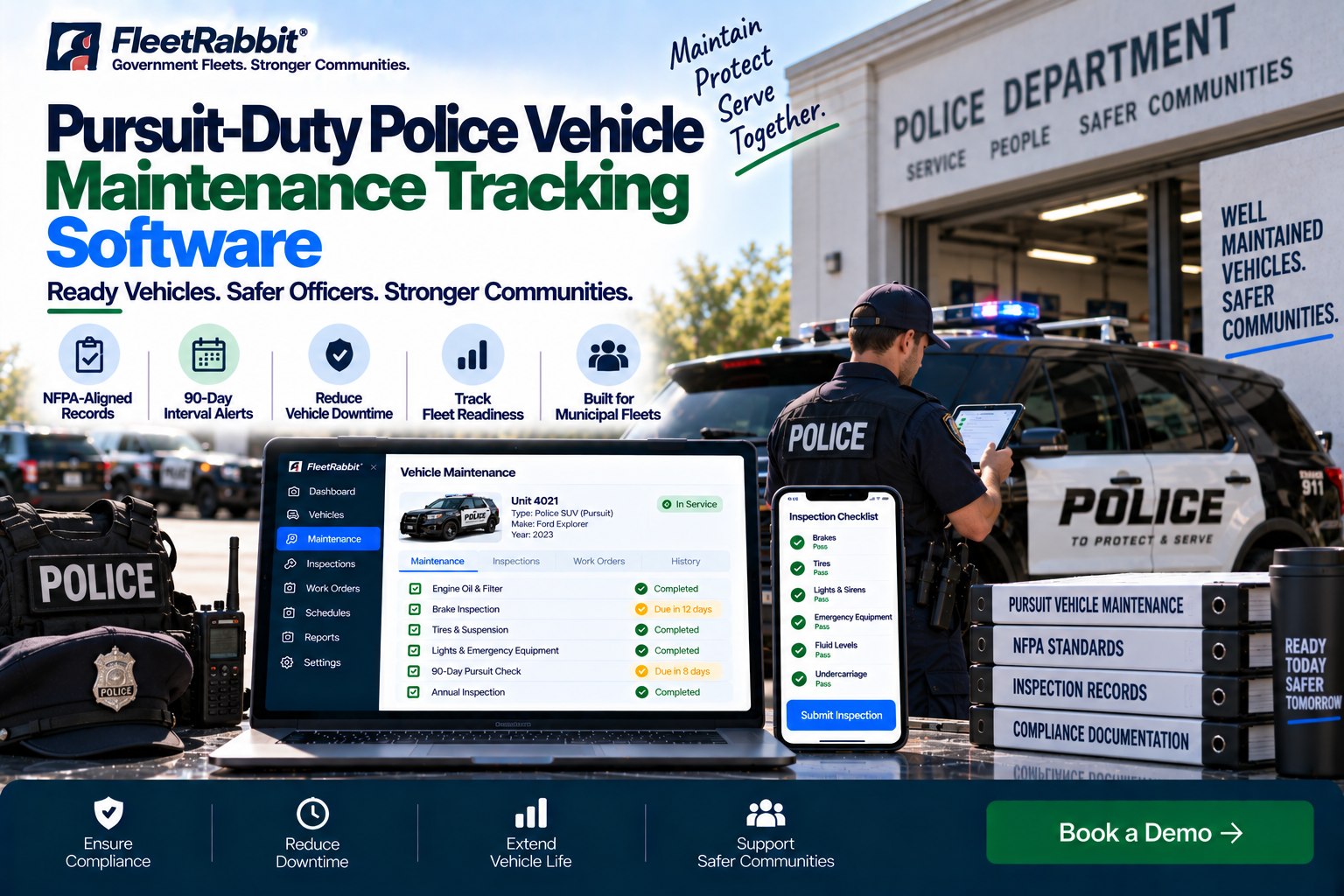
A patrol car that stalls mid-shift isn't a maintenance footnote — it's an incident report waiting to be written. Departments running mixed municipal fleets — marked cruisers, unmarked units, motorcycles, K-9 vehicles, and administrative sedans — live with a hard truth: the gap between "due for service" and "actually inspected" is exactly where audits fail, budgets bleed, and public trust erodes.
Pursuit-duty vehicles don't wear the way a delivery van does. Long idles behind a radar gun, hard braking at speed, and a dashboard full of always-on electronics stress a cruiser in ways a standard oil-and-tires schedule was never built to catch. Agencies that sign up for pursuit-aware tracking trade guesswork for a record that holds up the moment someone asks to see it.
Mixed fleets, one system
Patrol, admin, and specialty units run on different duty cycles — tracking them on one schedule is how the mismatched ones get missed.
90-day alert cadence
Built-in checkpoints at day 30, 60, and 90 keep brake, tire, and pursuit-equipment inspections from quietly slipping past due.
A record an auditor can open
Every inspection, defect, and repair is timestamped and attached to the vehicle — not scattered across a filing cabinet.
Why a Pursuit-Rated Cruiser Ages Differently
Most preventive maintenance schedules are written around mileage. A patrol vehicle can sit at idle for an entire shift with lights, radios, laptops, and a light bar pulling off the battery, then be asked for a hard stop from seventy miles an hour twenty minutes later. Brake pads, rotors, and charging systems wear on a curve that has almost nothing to do with the odometer.
Software built for civilian fleets tends to trigger service off calendar months or mileage bands. Pursuit-duty maintenance tracking works differently: it lets a fleet manager set condition-based triggers — brake wear tied to patrol shifts, battery load tested on a shorter cycle, pursuit lighting and push-bumper checks folded into the same visit as the oil change. Departments that book a demo usually start here, since it's the piece a paper log handles worst.
The 90-Day Interval, Mapped Out
Instead of a single annual service date, pursuit-duty vehicles need checkpoints that repeat every quarter. The dial below shows how a 90-day cycle breaks down for a typical marked unit — each stop is a scheduled alert, not a vehicle waiting to be noticed.
Day 30
Brake pad depth and pursuit lighting checked against use, not the calendar.
Day 60
Battery load test and tire wear recorded, with photos attached to the file.
Day 90
Full inspection closes the cycle and the next round of alerts is set automatically.
Where NFPA-Style Discipline Fits In
NFPA 1911 was written for fire apparatus, but its 2017 revision widened both its title and its scope from "fire apparatus" to "emergency vehicles" more broadly. Few departments run patrol cars under a literal NFPA 1911 certificate, but plenty of public safety fleets have borrowed its underlying discipline: defined inspection intervals, graded defect severity, documented out-of-service criteria, and a retained record that survives a records request.
That's what "NFPA-aligned" means in practice for a pursuit fleet: not a fire-apparatus certificate, but the same structure applied to patrol cars, motorcycles, and specialty units. A fleet manager who wants that structure without rebuilding it from a binder can sign up and import existing service history in an afternoon.
Give your fleet a record that holds up
Set your intervals once and let the alerts do the chasing. See what a pursuit-duty inspection log looks like from the very first entry.
One Fleet, Several Duty Cycles
A municipal fleet rarely runs one type of vehicle, and treating all of them the same is how the mismatched ones fall through.
Marked patrol cruisers
The highest duty cycle in the fleet — hard braking, long idles, and always-on electronics. These carry the shortest inspection intervals of any unit.
Motorcycles
A different wear pattern entirely. Tire and drivetrain checks matter more than battery load, and seasonal storage changes the whole schedule.
K-9 vehicles
Climate control and containment systems run continuously. A failure here is a welfare issue first, and a downtime issue second.
Admin and unmarked units
Lower duty cycle overall, but still need a documented history for the day the vehicle is reassigned, resold, or reviewed.
What an Auditor Actually Wants to See
When a records request or an internal review lands on a fleet manager's desk, the question is rarely "was the car serviced." It's "can you show me when, by whom, and what was found." Paper logs and spreadsheets answer that slowly, if at all — and a slow answer reads the same as no answer during a review.
A digital inspection record settles the question before it's asked: timestamped entries, defect photos, technician sign-off, and a due-date history attached to the vehicle instead of a folder. Agencies that sign up can pull that record in the time it takes to open a browser tab; the ones weighing the switch can book a demo and see the difference side by side.
The Night Before an Audit
Paper-based fleet
Binders pulled from three different offices, mileage cross-checked by hand, and at least one service sheet nobody can locate before morning.
Pursuit-duty software
One search by unit number returns every inspection, defect, and repair on file — exportable before the coffee finishes brewing.
Ready to see your whole fleet on one dashboard
From marked cruisers to admin sedans, bring every unit onto a single, audit-ready record.
Common questions
What counts as a pursuit-duty maintenance interval
It's a service checkpoint set around how a vehicle is actually used in the field — patrol shifts, brake events, and idle time — rather than a flat monthly or mileage-based schedule borrowed from a civilian fleet.
Does this replace NFPA 1911 certification for fire apparatus
No. NFPA 1911 remains a fire-apparatus and emergency-vehicle testing standard administered by the National Fire Protection Association. Pursuit-duty software borrows its documentation discipline for patrol fleets; it does not issue or replace an NFPA certificate.
Can one system handle cruisers, motorcycles, and admin vehicles together
Yes. Each vehicle type keeps its own interval schedule and inspection template, while every record still lives on one fleet-wide dashboard for reporting and audits.
How does the 90-day alert schedule actually work
Checkpoints at day 30, day 60, and day 90 are configurable per unit type, so a cruiser and an admin sedan can run on different clocks without needing two separate systems.
How long does it take to get a department set up
Most departments are logging inspections within a day of choosing to sign up, since existing service history imports directly instead of being re-entered by hand.
What if we want to see it running before committing
That's exactly what a walkthrough is for — bring a sample of your current fleet list and book a demo to see it configured against real units.