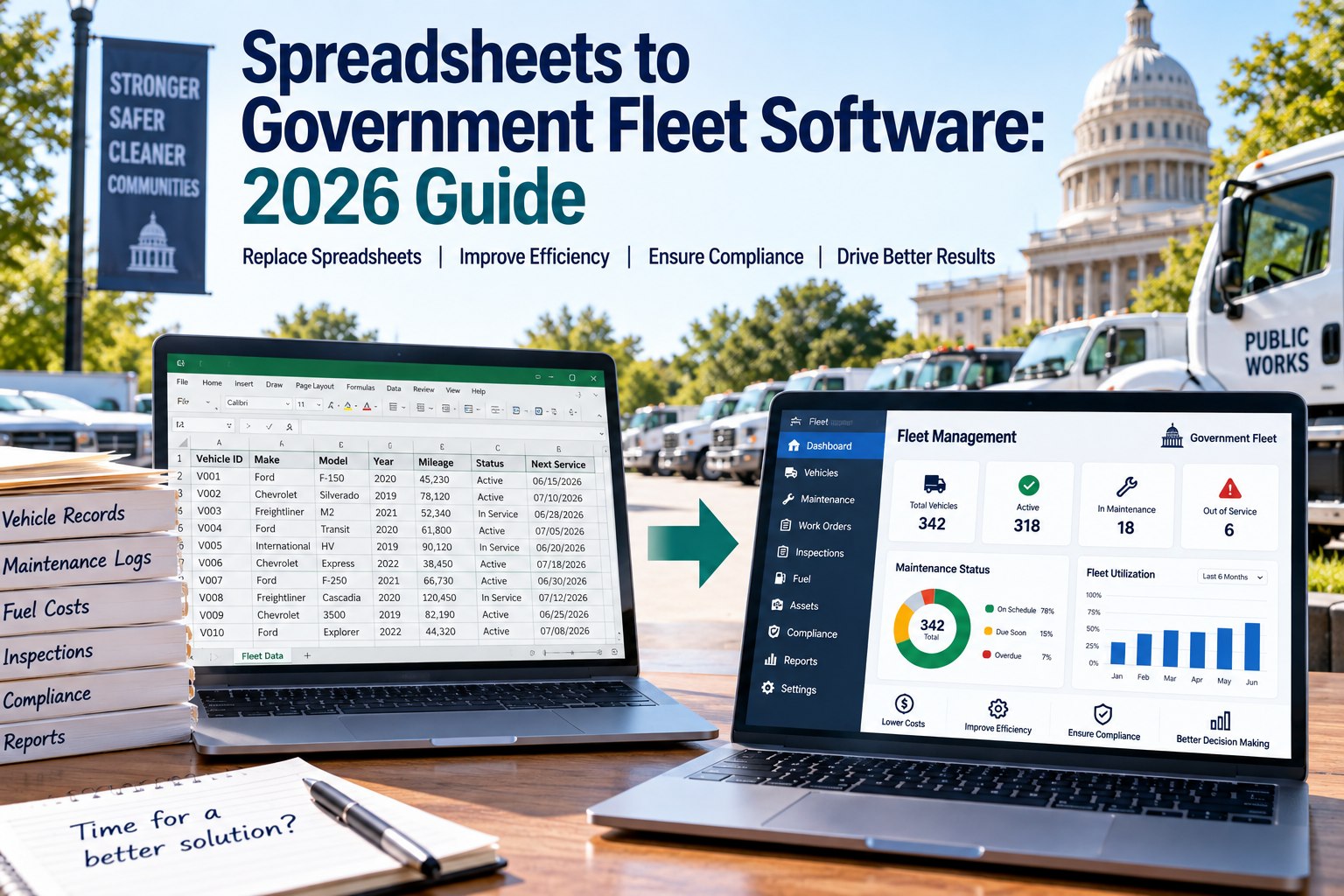
Hundreds of municipal, county, and state agencies still run critical fleet operations on shared Microsoft Excel workbooks and Google Sheets. While spreadsheets cost nothing upfront, their hidden costs—broken cell formulas, blind maintenance intervals, failed audit trails, and hours lost to manual data entry—create major liabilities for public sector leaders. Transitioning to dedicated public sector fleet management software protects municipal budgets and ensures compliance across departments. FleetRabbit delivers an automated, AI-powered fleet operations platform designed to migrate legacy spreadsheets into audit-proof digital workflows with zero frontline downtime. See how simple the transition can be: book a tailored demo or sign up to explore the platform.
Spreadsheets to Government Fleet Software: 2026 Buyer's Guide
The Tipping Point: Spreadsheets vs. Dedicated Government Fleet Software
Every growing municipal fleet eventually outgrows manual sheet tracking. When a workbook reaches multiple tabs, shared drive conflicts, and disconnected fuel receipts, public safety and compliance are put at risk.
The Hidden Cost of "Free" Tracking
- No Live Telematics: Odometers and engine hours require manual inputs from grease-stained paper logs.
- Audit Vulnerabilities: Accidental cell edits, deleted rows, and missing timestamps fail state compliance checks.
- Siloed Multi-Fund Records: Splitting fuel and repair charges across General, Water, and Police funds requires hours of pivot-table crunching.
- Reactive Maintenance: Technicians only service equipment after a component failure, leading to expensive towing and downtime.
Modern Public Sector Infrastructure
- Continuous Ingestion: Odometer, fuel transactions, and fault codes sync in real time via telematics and card bridges.
- Immutable Audit History: Every digital signature, work order revision, and inspection note is securely logged.
- Automated Cost Center Ledger: Labor, parts, and vendor bills map automatically to designated municipal GL funds.
- Proactive Work Orders: Service schedules auto-generate before critical components wear out, extending vehicle lifespans.
Direct Cost Comparison: Spreadsheets vs. FleetRabbit (2026 TCO)
While spreadsheets carry zero software licensing fees, the administrative overhead, missed preventative maintenance, and unrecovered warranties result in significant unnecessary spending for public agencies.
| Cost Driver | Manual Spreadsheet Tracking | FleetRabbit Cloud Platform | Annual Municipal Impact |
|---|---|---|---|
| Direct Software Licensing | $0 (Included with municipal Office suites) | $5 – $10 per active vehicle / month | Predictable, transparent SaaS line item |
| Clerical Data Entry Labor | 10–15 hrs/week per clerk manual re-keying | Automated via mobile DVIR & fuel card sync | Saves $18,000–$28,000 in administrative overhead |
| Unscheduled Fleet Downtime | High; missed interval PMs cause major breakdowns | Low; automated alerts prevent catastrophic wear | Reduces emergency secondary repairs by 25–40% |
| Warranty Recovery | Rarely tracked; parts purchased out-of-pocket | Automated parts & OEM warranty claim flags | Recovers $4,000–$12,000 annually in vendor credits |
| Audit & Grant Compliance | Days of stressful record collation during audits | Instant one-click exports for state & federal audits | Eliminates reporting non-compliance fines |
4-Step Blueprint: Migrating from Sheets to FleetRabbit
Transitioning away from spreadsheets does not require weeks of manual data entry. FleetRabbit utilizes a structured migration pipeline that ingests, cleanses, and maps your existing sheets with full operational continuity.
Export & Header Mapping
Save your current vehicle master, driver rosters, and parts lists to standard CSV files. FleetRabbit’s ingestion tools automatically map your column headers to our database schema.
Automated VIN & VMRS Standardization
Our onboarding engine validates vehicle identification numbers (VINs), normalizes fragmented equipment names, and standardizes maintenance task codes to VMRS conventions.
Fund & Department Allocation
Assign assets to their respective municipal funds, departmental cost codes, and geographic depots. Set role-based permissions to maintain department-level privacy boundaries.
Driver & Shop Floor Activation
Replace paper inspection sheets with the FleetRabbit mobile app. Drivers conduct digital inspections on smartphones or tablets while mechanics manage digital work order boards.
Key Implementation Pitfalls When Transitioning and How to Avoid Them
Understanding potential data and process hurdles before upgrading ensures an efficient rollout across municipal garages and administration offices.
Old Excel files frequently contain broken VLOOKUPs, circular calculations, or hidden rows that skew historical cost-per-mile benchmarks.
Our data ingestion tool isolates calculation discrepancies during pre-upload, allowing you to establish clean baseline metrics without carrying over legacy errors.
Field personnel used to pen-and-paper clipboards can be hesitant to adopt complex desktop software screens.
FleetRabbit features large touch targets, barcode scanning for vehicle VINs and parts bins, and voice-to-text notes for technicians wearing work gloves.
Tracking GPS tracking in one portal, fuel in another, and vehicle assets in a spreadsheet leads to fragmented operational insights.
FleetRabbit natively consolidates live telematics, automated fuel card streams (WEX, Voyager), and shop inventory into a unified live dashboard.
Spreadsheets do not provide tamper-evident version history, leaving municipal fleets vulnerable during formal state DOT or safety reviews.
All maintenance records, digital signatures, and inspection photos generate an immutable, audit-ready compliance timeline with full exportability.