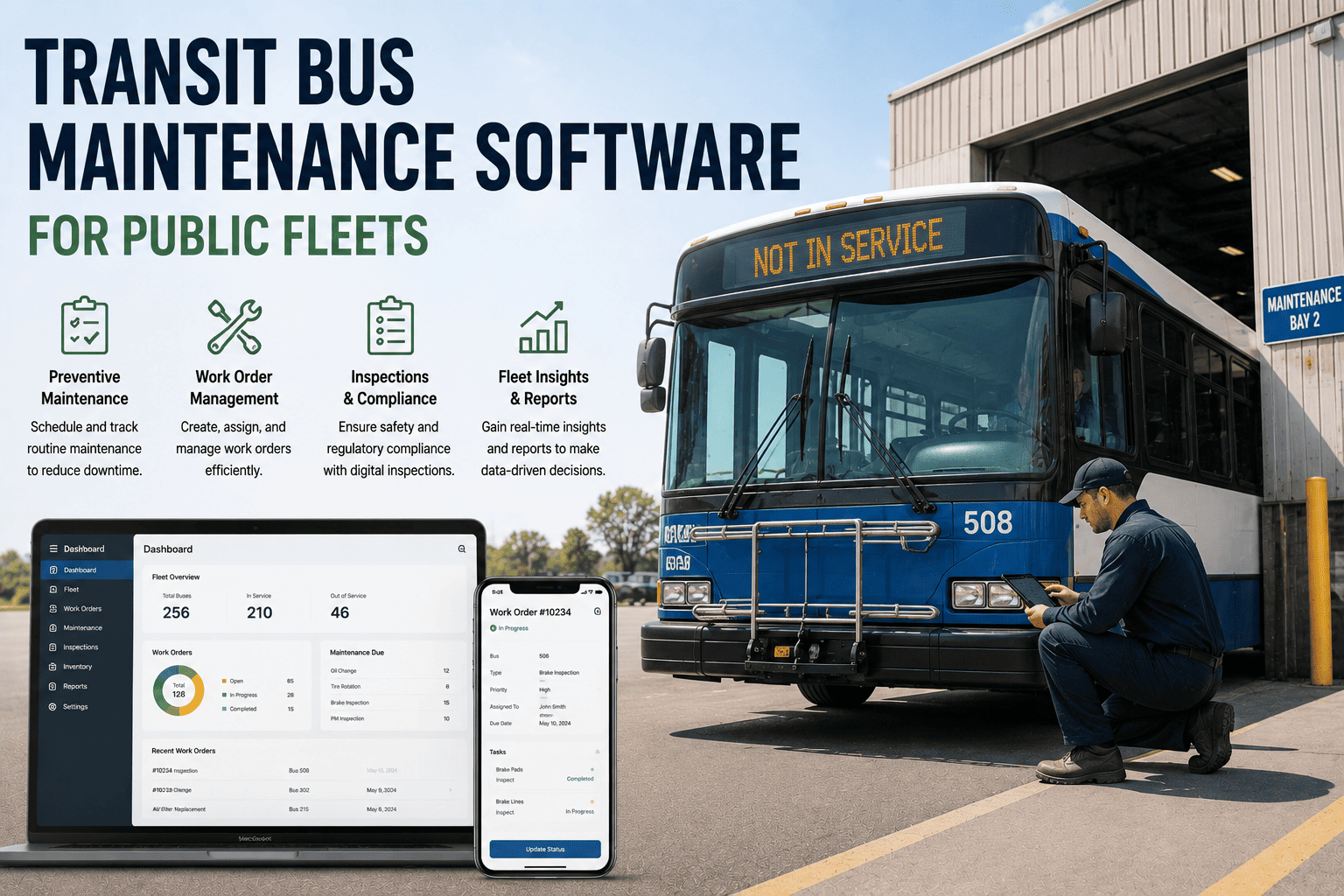
Every transit agency runs on a promise: the bus shows up, on time, every time. That promise is kept or broken long before a vehicle ever leaves the yard — it's decided in the maintenance bay, in the inspection log, and in whether a preventive maintenance interval was actually completed or just marked "done" on a clipboard. As fleets grow and federal reporting requirements tighten, agencies running fixed-route, paratransit, and non-revenue vehicles on spreadsheets are finding that manual tracking simply can't keep pace with the documentation transit maintenance now demands. This guide breaks down what transit bus maintenance software actually does, why public fleets are moving toward it, and how the right system turns compliance from a scramble into a routine.
What Transit Bus Maintenance Software Actually Does
At its core, transit bus maintenance software replaces the paper binder and the shared spreadsheet with one connected system that every technician, dispatcher, and compliance officer can see at the same time. It logs every inspection, tracks every preventive maintenance interval by mileage or engine hours, and stores the records auditors ask for without anyone digging through file cabinets. For agencies still relying on manual logs, the shift usually starts with a simple sign up to see how much time a connected system saves in the first week alone.
Digital PM Scheduling
Preventive maintenance is triggered automatically by mileage, engine hours, or calendar intervals — matching manufacturer-recommended service cycles instead of guesswork.
Inspection & DVIR Logging
Daily driver vehicle inspection reports, brake checks, and safety walkarounds are captured digitally and time-stamped the moment they happen.
ADA Equipment Tracking
Wheelchair lifts, ramps, and securement systems get their own inspection cycles, since accessibility equipment failures are a recurring audit finding.
Audit-Ready Records
Every completed task, part used, and technician sign-off is stored in one searchable history, ready the moment a reviewer asks for proof.
See What Your Fleet Looks Like on One Dashboard
Bring every bus, every checklist, and every compliance record into a single view your whole maintenance team can trust.
The Compliance Load Public Fleets Actually Carry
Public transit vehicles sit under more regulatory weight than almost any other fleet category. Annual inspections, ninety-day emergency exit checks, driver certification records, and drug and alcohol testing documentation all have to be maintained in parallel with day-to-day repair work. Agencies are also expected to track vehicle age against federal useful-life standards, generally twelve years or a set mileage threshold for a standard urban bus, to justify replacement funding. Falling behind on any one of these threads doesn't just risk a citation — it can put grant funding and service continuity on the line.
DOT & Federal Inspection Cycles
Annual vehicle inspections, brake and tire checks, and lighting audits need a complete, searchable history rather than scattered paper trails.
PM Interval Documentation
Reviewers expect maintenance intervals that match manufacturer or industry standards, with your CMMS templates serving as living proof of the plan.
Accessibility & Safety Systems
Lift cycles, securement checks, and emergency exit tests get their own recurring schedule so nothing slips through during a busy service week.
None of this has to mean more paperwork for your team. When these requirements live inside one platform, technicians close out a task once and the record satisfies maintenance history, safety documentation, and audit prep at the same time. Agencies that book a demo usually start by walking through their current PM template and seeing it rebuilt as a live, trackable schedule in real time.
Reactive Repairs vs. a Connected Maintenance Program
Fleets running on manual tracking tend to drift toward reactive repair — fixing what breaks instead of catching what's about to. A connected maintenance program flips that ratio, and the difference shows up directly in service reliability.
The gap between those two numbers is the difference between a fleet that's constantly explaining missed service windows and one that's confidently walking auditors through a clean record. Agencies that make the move often sign up for a trial period specifically to measure this shift on their own vehicles before committing fleet-wide.
How Agencies Put It to Work
Digitize the PM Plan
Existing service schedules and OEM-recommended intervals are loaded into the system, replacing the binder your team currently references by hand.
Automate Alerts
The software flags vehicles approaching a service threshold weeks ahead of time, so maintenance happens on a slow day instead of during a breakdown.
Capture Every Inspection
Drivers and technicians log DVIRs, brake checks, and ADA equipment tests from a phone or tablet, right at the vehicle.
Report With Confidence
Compliance summaries, cost-per-mile trends, and fleet availability numbers are ready in minutes when a director or auditor asks for them.
This kind of shift doesn't require ripping out your existing process overnight. Most maintenance teams start with one route or one depot, prove out the workflow, and expand from there. If you're weighing whether this fits your agency's size, the fastest way to find out is to book a demo and walk through your actual fleet data with a specialist.
Give Your Maintenance Team the System It Deserves
Stop chasing paperwork between depots. Start running preventive maintenance, inspections, and compliance records from one connected platform.
Frequently Asked Questions
What is transit bus maintenance software.
It's a digital system built specifically for public transit fleets that manages preventive maintenance scheduling, daily inspections, ADA equipment tracking, and compliance documentation in one connected platform, replacing spreadsheets and paper logs.
Is this different from general fleet management software.
Yes. General fleet platforms are typically built for trucking or construction equipment and lack transit-specific features like ADA lift inspection cycles, route-based maintenance triggers, and the documentation formats federal transit reviews expect.
How does the software help during an audit or review.
Every completed inspection, work order, and PM task is time-stamped and stored automatically, so agencies can produce a complete maintenance history in minutes instead of reconstructing records from paper files under pressure.
Can smaller agencies use it, or is it built for large fleets only.
Transit maintenance software scales from small paratransit operations to fleets of several hundred vehicles. The setup adjusts to the number of buses, routes, and depots an agency actually runs.
How long does it take to get a fleet fully set up.
Most agencies move existing PM templates and vehicle records into the system within a few weeks, often starting with one depot or route before rolling it out fleet-wide.
What's the best way to see it before committing.
The most direct way is to book a demo and walk through your current maintenance workflow with a specialist, or sign up to explore the platform with your own fleet data.