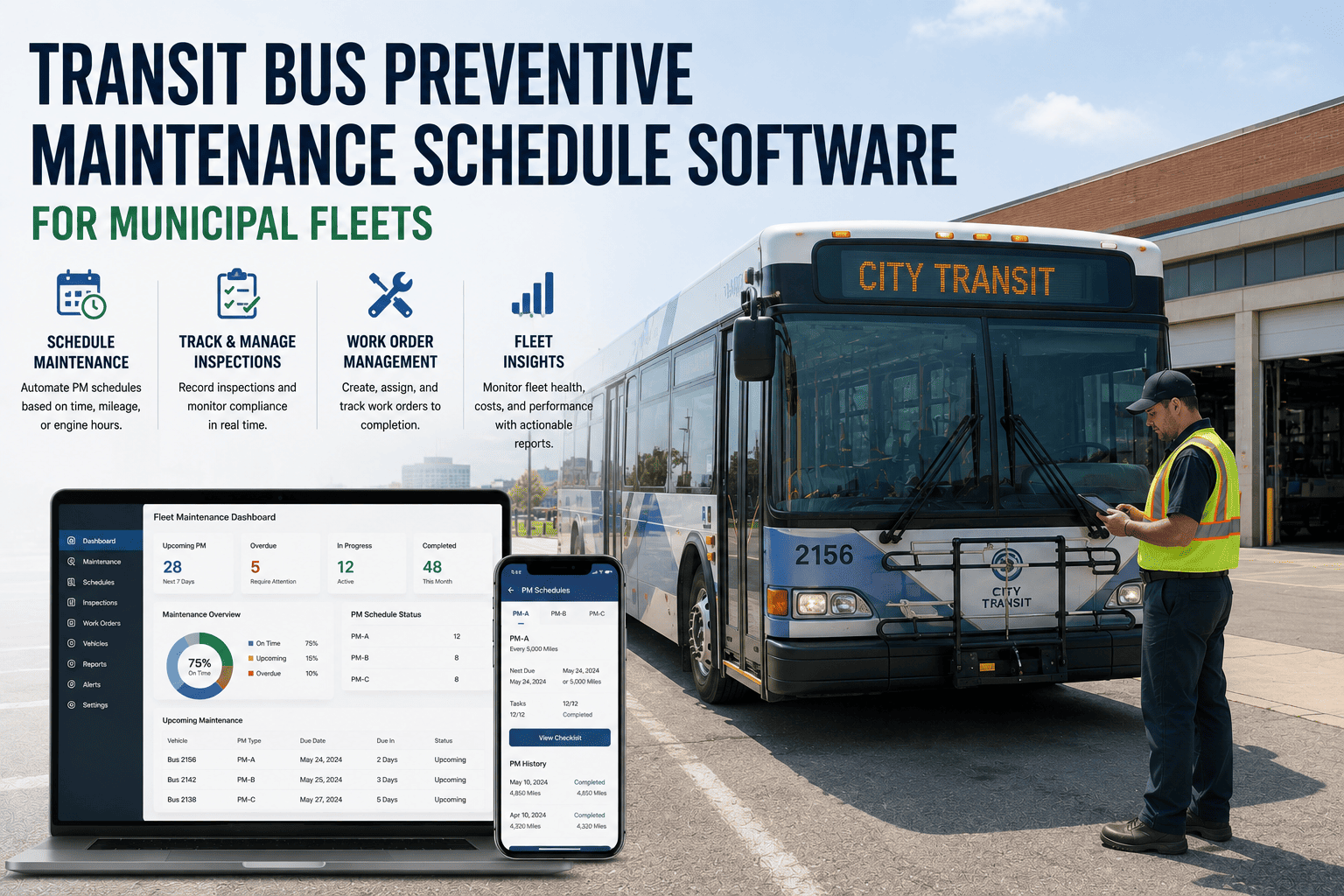
A municipal fleet manager rarely gets the luxury of managing one type of vehicle. The same garage that services a transit bus also handles a police cruiser, a fire engine, and a refuse truck, and it is tempting to run all of them off one shared PM calendar. Transit buses are the asset class that suffers most from that shortcut, since their preventive maintenance depends on a mix of mileage, engine hours, and passenger-carrying obligations that a generic municipal template was never built to track.
One Garage, Five Very Different Maintenance Problems
A typical municipal fleet is really several fleets sharing a shop. Each asset class carries its own inspection standard, its own wear pattern, and its own compliance framework, and a transit bus sits closer to the passenger-safety end of that spectrum than almost anything else on the lot.
Police
High-mileage, rapid-cycle service with emergency equipment checks.
Fire Apparatus
Pump and ladder testing under specialized inspection standards.
Transit Bus
Mileage and engine-hour PM tiers plus ADA lift and passenger safety checks.
Refuse Truck
Hydraulic and compaction system inspection separate from chassis PM.
Parks Equipment
Seasonal PM templates tied to mowing and grounds schedules.
Running a transit bus on the same PM calendar as a sedan or a mower means either over-servicing the light vehicles or, more commonly, under-servicing the bus. A transit bus preventive maintenance schedule built specifically for passenger fleets is what keeps that gap from becoming a road call.
Why One Trigger Is Never Enough for a Transit Bus
Transit buses rarely wear in a straight line with mileage alone. Idle time at stops, frequent door cycles, and stop-and-go city routes all add engine hours and mechanical stress that a mileage-only schedule underestimates. The safest approach is a dual-trigger model, where PM fires on whichever threshold is reached first.
Standard distance-based intervals, accurate for highway-heavy or express routes with fewer stops.
Captures wear from idling, frequent stops, and low-speed city routes that mileage alone would miss.
Departments still running mileage-only schedules on their transit fleet can book a demo to see dual-trigger PM catch wear a single-metric system would leave unaddressed.
PM-A/B/C Tiers for a Passenger-Carrying Municipal Asset
The tier structure itself stays familiar, but the checklist inside each tier has to reflect that a transit bus carries the public, not just cargo or equipment.
Short Interval
Fluids, filters, and brake checks on a tight cycle, since safety-critical items on a passenger vehicle carry no margin for delay.
Mid Interval
Brake, suspension, and door hardware attention alongside ADA lift or ramp functional testing.
Extended Interval
Full system inspection covering transmission, cooling, and structural points before fatigue affects service reliability.
Fleets ready to move off a shared municipal template and onto a transit-specific one can sign up and build PM tiers around how the bus is actually driven, not a generic sedan interval.
Give Your Transit Fleet Its Own PM Logic
FleetRabbit separates transit bus scheduling from the rest of your municipal fleet, with dual mileage and engine-hour triggers built in from day one.
Standing Up to Council Review and Public Records Requests
Public fleets operate under scrutiny most private operators never face. A single repair invoice, inspection record, or PM completion rate can end up in front of a council meeting or an open records request with almost no notice. Inspection documentation built to satisfy that level of transparency, disciplined enough to match NFPA-style audit rigor and standard DOT recordkeeping, turns that moment from a scramble into an export.
PM completion rate is usually the first number reviewers look for, and departments running transit buses on an inconsistent schedule are the ones most likely to be caught short.
Typical minimum PM completion rate expected during a municipal fleet audit or compliance review
Passenger Safety Items a Generic Municipal Checklist Misses
ADA lift and ramp systems need daily functional verification, not a monthly glance, and that requirement does not shrink just because a transit bus shares a shop with vehicles that carry no passengers at all. Driver-side credentials, including CDL endorsements and any transit-specific certifications, also need tracking on their own renewal schedule, separate from vehicle PM but just as critical to keeping a bus in service.
Departments consolidating both under one system, rather than tracking driver credentials in a separate spreadsheet from vehicle maintenance, can sign up and bring passenger safety and compliance records into a single view.
What a Transit-Specific Municipal Platform Handles
Mileage and engine hours tracked together so city-route wear never slips past a mileage-only threshold.
Daily functional checks tied to driver ID, stored alongside monthly inspection records.
CDL and transit-specific certification expirations flagged before they lapse.
Separate views for transit buses, police, fire, and other municipal asset classes in one platform.
PM history, inspections, and credentials structured for council review or a records request.
Curious how this looks against your current transit routes? Book a demo and walk through your fleet's actual PM history with our team.
Stop Running Transit Buses on a Generic Municipal Template
Dual-trigger PM, ADA compliance logging, and audit-ready records built specifically for passenger-carrying municipal fleets.
Frequently Asked Questions
Why can't a transit bus share a PM schedule with other municipal vehicles
Transit buses carry passenger-safety obligations, including ADA lift checks, and wear differently due to frequent stops and idle time, none of which a generic sedan or equipment schedule accounts for.
What is a dual-trigger PM schedule
It means a PM interval fires based on whichever threshold, mileage or engine hours, is reached first, which better reflects wear on stop-heavy city routes than mileage alone.
How often should PM-A checks run on a transit bus
Most programs run A-checks on the shortest cycle, focused on fluids, filters, and brakes, since safety-critical items on a passenger vehicle need the tightest possible interval.
Does this software track driver credentials as well as vehicle maintenance
Yes, CDL endorsements and transit-specific certifications can be tracked on their own renewal schedule alongside vehicle PM records in the same system.
What does audit-ready documentation actually mean for a municipal fleet
It means PM history, inspections, and credential records can be exported in minutes for a council review or public records request, instead of being assembled from paper under deadline pressure.
Can this work for a small municipal transit operation, not just a large city system
Yes, the same dual-trigger scheduling, ADA logging, and audit export apply just as cleanly to a handful of buses as they do to a citywide fleet.