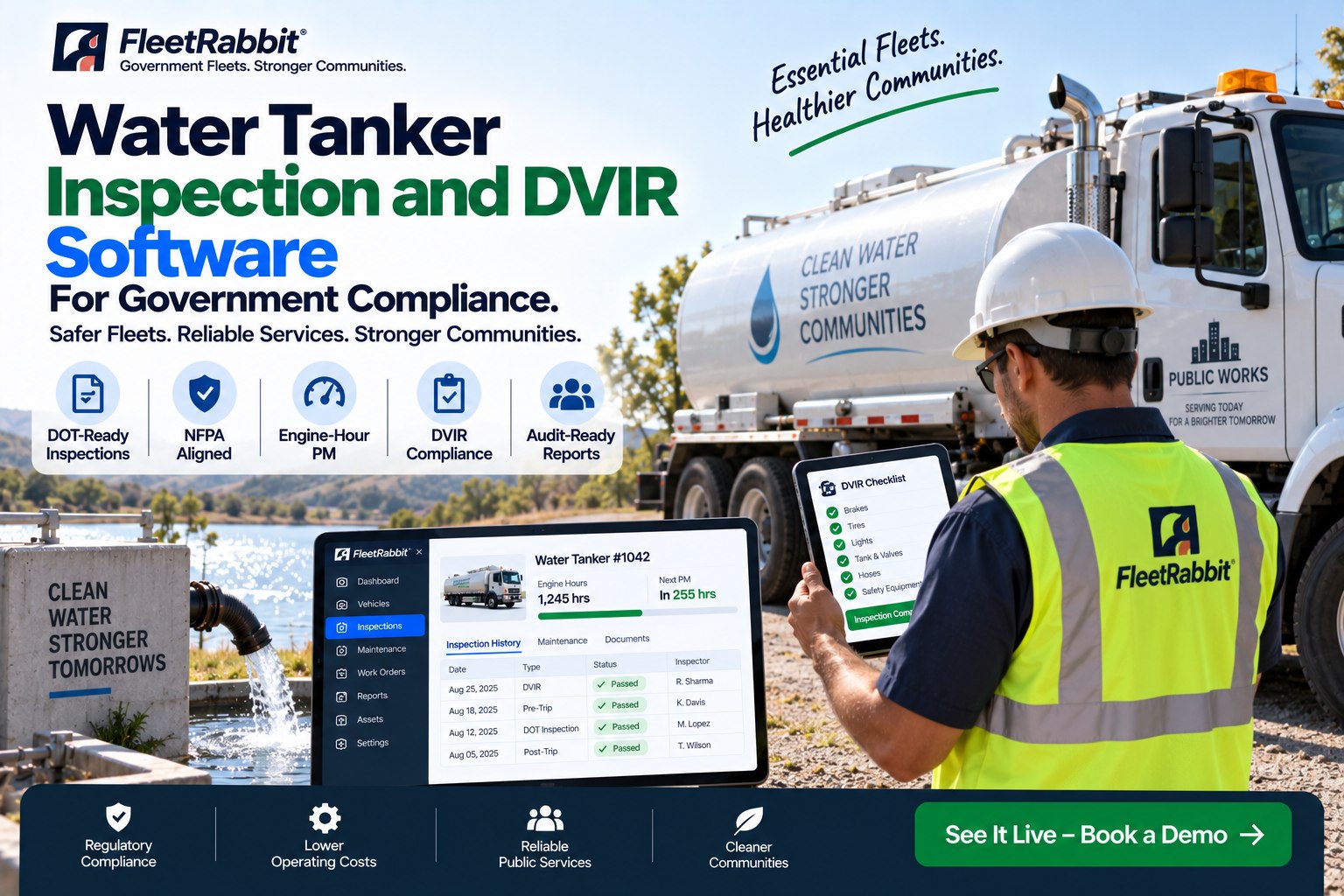
Government fleets running water tankers answer to two rulebooks atonce: NFPA 1901 §5.12 baffle and construction requirements for fire department tenders, and DOT 49 CFR Part 396 driver inspection rules for every vehicle on the road, regardless of what it hauls. When calibration of that overlap lives on paper clipboards instead of a single digital checklist, agencies face failed DVIR audits, undocumented baffle damage, and tanker rollovers tied to water surge that a five-minute pre-trip check would have caught. FleetRabbit delivers water tanker inspection and DVIR software built for government fleets, uniting NFPA-aligned baffle and tank checks, DOT 49 CFR 396.11/396.13-compliant driver inspection workflows, and engine-hour-based preventive maintenance triggers that mileage alone can't cover. Book a demo to see water tanker inspection software built for public fleets.
Water tanker inspection software that holds up in an audit
One tank, two rulebooks: NFPA 1901 baffle and apparatus construction requirements for fire department tenders, and DOT 49 CFR Part 396 driver inspection rules for every vehicle on the road. FleetRabbit runs both from a single mobile checklist, tracks engine hours instead of just mileage, and keeps every signature ready before an auditor ever asks.
A half-full tank is more dangerous than a full one
A public works water tanker is dispatched for dust control on a job site, or a fire tender rolls to a rural structure fire with a partial load. In both cases, the tank is never quite full, and that is exactly when it's most dangerous. As the load empties, water has more room to build speed before it slams into the tank wall — shifting the vehicle's center of gravity sideways in a curve or forward under braking. Baffles exist to break that surge into smaller, manageable pulses instead of one violent shift.
Fire department water tenders built to NFPA 1901 §5.12 must carry one vertical baffle for every 24 square feet of tank cross-section. Public works and utility tankers answer to the same physics even without that construction standard, which is why baffle condition, weld integrity, and surge-control hardware belong on every pre-trip check — not just an annual inspection.
SURGE RISK BY FILL LEVEL
The driver vehicle inspection report, in the order the rule actually requires
A DVIR isn't a form drivers fill out because they feel like it — 396.11 and 396.13 lay out exactly who inspects, who signs, and who certifies, in a specific sequence. Miss a step and the paperwork trail breaks the moment an auditor pulls the file.
Driver inspects and reports
At the end of each day's work, the driver checks brakes, tires, valves, spray equipment, lights, and emergency gear, then files a written or electronic report.
§396.11(a)Carrier repairs the defect
Any defect likely to affect safe operation must be fixed before the vehicle runs again — no exceptions for a busy dispatch board.
§396.11(a)(3)Repair is certified on the DVIR
The carrier certifies, on the same report, that the defect was repaired or that repair wasn't necessary — creating the paper trail auditors look for first.
§396.11(a)(3)(ii)Next driver reviews and signs
Before operating, the next driver reviews the prior report and signs to acknowledge the repair certification.
§396.13Put this sequence on the phone your drivers already carry
FleetRabbit walks every driver through the same four steps automatically, captures the signatures in order, and blocks dispatch until a flagged defect is certified as repaired.
What a real water tanker inspection actually covers
Each zone below gets its own checklist item in FleetRabbit, with a photo prompt and a pass/fail flag instead of a blank line to initial.
Internal baffles & surge control
Check for cracked welds, missing baffle sections, or loose surge-reduction hardware. On NFPA 1901 tenders, confirm baffle spacing still matches the §5.12 build spec.
Discharge valves & fittings
Look for weeping seals, corroded threads, or a valve that won't fully seat. A slow leak here is a compliance issue and a wasted load.
Brakes, tires & rims
Standard 396.11 items — service brakes, trailer connections, tire tread and pressure, rim condition — carry extra weight on a top-heavy, partially loaded tanker.
Spray bar / discharge system
Confirm nozzle pattern, pump response, and drain-down behavior. A clogged nozzle or dead pump turns a dust-control run into a wasted trip back to the yard.
Chassis, lights & mirrors
Emergency equipment, lighting, and mirrors round out the daily DVIR list — easy to skip when the crew is focused on the tank, easy to cite when they are.
CDL tanker (N) endorsement
Drivers hauling liquid in bulk above the tank-vehicle threshold need an active N endorsement. Track expirations alongside the vehicle record, not in a separate HR file.
Mileage doesn't tell you when to service a tanker
A water tanker can sit parked at a job site for hours with the pump and spray bar running, or idle in a fire lane feeding a shuttle operation — racking up wear the odometer never sees.
Mileage-only PM schedule
- Assumes wear tracks with road miles
- Misses hours spent stationary while pumping or spraying
- Pump seals, PTO components, and spray valves go unserviced between long routes
- Failures show up mid-job, not in the shop
Engine-hour PM in FleetRabbit
- Tracks runtime and PTO hours directly from the vehicle
- Triggers service on pump seals, blower oil, and filters based on actual operating wear
- Runs alongside mileage triggers, not instead of them
- Flags the asset before a scheduled dispatch, not after a breakdown
Built around the same five zones, front to back
Digital DVIR, in order
Guides drivers through the 396.11/396.13 sequence with required photos and signatures at each step.
Engine-hour PM triggers
Runs alongside mileage schedules so stationary pump and spray-bar wear never gets missed.
Baffle & tank templates
Purpose-built checklist items for baffles, valves, and spray systems, not a generic truck form.
Audit-ready export
Pull inspection history, repair certifications, and endorsement records into one export for any AHJ or DOT review.
Frequently asked questions
Yes. The DVIR requirement in 49 CFR 396.11 applies to the commercial motor vehicle itself, covering brakes, tires, and other listed systems — it doesn't carve out an exception for tank trucks. Baffle and tank-specific checks are additions on top of the federal minimum.
NFPA 1901 governs fire apparatus construction, including the baffle spacing rule in §5.12. A non-fire municipal tanker used for dust control or hauling isn't built to that standard, but the same surge physics apply, so a baffle and surge-control check still belongs on the daily inspection.
Federal rule requires the DVIR, repair certification, and driver review to be kept for at least 3 months. Check your state or local AHJ requirements too — several ask for longer, and FleetRabbit retains records for whichever period you configure.
A tanker's pump, PTO, and spray system can run for hours while the truck is parked at a job site — wear the odometer never records. Hour-based triggers catch that wear; mileage triggers alone don't.
See your own tanker fleet mapped to this checklist
Bring your inspection form to the call — we'll show you exactly how it maps to FleetRabbit's baffle, valve, and engine-hour tracking before you commit to anything.