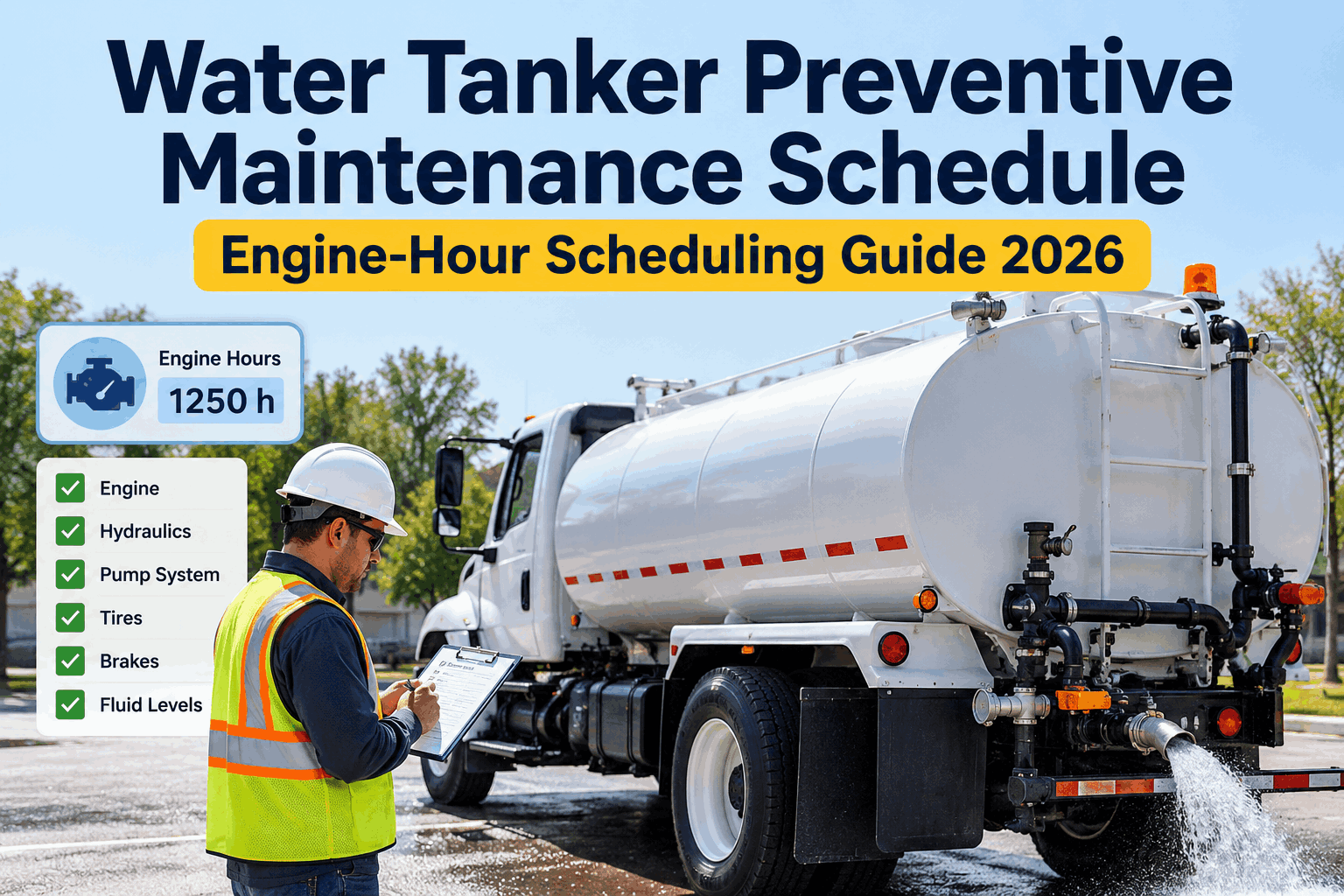
A water tanker can spend a summer afternoon parked beside a construction site with the engine turning over and the pump running, and add several hours of wear without adding a single mile to the odometer. That is why a water tanker preventive maintenance schedule built on miles or calendar dates keeps missing the service the truck actually needs. For public works, utilities, and fire-service tenders, the reliable answer is an engine-hour PM schedule with the daily inspection and the annual calendar checks layered on top. This guide shows how to build one, what to put on it, and how to keep every record ready for an audit. You can sign up to see your own tankers scheduled by the hours they really work.
Build the Schedule Around the Hours Your Water Tanker Actually Works
Municipal water tankers do their real work standing still: pumping, spraying, filling, and idling at a job site. Turn engine hours, pump hours, and daily inspections into one schedule that never depends on someone remembering the last oil change. You can book a demo to see it run against your own units.
Hours-based services land in June and September, when the wear happened. The calendar schedule lets the second half run 354 hours between services.
One Water Tanker, Three Clocks
A tanker wears in three different places at three different speeds, and each one is measured by a different meter. A schedule that watches only the odometer is watching the smallest of the three.
Odometer Miles
Drives chassis wear
Brakes, tires, wheel ends, steering, and suspension. Mileage is low on a job-site tanker, but the chassis still needs its checks.
Engine Hours
Drives engine wear
Oil and filters, coolant, belts, batteries, and aftertreatment. Hours keep climbing while the truck idles, pumps, or crawls between fill points.
Pump and PTO Hours
Drives wet-side wear
Pump seals and packing, PTO and driveline, valves, spray bar, and hose reels. Tracked where the unit reports it or the operator logs it.
Engine manufacturers commonly publish service intervals in miles, hours, or months, whichever comes first, so the shortest clock should win. Fleets that sign up for FleetRabbit let every clock run against the same vehicle record.
A Sample Engine-Hour Schedule You Can Adapt
Use this as a starting structure, then replace every interval with the number from your engine, pump, and chassis manuals. You can book a demo to see a schedule like this loaded and running for your own fleet.
Pre-Trip and Post-Trip Walkaround
Engine and Wet-Side Basics
Service A Plus Deeper Checks Includes A
Service B Plus Driveline and Tank Includes B
Annual Reset Includes C
Put Every Water Tanker on an Engine-Hour Schedule
Automatic PM alerts, daily inspections, and work orders for every tanker, built around the hours each truck really works.
Build Your Schedule in Five Steps
Pull the Manufacturer Intervals
Collect the engine, pump, PTO, and chassis service intervals and write each one down in miles, hours, and months.
Baseline Every Unit
Record current engine hours and the date of the last service for each tanker so the first due dates are real, not guessed.
Let the First Trigger Win
Set each service to fire on hours, miles, or calendar time, whichever arrives first, with the annual inspection as a fixed calendar backstop.
Group Tasks Into Service Levels
Bundle tasks into Service A, B, and C so every work order arrives with a complete checklist instead of a blank page.
Automate the Reminders
Let alerts, work orders, and records run on their own so the schedule never depends on someone remembering to check a spreadsheet.
Fleets that sign up can complete steps two through five inside FleetRabbit in a single afternoon.
Water Tanker Wear Changes With the Calendar
Municipal tankers swing between long summer days at full pump load and quiet winters, and a good schedule bends with both. You can book a demo to see seasonal usage reflected in your own service forecast.
Dust Control, Watering, and Flushing
- Engine hours climb fastest, so services arrive months closer together.
- Pump seals, spray nozzles, and the cooling system take the heaviest load.
- Fire-season standby adds idle hours with no mileage at all.
Freeze Protection and Calendar Backstops
- Drain the pump, lines, and tank when the unit sits in freezing weather, and log it.
- Engine hours slow down, so a calendar backstop keeps batteries and annual items from slipping.
- Potable-water tankers add their own sanitation and flush records under state rules.
The Questions a Spreadsheet Cannot Answer Quickly
Federal maintenance rules in 49 CFR Part 396 call for systematic inspection, repair, and maintenance, a daily driver vehicle inspection report, an annual inspection, and records kept for a set period. Many state and local government fleets follow those rules by state adoption or use them as the benchmark, and fire-service tenders also follow NFPA inspection and testing standards, where NFPA 1911 was folded into NFPA 1910 in 2024. Confirm what your own authority requires, then make the answers easy to find. Fleets that sign up keep all of it in one searchable record.
| Question Someone Will Ask | Spreadsheet or Paper | FleetRabbit |
|---|---|---|
| Which tankers are due this week | Someone compares hour meters to a sheet | Engine-hour PM alerts fire automatically |
| Did that inspection defect get fixed | Paper form, follow-up by memory | Defect becomes a work order tracked to close |
| What is the full history of Unit 12 | Folders, receipts, and texts | One searchable vehicle record |
| Can we produce records for an audit | Assembled by hand under a deadline | Complete history exported in one step |
| What if the yard has no signal | Paper, retyped later | Offline mobile capture that syncs later |
Stop Guessing When the Water Tanker Is Due
Engine-hour PM scheduling, inspections, work orders, and audit-ready records for every water tanker in your fleet.
Frequently Asked Questions
What is an engine-hour PM schedule for a water tanker
It is a preventive maintenance schedule that triggers service by the hours the engine has run instead of miles driven. Because a water tanker spends much of its working life idling, pumping, or crawling at a job site, engine hours track real wear far better than the odometer does.
How often should a water tanker be serviced
Follow the engine, pump, and chassis manufacturer intervals, which are commonly published in miles, hours, or months, whichever comes first. High-idle and stop-and-go duty like water hauling usually makes the hours limit the one that arrives first.
Do water tankers need a daily inspection report
Federal rules require a driver vehicle inspection report for many commercial vehicles, and many state and local government fleets adopt those rules or an equivalent. A documented daily walkaround is good practice for every tanker, whether or not the federal rule applies directly.
Why keep a calendar backstop if the schedule runs on hours
Engine hours slow down in winter and on standby units, so some items would never come due. Calendar triggers keep annual inspections, batteries, and fluid aging from slipping while the hour meter barely moves.
How does FleetRabbit handle water tanker maintenance
FleetRabbit schedules service by engine hours, miles, or calendar dates, tracks pump or PTO hours where they are available, captures daily inspections on a mobile app that works offline, turns inspection defects into work orders, and keeps a complete searchable record for every tanker.