Public transit executives, municipal transportation superintendents, and regional mobility directors operate under intensive federal scrutiny: securing and maintaining Federal Transit Administration (FTA) grant apportionments requires uncompromising compliance with federal statutory mandates. FTA compliance is the structured operational discipline of aligning public transit vehicle operations, maintenance facilities, and safety management procedures with federal regulations—encompassing National Transit Database (NTD) asset reporting, Transit Asset Management (TAM) performance targets under 49 CFR Part 625, Public Transportation Agency Safety Plans (PTASP) under 49 CFR Part 673, Title VI non-discrimination standards, and mandatory 49 CFR Part 655 drug and alcohol testing testing protocols. When civic agencies track bus inspections, cutaway preventative maintenance, and safety events across fragmented paper work orders and legacy desktop databases, transit systems face Triennial Review audit findings, corrective action plans, withheld federal funding, and compromised passenger safety. Fleet Rabbit delivers a purpose-built transit fleet management and compliance platform engineered for municipal and regional mobility providers, unifying paperless pre-trip mobile vehicle walkarounds, auxiliary engine-hour maintenance, and audit-ready federal reporting into one intuitive dashboard. Eliminate compliance friction, satisfy Triennial Reviews without stress, and maintain reliable passenger transit readiness. Book a Demo to see our transit FTA compliance management platform in action.
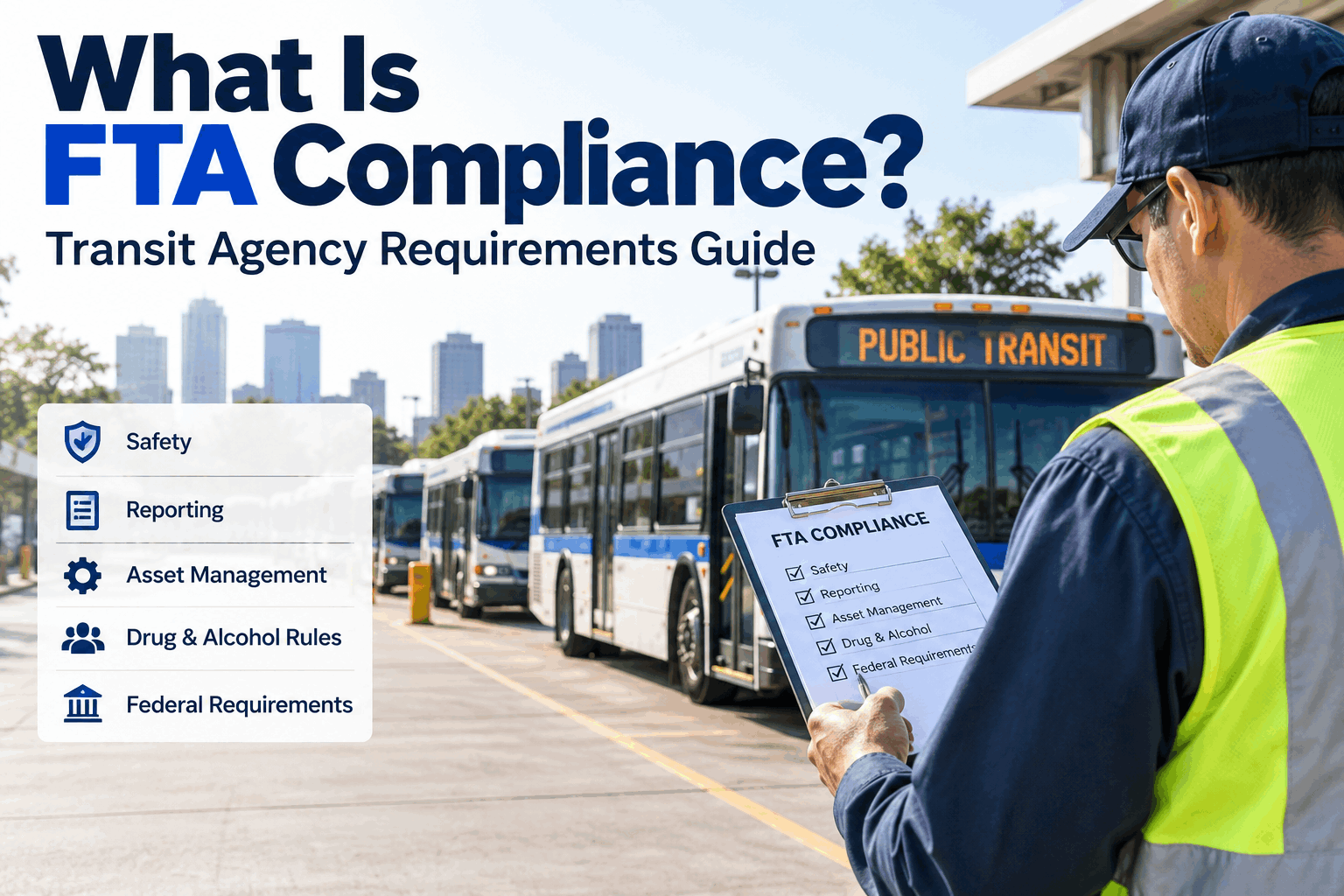
What Is FTA Compliance? Transit Agency Requirements Guide
A comprehensive regulatory and operational handbook for municipal transit directors, grant administrators, and maintenance superintendents: master federal transit mandates, navigate Triennial Review audits, streamline NTD asset reporting, and ensure continuous State of Good Repair (SGR).
The Legal & Financial Stakes of Federal Transit Oversight
Recipients of federal urbanized formula grants (Section 5307), rural formula funds (Section 5311), and capital investment grants (Section 5339) are legally bound to uphold federal operational and asset management standards. The Federal Transit Administration conducts rigorous reviews—most notably the statutory Triennial Review—to examine 23 distinct compliance areas. Sign up to streamline your agency's compliance documentation.
Failing an FTA compliance audit is not merely an administrative inconvenience. Significant audit findings trigger formal corrective action plans, frozen grant drawdowns, mandatory reimbursement of expended federal funds, and in extreme cases, the direct suspension of federal capital apportionments. Managing public transit operations requires converting static paper logs into verifiable digital records that withstand intense federal scrutiny. Book a demo to inspect our audit-ready compliance export engine.
The 5 Primary Pillars of FTA Transit Compliance
To establish comprehensive regulatory governance, transit directors must structure their fleet and maintenance systems around five primary federal statutory frameworks.
TAM Useful Life Benchmarks (ULB) for Transit Rolling Stock
Under 49 CFR Part 625, transit agencies must track rolling stock against established Useful Life Benchmarks. When vehicles exceed these parameters, agencies must document capital replacement prioritization in their TAM plans. Book a demo to evaluate automated ULB replacement forecasting.
| Transit Vehicle Classification | FTA Vehicle Code | Default Useful Life Benchmark (Age) | Minimum Service Mileage | Primary Compliance Risk Point |
|---|---|---|---|---|
| Standard Heavy-Duty Transit Bus | MB (Motorbus) | 12 to 14 Years | 500,000 Miles | Chassis fatigue, structural corrosion, PM logs |
| Cutaway Paratransit Bus | CU (Cutaway) | 7 to 10 Years | 200,000 Miles | Wheelchair ramp failure, transmission wear |
| Passenger Van / Microtransit | VN (Van) | 5 to 8 Years | 150,000 Miles | Severe start-stop wear, steering linkage play |
| Articulated Heavy-Duty Bus | AB (Articulated Bus) | 12 to 14 Years | 500,000 Miles | Turntable joint wear, hydraulic bellows leaks |
| Transit Facility Service Trucks | SV (Service Vehicle) | 8 to 10 Years | 100,000 Miles | Auxiliary PTO hours, safety equipment readiness |
The Triennial Review Preparation Protocol: Surviving Federal Audits
Every three years, the FTA examines transit operations across 23 functional areas. Fleet Rabbit organizes digital operational records to resolve the most heavily scrutinized fleet maintenance and safety modules. Sign up to organize your agency's Triennial Review documentation.
Compliance Comparison: Paper Binder Tracking vs. Fleet Rabbit
Evaluate the clear operational differences, audit risks, and software overhead between traditional manual paper processes and Fleet Rabbit’s connected platform. Book a demo to evaluate your agency's compliance posture.
| Regulatory Management Dimension | Fleet Rabbit Transit Suite | Paper Clipboards & Spreadsheets | Legacy Enterprise Transit CMMS |
|---|---|---|---|
| Subscription Rate | $5 / asset / month | High administrative payroll & audit fines | $50 – $90+ / asset / month |
| PM Interval 10% Compliance | Automated telematics alerts & tracking | Frequent missed windows on paper logs | Manual work order scheduling |
| Mobile Driver Pre-Trip & ADA Walkaround | Included offline-first mobile app | Stained or lost paper inspection slips | Desktop-only terminals in bay |
| NTD Data Aggregation | 1-click automated annual export | Weeks of manual spreadsheet formatting | Complex custom report generation |
| TAM Capital Replacement Modeling | Real-time ULB and condition curves | Static calendar estimates | Requires expensive add-on module |
| Procurement & Rollout | Micro-purchase friendly, live in 14 days | Continuous administrative drag | 9 to 18-month locked RFP procurement |
4-Phase Transit Compliance Implementation Blueprint
Deploy Fleet Rabbit smoothly across central maintenance garages, dispatch depots, and administrative offices without disrupting passenger transit routes. Sign up to begin your transit fleet onboarding.
Transit Agency Case Study: Valley Regional Mobility Authority
Learn how a regional public transit agency eliminated Triennial Review audit findings across 48 fixed-route and paratransit buses. Book a demo to see how Valley Regional achieved compliance.
Operating 48 fixed-route buses and demand-response paratransit cutaways, Valley Regional Mobility Authority received three serious corrective action findings during a previous Triennial Review: preventative maintenance inspections routinely violated the 10% interval benchmark, wheelchair lift tests were unrecorded on paper logs, and annual NTD maintenance reporting took six weeks of manual reconciliation.
By implementing Fleet Rabbit at $5/asset/month, the authority automated mileage-based PM notifications, equipped drivers with smartphone pre-trip walkaround checklists, and centralized wheelchair lift verification logs. At their subsequent federal Triennial Review, auditors cleared all previous corrective action plans with zero repeat findings, PM on-time compliance reached 99.2%, and NTD annual reporting time dropped from six weeks to a single afternoon.