Municipal finance directors, city comptrollers, and public works fleet superintendents face an unforgiving standard during annual municipal audits: proving government-wide full accrual financial accountability under Governmental Accounting Standards Board (GASB) Statement No. 34. Enacted to eliminate distorted cash-basis public accounting, GASB 34 mandates that state, county, and local governments report the historical cost, accumulated depreciation, capital asset impairments, and net book value of all long-term capital assets—including heavy public works dump trucks, emergency fire apparatus, police interceptors, and municipal transit buses. When fleet departments track maintenance, salvage value, and machine hours across fragmented paper shop tickets and disconnected spreadsheets, finance teams struggle through weeks of manual reconciliation, resulting in audit findings, restated balance sheets, and damaged municipal credit ratings. Fleet Rabbit provides a purpose-built civic fleet management software platform that links day-to-day garage work orders, auxiliary engine hours, and vehicle capitalization thresholds directly to full accrual accounting ledgers. Streamline Annual Comprehensive Financial Report (ACFR) filings, automate vehicle depreciation schedules, and justify data-backed capital replacement reserves to city council members. Book a Demo to see our GASB 34 fleet accounting and depreciation engine live.
Government Financial Reporting & Capital Asset Governance
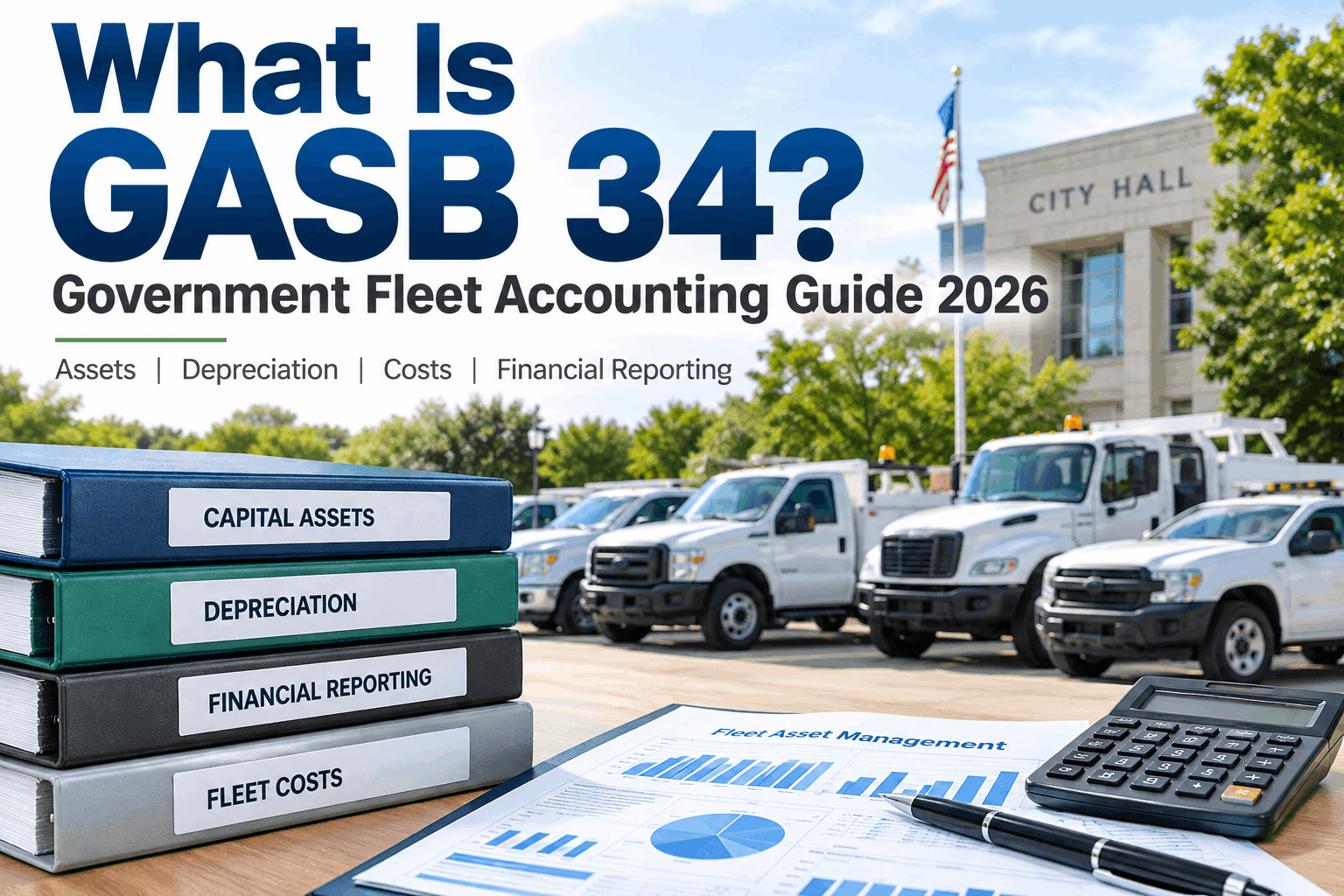
What Is GASB 34? Government Fleet Accounting Guide 2026
The definitive financial and operational guide for municipal fleet directors and finance officers: master full accrual accounting mandates, calculate capital asset depreciation curves, defend vehicle replacement budgets, and automate ACFR reporting ledgers.
Full Accrual Net Book Value
Modified Approach vs. Depreciation
Capital Asset Capitalization Thresholds
100%
ACFR Compliance
Automated capital asset depreciation schedules ready for external municipal auditors.
65%
Audit Prep Time Saved
Eliminates year-end spreadsheet aggregation across disparate municipal maintenance yards.
$5
Per Asset / Month
Transparent civic software pricing structured for municipal general and enterprise funds.
0
Audit Finding Citations
Verified capitalization logs, salvage offsets, and cumulative maintenance histories.
Align Civic Maintenance Operations with Governmental Accounting Standards
Automate straight-line asset depreciation, capture auxiliary machinery runtime, and provide city finance directors with exportable general ledger journals for just $5/asset/month.
The Legal & Financial Mechanics of GASB Statement No. 34
Prior to GASB 34, governments accounted for capital purchases using modified accrual fund accounting. When a city purchased a $350,000 aerial fire ladder truck, the entire expense was expensed in the year of acquisition. Once purchased, the vehicle effectively vanished from long-term financial statements, hiding capital asset degradation from taxpayers and bond rating agencies. Sign up to modernize your civic capital asset accounting.
GASB 34 fundamentally reshaped public finance by requiring dual-perspective financial reporting: Fund-level financial statements (measuring short-term fiscal accountability) paired with Government-wide financial statements (measuring long-term operational accountability on a full accrual basis). Under this framework, municipal fleets must record vehicles as capital assets on the statement of net position, capitalize qualifying acquisition expenses, and report annual depreciation expenses throughout the vehicle's established useful life. Book a demo to inspect our automated full accrual accounting ledgers.
The 4 Pillars of GASB 34 Fleet Compliance
Government fleet directors and finance controllers must structure their asset data around four rigorous statutory pillars to satisfy external financial auditors.
Pillar 01
Capitalization Threshold Determination
Municipalities establish a dollar threshold (typically $5,000 to $25,000) and an estimated useful life minimum (greater than one year). Every vehicle, heavy trailer, and auxiliary attachment matching these criteria must be recorded in the government's capital asset ledger, including upfitting expenses like police light bars, sirens, and plow hitches.
Sign up to track capitalized vehicle upfitting costs.
Pillar 02
Depreciation Method Selection
Agencies must calculate and document depreciation across an asset's useful life. While governments can choose the "Modified Approach" for eligible infrastructure networks (requiring documented preservation conditions), rolling fleet assets almost universally require standard depreciation schedules, most commonly straight-line depreciation with estimated salvage offsets.
Pillar 03
Useful Life Estimation & Auxiliary Hours
Setting useful life strictly by civilian road miles fails public machinery. A street sweeper or catch-basin jetter operates stationary for thousands of auxiliary power take-off (PTO) hours. Fleet Rabbit pairs vehicle telematics with true engine hours, establishing defensible asset longevity curves for auditor review.
Book a demo to inspect our PTO engine-hour asset tracking.
Pillar 04
Asset Impairment & Disposal Accounting
Under GASB Statement No. 42 (an extension of GASB 34), assets experiencing significant, unexpected declines in service utility—such as a wrecked cruiser or flooded rescue truck—must be tested for impairment and written down immediately. Fleet Rabbit records incident data, salvage write-offs, and auction recovery in one audit-ready ledger.
The Straight-Line Depreciation Formula for Public Fleets
To report accurate annual depreciation on the government-wide Statement of Activities, finance officers apply standardized mathematical models to capitalized fleet inventory. Sign up to automate fleet depreciation schedules.
Depreciation Lifespans & Threshold Benchmarks by Asset Class
Review typical municipal capitalization thresholds, useful lifespan guidelines, and salvage assumptions utilized across public sector fleet portfolios. Book a demo to evaluate custom capitalization rules.
| Municipal Asset Class |
Typical Capitalization Threshold |
Standard Useful Life |
Estimated Salvage Value |
Primary Wear Metric |
| Police Patrol Interceptors |
$10,000 |
3 to 5 Years |
15% – 20% |
Engine Idle Hours & Severe Duty Miles |
| Public Works Tandem Dump Trucks |
$25,000 |
8 to 12 Years |
10% – 15% |
PTO Hours, Winter Salt Exposure & Miles |
| Fire Department Aerial Apparatus |
$50,000 |
15 to 20 Years |
10% |
Pumping Hours & NFPA Service Tests |
| Street Sweepers & Jetters |
$25,000 |
7 to 10 Years |
8% – 12% |
Auxiliary Engine Runtime & Hydraulic Cycles |
| Parks & Utility Commercial Mowers |
$5,000 |
4 to 6 Years |
5% |
Deck Operating Hours |
| Administrative Pool Sedans & EVs |
$10,000 |
6 to 8 Years |
20% – 25% |
Odometer Miles & Battery State-of-Health |
Modified Approach vs. Straight-Line Depreciation: The Fleet Dilemma
GASB 34 provides public entities with an alternative to depreciation known as the "Modified Approach" for infrastructure assets. Evaluating this mechanism against rolling fleet assets is a frequent inquiry among municipal controllers. Sign up to explore our asset governance modules.
Standard Depreciation Method
Recommended for Rolling Vehicles
Under standard straight-line depreciation, the government expenses the asset's cost over its estimated useful life. This is the overwhelmingly preferred method for vehicle fleets because individual mobile vehicles degrade physically and cannot be maintained in an indefinite "steady state" like road networks or bridge systems. Fleet Rabbit automates this entire lifecycle calculation effortlessly.
The Modified Approach
Restricted to Infrastructure Networks
The Modified Approach allows agencies to forgo depreciation if they maintain an asset management system that performs condition assessments every three years and documents that the assets are being preserved at or above a specified condition level. While viable for roads and water mains, auditors rarely allow the modified approach for vehicle fleets due to unavoidable mechanical obsolescence.
Book a demo to inspect our vehicle lifecycle governance engine.
Solving the Budget Chasm: How GASB 34 Data Justifies Fleet Replacement
A recurring struggle for fleet superintendents is convincing elected officials to allocate capital for new vehicles before aging assets break down completely. GASB 34 compliance data bridges this divide by turning emotional arguments into indisputable financial equations. Sign up to generate data-backed fleet replacement reports.
01
Visualizing the Maintenance "Tipping Point"
When an aging dump truck's cumulative annual repair costs exceed its remaining net book value and annual depreciation expense, Fleet Rabbit flags the asset as economically obsolete, providing city managers with empirical proof for auction replacement.
02
Structuring Internal Service Fund (ISF) Reserves
Cities operating Internal Service Funds charge individual departments (Police, Parks, Utilities) an annual capital replacement fee matching the vehicle's true depreciation. This creates a dedicated, protected sinking fund that eliminates sudden tax spikes.
Book a demo to see our ISF fund chargeback engine.
03
Protecting Municipal Bond Credit Ratings
Credit rating agencies (Moody's, S&P) heavily scrutinize ACFR capital asset notes. Demonstrating complete capital tracking, accurate depreciation schedules, and well-funded replacement reserves lowers municipal borrowing costs across civic bond issues.
System Comparison: Legacy Government CMMS vs. Fleet Rabbit
Compare the operational, procurement, and financial differences between legacy enterprise civic software and Fleet Rabbit’s modern $5/asset platform. Sign up now to explore all platform features.
| Evaluation Dimension |
Fleet Rabbit Civic Suite |
Legacy Enterprise Municipal CMMS |
Generic Commercial GPS Trackers |
| Subscription Rate |
$5 / asset / month |
$50 – $90+ / asset / month |
$25 – $45 / vehicle / month |
| Automated GASB 34 Ledger |
Native depreciation & salvage engine |
Requires custom-paid financial module |
Not supported |
| Auxiliary PTO Hour Tracking |
Automated telematics sync |
Expensive add-on development |
Odometer miles only |
| Inter-Departmental Fund Sync |
Automated General & Enterprise sync |
Manual spreadsheet reconciliation |
Not available |
| Mobile Driver & Mechanic Tools |
Included offline-first mobile app |
Clunky desktop-only stations |
Driver app only (no garage tools) |
| Implementation Velocity |
Live in under 14 days |
9 to 18-month consultant setup |
3 to 6 weeks average |
| Procurement Method |
Micro-purchase / cooperative friendly |
Multi-month formal RFP cycles |
1 to 3-year auto-renewing contract |
4-Phase Implementation: Achieving Audit Readiness in 14 Days
Deploy Fleet Rabbit smoothly across central municipal garages, satellite yards, and finance offices without disrupting public services. Book a demo to plan your agency's onboarding schedule.
Phase 01
Asset Capitalization Ingestion (Days 1–3)
Upload vehicle acquisition dates, purchase orders, capitalized upfitting invoices, and fund billing codes via standardized CSV templates.
Phase 02
Depreciation Rule Mapping (Days 4–7)
Configure useful lifespans, salvage percentages, and auxiliary PTO telemetry thresholds across specific departmental asset classes.
Phase 03
Garage & Shop Floor Rollout (Days 8–11)
Equip garage mechanics and operators with mobile tablet apps for paperless work order updates, parts tracking, and daily pre-trip DVIRs.
Phase 04
Live ACFR Ledger Export (Days 12–14)
Activate automated monthly depreciation postings, vehicle replacement scorecards, and one-click external auditor compliance dossier exports.
Civic Case Study: City of Riverdale Public Works & Public Safety
Learn how a municipal government eliminated year-end audit discrepancies and structured a defensible vehicle replacement fund across 94 civic assets. Sign up to achieve similar audit governance results.
Municipal Case Study
3 Weeks
Saved in Annual Audit Prep
$62,000
Annual Software & Repair Savings
City Eliminates Capital Asset Audit Deficiencies and Streamlines Financial Reporting
Managing 94 vehicles across Police, Fire, Water Utility, and Street Maintenance divisions, the City of Riverdale faced recurring audit findings from their external CPA firm. Vehicle capitalization records were scattered across outdated spreadsheet tabs, upfitting costs for new police cruisers were never capitalized, and two decommissioned public works trucks were still carrying book value on the balance sheet. Finance staff spent three full weeks each autumn reconciling maintenance records for the ACFR filing.
By deploying Fleet Rabbit at $5/asset/month, the city consolidated vehicle work orders, auxiliary PTO run-hours, and straight-line depreciation into an automated general ledger pipeline. Year-end capital asset audit preparation was cut from three weeks to a single afternoon, external audit citations fell to zero, and data-backed replacement scorecards successfully justified a $1.2 million rolling equipment reserve fund during city council budget hearings.
Frequently Asked Questions
What is the difference between fund-level accounting and GASB 34 government-wide reporting?
Fund-level accounting uses the modified accrual basis, focusing on short-term fiscal accountability and near-term expendable resources—meaning capital assets like vehicles are expensed immediately when purchased. Government-wide financial statements mandated by GASB 34 use the full accrual basis, requiring rolling vehicles to be capitalized on the Statement of Net Position and depreciated over their economic useful lives to reflect long-term operational health.
Should vehicle upfitting expenses be capitalized under GASB 34 guidelines?
Yes. Under GASB 34, all initial expenditures required to place a capital asset into intended service condition must be capitalized. For municipal vehicles, this includes essential aftermarket upfitting such as emergency lightbars, radio communications consoles, prisoner cages, hydraulic snowplow hitches, utility utility cranes, and custom service utility bodies.
How does Fleet Rabbit support multi-fund municipal accounting chargebacks?
Fleet Rabbit tags all mechanic wrench time, storeroom replacement parts, fuel usage, and depreciation allocations directly to individual departmental fund codes (such as General Fund, Enterprise Water Fund, or Internal Service Fund). The platform generates exportable general ledger accounting summaries that reconcile inter-departmental costs seamlessly with municipal financial software.
Can operators complete pre-trip vehicle walkarounds in remote areas without cellular coverage?
Yes. Fleet Rabbit features an offline-first mobile architecture. Public works operators, conservation wardens, and emergency personnel can complete pre-trip DVIR walkarounds, document vehicle defects with photos, and log engine hours in underground maintenance pits or remote parks without cellular service. All data synchronizes automatically once network reception returns.
What are the subscription rates and procurement terms for Fleet Rabbit's software?
Fleet Rabbit is priced at a transparent rate of $5 per civic asset per month billed annually. This gives complete access to GASB 34 depreciation schedules, PTO engine-hour PM scheduling, mobile mechanic work orders, parts inventory management, and FEMA audit compliance exports. We offer a 14-day free live trial on up to 3 assets with zero setup fees or locked RFP contracts.
Ready to Automate Your GASB 34 Government Fleet Accounting?
Streamline annual ACFR audit reporting, automate straight-line asset depreciation, and justify data-backed vehicle replacement budgets for just $5/asset/month.
September 22, 2026
By Mark
All Posts