What Is Predictive Maintenance for Municipal Fleets?
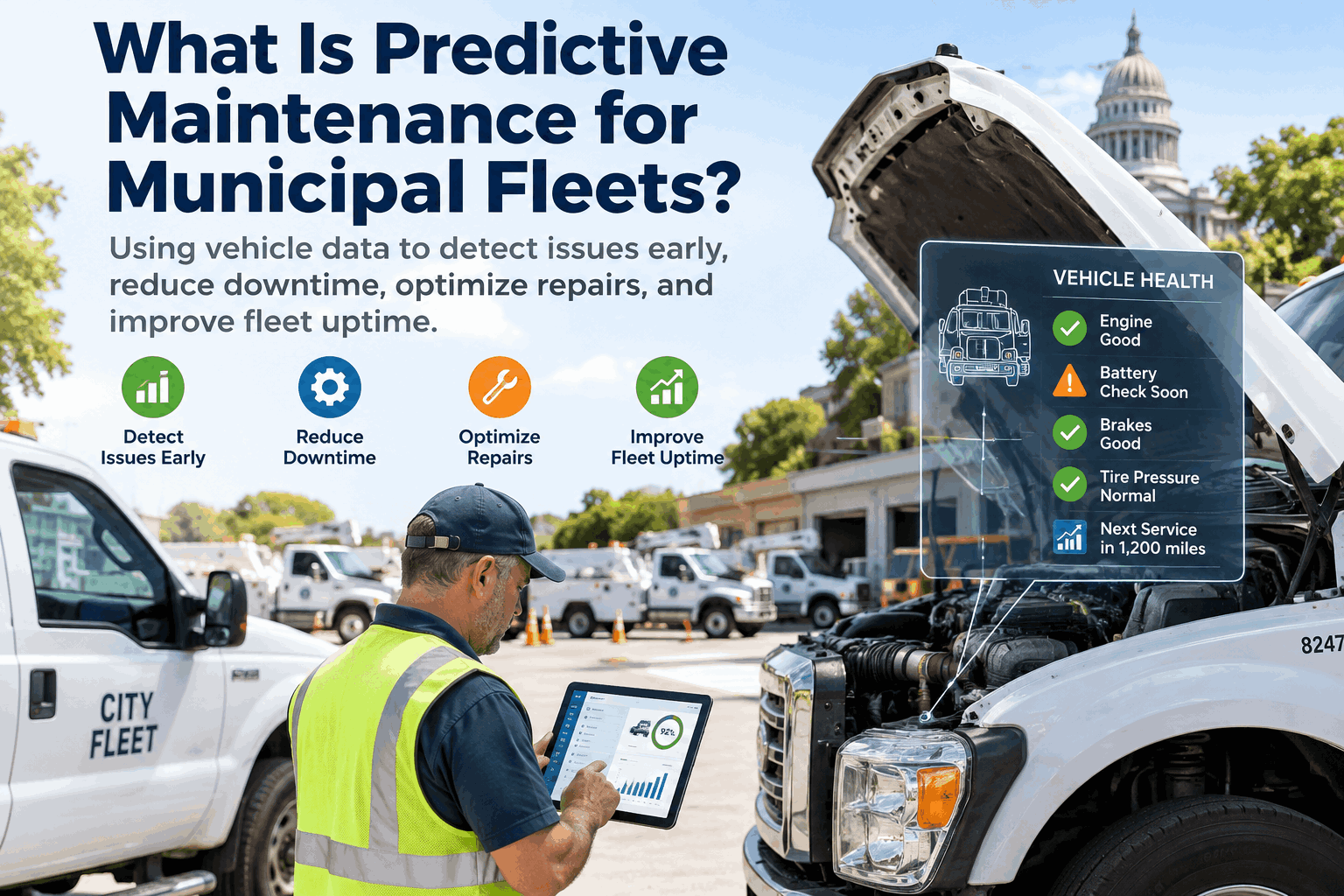
Public works directors, municipal garage supervisors, and county fleet managers face an expensive operational reality: managing diverse civic vehicle assets under tight taxpayer budgets while trying to prevent unexpected roadside mechanical breakdowns. For decades, local governments relied on reactive repairs or rigid preventive schedules based on broad calendar intervals or odometer mileage. Predictive maintenance (PdM) fundamentally transforms municipal garage operations by continuously analyzing live OBD-II and J1939 CAN-bus vehicle diagnostics, auxiliary power take-off (PTO) engine run-hours, battery state-of-health, hydraulic pressure fluctuations, and temperature anomalies to identify component failures before they happen. When civic maintenance facilities lack real-time predictive diagnostic insight, heavy snowplows blow transmissions during emergency winter storms, sewer vacuum jetters seize hydraulic pumps, and emergency vehicles stall during service calls. Fleet Rabbit provides dedicated predictive fleet maintenance software engineered specifically for municipal and public sector operations. Automate early fault detection, schedule repairs around actual mechanical degradation rather than arbitrary schedules, streamline technician work orders, and safeguard civic asset availability across every municipal department. Book a Demo to see our municipal predictive maintenance software in action.
What Is Predictive Maintenance for Municipal Fleets?
An engineering and financial management guide for municipal fleet superintendents: harness vehicle CAN-bus diagnostics, auxiliary PTO telemetry, and machine-learning pattern recognition to prevent mechanical failures, cut garage overtime, and maximize public fleet uptime.
Municipal Predictive Fleet Telemetry & Fault Detection Pipeline
42%
Downtime Reduction
Early fault detection resolves wear issues before mechanical failure occurs.
3.5x
ROI Multiplier
Savings across eliminated emergency towing, overtime labor, and secondary damage.
100%
CAN-Bus Visibility
Direct J1939 and OBD-II diagnostics capture auxiliary PTO engine workload.
$5
Per Civic Asset / Month
Predictable public sector software pricing with zero locked RFP contracts.
Transition from Reactive Breakdowns to Predictive Civic Fleet Reliability
Stop relying on arbitrary calendar oil changes. Connect vehicle diagnostic telemetry, track auxiliary PTO engine load, and equip municipal mechanics with predictive failure alerts for just $5/asset/month.
The Costly Limits of Reactive & Basic Preventive Maintenance
Municipal fleet management has traditionally operated on two outdated philosophies: reactive maintenance (fixing machinery after it breaks on the road) or basic preventive maintenance (changing fluids and filters at fixed mileage or calendar intervals). Both approaches create substantial financial and operational waste for local taxpayers. Sign up to modernize your municipal maintenance operations.
Failure Mode 01
The Odometer Mileage Blind Spot
A public works sewer cleaner or aerial bucket truck may drive only 25 miles in a shift, yet operate stationary auxiliary PTO pumps and hydraulic rams under severe load for eight hours. Rigid mileage schedules leave high-stress engine components unserviced, resulting in sudden pump and hydraulic cylinder failures. Book a demo to inspect our auxiliary PTO engine-hour tracking.
Failure Mode 02
Premature Fluid & Filter Discards
Conversely, fixed calendar preventive maintenance often forces municipal mechanics to replace perfectly clean synthetic fluids, transmission oils, and brake pads simply because an arbitrary 90-day interval arrived, squandering taxpayer budget dollars and technician wrench hours.
Failure Mode 03
Emergency Overtime & Secondary Component Damage
When a mechanical fault goes undetected, minor wear cascades into catastrophic component destruction. A neglected $40 bearing failure quickly destroys a $3,500 differential assembly, triggering emergency road calls and evening overtime shifts. Sign up to eliminate emergency roadside tow fees.
Failure Mode 04
Severe Public Service Disruptions
When public works dump trucks break down during a major winter snowstorm or a police interceptor suffers an alternator seizure during emergency dispatch, civic services halt, compromising community safety and citizen confidence.
Maintenance Evolution: Reactive vs. Preventive vs. Predictive
Captures active and pending Diagnostic Trouble Codes (DTCs) straight from vehicle electronic control units (ECUs). The platform filters benign transient sensor errors while immediately flagging severe mechanical fault patterns—such as cylinder misfires or turbocharger boost leaks—before the dashboard check engine light activates.
Pillar 02
Auxiliary PTO & Stationary Engine Load Telemetry
Measures real power take-off operating hours on hydraulic booms, vacuum blowers, street sweepers, and snowplow spreaders. Service intervals for hydraulic fluid, filters, and auxiliary gearboxes trigger automatically based on actual runtime workload rather than odometer miles. Book a demo to inspect our hydraulic runtime tracking.
Pillar 03
Electrical System Degradation & Cranking Voltage
Monitors starter battery voltage curves during engine cranking events and alternator charging outputs. By identifying subtle voltage drops and internal battery resistance spikes, the platform predicts dead battery failures weeks before police cruisers or ambulances fail to start on cold mornings.
Pillar 04
Thermal Drift & Coolant System Profiling
Analyzes engine coolant and transmission fluid operating temperatures relative to vehicle speed and ambient weather. Subtle thermal climb patterns indicate failing thermostats, water pump cavitation, or radiator clogging, auto-generating a garage shop ticket before an engine overheats. Sign up to automate thermal drift monitoring.
The Closed-Loop Predictive Workflow: From Signal to Shop Floor
The in-cab telematics device interrogates the CAN-bus every few seconds, capturing engine RPM, coolant temperature, fuel trim, and electrical voltage.
Phase 02
Machine-Learning Analysis
The cloud analytics engine correlates incoming data against historical failure baselines, identifying abnormal degradation patterns across specific vehicle classes.
Phase 03
Automated Work Order Generation
When risk thresholds are breached, the platform automatically opens a prioritized repair work order in the maintenance garage, assigning recommended parts and labor hours. Sign up to automate shop work order creation.
Phase 04
Mobile Technician Execution
Garage mechanics receive the job on mobile tablets, complete guided diagnostics, scan storeroom replacement parts, and sign off the repair with verified diagnostic clearing.
Platform Comparison: Legacy Public CMMS vs. Fleet Rabbit PdM
City Eliminates Roadside Breakdowns and Reduces Overtime Across 74 Civic Assets
Managing 74 diverse vehicles across Public Works, Water Utility, Parks, and Police departments, the City of Grandview struggled with costly mechanical failures. During a severe winter storm, two frontline tandem snowplow trucks suffered transmission fluid overheating, resulting in cracked torque converters that cost $14,000 in emergency repairs and left residential arterial roads unplowed. Mechanics relied on paper clipboards and simple 5,000-mile oil change intervals.
By implementing Fleet Rabbit at $5/asset/month, the city connected vehicle OBD-II and J1939 telematics directly to our predictive maintenance engine and equipped garage technicians with mobile tablets. Automated thermal anomaly alerts caught a failing transmission cooler on a plow truck during a routine salt run three weeks before a major blizzard, allowing mechanics to replace a $120 thermostat instead of an entire transmission. Unscheduled vehicle downtime dropped by 44%, annual repair expenditures fell by $56,000, and winter storm equipment availability reached 100%.
Frequently Asked Questions
What is the difference between preventive maintenance and predictive maintenance?
Preventive maintenance (PM) relies on predetermined calendar intervals or odometer mileage thresholds (such as changing engine oil every 5,000 miles or 90 days), regardless of whether the fluid is actually degraded. Predictive maintenance (PdM) continuously monitors real-time vehicle diagnostic telemetry—such as CAN-bus fault codes, cranking voltages, auxiliary engine hours, and thermal drift—to detect actual component wear and schedule repairs right before failure occurs, eliminating both premature maintenance and catastrophic breakdowns.
Why is auxiliary engine runtime critical for municipal predictive maintenance?
Many municipal assets—including vacuum sewer cleaners, aerial bucket trucks, street sweepers, and snowplow spreaders—operate stationary for hours powering heavy hydraulic attachments. Relying strictly on civilian road odometer miles understates true mechanical engine, fluid, and transmission wear by 50% or more. Capturing auxiliary PTO engine runtime provides the empirical data required to predict hydraulic pump and engine oil breakdown accurately.
How does predictive maintenance help lower municipal garage labor costs?
Predictive maintenance eliminates high-cost emergency firefighting. By identifying failing components weeks in advance, garage supervisors can order replacement parts ahead of time at standard shipping rates and schedule repairs during normal shop shift hours, dramatically cutting expensive technician overtime and eliminating third-party emergency roadside towing charges.
Can mechanics and operators use the mobile application without cellular reception?
Yes. Fleet Rabbit features an offline-first mobile architecture. Garage mechanics and operators can complete pre-trip DVIR walkarounds, update work order job cards, and scan storeroom replacement parts inside underground maintenance pits, remote salt storage sheds, or rural municipal parks without cellular coverage. All data synchronizes automatically once network reception returns.
What are the pricing details and contract terms for Fleet Rabbit's software?
Fleet Rabbit is priced at a flat rate of $5 per active civic asset per month billed annually. This includes complete access to predictive maintenance diagnostic modeling, auxiliary PTO runtime scheduling, mobile technician work orders, parts storeroom inventory control, and inter-departmental chargeback reporting. We provide a 14-day free live trial on up to 3 assets with zero setup fees or long-term locked RFP contracts.
Ready to Bring Predictive Maintenance to Your Municipal Fleet?
Detect mechanical failures early, eliminate emergency roadside tow fees, and optimize municipal garage productivity for just $5/asset/month.