Forklift downtime in a manufacturing plant is never just a maintenance cost — it is a production cost, a labour cost, a throughput cost, and increasingly a customer fulfilment cost. A single forklift removed from a production line or shipping dock for an unplanned repair during peak hours doesn't sit in isolation; it creates a cascade of delays that touches every downstream operation depending on that vehicle. Yet the majority of manufacturing plants managing fleets of 20 or more forklifts are still operating on a reactive maintenance model — responding to breakdowns after they occur rather than preventing them before they disrupt production. The plants achieving 98.7% forklift fleet uptime aren't running newer equipment or employing larger maintenance crews. They are running smarter systems: hour-based service tracking that catches wear patterns before components fail, real-time fault code monitoring that surfaces developing mechanical issues while vehicles are still operational, and utilisation analytics that distribute run hours across the fleet rather than burning out the same three machines while others sit underused. Start maximising your forklift fleet uptime with FleetRabbit or book a fleet performance demo with our team.
FleetRabbit Manufacturing Fleet Intelligence
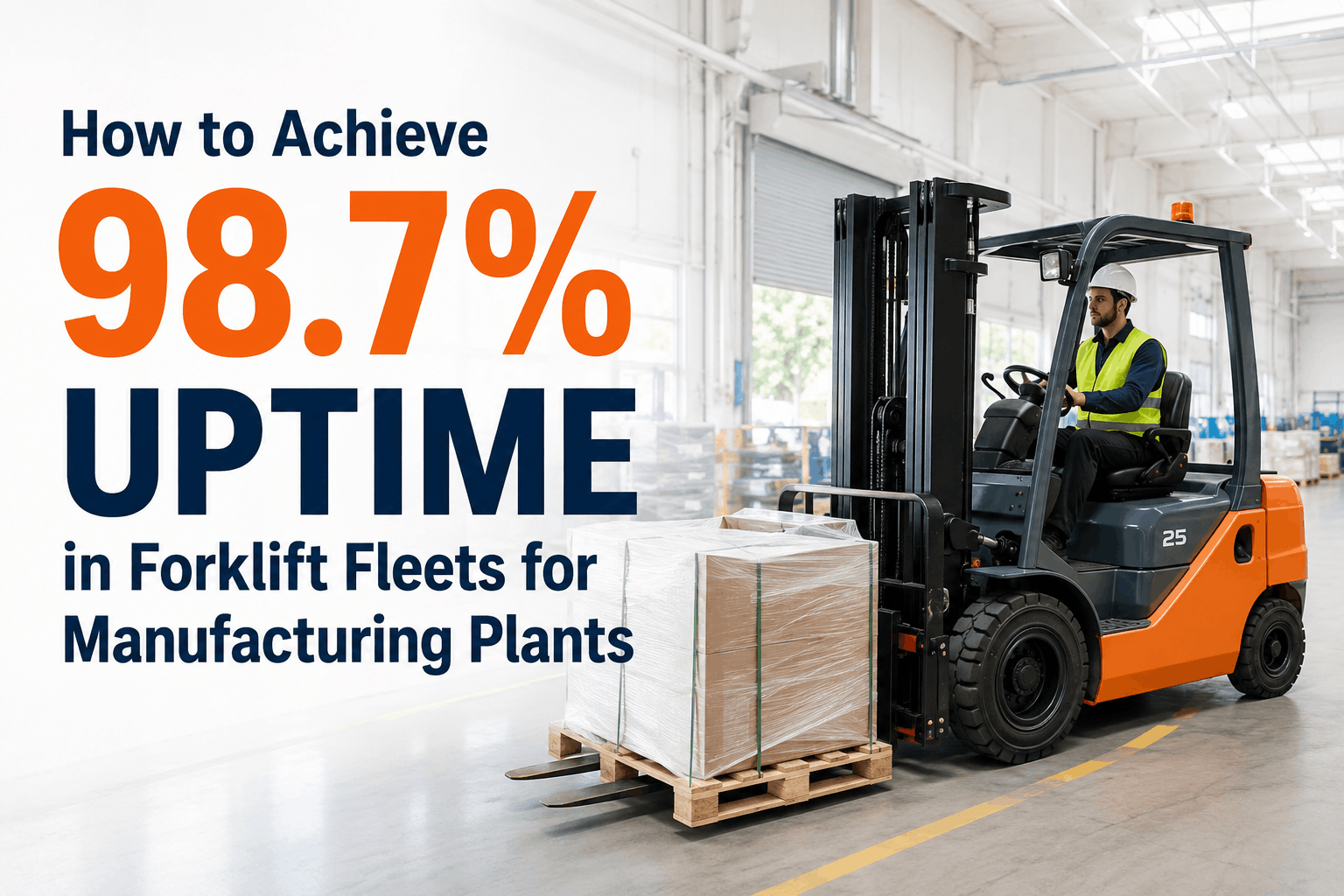
How to Achieve 98.7% Uptime in Forklift Fleets for Manufacturing Plants
Learn how predictive maintenance, hour-based tracking, and real-time alerts help manufacturing plants reach 98.7% forklift uptime and minimise costly production downtime — across every vehicle class, every shift, and every plant zone.
98.7%Forklift uptime achievable with predictive maintenance systems
$8,500+Average cost per hour of unplanned production downtime in manufacturing
3×More costly: reactive vs. proactive forklift maintenance model
Real-TimeFault code alerts and hour-tracking across every fleet asset
Why Manufacturing Plants Lose Forklift Uptime — And What Is Actually Causing It
Most plant operations managers know downtime is expensive. Fewer have mapped precisely where in the maintenance and utilisation cycle their forklift fleet is losing availability — and why. The root causes of below-target uptime in manufacturing forklift fleets are almost never catastrophic equipment failures. They are accumulated, preventable failures: service intervals missed because hour tracking is manual and inaccurate, fault codes that sat in a vehicle's onboard system for two weeks before anyone read them, utilisation imbalances that run certain vehicles into the ground while others are underused, and pre-shift inspection defects that were logged on paper but never escalated to the maintenance team before the vehicle was dispatched. FleetRabbit gives manufacturing plant operations and maintenance teams the real-time fleet intelligence to prevent each of these failure modes — turning a reactive downtime management programme into a proactive uptime protection system.
Unplanned Breakdown Events
Root Cause — Reactive Maintenance Model
Unplanned breakdowns are the single largest driver of below-target forklift uptime in manufacturing plants — and they are almost always preceded by detectable warning signals that a reactive maintenance model misses entirely. Hydraulic system pressure drops, battery charge cycle degradation, drivetrain noise progression, and brake wear rates all follow predictable trajectories that instrument-equipped forklifts generate data on continuously. Plants without real-time telemetry access that data only when a technician performs a periodic inspection — by which point the degradation has often progressed to imminent failure. FleetRabbit's onboard telemetry connects to forklift CANbus systems and streams fault codes, runtime hours, battery status, and performance metrics to a central fleet dashboard — giving maintenance teams the early warning signals they need to schedule repairs during planned downtime windows rather than discover failures during production shifts.
Service Interval Drift
Root Cause — Inaccurate Hour Tracking
Forklift manufacturers specify service intervals by operating hours — not by calendar time — because a forklift running three shifts a day accumulates wear at three times the rate of one running a single shift. Manual hour logging systems, odometer readings taken inconsistently, and service records maintained in paper folders at the maintenance bay routinely produce hour tracking errors that push vehicles past their service interval without the maintenance team's awareness. A forklift running 200 hours past its 500-hour hydraulic fluid and filter service interval isn't merely overdue — it's operating with degraded hydraulic system performance that increases the probability of both component failure and operator incident. FleetRabbit's hour-based maintenance scheduling tracks actual runtime hours from vehicle telemetry, generates service work orders automatically at interval threshold, and prevents hour tracking drift regardless of shift patterns, vehicle reassignments, or seasonal utilisation fluctuations.
Utilisation Imbalance Across Fleet
Root Cause — No Fleet-Wide Visibility
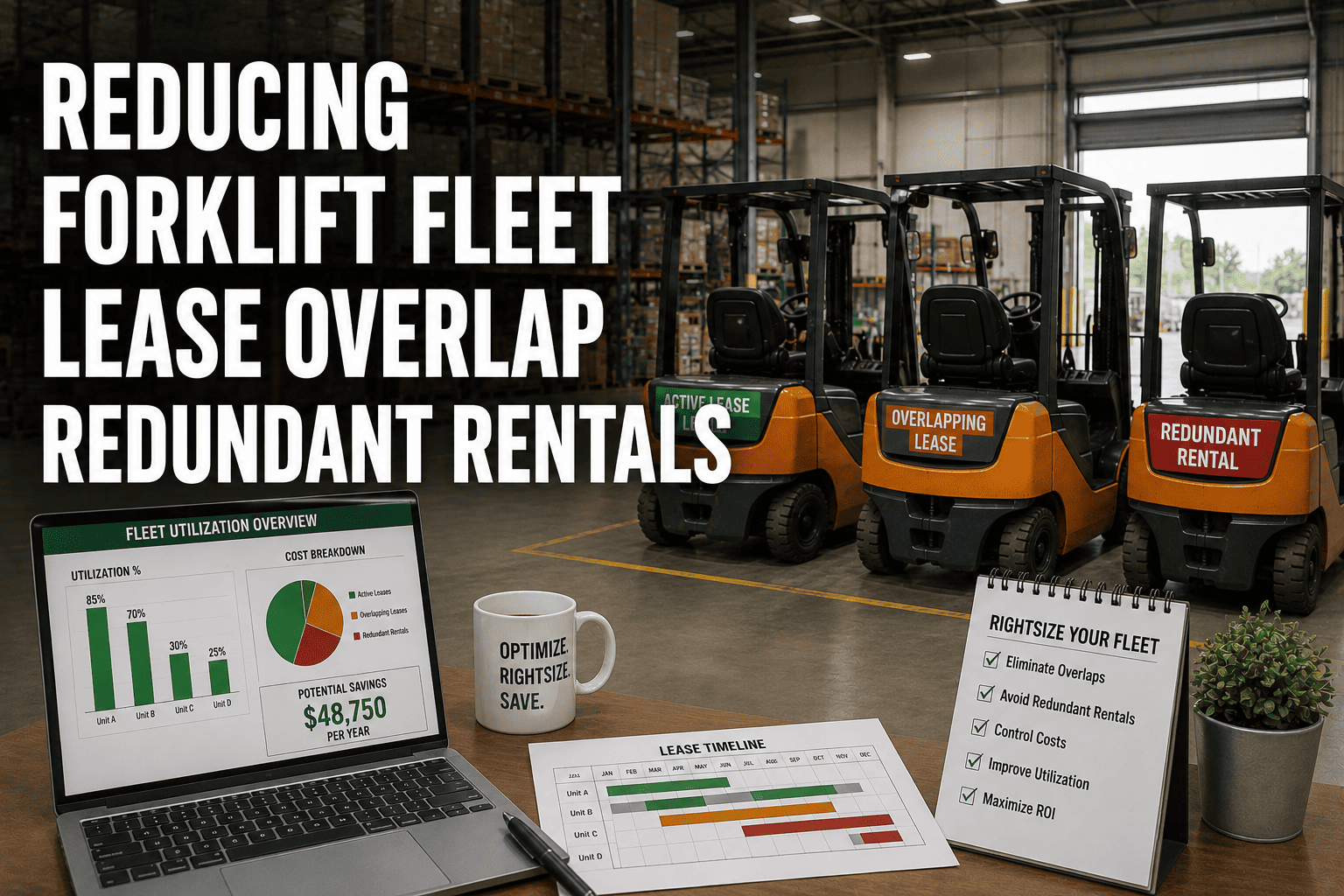
In manufacturing plants without fleet-wide utilisation visibility, operators and supervisors naturally gravitate toward the same familiar vehicles — the forklift parked closest to the charging station, the reach truck that's always available at shift start, the order picker that a particular operator prefers. Over time, this creates severe utilisation imbalances: certain vehicles accumulate hours at two to three times the fleet average, reaching service intervals and wear thresholds far earlier than fleet planning anticipated, while others sit underutilised and generate no productive output from their capital cost. FleetRabbit's utilisation analytics surface individual vehicle run hours, idle time ratios, and cumulative hour totals across the entire fleet — enabling plant operations managers to actively balance utilisation, extend the service life of high-run vehicles, and improve the return on the total fleet asset investment.
Six Operational Strategies to Reach 98.7% Forklift Fleet Uptime
Achieving 98.7% forklift fleet uptime in a manufacturing plant environment is not a single-intervention outcome — it is the result of six interdependent operational disciplines working simultaneously. Plants that implement one or two of these strategies in isolation see marginal uptime improvement. Plants that implement all six through a unified fleet intelligence platform see the compounding uptime gains that push availability above 98% and hold it there across shift patterns, seasonal production cycles, and fleet expansion. The strategies below reflect the implementation sequence FleetRabbit's manufacturing fleet team has validated across plant operations ranging from 15 to 400 forklifts.
01
Deploy Real-Time Telemetry Across Every Vehicle
The foundation of a 98.7% uptime programme is continuous visibility into every vehicle's operational status — not periodic manual readings that create data gaps between inspections. FleetRabbit's telemetry hardware connects to forklift onboard systems and streams runtime hours, fault codes, battery state of charge, operating temperature, and impact events to a central fleet dashboard updated in real time. Fault codes that indicate developing mechanical issues — hydraulic pressure warnings, battery cell imbalance, brake system alerts — are surfaced immediately to the maintenance team rather than sitting undetected in the vehicle's onboard system until the next technician visit. The shift from periodic to continuous monitoring is the single operational change that most consistently drives unplanned breakdown reduction in manufacturing forklift fleets, because it eliminates the detection gap between when a problem develops and when it is acted on.
02
Implement Hour-Based Predictive Maintenance Scheduling
Forklift manufacturers' service interval specifications are designed around operating hours, not calendar time — and any maintenance programme that ignores actual runtime in favour of fixed calendar schedules is either over-maintaining low-utilisation vehicles or under-maintaining high-utilisation ones. FleetRabbit's predictive maintenance engine tracks actual runtime hours from vehicle telemetry against manufacturer-specified service intervals for each vehicle make and model in your fleet — generating maintenance work orders automatically at threshold, assigning them to technicians, and tracking completion with parts used and time to close. The system supports multi-level interval scheduling — 250-hour, 500-hour, 1,000-hour, and 2,000-hour service milestones — with escalating alert windows that give maintenance planners sufficient lead time to schedule repairs during planned production windows rather than emergency maintenance bays.
03
Establish Digital Pre-Shift Inspection Workflows
Pre-shift operator inspections are the first line of defence against developing mechanical issues progressing into mid-shift failures — but only if defects identified during the inspection are escalated to the maintenance team before the vehicle is dispatched. Paper-based pre-shift inspection checklists consistently fail at this critical handoff: defects are noted on paper, the paper stays in the cab, and the vehicle enters service with an identified issue that the maintenance team never sees until it becomes a breakdown. FleetRabbit's digital pre-shift inspection system deploys checklists to operators' mobile devices before each shift, with mandatory completion confirmation, photo capture for flagged defects, and automatic maintenance work order generation for any item that fails inspection criteria. Vehicles with open safety-critical defects are automatically flagged as unavailable in the fleet dashboard until the maintenance team closes the work order — preventing defect-to-dispatch events that drive both unplanned downtime and operator safety incidents.
04
Configure Real-Time Alert Escalation for Critical Faults
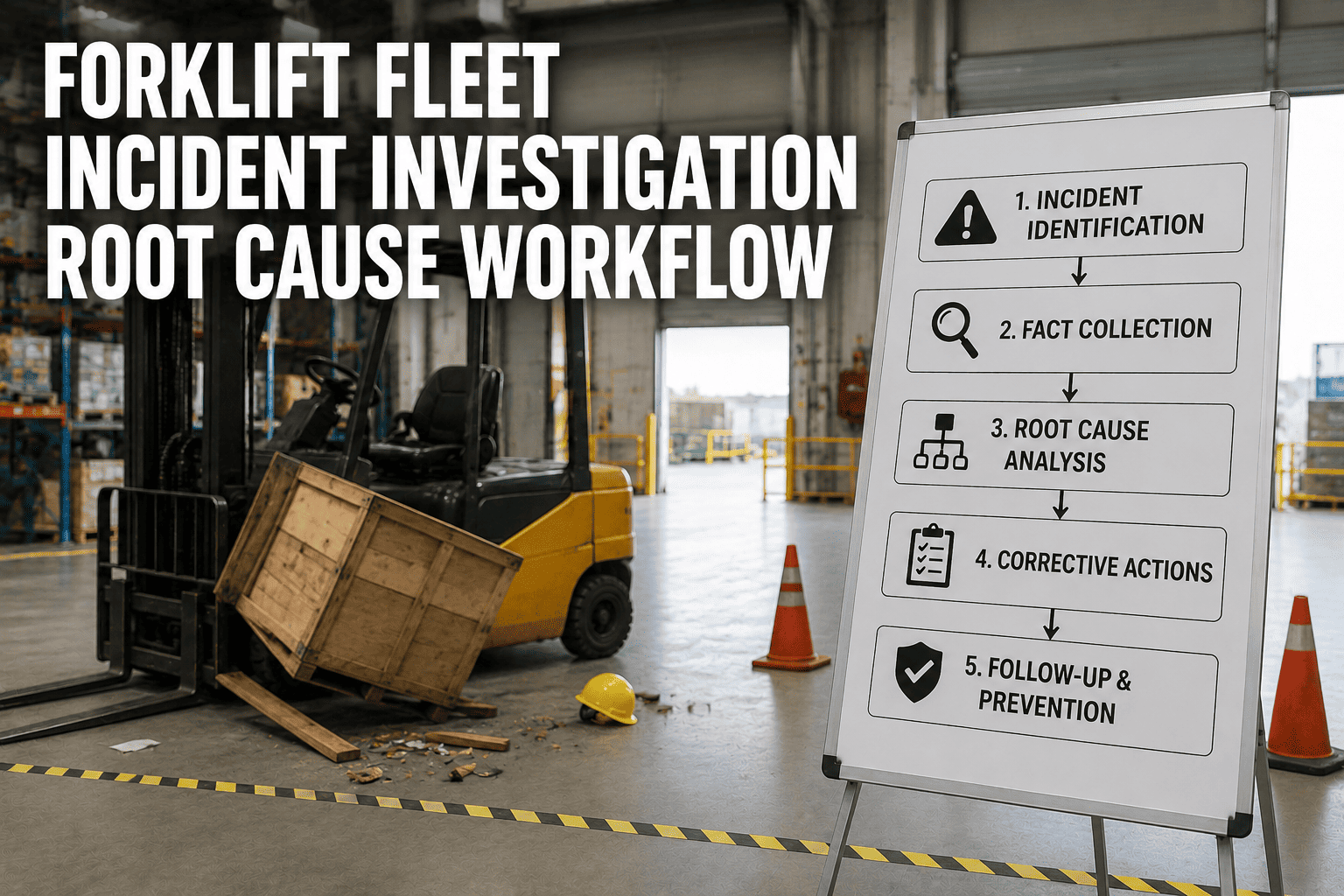
Not all fault codes carry equal urgency — a seat belt interlock alert and a hydraulic overpressure warning require very different response timeframes. FleetRabbit's alert configuration system allows maintenance managers to define severity tiers for fault codes and telemetry threshold breaches, with corresponding escalation rules that determine who is notified, in what sequence, and within what time window. A hydraulic temperature exceedance during a production shift can trigger an immediate push notification to the on-shift maintenance technician and a simultaneous SMS to the plant maintenance supervisor — while a battery balancing advisory generates a work order for the next planned maintenance window without interrupting production. Alert acknowledgement and response action are logged in the compliance record for each vehicle, creating a documented escalation trail that supports both maintenance programme analysis and any incident investigation that follows a downtime event.
05
Balance Fleet Utilisation With Hour-Tracking Analytics
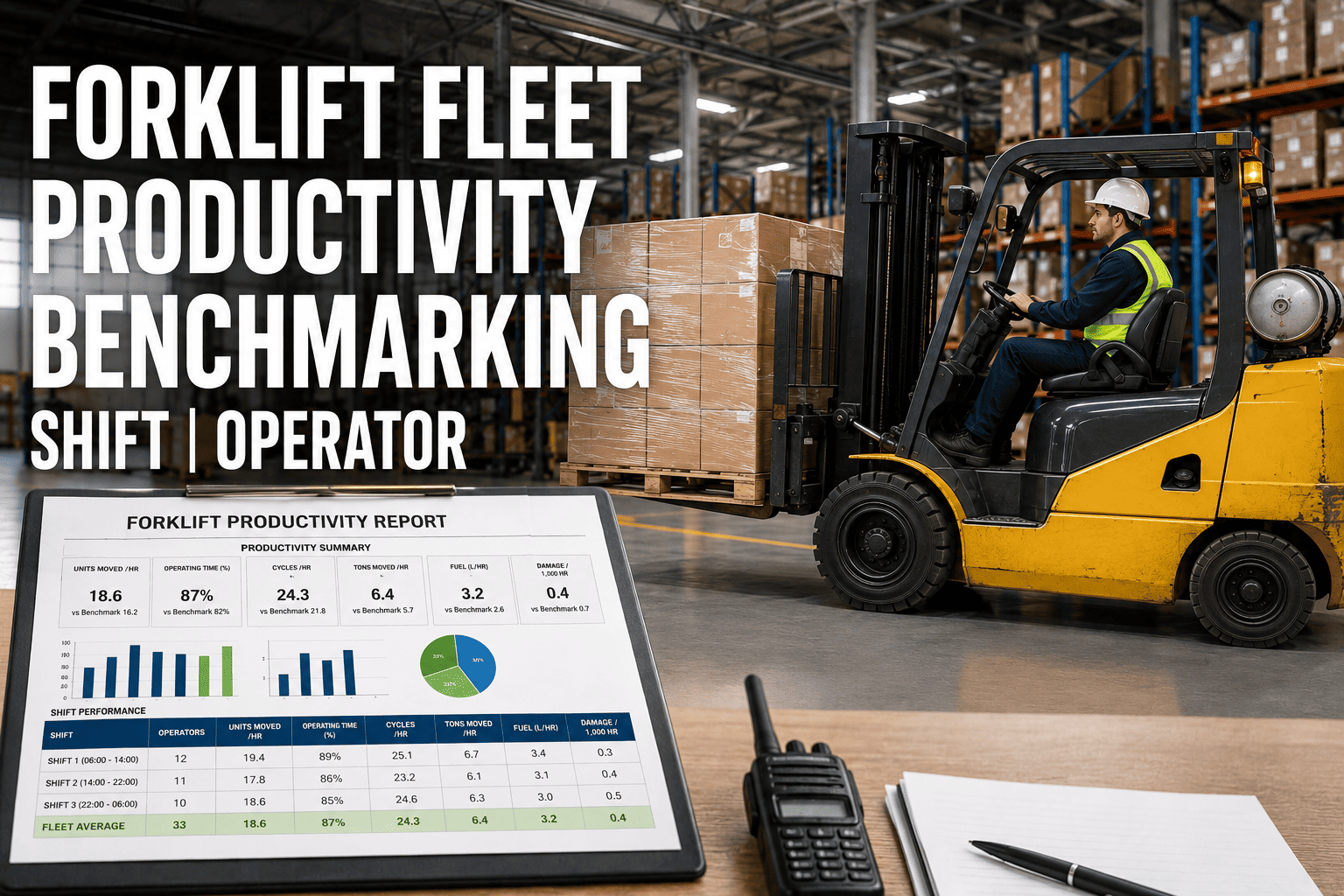
Fleet utilisation imbalance is one of the most consistently overlooked drivers of premature component failure and early fleet replacement cycles in manufacturing plants. FleetRabbit's utilisation analytics provide individual vehicle runtime totals, shift-by-shift hour accumulation, idle time ratios, and fleet-wide hour distribution charts that surface imbalances the moment they begin developing — not after a high-run vehicle reaches its replacement threshold years ahead of schedule. Plant operations managers use FleetRabbit's utilisation data to implement active fleet rotation policies that equalise run hours across vehicles of the same class — extending component life, smoothing maintenance workload, and deferring fleet replacement capital expenditure by extending the productive service life of each vehicle in the fleet. Fleets implementing active utilisation balancing through FleetRabbit typically see a 15–22% reduction in early component replacement events within the first year.
06
Track and Reduce Impact Events With Operator Accountability
Impact events — collisions with racking, dock equipment, other vehicles, and infrastructure — are a leading cause of unplanned forklift downtime that maintenance scheduling cannot predict or prevent. FleetRabbit's impact detection system logs every impact event above configurable g-force thresholds with timestamp, vehicle identity, GPS location, and operator attribution — creating a documented impact record that maintenance teams use to schedule post-impact inspections before vehicles re-enter service with undetected structural damage. Operations managers use the impact event log to identify operators with above-average incident rates, enabling targeted retraining interventions before operator behaviour becomes a chronic maintenance cost driver. Plants that implement FleetRabbit's impact detection alongside operator coaching programmes typically see a 30–40% reduction in impact-related unplanned maintenance events within 90 days of implementation.
FleetRabbit Manufacturing Fleet Intelligence
Stop Discovering Forklift Failures on the Production Floor. Start Preventing Them in the Maintenance Bay.
FleetRabbit gives manufacturing plant operations and maintenance teams real-time telemetry, hour-based predictive maintenance scheduling, digital pre-shift inspections, and fleet-wide utilisation analytics — the complete uptime protection system that drives forklift fleet availability above 98% and keeps it there.
How FleetRabbit Uptime Performance Scales Across Manufacturing Plant Types
Forklift fleet uptime requirements vary significantly across manufacturing plant types — a single-shift automotive parts plant with 18 counterbalance forklifts has different operational constraints than a three-shift e-commerce fulfilment centre running 120 reach trucks and order pickers around the clock. FleetRabbit's manufacturing fleet platform configures to both ends of this spectrum — adapting to vehicle class mix, shift patterns, maintenance staffing levels, and plant layout complexity — without requiring separate product tiers or extended customisation timelines for operation-specific uptime requirements.
Automotive Manufacturing
Automotive plants running tightly sequenced production lines cannot tolerate the production cascade that a single forklift breakdown triggers during a live build cycle. FleetRabbit's real-time fault alerting and shift-boundary maintenance scheduling ensures that developing mechanical issues are addressed between production windows rather than during them — protecting the line sequencing that automotive uptime targets depend on.
Food and Beverage Production
Food and beverage manufacturing plants combining forklift fleet uptime requirements with FSMA sanitary transport compliance needs require maintenance documentation that serves both operational and regulatory purposes. FleetRabbit captures maintenance records in formats that support food safety compliance documentation alongside uptime programme management — eliminating the dual-system overhead that food plant operations teams currently manage separately.
Distribution and Fulfilment
High-velocity distribution centres and e-commerce fulfilment operations running 24/7 shift patterns require uptime management systems that function across shift handovers without data loss, inspection gaps, or maintenance handoff failures. FleetRabbit's shift-agnostic digital inspection and telemetry system maintains continuous vehicle status visibility regardless of shift pattern, operator rotation, or maintenance crew changes — preserving uptime protection through the shift boundaries where manual systems consistently fail.
Heavy Manufacturing and Metals
Heavy manufacturing and metals processing plants operating large-capacity forklifts in high-intensity environments require maintenance programmes calibrated to accelerated wear rates that standard service intervals underestimate. FleetRabbit supports custom service interval configurations by vehicle class and operating environment — enabling heavy manufacturing maintenance managers to apply tighter inspection cadences and earlier component replacement thresholds to vehicles operating in conditions that exceed standard duty cycle specifications.
From the Plant Floor
"We run 44 forklifts across two facilities — a mix of counterbalance trucks, reach trucks, and order pickers — and before FleetRabbit our maintenance programme was entirely calendar-based. We were doing monthly inspections regardless of how many hours a vehicle had run that month, and we had no visibility into fault codes unless a technician physically plugged into the vehicle's diagnostic port. We were averaging four to six unplanned breakdown events per month across the fleet, which was costing us approximately $340,000 a year in combined maintenance costs, lost production time, and expedited parts sourcing. In the 12 months after deploying FleetRabbit, we had eleven unplanned breakdowns — down from roughly 60 — and our average fleet availability went from 91.4% to 98.2%. The two changes that drove the biggest impact were switching from calendar-based to hour-based maintenance scheduling using FleetRabbit's actual runtime data, and the fault code alert system — three times in the first six months we caught a developing hydraulic issue from a fault code alert and scheduled a repair before the vehicle failed. Every one of those was a potential production line shutdown we avoided. The system paid for the full two-facility deployment in the first four months."
VP of Plant Operations
·
Tier 2 Automotive Parts Manufacturer — 44 Forklifts — 2 Facilities — FleetRabbit Uptime Active
Frequently Asked Questions
QHow does FleetRabbit connect to existing forklifts and what telematics hardware is required?
FleetRabbit's telemetry hardware connects to forklifts via the vehicle's CANbus port — the same diagnostic port used by manufacturer service tools — and is compatible with the major forklift brands used in North American and European manufacturing plants, including Toyota, Crown, Raymond, Hyster, Yale, Jungheinrich, and Linde. Installation is typically completed by a FleetRabbit-certified technician in 45–90 minutes per vehicle and does not require vehicle modification or manufacturer service involvement. For vehicles without an accessible CANbus port, FleetRabbit offers an alternative hardware configuration that captures runtime hours, impact events, and GPS location from external sensors. The complete hardware compatibility list for your specific fleet mix is confirmed during the pre-deployment assessment, which FleetRabbit's manufacturing fleet team conducts before hardware procurement to ensure there are no compatibility gaps before installation begins.
QWhat maintenance scheduling configurations does FleetRabbit support, and can we use our existing service intervals?
FleetRabbit supports fully configurable maintenance scheduling that can replicate your existing manufacturer-specified service intervals precisely or allow your maintenance team to define custom intervals based on your plant's operating environment and duty cycle requirements. Standard configurations support multi-level interval scheduling — 250-hour, 500-hour, 1,000-hour, and 2,000-hour thresholds — with separate service task lists at each level reflecting the specific maintenance requirements at that milestone. Alert windows are configurable per interval level — for example, generating a work order at 450 hours for a 500-hour service to provide sufficient lead time for parts procurement and technician scheduling. All existing service intervals, task lists, and parts specifications can be imported into FleetRabbit during onboarding, preserving the institutional knowledge your maintenance team has built around your specific fleet without requiring a complete programme rebuild from scratch.
QHow does FleetRabbit's uptime programme integrate with existing CMMS or ERP systems used in our plant?
FleetRabbit offers API-based integration with the major CMMS and ERP platforms used in manufacturing plant maintenance operations, including SAP PM, IBM Maximo, Infor EAM, and UpKeep. Work orders generated by FleetRabbit's predictive maintenance engine can be pushed directly to your existing CMMS work order queue — preserving the maintenance technician workflows, parts inventory systems, and cost tracking processes your team already operates rather than requiring a parallel workflow in a separate platform. For plants without a CMMS, FleetRabbit's native work order management system provides technician assignment, parts tracking, completion confirmation, and maintenance history storage as a standalone capability. Integration scope and configuration options are assessed during onboarding, with standard integrations typically live within two weeks of the initial fleet telemetry deployment.
FleetRabbit Manufacturing Fleet Intelligence
98.7% Forklift Uptime Is Not a Target. It's a System. Build Yours Today.
FleetRabbit gives manufacturing plant operations teams real-time telemetry, hour-based predictive maintenance, digital pre-shift inspections, utilisation analytics, and impact event tracking — the complete forklift fleet uptime protection system that eliminates unplanned breakdowns and keeps production running.
Real-Time Telemetry
Hour-Based PM Scheduling
Fault Code Alerts
Utilisation Analytics
Impact Event Tracking
Digital Pre-Shift Inspections
May 26, 2026
By Taylor
All Posts