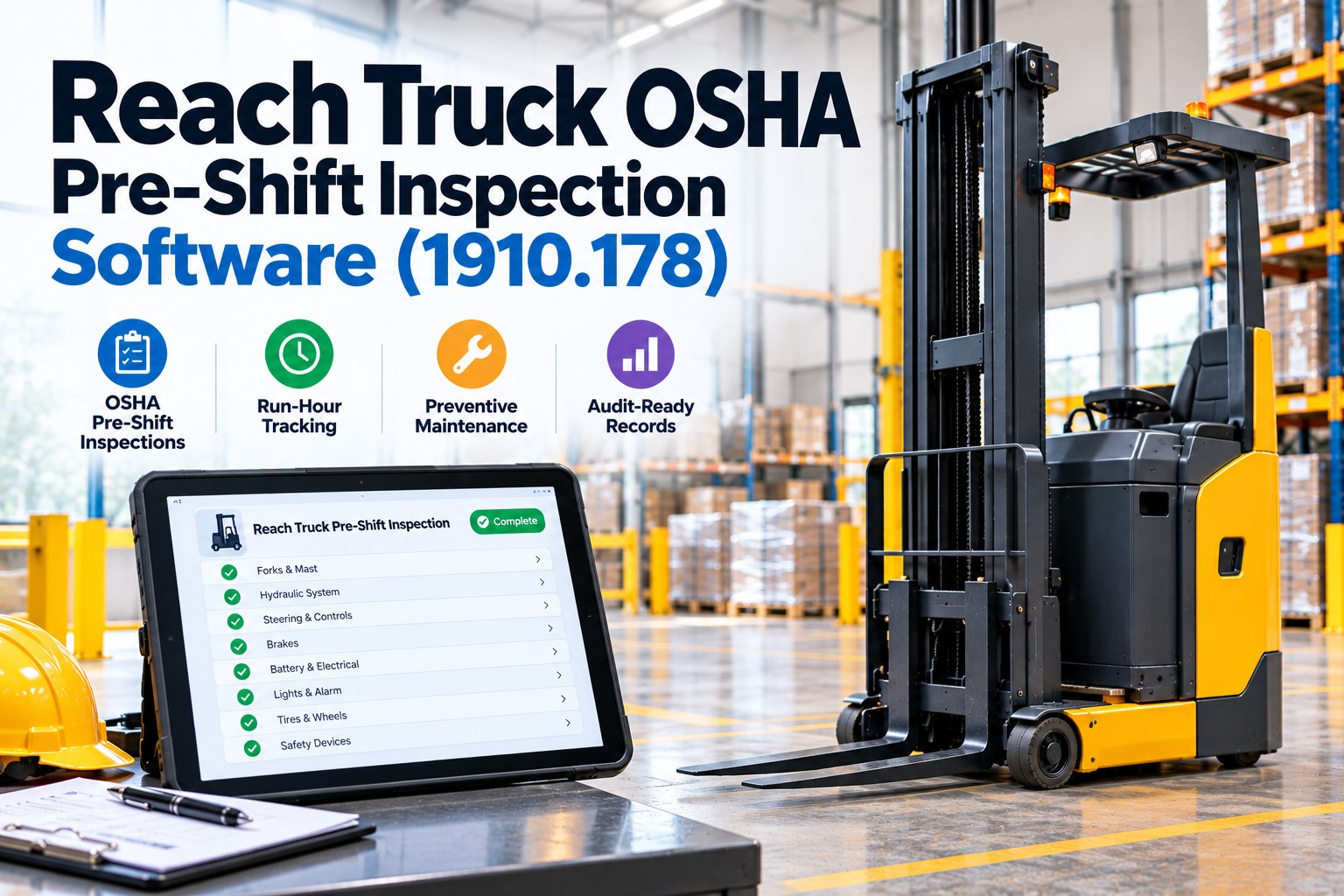
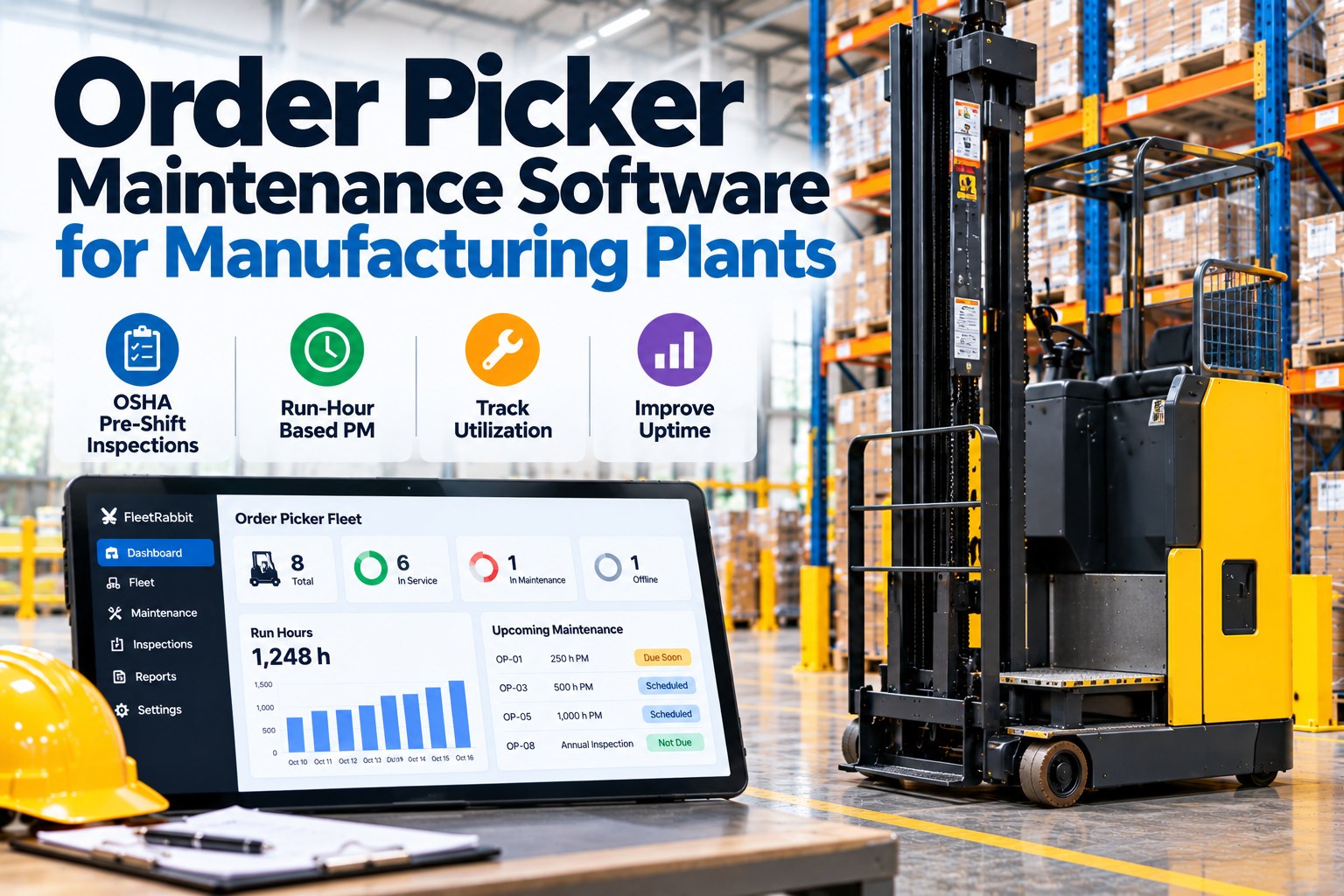
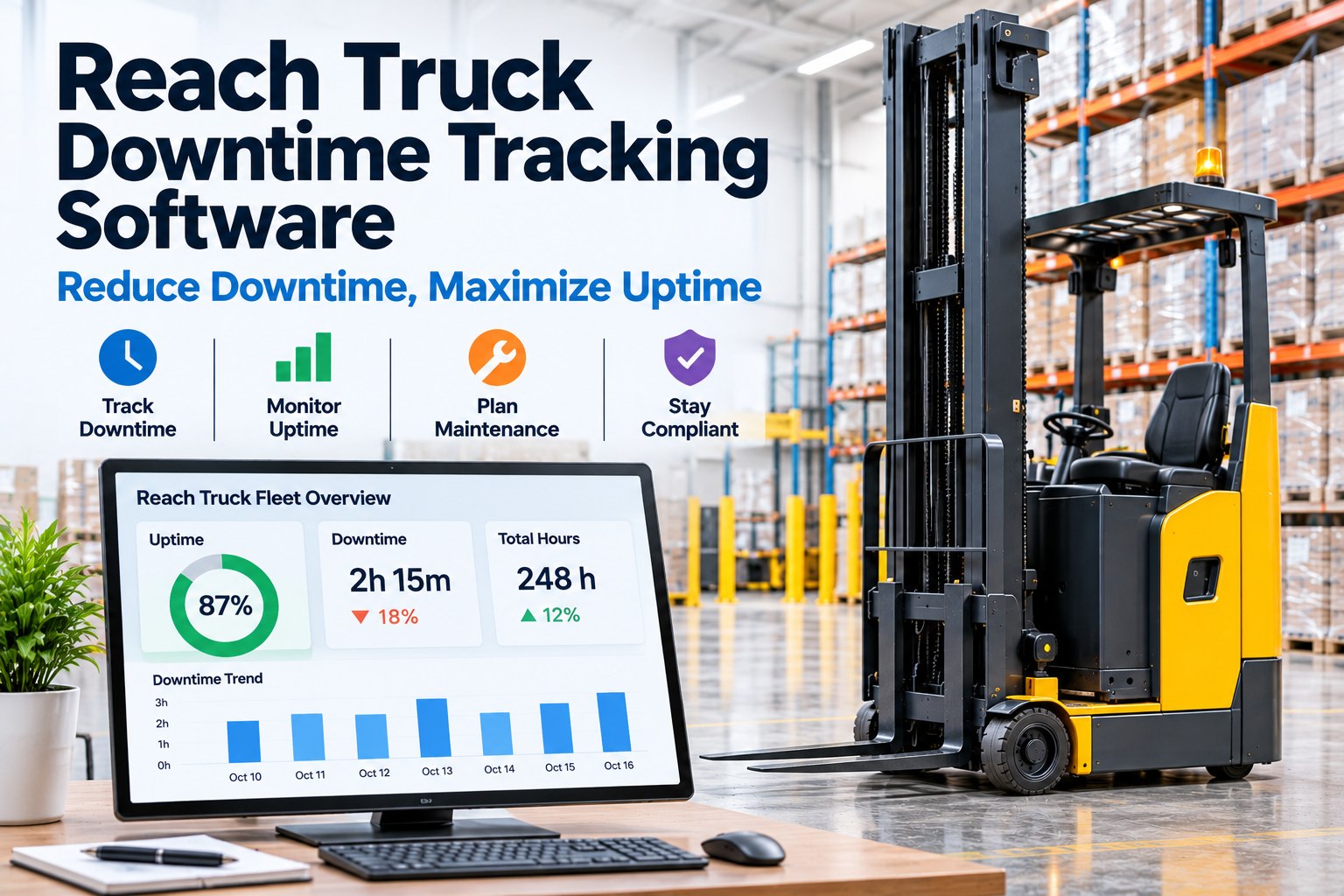
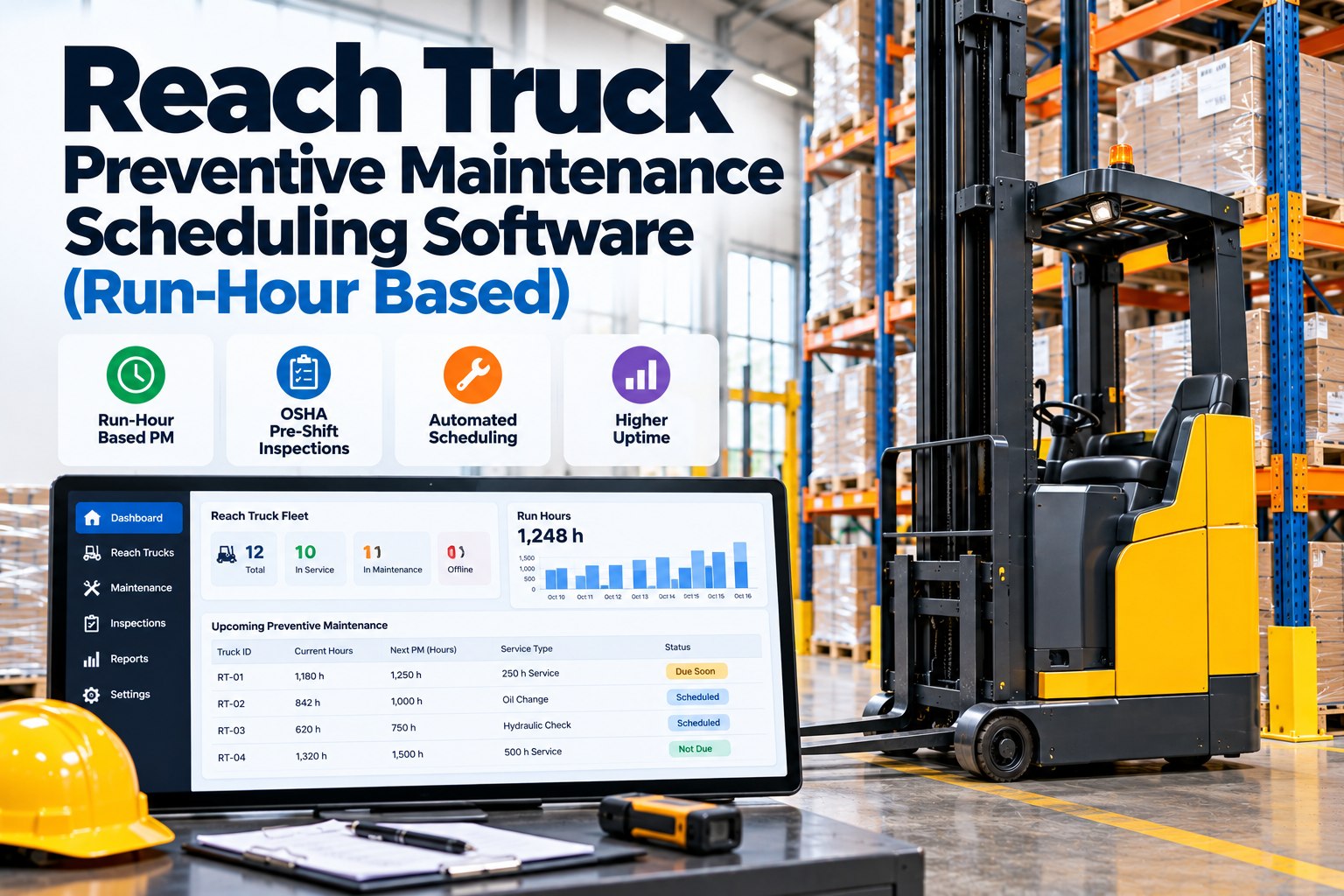
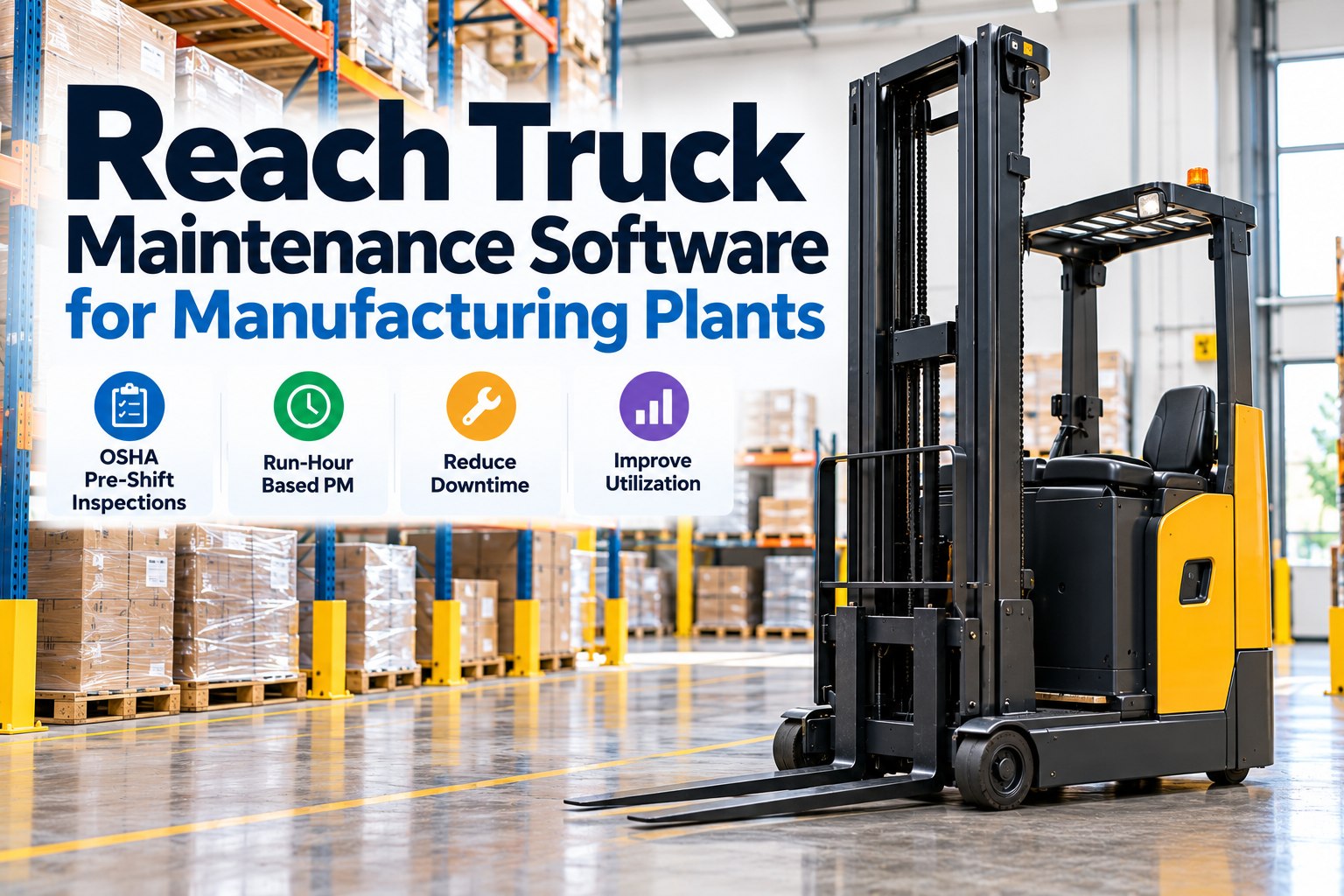
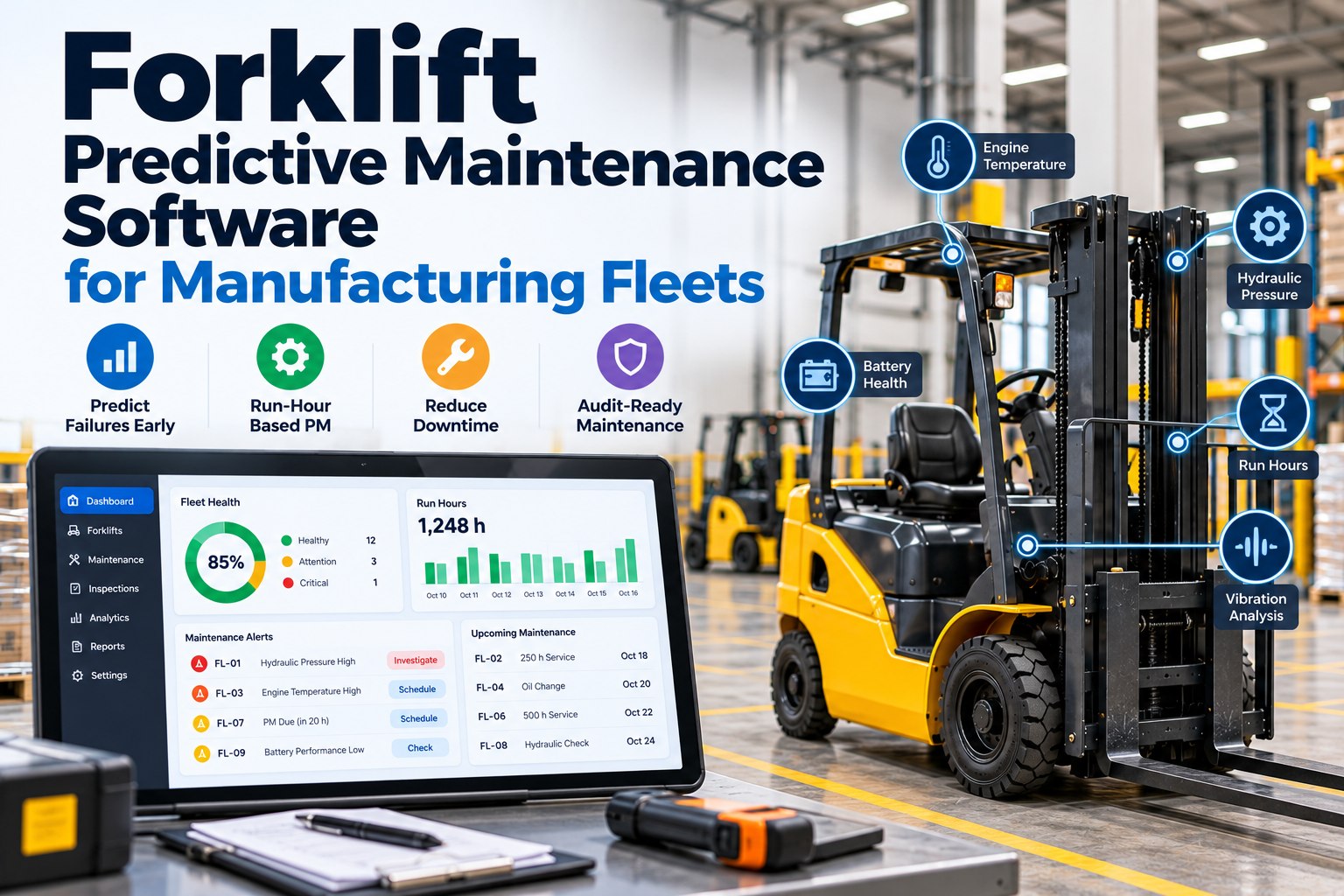
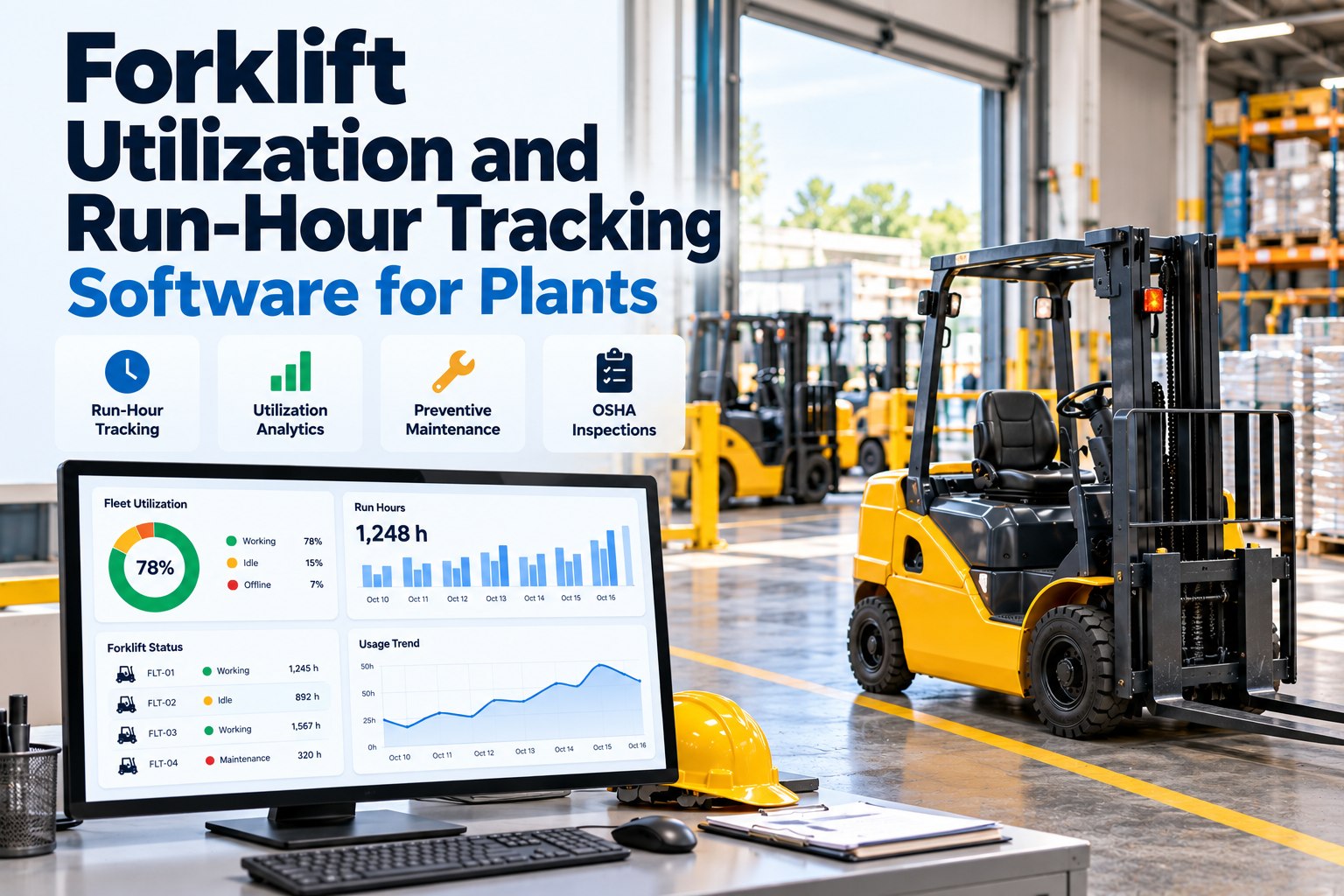
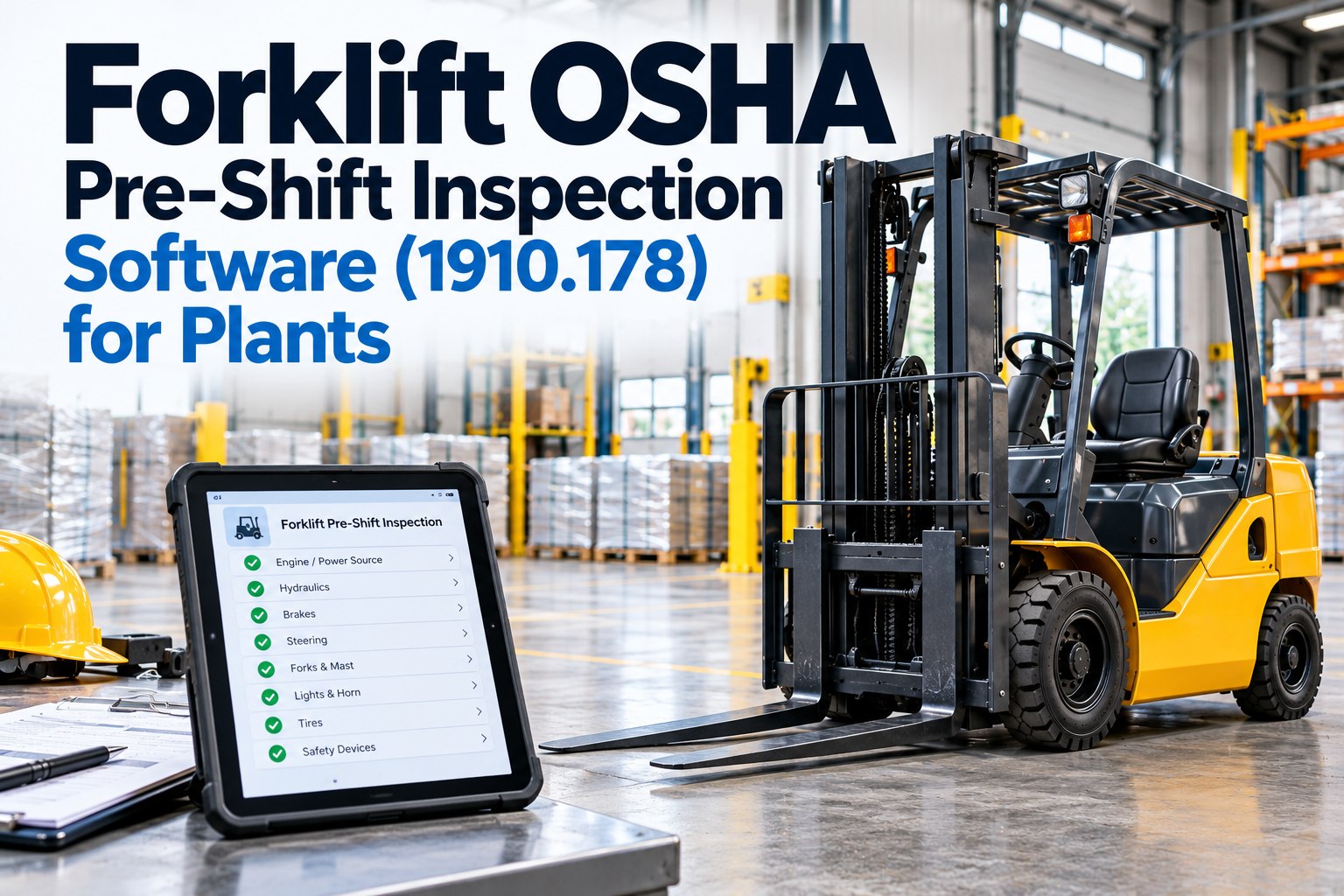
Reach truck OSHA inspection software has to cover a hazard most forklift checklists never mention. Stand-up reach trucks often travel with the forks trailing, which leaves the operator's compartment facing rack beams it can slide under. OSHA counted at least nine operators killed this way between 1993 and 2008. This guide covers what a 29 CFR 1910.178 pre-shift check on a reach truck should include, how to tie each check to a certified operator, and how the same records feed predictive maintenance and utilization. Book a 20-minute FleetRabbit demo to see a reach truck pre-shift check in action.
Manufacturing plants · Stand-up reach trucks · 29 CFR 1910.178
On a stand-up reach truck, six inches between the compartment and a rack beam can decide whether a reverse move is routine or fatal.
For EHS managers, maintenance leads and supervisors responsible for reach truck operators in plant stores and narrow aisles.
Heights from one fatality OSHA described
A 6-inch gap let the beam enter the operator's compartment.
The Under-Ride Hazard OSHA Flagged on Stand-Up Forklifts: At Least Nine Operators Killed Backing Toward Racks
OSHA's 2009 Safety and Health Information Bulletin on stand-up forklift under-ride describes the pattern. A truck travels in reverse with its forks trailing, backs toward a rack, and passes beneath a horizontal crossbar that enters the compartment. From 1993 to 2008, OSHA data showed at least nine employees killed and three severely crushed this way. None of those forklifts had a protective rear guard or corner post.
OSHA bulletin
Standup Forklift Under-ride Hazards · 2009
Pattern
Travelling in reverse, forks trailing, toward a rack crossbar
Toll, 1993–2008
At least 9 killed, 3 severely crushed
Common factor
No rear guard or corner post on the truck
NIOSH case file
Iowa warehouse · 2003
Truck
Stand-up reach truck, reversing on night shift
Heights
Rack beam 54 in, operator console 52 in
Finding
Truck and brakes tested normal; no rear corner framing
OSHA SHIB 07-27-2009; NIOSH FACE report 03IA057.
Both cases point to the same lesson for inspection software: the pre-shift check on a reach truck has to look at the operator's protection, not just the truck's mechanics. A short walkthrough shows those items built into a check.
What a 1910.178(q)(7) Pre-Shift Check on a Reach Truck Should Cover, Layer by Layer From the Overhead Guard Down
The standard requires every truck to be examined before it's placed in service, and any truck with a condition that affects safety to stay out of service until repaired. On a stand-up reach truck, that examination runs from the overhead guard to the load wheels.
Overhead and mast
Overhead guard intact · mast channels and chains · load backrest · forks and fork locks
Operator compartment
Rear guard and corner posts intact, where fitted · no damage or loose bolts · floor plate clear · handholds secure
Controls and alarms
Operator presence pedal and deadman · travel and reach controls return to neutral · horn, travel alarm, lights
Power
Battery charge, connector and restraint · cables · discharge indicator · drive and hoist hour meters
Base and wheels
Drive wheel and load wheels · outriggers · brakes · hydraulic leaks under the truck
Truck items adapted from OSHA's sample daily checklist for electric trucks. Compartment items reflect OSHA's under-ride bulletin. Follow your truck maker's checklist.
On a digital pre-shift inspection, a failed compartment-protection item can be set to take the truck out of service automatically. You can build this checklist free on three trucks.
Reach Truck Operators Need Their Own Certification: Why a Counterbalance Card Isn't Enough Under 1910.178(l)
Operator training under §1910.178(l) covers both truck-related and workplace-related topics, and refresher training is required when an operator is assigned to a different type of truck. A stand-up reach truck handles very differently from a sit-down counterbalance truck: the operator stands sideways, the forks extend forward, and the truck often travels forks-trailing.
KS
K. Singh
Sample operator record
Counterbalance
Certified · evaluated 02/2025
Stand-up reach
Certified · evaluated 06/2025
Order picker
Not certified
Next evaluation due within 3 years of each date
(l)(6)
Certification records the operator's name, training date, evaluation date and who trained or evaluated
(l)(4)(iii)
Performance evaluated at least once every three years
(l)(4)(ii)(D)
Refresher required when assigned to a different type of truck
(l)(4)(ii)(B)
Refresher required after an accident or near-miss
When every pre-shift check carries the operator's name, a check signed by someone not certified on reach trucks stands out immediately. Keeping certifications and checks on one compliance record makes that comparison automatic.
Put rear guard, corner post and overhead guard checks on every reach truck's pre-shift list
Signed by a certified operator, time-stamped before the first lift.
Adding Rear Guards or Corner Posts to a Reach Truck? Get Written Manufacturer Approval Under 1910.178(a)(4)
OSHA's bulletin recommends buying stand-up trucks with corner posts, extended backrests or rear post guards, or asking manufacturers about retrofits. It also reminds employers that changes affecting safe operation need the manufacturer's prior written approval, and that guards shouldn't block visibility or add new pinch points. NIOSH noted homemade pipe or angle-iron retrofits are the least desirable option.
1
Request
Ask the truck maker for an approved rear guard or corner post kit
2
Approve
Keep the written approval on the truck's record
3
Fit and check
Confirm visibility and no new pinch points
4
Record
Change plates if needed and add the guard to the pre-shift checklist
Racks matter too. The bulletin suggests adjusting shelf heights or adding floor-level barriers so the truck body or overhead guard strikes first. Logging those changes alongside the truck record shows an inspector the whole picture.
One Reach Truck Pre-Shift Check, Three Uses: Compliance, Predictive Maintenance and Utilization Tracking
The check OSHA requires is also the richest data source a plant has on its reach trucks. Captured digitally, every check feeds three things at once.
Signed pre-shift check
Operator · truck · time · hour meters · items passed or failed · photos
Compliance
Proof of (q)(7) examination and (q)(1) out-of-service action
Predictive maintenance
Repeat defects and hoist-hour trends flag the next failure
Utilization
Hours by truck, shift and operator show which reach trucks carry the load
For the utilization side, FleetRabbit's guide to improving forklift fleet utilization covers the fleet-sizing questions. Hour readings from the same check also drive the truck's run-hour PM.
How FleetRabbit Runs 1910.178 Pre-Shift Inspections for Reach Trucks and the Operators Who Drive Them
FleetRabbit puts the reach truck checklist on the operator's phone and connects each result to the truck, the operator's certification and the maintenance plan.
RT-03 · pre-shift
K. Singh · reach certified ✓
Rear corner post
Fail · photo
Truck out of service · work order opened
OSHA pre-shift inspections
Reach truck checklists with compartment-protection items, photos and signatures
Operator-linked checks
Every check shows whether the operator is certified on that truck type
Run-hour PM and predictive flags
Drive and hoist hours schedule service; repeat defects open work orders
Utilization tracking
Hours by truck, shift and operator from the same checks
Audit-ready by default
Checks, certifications, modification approvals and repairs on one record
What the 20-minute demo covers
A reach truck checklist with under-ride items
A failed corner post taking the truck out of service
A check flagged for an uncertified operator
Utilization and PM built from the same checks
Reach Truck OSHA Inspection Software: Questions EHS and Plant Teams Ask
Does OSHA require a pre-shift check on reach trucks?
Yes. Reach trucks are powered industrial trucks, so 29 CFR 1910.178(q)(7) requires an examination before each is placed in service, and after each shift where trucks run around the clock.
What is the stand-up forklift under-ride hazard?
When a stand-up truck travels in reverse toward a rack, the compartment can pass under a crossbar that then crushes the operator. OSHA's 2009 bulletin describes at least nine such deaths from 1993 to 2008.
Can we add rear guards to existing reach trucks?
Ask the manufacturer. Modifications affecting safe operation need the manufacturer's prior written approval under §1910.178(a)(4), and guards must not add new hazards.
Do reach truck operators need separate training?
Training must cover the truck types the operator will use, and refresher training is required when an operator is assigned to a different type of truck.
How does inspection data help predictive maintenance?
Repeat defects on the same truck, and trends in hour-meter readings, show which reach trucks are heading for a failure before it happens.
Can we try it on a few reach trucks?
Make Every Reach Truck Check Protect the Operator, Prove Compliance and Predict the Next Repair
Under-ride and compartment checks on every pre-shift list, signed by certified operators, feeding run-hour PM and utilization on one audit-ready record.
Free for up to 3 units · No credit card required
October 23, 2026
By Sam Parker
All Posts