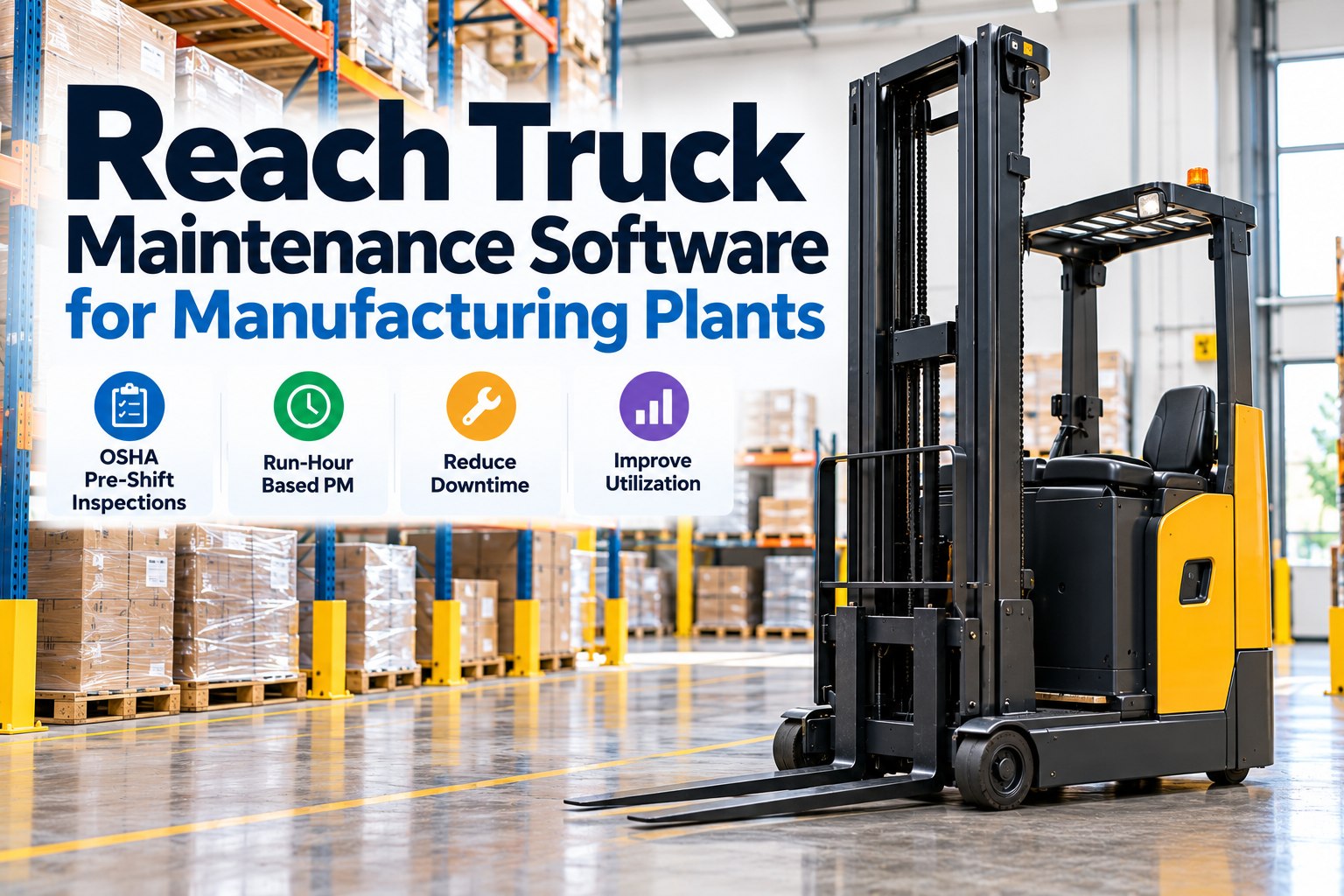
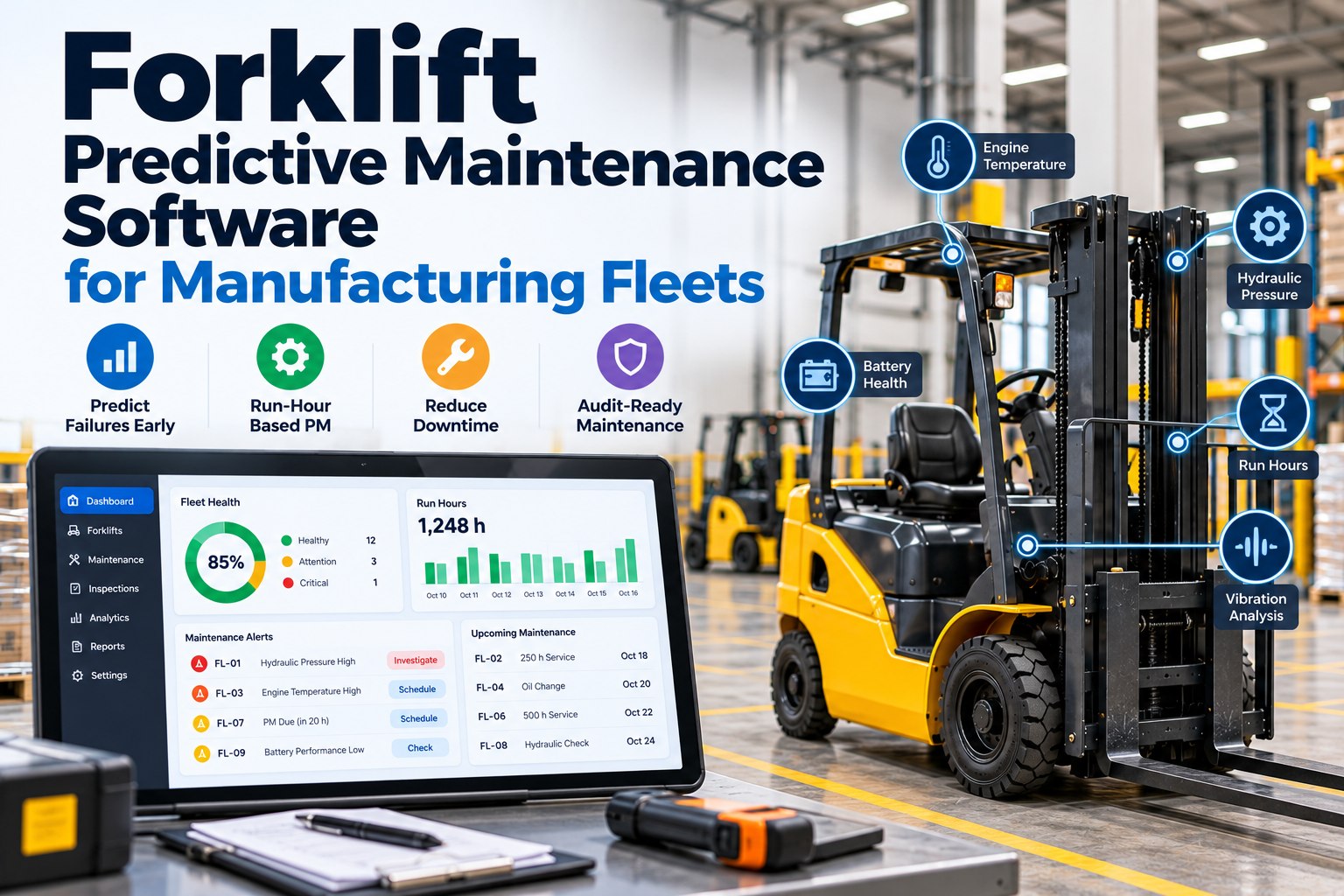
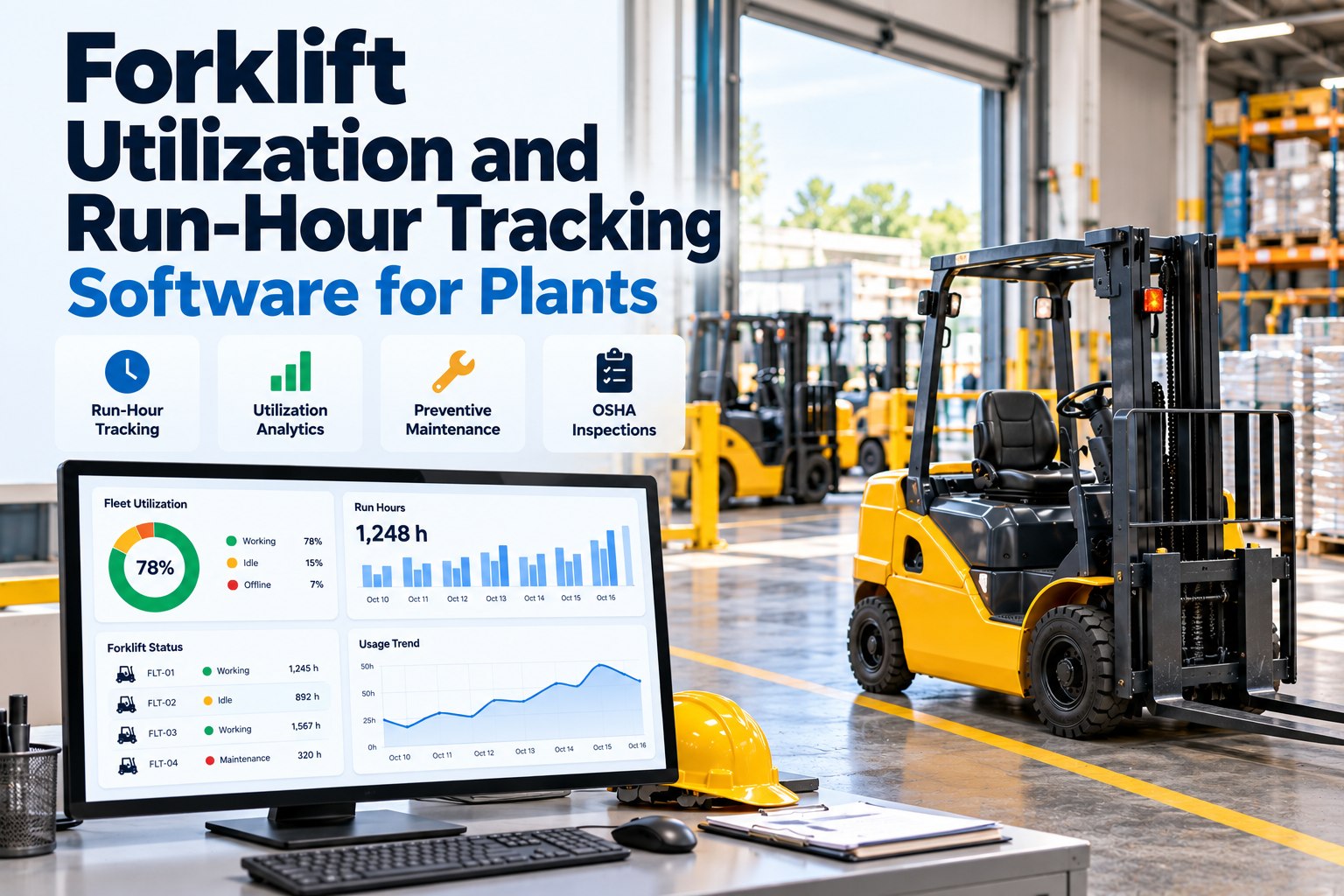
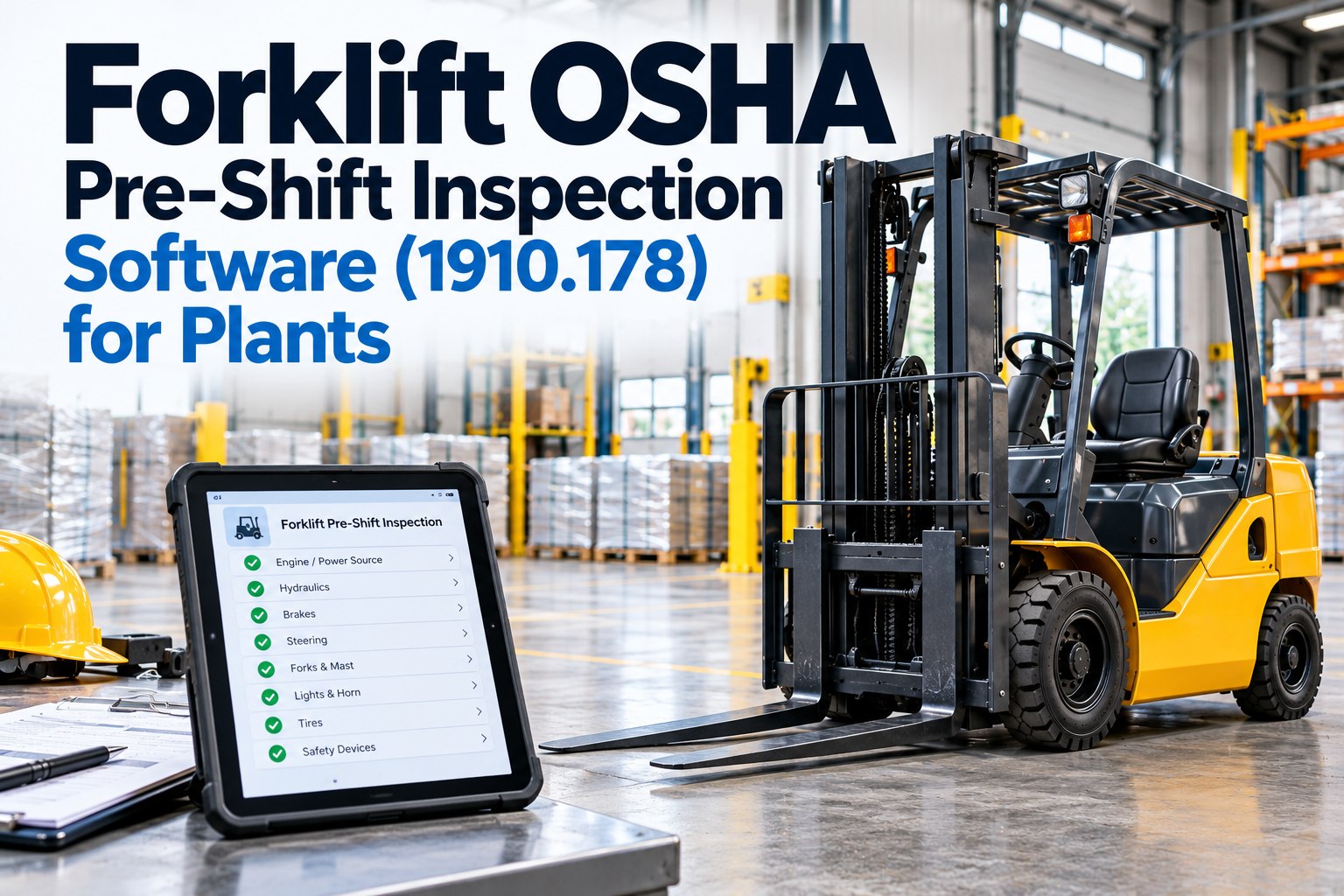
Reach truck preventive maintenance software should count two kinds of hours, not one. A reach truck that spends its shift travelling long aisles wears its drive unit and wheels. One that spends it putting pallets on the top rack wears its mast, chains, hydraulics and reach mechanism. OSHA's own sample electric truck checklist already asks operators to record both drive and hoist hour meters. This guide shows how to use each reading to schedule the right service, and how to keep the records 1910.178-ready. Book a 20-minute FleetRabbit demo to see drive and hoist hours scheduling PM on your trucks.
Manufacturing plants · Reach truck run-hour PM
Same truck, same shift, two very different kinds of wear. Your PM schedule should know which one it's counting.
For maintenance planners and shop leads scheduling electric reach trucks in plant stores, finished-goods racking and narrow aisles.
Drive hours
2,318 h
Drive unit, wheels, brakes, steering
Hoist hours
1,404 h
Mast, chains, hydraulics, reach mechanism
OSHA's Sample Electric Truck Checklist Already Asks for Two Hour Meters: Drive and Hoist
OSHA's training library includes a sample daily checklist for electric powered industrial trucks. Its record section asks for the truck and serial number, the shift, and readings from both the drive and hoist hour meters, alongside battery water and hydraulic oil added. Most plants copy the checks and skip the readings.
Daily record · electric truck
Based on OSHA's sample
Hour meter · drive
2,318.4
Hour meter · hoist
1,404.1
Fields modeled on OSHA's "Sample Daily Checklists for Powered Industrial Trucks." Industry guideline FEM 4.101 defines working time on electric trucks as time traction, pump or steering motors run, separate from key-on time.
Those two highlighted fields are the whole data feed for run-hour PM. Captured on a digital pre-shift inspection at every 1910.178(q)(7) examination, they cost the operator a few seconds. You can add both meters to your checklist free.
Split Reach Truck PM by Meter: What Runs on Drive Hours, What Runs on Hoist Hours, What Stays on the Calendar
Once both readings are recorded, each task can follow the meter that actually wears it. Your truck maker's manual sets the intervals; this is how the work divides.
Drive unit gearbox oil
Drive wheel and load wheels
Brakes and steering
Traction motor and controller checks
Lift chains: lube and elongation
Mast channels, rollers and shims
Hydraulic oil and filters
Reach mechanism pins and bushings
Tilt and sideshift
Battery watering and equalize, weekly
Specific gravity readings, monthly
Backstop for any low-use truck
Full annual service
Battery routine from battery maker guidance published in MHL News. Some trucks only display one combined meter; in that case use it for all hour-based work.
Two Reach Trucks, the Same Total Hours, Opposite Wear: Why a Single Meter Misleads
Put two identical reach trucks on different jobs for a week and the combined hours look the same. The split tells a different story.
RT-03 · put-away
Top-rack storage, short travel
RT-07 · line feed
Long aisles, low lifts
Both show about 40 working hours. RT-03 logged about two and a half times as many hoist hours, so its mast and chains are wearing much faster than RT-07's.
Illustrative week. Your readings will vary by job and truck.
On a single combined meter both trucks get the same service at the same time. With the split, RT-03's chain and hydraulic work comes forward and RT-07's drive unit and wheels get the attention. A walkthrough shows both meters driving one truck's schedule.
Schedule mast and hydraulic work on hoist hours, and drive work on drive hours, automatically
Start From the Manufacturer's Electric Truck Interval, Then Let Each Reach Truck's Hours Set the Date
Dealer guidance commonly puts electric lift trucks on planned maintenance about every 500 hours, with more frequent service in harsh conditions. Your reach truck's manual is the authority. Once the interval is set, the date for each truck is just its remaining hours divided by its hours per week.
Truck · next service
Hours left
Hours / week
Due in
RT-03 · hoist service
38 h
26 h
RT-07 · drive service
110 h
30 h
RT-05 · hoist service
240 h
18 h
RT-09 · any service
410 h
3 h
Interval guidance: Toyota Lift Northwest, "Planned Maintenance: What's in it for me?" Example rows are illustrative.
RT-09 shows why the calendar still matters: at three hours a week, its hour-based service is years away, but its battery, fluids and seals still age. Set a calendar limit on every preventive maintenance plan so low-use trucks aren't forgotten.
Keeping Reach Truck PM 1910.178-Ready: The Four Records That Prove Each Service Happened Properly
OSHA's powered industrial truck standard doesn't prescribe a PM interval, but several of its paragraphs touch every maintenance visit. Each one leaves a record you should be able to produce.
(q)(7)
Examined before service
The pre-shift check, with drive and hoist readings
(q)(1) · (p)(1)
Unsafe trucks parked
Out of service until repaired by authorized staff
(q)(5)
Equivalent parts
Chains, pins and filters equal to the original design
(a)(4)
Approved changes only
Cameras or attachments approved, plates changed to match
When parts used on each work order are tracked through parts and inventory, the (q)(5) record writes itself: part number, supplier and the truck it went on.
How FleetRabbit Schedules Reach Truck PM on Drive Hours, Hoist Hours and the Calendar
FleetRabbit reads both meters from each pre-shift check and keeps three clocks running for every reach truck.
Hoist service
38 h left · ≈ 1½ weeks
Drive service
225 h left · ≈ 16 weeks
Calendar backstop
Annual service in 7 months
Next work order: chain elongation, hydraulic filter, reach pin check
1910.178-ready pre-shift checks
Electric checklist plus reach items, with drive and hoist fields and sanity checks on readings
Two-meter run-hour PM
Each task follows drive or hoist hours, with a calendar backstop
Forecast by truck
Due dates calculated from each truck's own weekly hours
Audit-ready by default
Checks, readings, parts and sign-offs on one record per truck
What the 20-minute demo covers
Drive and hoist fields on your pre-shift check
Tasks assigned to the right meter
A due-date forecast for every reach truck
A low-use truck caught by the calendar backstop
Reach Truck Preventive Maintenance Scheduling: Questions Plants Ask
How often should a reach truck get preventive maintenance?
Follow the manufacturer. Dealer guidance commonly puts electric lift trucks around every 500 hours, with shorter intervals for harsh duty. Add a calendar limit for low-use trucks.
Should reach truck PM use drive hours or hoist hours?
Both, where the truck records them. Drive-related work follows drive hours, and mast, chain, hydraulic and reach work follows hoist hours.
Does OSHA require recording the hour meter?
No. OSHA requires the examination before use; its sample electric checklist includes drive and hoist hour meter fields as good practice.
What if our reach trucks only have one hour meter?
Use it for all hour-based tasks and note the truck's main job, so put-away trucks can get mast and chain checks a little earlier.
Is a 1910.178-ready PM program the same as OSHA compliance?
It means the records OSHA's paragraphs touch — examinations, out-of-service tags, parts and modifications — are complete and easy to produce. Compliance also depends on training and operation.
Can we start with a few reach trucks?
Give Every Reach Truck a PM Schedule That Counts the Wear It Actually Gets
Drive and hoist readings from every OSHA pre-shift check, tasks on the right meter, a calendar backstop and records ready for any review.
Free for up to 3 units · No credit card required
October 23, 2026
By Alex Rowan
All Posts