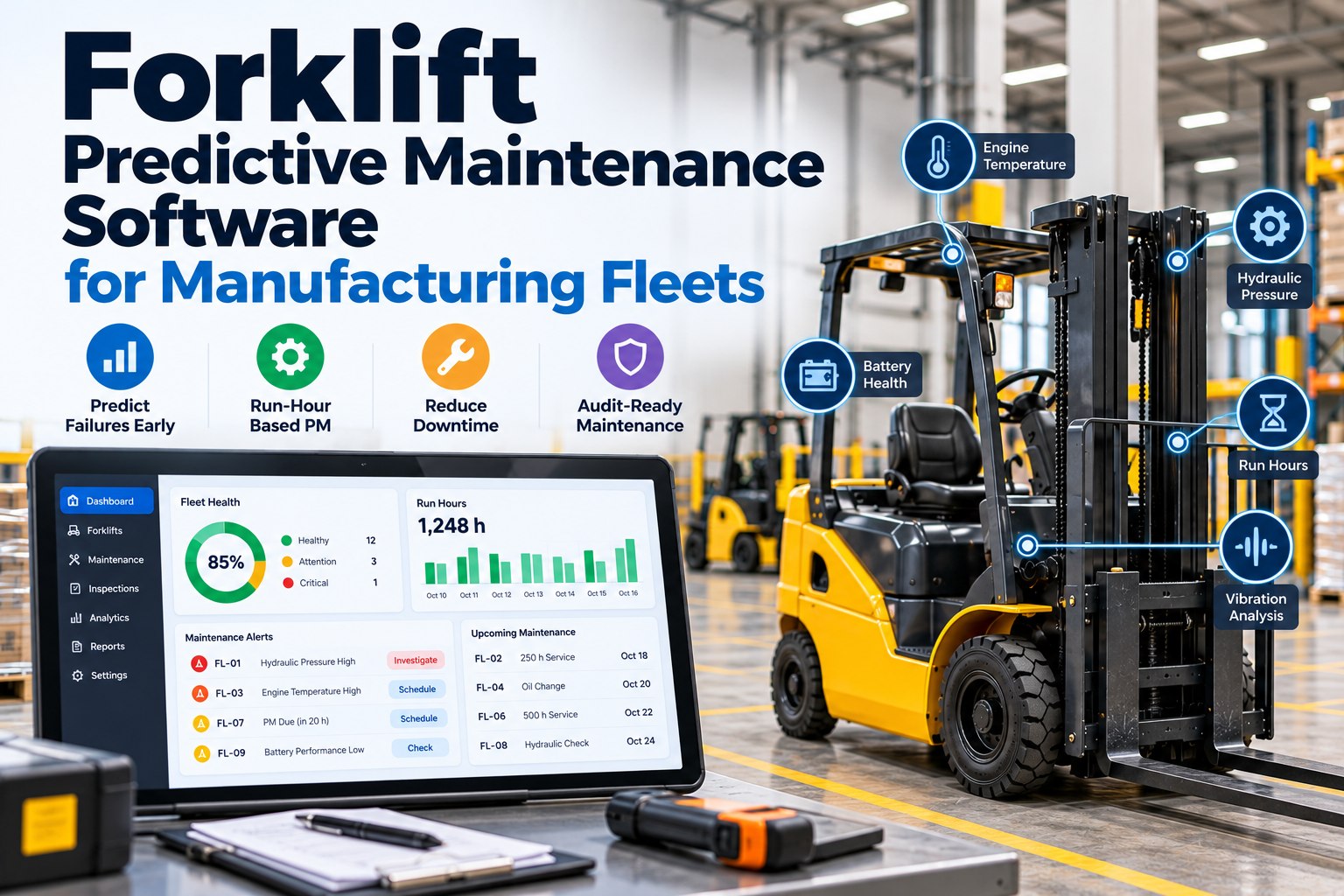
Forklift predictive maintenance software doesn't need a sensor on every mast. Most forklift failures give warning weeks ahead: a chain that stretches a little each month, a fork heel wearing toward its limit, one battery cell falling behind the rest, the same defect noted on three pre-shift checks in a row. The work is measuring those signals on a schedule, plotting them, and acting before they cross the line. This guide shows how to do it across a plant fleet. Book a 20-minute FleetRabbit demo to see wear trends on your own trucks.
Manufacturing plants · Predictive forklift maintenance
A forklift rarely fails without warning. The warning is usually just written on paper nobody plots.
For plant maintenance managers and reliability leads who want forklift repairs planned, not discovered.
The Warning Window Before a Forklift Failure: Where Each Signal Shows Up and How Much Time It Gives You
Reliability engineers call it the P-F interval: the time between the first point a failure can be detected and the moment the part actually fails. The earlier your signal sits on that line, the more time you have to plan the repair, order parts and book the truck into a quiet shift.
Measured wear
Chain gauge, fork caliper, battery hydrometer, oil sample
Usually weeks to months of warning
Trend in hours or defects
Hour meter climbing fast, the same item noted again and again
Often weeks
Felt or heard by the operator
Noise, drift, slow lift, soft brakes
Days
Breakdown
Truck stopped, tagged out of service
No warning left
Warning windows are general guidance; actual intervals depend on the component, duty and how often you measure.
The goal of predictive maintenance is simply to catch more failures in the first two columns. That starts with recording readings on the truck's own record every time someone takes them. You can start logging them free.
Five Forklift Wear Readings With Published Limits You Can Measure and Trend Today
Each of these readings has a known limit, a simple tool and a natural place in the PM routine. Recording the number, not just pass or fail, is what makes it predictive.
Lift chain elongation
Chain wear gauge
Replace above 3% stretch
Toyota Material Handling
Fork blade thickness
Fork caliper at the heel
Out of service at 90% of original
ASME B56.1
Battery specific gravity
Hydrometer, every cell
Monthly, after charge; compare cells
Douglas Battery via MHL News
Hydraulic oil condition
Oil sample to a lab
Trend wear metals and cleanliness
Your lab's limits
Tire wear
Wear line or tread depth
Replace at the maker's wear line
Tire manufacturer
FleetRabbit's guide to forklift oil and fluid analysis covers how to read lab reports. The rest of these readings take a few minutes during a scheduled preventive maintenance visit.
Plot the Readings and the Replacement Date Predicts Itself: A Lift Chain Wearing Toward 3%
A single chain reading of 2.4% tells you the chain passes. Five readings tell you when it won't. Here's an illustrative chain measured at each 250-hour service.
FL-04 · left lift chain elongation
Illustrative
≈2.8%
3,250 h · order chain
≈3.2%
3,500 h · past limit
Prediction
At about 0.4% per 250 hours, this chain crosses 3% before the 3,500-hour service. Replace it at 3,250 hours, with the chain ordered now.
The same logic works for fork thickness, tire wear and specific gravity: record the number at every visit and the trend gives you the date. Chains and forks can then be staged through parts and inventory before the truck comes in.
Record the number, not just pass or fail — and let every forklift's trend tell you when to order the part
Repeat Defects on the OSHA Pre-Shift Check Are the Cheapest Predictive Signal Your Plant Already Collects
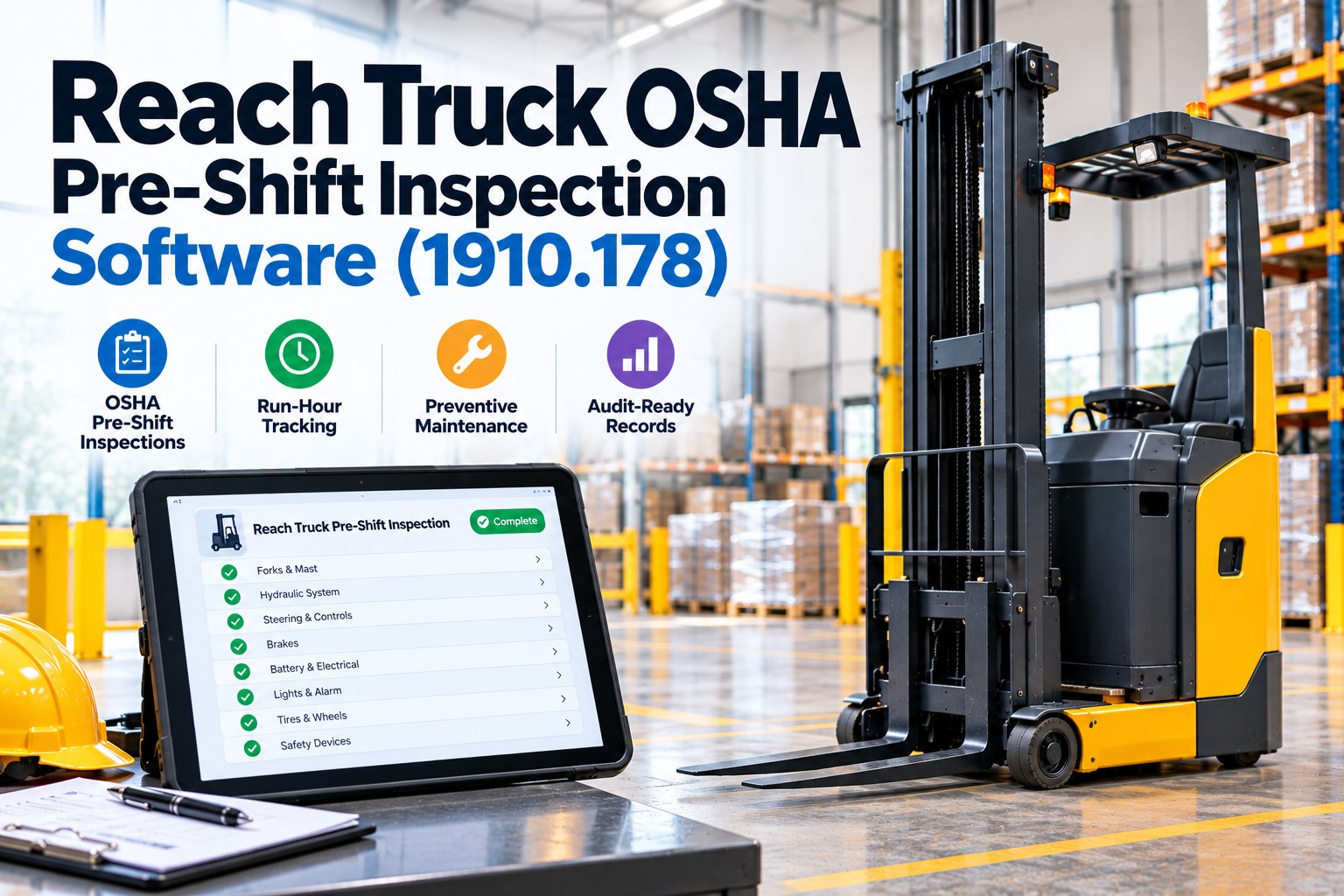
OSHA requires an examination before each forklift goes into service (29 CFR 1910.178(q)(7)). Most plants treat each check on its own. Read across two weeks, the same checks show which trucks are heading for trouble.
Truck
Two weeks of pre-shift checks
Signal
FL-04
Mast leak noted 3 times
FL-13
Brakes soft, then failed
FL-18
Checks missed on most days
FL-13's soft-brake notes were the warning; the failure came on day ten. With checks on a digital pre-shift inspection, a third repeat of the same item can open a work order automatically, instead of waiting for someone to notice the pattern.
One Lagging Cell Predicts an Electric Forklift Battery Problem Before Operators Notice Shorter Shifts
Battery maker guidance published in MHL News sets a simple routine for lead-acid forklift batteries: check water levels weekly and top off after charging, give an equalize charge weekly, and take a specific gravity reading on every cell with a hydrometer monthly, after charge. The monthly reading is the predictive one.
Monthly specific gravity, one 18-cell battery · illustrative
Cell 10 reads well below the rest after a full charge. Recheck after an equalize charge; if it stays low, the battery needs service before it starts cutting shifts short.
Routine from "Proper Care, Safety and Maintenance of Forklift Batteries," MHL News (Douglas Battery). Use your battery maker's specific gravity values.
Turning a Forklift Wear Signal Into Planned Work: Which Action Fits Which Reading
Predictive maintenance only pays off if each signal leads to a clear next step. A simple rule set keeps different technicians and shifts making the same call.
Well inside limit, flat trend
Keep measuring at each PM
Next scheduled service
Trend will cross limit before next PM
Order the part, book the repair into the current PM
This visit
Open a work order; inspect before next shift if safety-related
Within a day
Remove from service until repaired, per §1910.178(q)(1)
Now
How FleetRabbit Runs Forklift Predictive Maintenance on the Inspections and Readings You Already Take
FleetRabbit stores every reading as a number on the truck's record, plots it over time and turns patterns into scheduled work.
Left lift chain
2.4% · replace at next PM
Mast leak notes
3 in 10 days · work order open
Run hours
3,012 h · PM at 3,250
OSHA pre-shift inspections
Signed checks with photos; repeat defects flagged automatically
Measured readings
Chain, fork, tire and battery values stored as numbers, not ticks
Run-hour PM
Hour readings schedule the next service and the next measurement
Audit-ready by default
Every reading, decision and repair on one record per truck
What the 20-minute demo covers
1
Wear readings added to your PM checklists
2
A chain trend plotted across services
3
A repeat pre-shift defect opening a work order
4
Parts staged before the truck comes in
Forklift Predictive Maintenance Software: Questions From Plant Reliability Teams
Do we need sensors for forklift predictive maintenance?
No. Measured readings like chain stretch, fork thickness and battery specific gravity, plus repeat defects on pre-shift checks, predict many failures. Telematics and oil analysis add more signals when you have them.
When should a forklift lift chain be replaced?
Toyota Material Handling advises replacing a chain once elongation exceeds 3%, measured with a chain wear gauge for that chain's pitch.
When do forklift forks come out of service?
ASME B56.1 says a fork may not return to service once blade thickness has worn to 90% of the original.
How often should battery specific gravity be checked?
Battery maker guidance commonly calls for monthly hydrometer readings on all cells after a full charge, with weekly watering and equalize charges.
How is predictive different from preventive maintenance?
Preventive maintenance services a truck at fixed hours or dates. Predictive maintenance uses measured condition to decide when a specific part needs work, often during the preventive visits you already schedule.
Can we start on a few trucks?
See Every Forklift Failure Coming Weeks Before It Stops Your Line
Chain, fork, tire and battery readings trended on each truck, repeat pre-shift defects flagged, and parts ordered before the breakdown.
Free for up to 3 units · No credit card required
October 23, 2026
By Emily Parker
All Posts