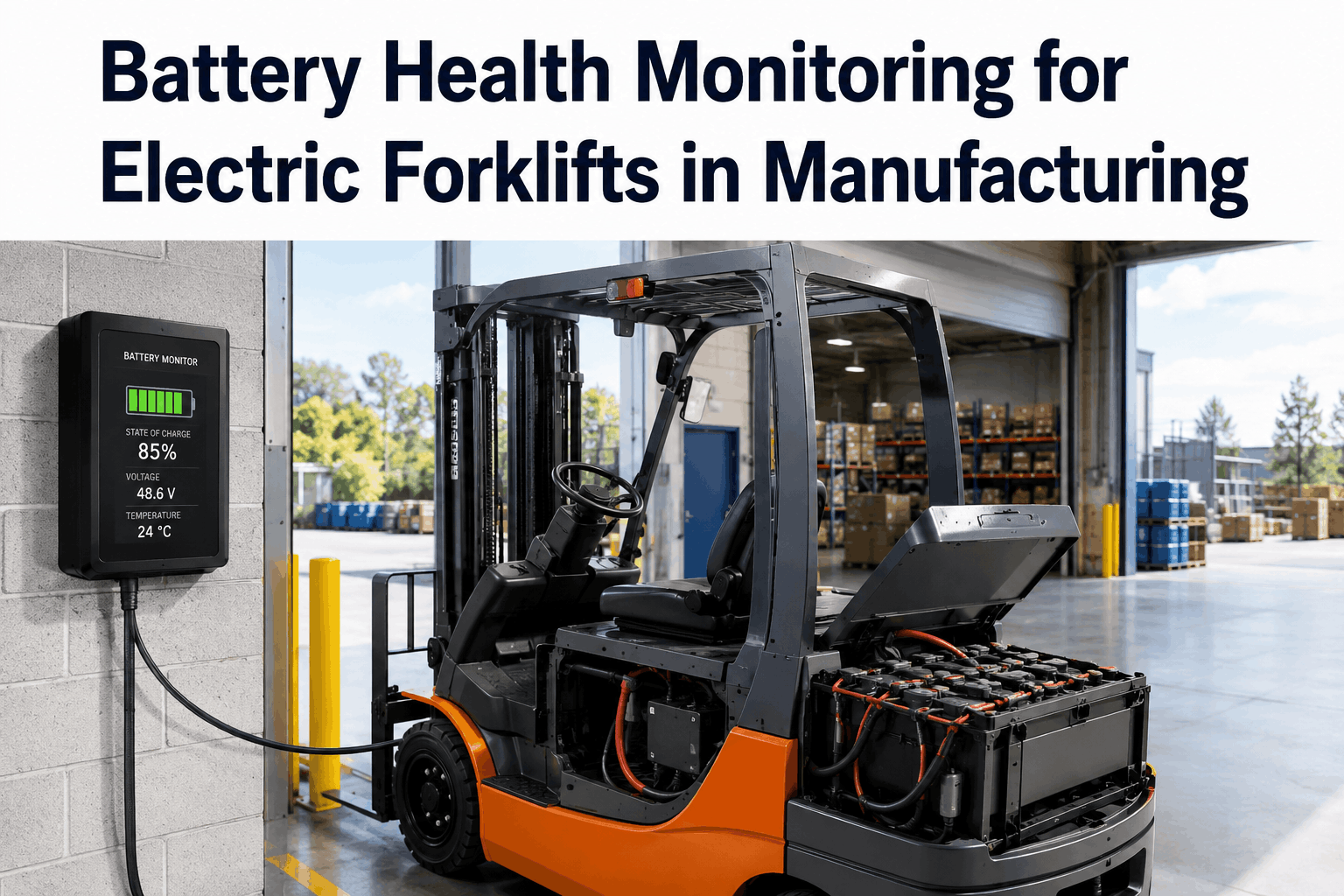
Battery Health Monitoring for Electric Forklifts in Manufacturing
When an electric forklift's battery drops to 15% state of charge at hour six of a ten-hour shift—and nobody notices until the mast slows, the operator reports sluggish response, and the vehicle is pulled mid-run—the cost isn't just the productivity gap. It's an unplanned opportunity charge that degrades cycle life, a load left stranded in a staging lane, and a maintenance team that had no warning because battery health was checked manually once a week during a scheduled inspection. Unmonitored battery degradation and untracked charge cycle data aren't maintenance oversights. They are the predictable consequence of managing electric forklift battery health the same way manufacturing facilities managed it in 2005: voltage checks, paper logs, and operator reports.
This guide gives manufacturing plant managers, warehouse fleet directors, and industrial EV maintenance teams a comprehensive framework for implementing automated battery health monitoring across electric forklift fleets. We cover real-time state-of-charge tracking, battery degradation analytics, predictive cell failure detection, charge cycle optimisation, and the connected IoT platform capabilities that extend battery lifespan, maximise forklift uptime, and eliminate the silent productivity drain of unmanaged industrial battery health. Manufacturing operations ready to protect their electric forklift investment can start their free trial today.
Electric Forklift Battery Health Reality 2026
The Hidden Cost of Unmanaged Industrial Battery Degradation
80%
of electric forklift battery failures occur in batteries that showed no manual inspection warning sign in the preceding 30-day service window
65%
of premature battery replacements in manufacturing fleets are caused by avoidable deep discharge events and suboptimal charge cycle management
75%
reduction in unplanned downtime events reported by electric forklift fleets using IoT battery monitoring and predictive health analytics
Source: Battery Council International, Industrial Truck Association Fleet Reports, and Manufacturing Logistics IQ Survey 2024–2025
The financial and operational stakes of unmonitored forklift battery health extend well beyond replacement cost. A single lead-acid battery pack for a Class I or Class II electric forklift ranges from $4,000 to $12,000. A lithium-ion pack for a high-throughput manufacturing application runs $15,000 to $40,000. When these batteries fail prematurely due to preventable degradation—deep discharge cycling, chronic opportunity charging without management, or thermal abuse that manual checks never detected—the replacement cost compounds with shift disruption, temporary vehicle shortfall, and the operational cost of managing unplanned downtime events that a real-time battery health monitoring system would have predicted weeks in advance.
The Electric Forklift Battery Health Gap: From Manual Check to Fleet Failure
Most manufacturing operations underestimate their battery health exposure because the degradation is invisible until a forklift underperforms or fails to complete its shift. State-of-charge readings taken at the start of each shift, battery voltage logged by a technician during weekly maintenance, and cell condition assessed by visual inspection at quarterly service intervals—these practices are standard across electric forklift fleets that haven't modernised their approach to industrial battery management.
Electric Forklift Battery Failure Pathway
From undetected cell degradation to fleet downtime and emergency replacement
01
Silent Cell Degradation
Individual battery cells degrade asymmetrically under load cycling; voltage divergence builds across cell groups while weekly manual checks record only aggregate pack voltage
02
Capacity Drift Undetected
Usable capacity drops 15–25% below nameplate; operators extend shifts to compensate; deep discharge events accelerate further degradation with no automated alert
03
Mid-Shift Performance Failure
Battery fails to sustain load during peak throughput window; vehicle pulled from service mid-shift; staging lanes disrupted; throughput target missed for the day
04
Emergency Replacement Cost
Battery declared end-of-life; emergency procurement cycle initiated; $8K–$40K replacement cost incurred 18–24 months before a managed replacement schedule would have required it
Automated battery health monitoring breaks this chain at step one. When every electric forklift has continuous IoT cell monitoring, every charge cycle is tracked and optimised, and degradation trend analytics generate predictive alerts weeks before capacity failure—battery health gaps become manageable scheduled events rather than emergency downtime accumulating toward your next production disruption. Book a Demo.
Manual Battery Management vs. IoT Forklift Monitoring Platform: The Operational Gap
The difference between manual battery checks and an intelligent electric forklift battery monitoring platform isn't a matter of frequency—it's a difference in what the operation can actually detect and act on. Manufacturing plants managing battery health on spreadsheets and weekly technician rounds are responding to failures they discover rather than preventing the degradation patterns that produce them.
Battery Management Approach Comparison
✗
Reactive / Manual Electric Forklift Battery Management
State-of-charge checked manually at shift start with no real-time depletion tracking
Cell voltage imbalance invisible until aggregate pack performance degrades visibly
Deep discharge events recorded after the fact—if recorded at all
Charge cycle counts managed from memory or paper logs per battery
Battery temperature spikes discovered at next manual inspection
Replacement decisions based on operator reports and technician intuition
No fleet-wide battery health benchmarking or degradation trend comparison
Reactive, Degraded & Downtime-Prone
✓
FleetRabbit IoT Battery Health Monitoring Platform
Continuous real-time state-of-charge with per-minute depletion rate and shift projection
Individual cell voltage monitoring with instant imbalance alerts before capacity impact
Deep discharge event detection with immediate alerts and automated charge scheduling
Full charge cycle history per battery with capacity trend analytics and EOL projection
Battery temperature monitoring with thermal spike alerts and cooling workflow triggers
Data-driven replacement scheduling based on actual measured capacity degradation curves
Fleet-wide battery health benchmarking identifying underperformers across all vehicles
Proactive, Protected & Uptime-Optimised
Digital battery health monitoring doesn't just close visibility gaps—it creates new operational capabilities that manual programmes cannot deliver. Per-cell voltage trend data reveals which battery packs are approaching imbalance thresholds before any measurable capacity loss occurs. Charge cycle analytics identify whether specific charging stations, shift patterns, or operators are accelerating degradation faster than fleet baseline. And comprehensive battery health records become a manufacturing operation's strongest evidence in any warranty claim, insurance assessment, or capital expenditure justification for planned battery replacement cycles.
Measured improvements from FleetRabbit battery health automation across electric forklift fleets
75%
Downtime Reduction
Unplanned Battery Events Year-on-Year
40%
Battery Life Extension
Managed vs. Unmanaged Cycle Programmes
$31K
Avg. Annual Savings
Per 10-Vehicle Electric Forklift Fleet
3.8x
Platform ROI
Battery Cost Avoidance Within 18 Months
Core Platform Capabilities: What Electric Forklift Battery Monitoring Must Deliver
Not all fleet management platforms include genuine industrial battery intelligence. Many offer basic vehicle tracking without cell-level monitoring, charge cycle analytics, or thermal event detection. Manufacturing operations evaluating battery health monitoring software must assess five core capabilities that separate proactive battery management platforms from digitised maintenance logs.
Five Core Electric Forklift Battery Monitoring Capabilities
Real-Time State-of-Charge Monitoring
Continuous per-minute state-of-charge tracking with shift-projection algorithms that calculate remaining runtime under current load conditions—alerting dispatch before a vehicle's battery will fail to complete its assigned route or work cycle.
Cell Voltage and Degradation Analytics
Individual cell group voltage monitoring with imbalance detection algorithms that identify diverging cells before pack-level capacity loss occurs—generating predictive replacement schedules based on actual measured degradation curves, not manufacturer calendar intervals.
Charge Cycle Optimisation and Scheduling
Full charge cycle history per battery pack with opportunity charge detection, partial cycle tracking, and automated scheduling recommendations that protect battery longevity—reducing deep discharge events by up to 80% across the fleet through proactive charge window management.
Thermal Event Detection and Battery Alerts
Battery temperature sensors detect thermal anomalies during charge and discharge cycles—generating industrial EV battery alerts when temperature exceeds safe operating parameters, triggering cooling workflows and preventing thermal runaway events that cause irreversible cell damage or safety incidents.
The ROI Equation: Manual Battery Management vs. IoT Forklift Monitoring
Investing in electric forklift battery health monitoring is frequently categorised as a maintenance overhead, but the financial reality of unmanaged industrial battery degradation tells a different story. Premature battery replacement, unplanned downtime, shift disruption, and the throughput loss from underperforming vehicles far exceed the platform investment within the first battery replacement event avoided.
ROI Calculator: IoT Monitoring vs. Manual Battery Management
Based on a mid-sized manufacturing fleet (10–40 electric forklifts, multi-shift operations)
Reactive / Manual Electric Forklift Battery Management
Premature battery replacement cost per pack$8K – $40K
Unplanned downtime per mid-shift failure event$3K – $12K / event
Throughput loss from underperforming batteries$18K – $60K / yr
Manual battery admin and technician inspection hours200+ hrs / $14K+ yr
Annual Risk Exposure: $43K – $126K+ per fleet
VS
FleetRabbit IoT Battery Health Monitoring Platform
Platform subscription (annual)$8K – $28K / yr
Sensor installation (one-time per vehicle)$3K – $9K
Manufacturing operations that implement IoT battery monitoring also benefit from improved maintenance scheduling accuracy as degradation curves replace guesswork; stronger warranty claim position through documented battery event histories; and reduced technician burden as automated alerts and digital health dashboards replace manual round-based inspection cycles. The financial case is decisive: reactive battery management costs multiples more than the platform that prevents it.
Stop Battery Degradation from Becoming Your Next Production Disruption
FleetRabbit delivers real-time state-of-charge tracking, cell-level degradation analytics, charge cycle optimisation, thermal event alerts, and predictive replacement scheduling—all connected to your electric forklift fleet operations. Schedule a consultation to see how IoT battery monitoring eliminates your unplanned downtime exposure.
Implementation: Building Electric Forklift Battery Health Maturity
Transitioning from manual battery checks to a fully automated IoT forklift battery monitoring system is a phased process that delivers measurable uptime improvements at each stage. Manufacturing operations that attempt to deploy every capability simultaneously often encounter adoption friction and data calibration challenges. A structured three-level approach consistently delivers 70–85% of projected downtime reduction within the first 90 days.
Electric Forklift Battery Monitoring Maturity Model
Start with the monitoring foundation: register every battery asset in the platform, install IoT sensors across the fleet, and activate state-of-charge dashboards so dispatchers can see real-time battery levels for every vehicle on a single screen. Then enable cell voltage alerts and deep discharge detection to surface degradation data your maintenance team has never had continuous access to. Finally, use accumulated health data to build predictive replacement schedules and charge cycle optimisation workflows that convert your battery management from a reactive cost centre into a proactive productivity asset.
Battery Health Monitoring Across Electric Forklift Classes and Battery Types
Modern industrial battery management doesn't stop at standard lead-acid counterbalance forklifts. The same platform that monitors cell voltage on a 48V wet cell pack should deliver health analytics for every battery chemistry and vehicle class in the fleet—lithium-ion, AGM, gel cell, and thin-plate pure lead batteries across Class I through Class III electric industrial trucks. A unified monitoring platform gives maintenance managers a single health dashboard for every battery asset, every vehicle class, and every shift pattern in the operation.
Battery Monitoring Across Electric Forklift Classes and Chemistries
One platform for every battery type and every electric vehicle class in your manufacturing fleet
Class I Counterbalance Riders
Class II Narrow Aisle Reach
Class III Walkie Pallet Trucks
Order Picker Platforms
Lead-Acid Flooded Cell
Lithium-Ion Packs
AGM and Gel Cell Batteries
Multi-Shift Swap Programmes
Cross-Chemistry Health Normalisation
Each battery's health thresholds, degradation benchmarks, and alert parameters are configured to its specific chemistry and manufacturer specifications—ensuring a lithium-ion pack is never managed against lead-acid discharge limits, and every battery is monitored against its actual design parameters.
Fleet-Wide Battery Health Dashboards
Maintenance managers see every vehicle's real-time state-of-charge, cell voltage balance, cycle count, and health score on a single industrial fleet battery analytics dashboard—without pulling individual battery logs or waiting for post-shift technician rounds to surface degradation warnings.
Replacement and Warranty Planning Pipeline
Fleet and maintenance managers see the 90-day battery replacement forecast across all vehicle classes—enabling proactive procurement planning, warranty claim preparation with documented health event histories, and capital expenditure scheduling aligned with actual measured battery end-of-life projections.
Connect every electric forklift battery to your manufacturing fleet monitoring platformGet Started →
Effective forklift battery life extension builds an operational culture that pays dividends far beyond maintenance cost reduction. When technicians know every battery's health is monitored continuously and replacement recommendations are data-driven rather than based on age alone, they develop more systematic pre-shift checks and charging discipline. When dispatchers have real-time state-of-charge dashboards, they assign vehicles to shifts with the confidence that no truck will run short mid-cycle. And when plant managers can see battery health scores across the entire fleet, they make capital investment decisions with measured degradation data rather than vendor replacement calendars. Book a Demo.
Give Your Electric Forklift Fleet the Battery Intelligence It Needs to Stay Productive
Join manufacturing operations using FleetRabbit to eliminate battery-related downtime, extend pack lifespan by up to 40%, and build the fleet battery intelligence that keeps electric forklifts running at full capacity every shift. Take the first step toward automated forklift battery health monitoring today.
How does IoT battery monitoring detect cell degradation before it affects forklift performance?
IoT sensors mounted on the battery pack continuously measure individual cell group voltages, pack temperature, charge and discharge current, and state-of-charge throughout every operating shift and charge cycle. Degradation detection algorithms compare each cell's voltage against pack average and historical baseline, identifying divergence patterns that precede capacity loss by 200–600 charge cycles in lead-acid batteries and 100–300 cycles in lithium-ion packs. When a cell group begins diverging from pack baseline—typically 30–60 millivolts in early-stage degradation—the platform generates a predictive maintenance alert flagging the battery for inspection and equalisation charging before the divergence affects usable capacity or causes a mid-shift failure. This early-stage detection window is entirely invisible to weekly manual voltage checks, which can only measure aggregate pack voltage and miss cell-level divergence until it has progressed to the point of visible capacity loss.
What charge management practices does the platform enforce to extend forklift battery lifespan?
The platform monitors and manages several charge behaviour patterns known to accelerate battery degradation. For lead-acid batteries, the system tracks opportunity charging events—partial charges during breaks that can cause stratification if not managed with periodic equalisation cycles—and schedules compensating equalisation charges automatically. Deep discharge events below 20% state-of-charge are detected in real time and generate immediate dispatch alerts to bring the vehicle in for charging before cell damage accumulates. For lithium-ion packs, the platform monitors charge rate, end-of-charge voltage, and resting temperature to prevent overcharge events. Across all chemistries, charge cycle counts are tracked per pack and compared against manufacturer degradation curves—generating replacement projections that allow procurement to be scheduled 8–12 weeks in advance rather than triggered by emergency failure.
How does the platform support multi-shift battery swap programmes in high-throughput manufacturing environments?
In operations running two or three shifts with battery swap programmes, the platform manages each battery pack as an independent tracked asset—separate from the vehicle it currently powers. Each pack has its own health profile, charge cycle history, and degradation status. When a battery is swapped, the platform records which pack is assigned to which vehicle and shift, enabling accurate attribution of degradation events to specific operating conditions rather than averaging health data across multiple vehicles. Swap scheduling can be automated based on state-of-charge thresholds: when a pack reaches a configurable discharge level, the platform alerts the operator and battery handler simultaneously, reducing the swap decision from a manual judgement call to a data-triggered workflow. Fleet managers can see the real-time status of every pack—in service, on charge, or on standby—from a single dashboard, enabling swap inventory to be managed with the same precision as vehicle scheduling.
Can battery health data be used to support warranty claims or insurance assessments?
Yes—and documented battery health history is one of the most practically valuable outputs of the platform for manufacturing operations managing significant battery asset values. When a battery fails within its warranty period, the platform provides a complete event history including charge cycle counts, discharge depth profiles, temperature excursions, and any detected cell anomalies—demonstrating that the failure was attributable to manufacturing defect or inherent cell degradation rather than operator misuse or charging programme deviation. This documented record substantially strengthens warranty claim submissions and reduces the rejection rate for premature failure claims. For insurance purposes, the same data package demonstrates proactive battery management to insurers assessing fire risk from lithium-ion thermal events, and provides a factual basis for asset valuation in the event of battery damage from facility incidents. All health records are stored per asset with full timestamp and export in PDF or structured data format.
How does fleet-wide battery benchmarking help manufacturing plant managers optimise their electric forklift investment?
Fleet-wide benchmarking compares the health score, degradation rate, charge efficiency, and remaining capacity of every battery pack across the operation—identifying which packs are performing above fleet average and which are deteriorating faster than expected for their age and cycle count. This comparison reveals actionable patterns: if a cohort of batteries on a specific shift is degrading 30% faster than fleet baseline, the analytics can correlate that pattern with charging station behaviour, operator deep discharge habits, or operating temperature conditions in a specific warehouse zone. Plant managers can then intervene at root cause—retraining operators, replacing a faulty charging station, or adjusting shift scheduling to reduce thermal exposure—rather than absorbing the cost of accelerated replacement without understanding why specific packs are underperforming. Over a 12-month data accumulation period, these insights typically reduce fleet-average degradation rate by 15–25% through targeted behavioural and infrastructure adjustments.