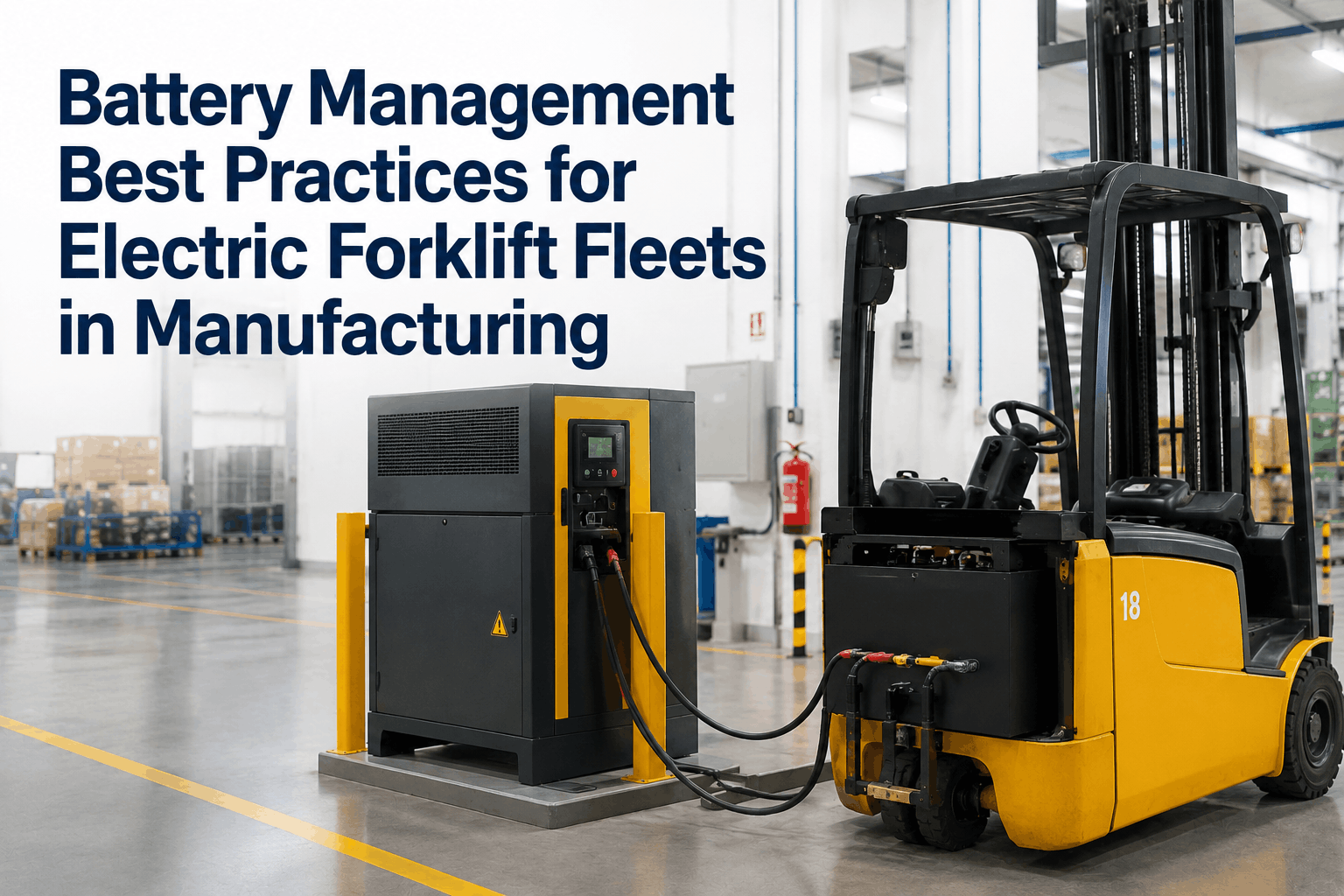
Battery Management Best Practices for Electric Forklift Fleets in Manufacturing
When an electric forklift's battery drops to 15% charge mid-shift and the operator keeps running it anyway — because your facility has no automated low-battery alert system and the shift supervisor is three bays over — the consequence isn't just an unplanned stoppage. It's accelerated battery degradation, a shortened cycle life, and a replacement cost that compounds silently across your entire fleet until your maintenance manager realises you're swapping batteries two years ahead of schedule. Depleted batteries, improper charging windows, and unmonitored thermal events aren't isolated equipment failures. They are the predictable consequence of managing electric forklift fleets the way warehouses managed lead-acid batteries in 2005: on instinct, paper logs, and end-of-shift guesswork.
This guide gives manufacturing plant managers, warehouse fleet directors, and industrial maintenance teams a comprehensive framework for implementing smart battery management across electric forklift and material handling fleets. We cover intelligent charging cycle optimisation, real-time battery health monitoring, thermal event detection, opportunity charging best practices, fleet-level power management, and the connected platform capabilities that extend battery life, reduce unplanned downtime, and build a measurable, data-driven electric fleet operation. Manufacturing operations ready to maximise their electric forklift investment can start their free trial today.
Electric Forklift Fleet Intelligence 2026
The Hidden Cost of Unmanaged Electric Forklift Battery Operations
80%
of premature electric forklift battery failures are attributable to improper charging practices, deep discharge events, and unmonitored thermal stress
60%
of manufacturing warehouses operating electric forklifts have no real-time battery state-of-health monitoring or charging cycle optimisation in place
70%
extension in average battery service life reported by electric forklift fleets using intelligent battery management and automated charge optimisation platforms
Source: Industrial Truck Association Battery Performance Report, Warehouse Technology Outlook, and Manufacturing Fleet Management Survey 2024–2025
The financial and operational stakes of poor electric forklift battery management extend far beyond the obvious replacement cost. A lithium-ion or lead-acid forklift battery running to protocol costs $8,000–$22,000 to replace. Multiply that by a fleet of 30 electric forklifts with batteries failing 18 months early due to mismanaged charging cycles, and the untracked cost becomes a six-figure maintenance line item that your finance team is attributing to normal fleet wear. Beyond replacement cost, unmanaged battery degradation creates unplanned downtime during peak production windows, unpredictable shift coverage gaps, and escalating maintenance labour that compounds across every vehicle in your electric material handling fleet.
The Electric Forklift Battery Failure Pathway: From Mismanaged Charge to Fleet Downtime
Most manufacturing operations underestimate their battery risk exposure because degradation is invisible until a battery fails mid-shift or a capacity drop makes a forklift operationally unreliable. Opportunistic charging disconnected at 30%, partial charges during short breaks, and deep discharge events that go unlogged — these patterns are standard operating procedure in fleets managing battery health by visual inspection and operator awareness rather than digital monitoring.
Electric Forklift Battery Degradation Pathway
From unmonitored charging practice to fleet downtime and premature replacement cost
01
Improper Charging Practice
Opportunity charging during 15-minute breaks, partial charges left incomplete, and deep discharges below 20% accumulate without any digital monitoring or operator alert workflow
02
Cell Degradation Builds
Battery state-of-health declines across cell groups; thermal events from incomplete equalization cycles go undetected; capacity loss accelerates without corrective intervention
03
Operational Unreliability
Battery capacity drops below functional threshold; forklifts fail mid-shift or underperform during peak production windows; operators report problems only when stoppage occurs
04
Early Replacement Cost
Battery replaced 18–24 months ahead of design life; fleet maintenance budget overrun attributed to "normal wear"; root cause management practice never addressed
Intelligent battery management breaks this chain at step one. When every forklift has continuous digital battery health monitoring, every charging cycle is optimised by platform intelligence, and thermal events trigger automated corrective workflows — degradation becomes a detectable and manageable variable rather than an invisible cost accumulating toward your next emergency battery replacement. Book a Demo.
Manual Battery Management vs. Digital Fleet Power Platform: The Operational Gap
The gap between manual battery management and an intelligent electric fleet power platform isn't a difference of degree — it's a difference in what the maintenance team can actually see and act on. Operations running on scheduled visual inspections and end-of-shift reports are managing battery health entirely in arrears, responding to failures they discover rather than preventing the conditions that produce them.
Electric Forklift Battery Management Approach Comparison
✗
Reactive / Manual Battery & Charging Management
Charging schedules set by operator habit — no cycle optimisation or depth-of-discharge control
Battery state-of-health assessed by visual inspection or end-of-shift report
Thermal events undiscovered until battery swells, smells, or fails completely
Deep discharge events unlogged and unaddressed until capacity drop becomes obvious
Fleet charging load unmanaged — peak demand spikes on grid incur excess energy cost
Replacement decisions based on operator complaint, not state-of-health data
No fleet-level battery performance benchmarking or preventive maintenance triggers
Reactive, Costly & Downtime-Prone
✓
FleetRabbit Digital Electric Fleet Battery Management
Automated charge cycle optimisation with configurable depth-of-discharge and top-off windows
Continuous real-time state-of-health monitoring with per-cell trend analytics
Instant thermal event alerts with automated fleet safety response workflow
Deep discharge events logged and flagged for immediate corrective action assignment
Smart fleet charging scheduling to flatten peak demand and reduce energy cost
Data-driven replacement forecasting with remaining useful life projections per battery
Fleet-wide battery health benchmarking with preventive maintenance trigger workflows
Proactive, Optimised & Downtime-Free
Digital battery management doesn't just prevent failures — it creates entirely new operational intelligence that reactive maintenance cannot deliver. State-of-health trend data by battery reveals which units need scheduled replacement before a mid-shift failure disrupts production. Fleet-level charging data identifies whether peak demand events occur during specific shift transitions — pointing to scheduling adjustments that reduce both energy cost and battery thermal stress. And comprehensive battery records become a facility's strongest asset in any insurance claim, equipment warranty dispute, or fleet investment justification.
Digital Electric Forklift Battery Management Platform: Performance Impact
Measured improvements from FleetRabbit battery intelligence across manufacturing electric forklift fleets
70%
Battery Life Extension
Average Service Life Year-on-Year
85%
Downtime Reduction
Mid-Shift Battery Failure Events
22%
Energy Cost Saving
Smart Charging Load Management
4.8x
Platform ROI
Battery Replacement Cost Avoidance
Core Platform Capabilities: What Electric Forklift Battery Management Must Deliver
Not all fleet management platforms include genuine battery intelligence for electric material handling equipment. Many offer basic telematics without charging cycle optimisation, state-of-health analytics, or thermal monitoring integration. Manufacturing operations evaluating electric forklift fleet management software must assess five core capabilities that separate proactive battery intelligence from digitised maintenance logs.
Five Core Electric Forklift Battery Management Capabilities
Intelligent Charge Cycle Optimisation
Automated charging protocols enforce optimal depth-of-discharge windows, prevent partial charges from interrupting equalization cycles, and schedule top-off charging during low-demand periods — extending battery service life without any manual schedule management.
Real-Time Battery Health Monitoring
Continuous state-of-health analytics track capacity, internal resistance, and cycle count per battery unit — generating remaining useful life projections that allow maintenance planners to schedule replacements during planned downtime rather than reacting to mid-shift failures.
Thermal Event Detection and Alerts
Temperature monitoring across battery packs with configurable thermal thresholds that trigger instant multi-channel alerts to maintenance and floor supervisors — enabling rapid intervention before a thermal event escalates to a safety incident or permanent cell damage.
Fleet Power Load Management
Smart fleet charging scheduling staggers charge cycles across the fleet to flatten peak demand events — reducing grid demand charges, lowering overall energy cost, and preventing simultaneous charging from causing voltage instability in facility electrical infrastructure.
The ROI Equation: Manual Battery Management vs. Digital Fleet Power Intelligence
Investment in electric forklift battery management software is frequently categorised as a maintenance overhead, but the financial reality of unmanaged battery degradation tells a different story. Premature battery replacement, unplanned production downtime, peak demand energy surcharges, and the maintenance labour cost of reactive battery management far exceed the platform investment within the first replacement cycle avoided.
ROI Calculator: Digital vs. Manual Electric Forklift Battery Management
Based on a mid-sized manufacturing facility (20–60 electric forklifts, multi-shift operations)
Reactive / Manual Battery Management
Early battery replacement (per unit, per event)$8K – $22K / unit
Production downtime from mid-shift failures annually$40K – $180K / yr
Peak demand energy surcharges from unmanaged charging$18K – $55K / yr
Reactive maintenance labour hours annually250+ hrs / $18K+ yr
Annual Risk Exposure: $76K – $275K+
VS
FleetRabbit Digital Battery Fleet Management
Platform subscription (annual)$12K – $42K / yr
Implementation & onboarding (one-time)$4K – $12K
Battery replacement cost (70% life extension)Significantly Reduced
Energy cost (22% peak demand reduction)Measurably Lower
Annual Investment: $16K – $54K
Electric forklift operations that implement digital battery management workflows also benefit from improved equipment insurance premiums as incident frequency declines; stronger vendor warranty positions through documented charging compliance records; and reduced maintenance supervisor burden as automated alerts and predictive replacement workflows replace reactive call-outs. The financial argument is decisive: reactive battery management costs multiples more than the platform that prevents it.
Stop Battery Degradation from Becoming Your Next Production Stoppage
FleetRabbit delivers automated charge cycle optimisation, real-time battery health monitoring, thermal event detection, and fleet power load management — all connected to your electric forklift operations. Schedule a consultation to see how intelligent battery management eliminates your replacement cost exposure and maximises every battery's service life.
Implementation: Building Electric Forklift Battery Management Maturity
Transitioning from manual battery inspection and informal charging practice to a fully digital electric forklift power management system is a phased process that delivers measurable performance improvements at each stage. Operations that attempt to deploy every capability simultaneously often struggle with operator adoption and infrastructure integration. A structured three-level approach consistently delivers 80–90% of projected battery life extension within the first 120 days.
Electric Forklift Battery Management Maturity Model
Remaining Useful Life ForecastingReplacement Budget Planning WorkflowsFleet-Level Battery BenchmarkingEnergy Cost Analytics and Reporting
Start with the fleet visibility foundation: register every forklift and battery asset, activate telematics and sensor integration, and establish the baseline state-of-health profile for every battery in your fleet so maintenance planners have real data for the first time. Then enable charge optimisation protocols and alert workflows to surface the deep discharge events and thermal patterns your team has never had visibility into. Finally, use accumulated battery data to build predictive replacement forecasts and energy cost analytics that convert your battery management from a reactive maintenance cost into a planned, optimised capital asset programme. Book a Demo.
Battery Management Best Practices Across Electric Forklift and Equipment Classes
Modern electric forklift battery management doesn't stop at standard counterbalance forklifts. The same platform that optimises lead-acid charge cycles should manage battery health and power monitoring for every electric material handling vehicle in the fleet — reach trucks, order pickers, pallet jacks, tow tractors, and AGVs. A unified battery management platform gives fleet managers a single performance dashboard for every vehicle, every battery chemistry, and every charge cycle across the operation.
Battery Management Across Electric Material Handling Equipment Classes
One platform for every electric vehicle and every battery chemistry in your industrial fleet
Counterbalance Forklifts
Reach Trucks
Order Pickers
Pallet Jacks
Tow Tractors
Automated Guided Vehicles
Straddle Carriers
Mobile Elevated Platforms
Cross-Chemistry Battery Compatibility Matrix
Each vehicle's battery chemistry — lead-acid, lithium-ion, or gel — is stored in a unified compliance profile that applies chemistry-specific charge protocols, depth-of-discharge limits, and thermal thresholds automatically. A lithium-ion battery is never subjected to lead-acid equalization cycles, and a gel battery never receives a fast-charge profile unsuited to its cell chemistry.
Fleet-Level Battery Health Dashboards
Maintenance managers see every vehicle's real-time state-of-charge, state-of-health trend, thermal status, and remaining useful life projection on a single fleet power management dashboard — without pulling individual battery logs or waiting for end-of-shift reports to surface degradation that has been building for weeks.
Planned Replacement and Maintenance Pipeline
Fleet and maintenance managers see the upcoming 90-day battery replacement forecast and scheduled equalization calendar across all equipment classes — enabling proactive capital planning during scheduled maintenance windows rather than emergency procurement when a battery fails mid-production shift.
Connect every electric forklift to your fleet battery management platformGet Started →
Effective electric forklift battery management builds an operational culture that pays dividends far beyond equipment longevity. When operators know their charging behaviour is monitored and corrective workflows are data-driven rather than arbitrary, they develop more consistent opportunity charging habits and deeper respect for equipment care protocols. When maintenance supervisors have real-time battery health dashboards, they conduct more effective pre-shift equipment briefings. And when fleet directors can see state-of-health trends by equipment cohort, they make capital replacement decisions with evidence rather than estimation. Book a Demo.
Give Your Electric Forklift Fleet the Battery Intelligence It Needs to Perform
Join manufacturing operations using FleetRabbit to eliminate premature battery replacement, reduce production downtime from mid-shift failures, and build the electric fleet management intelligence that keeps every forklift running at full capacity — every shift, every cycle, every charge. Take the first step toward intelligent battery management today.
What are the most damaging battery management practices for electric forklifts in manufacturing environments?
The three most damaging practices are deep discharge below 20% state-of-charge, partial opportunity charging that interrupts equalization cycles, and operating batteries in high-ambient-temperature environments without thermal monitoring. Deep discharge creates irreversible capacity loss in both lead-acid and lithium-ion chemistries — each deep discharge event below the design threshold permanently reduces a battery's effective capacity. Partial opportunity charging during short breaks accumulates sulphation in lead-acid batteries when equalization cycles are never completed, creating internal resistance that accelerates capacity decline. High-temperature operation without monitoring allows thermal stress to compound across cell groups without intervention. The platform addresses all three by enforcing minimum discharge thresholds, managing equalization cycle completion, and triggering thermal alerts before cell damage accumulates. Manufacturing operations typically see 60–80% of their battery life extension benefit from eliminating these three practices alone.
How does the platform differentiate between lead-acid, lithium-ion, and gel battery management protocols?
Each battery chemistry has a distinct optimal management profile stored in the platform as a chemistry-specific protocol template. Lead-acid batteries require equalization charging every 5–10 cycles, have a recommended discharge depth of 20–80% state-of-charge, and must complete full charge cycles before equalization is interrupted — the platform enforces these requirements automatically and flags any operator-initiated early disconnection. Lithium-ion batteries operate most effectively between 20–90% state-of-charge, do not require equalization cycles, and respond poorly to heat during charging — the platform applies tighter thermal thresholds and manages top-off charging to stay below the heat-generating upper charge zone. Gel batteries share lead-acid chemistry constraints but require lower charge voltage profiles to prevent gas generation — the platform applies gel-specific charge voltage limits automatically. When a new battery is registered, the assigned chemistry template activates the correct protocol across all monitoring, alerting, and charging schedule functions without any manual configuration required from the maintenance team.
How does smart fleet charging load management reduce energy costs in manufacturing facilities?
Most manufacturing facilities are billed on peak demand tariffs where the highest 15-minute power draw during a billing period sets the demand charge for that month — meaning a simultaneous charge event across 20 forklifts at shift change can drive a demand spike that costs thousands in monthly surcharges regardless of how efficiently power is used the rest of the time. The platform addresses this by staggering fleet charge cycles across available charging windows — prioritising units with the lowest state-of-charge, deferring full-charge units to off-peak periods, and distributing charging load across the shift gap to flatten the demand curve. The charge scheduling algorithm is configurable by shift pattern, charger capacity, and time-of-use tariff schedule — allowing it to optimise simultaneously for battery health (avoiding simultaneous thermal loading), energy cost (avoiding peak demand spikes), and operational readiness (ensuring priority vehicles are fully charged for the next shift). Facilities typically see 18–25% reductions in energy cost from demand charge elimination alone, independent of the battery replacement savings.
How does remaining useful life forecasting work and how accurate are the projections?
Remaining useful life projections are generated from a continuously updated model that combines four data streams for each battery: accumulated cycle count against design-rated cycle life; state-of-health trend (capacity as a percentage of original rated capacity, measured at each full charge-discharge cycle); internal resistance trend (rising resistance indicates sulphation or cell degradation); and thermal event history (each exceedance of safe operating temperature reduces projected remaining life proportionally). The model produces a remaining useful life estimate expressed in months to predicted end-of-service-life (defined as the point where capacity drops below 80% of original rated capacity) and updates it after every full cycle. Accuracy typically falls within ±15% at 12 months from predicted end-of-life and improves to ±8% within 6 months — sufficient for maintenance planning teams to schedule procurement, budget replacements in quarterly capital planning cycles, and coordinate with suppliers for scheduled delivery rather than emergency orders. The projection dashboard shows each battery's remaining life alongside its replacement procurement lead time so maintenance managers can initiate orders at the optimal point in the degradation curve.
Can the platform support multi-site manufacturing operations with electric forklift fleets across different facilities?
Yes — multi-site fleet management is a core design requirement for manufacturing groups operating electric forklift fleets across production plants, distribution centres, and fulfilment facilities. Each facility has its own independently configured battery management profiles, charge scheduling calendar, thermal alert thresholds, and maintenance documentation workflow. Fleet directors and maintenance managers with network-level access see a consolidated view of battery health status, charge cycle performance, and upcoming replacement forecasts across all facilities from a single dashboard — enabling network-level capital planning, cross-site battery pool management, and identification of facilities where charging practices are driving accelerated degradation compared to the network average. Individual site managers see only their facility's fleet data. Cross-site battery performance benchmarking is available as a reporting module — compiling state-of-health trends, energy consumption, and downtime events across all sites into a structured management report for quarterly fleet review.