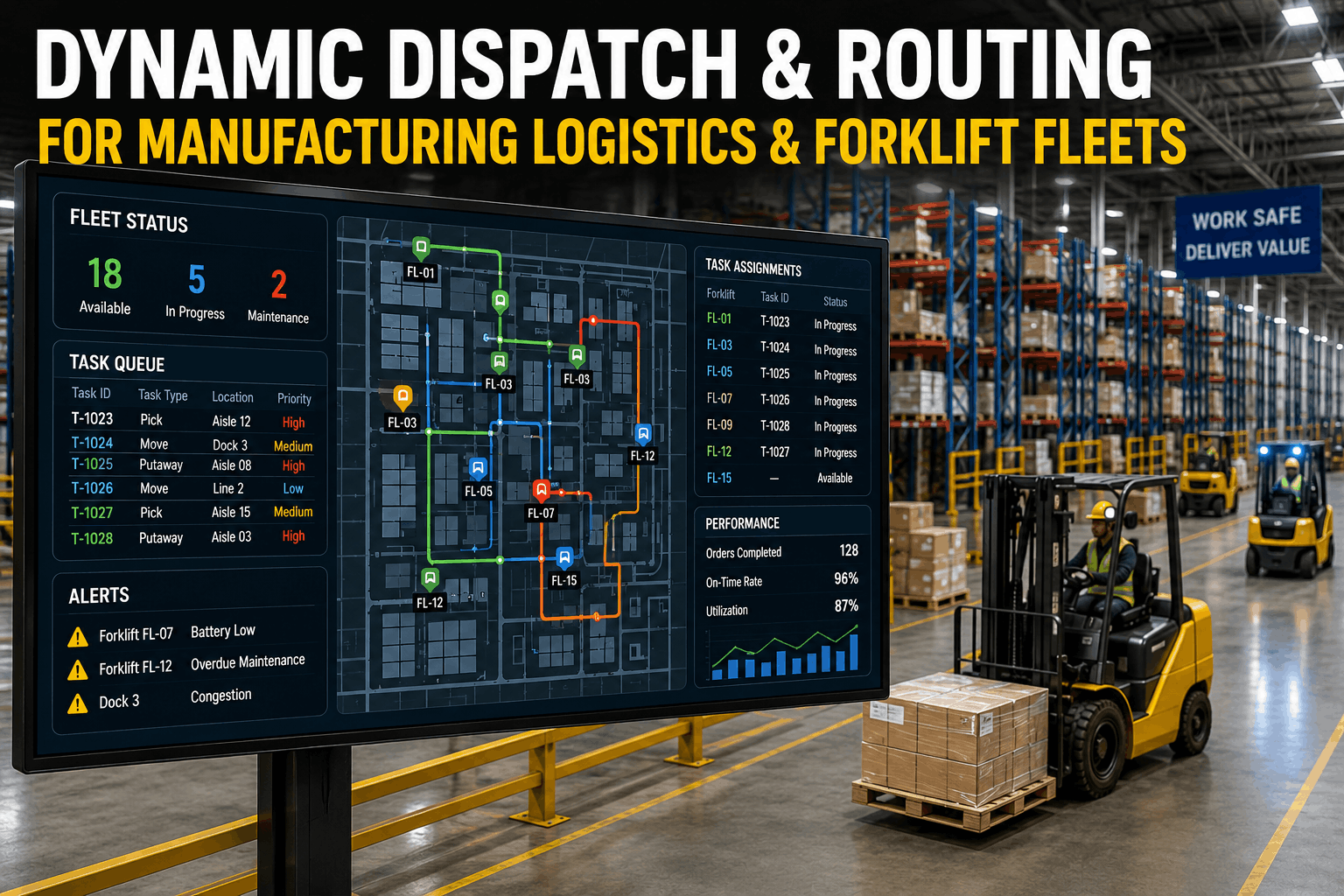
Manufacturing logistics is not a warehouse problem or a transportation problem — it is a coordination problem. When a production line needs a pallet of components from the staging area and three forklifts are available but none of them are dispatched because the dispatcher is working from a whiteboard and a radio, the line waits. When an inter-facility delivery truck sits idle at a dock for forty minutes because the routing software doesn't know the dock is occupied, the schedule slips. When a forklift operator drives the long route around the facility every single cycle because nobody has updated the routing logic since the plant expansion two years ago, the inefficiency is invisible — until someone does the math and discovers it costs the operation four hundred hours of productive time every quarter. Dynamic dispatch and intelligent routing transforms manufacturing logistics from a manual coordination exercise into a data-driven operation where every asset is assigned the right task, the right route, and the right priority — automatically, in real time. Start your free FleetRabbit trial today or book a dispatch and routing demo with our team.
FleetRabbit Dispatch & Routing
Dynamic Dispatch & Routing for Manufacturing Logistics & Forklift Fleets
Intelligent task assignment, geofence-triggered dispatch, and route optimization that eliminates inter-facility delays, reduces empty travel time, and gives plant managers real-time visibility into every asset across the operation floor.
28%Avg. Travel Time Reduction
Real-TimeGeofence-Triggered Dispatch
ZeroManual Route Assignments
100%Asset Visibility Across Facilities
Why Manufacturing Dispatch Fails — and How to Fix It
The gap between a task being created and an asset being dispatched is where manufacturing logistics loses hours every shift. Dispatch managers working from radios, whiteboards, and manual spreadsheets cannot simultaneously track which forklifts are idle, which delivery trucks are closest to the next pickup, which docks are available, and which inter-facility runs are overdue. The result is a system that relies on individual knowledge, institutional memory, and supervisor experience rather than real-time data. When a dispatcher leaves the shift, their awareness of the operation leaves with them. FleetRabbit's dynamic dispatch architecture replaces that institutional knowledge dependency with automated, data-driven task assignment and route optimization that works the same at 2 AM on a weekend as it does at peak shift on a Tuesday.
01
Manual Task Assignment Delays
When a production line signals a material need, a dispatcher manually identifies an available forklift, contacts the operator by radio, and relays the pickup and drop location verbally. This process takes 3–8 minutes per task, adds up to 40+ tasks per shift, and creates miscommunication errors that send operators to wrong locations. FleetRabbit's automated dispatch assigns tasks directly to the nearest qualified asset in under 30 seconds — no radio calls, no whiteboard updates, no dispatcher dependency.
02
Empty Travel & Inefficient Routing
Forklifts and yard trucks traveling empty between task assignments represent pure cost with zero output. In plants without route optimization, operators habitually take the same paths regardless of congestion, dock availability, or shorter alternatives created by facility layout changes. FleetRabbit's routing engine continuously updates travel paths based on real-time facility status — dock occupancy, aisle blockages, and task queue density — reducing empty travel time by up to 28% per shift.
03
No Geofence-Based Automation
Without geofencing, inter-facility handoffs require manual coordination at every stage: the driver must call ahead, the receiving dock must be manually cleared, and the next task must be manually assigned after arrival is confirmed. FleetRabbit geofences automatically trigger downstream actions the moment an asset crosses a zone boundary — dock preparation, next-task assignment, and delivery confirmation — eliminating the coordination overhead that accumulates to hours of delay per day.
04
Zero Cross-Facility Visibility
Plants with multiple buildings, outdoor storage, and inter-facility shuttle routes often have no unified view of asset locations across the full operation. A truck that left Building A for Building C fifteen minutes ago may be sitting at a gate with a paperwork issue — and nobody knows until the next call. FleetRabbit provides a unified real-time map across all facility zones with asset status, location, task assignment, and ETA visible to every authorized user simultaneously.
FleetRabbit Dispatch & Routing Capabilities
FleetRabbit connects task management, asset telematics, facility geofencing, and route optimization into a single dispatch platform that manufacturing logistics teams can operate without IT support or complicated configuration. Here is what the system handles across your plant and inter-facility operations:
Intelligent Nearest-Asset Dispatch
When a task is created — whether from a production line trigger, a WMS work order, or a supervisor request — FleetRabbit automatically identifies the nearest qualified available asset and assigns the task directly to the operator's mobile device. Assignment considers asset type, operator certification, current task queue depth, and zone proximity — not just raw distance. Task details appear on the operator's device with navigation, eliminating radio dependency entirely.
Geofence-Triggered Workflow Automation
FleetRabbit geofences defined around facility zones — production cells, staging areas, docks, gates, and inter-facility corridors — automatically execute workflow actions when assets cross boundaries. A forklift entering the receiving zone triggers a dock availability check and next-task pre-assignment. A delivery truck exiting the outbound gate triggers shipment confirmation and return-trip task generation. The manual coordination that currently consumes dispatcher time is replaced by automated event-driven logic.
Dynamic Route Optimisation
FleetRabbit's routing engine continuously recalculates optimal paths within the plant and between facilities based on live data: dock occupancy status, aisle blockage flags from operator reports, task queue clustering that enables multi-stop efficiency on a single forklift trip, and historical travel time data by zone and shift. Routes are pushed to operator devices in real time — when a dock becomes blocked, the system reroutes automatically without dispatcher intervention.
Inter-Facility Delivery Scheduling
For multi-building plants and facilities with shuttle routes between production and distribution, FleetRabbit manages the full inter-facility delivery schedule: departure windows, receiving dock pre-notification, load verification at handoff, and return-trip consolidation. The system identifies opportunities to consolidate inter-facility runs that are currently made as separate trips, reducing vehicle movements and fuel consumption while maintaining delivery window commitments across all production areas.
FleetRabbit Dispatch Intelligence
Connect Your Task Queue to Real-Time Asset Location — Automate Dispatch and Eliminate Coordination Delays
FleetRabbit's dispatch platform connects WMS work orders, production line triggers, and supervisor tasks directly to your asset telematics — automatically assigning, routing, and tracking every forklift and delivery truck across your facility with zero manual dispatcher input for routine operations.
From the Operations Floor
"Before FleetRabbit, dispatch at our plant was a radio-and-whiteboard operation. We had twelve forklifts, three inter-facility trucks, and a dispatcher who was genuinely talented — but she was the single point of failure for the entire logistics operation. When she was on break or absent, the floor coordination fell apart. When we implemented FleetRabbit's dynamic dispatch, the first thing that changed was task assignment time. What took 4–6 minutes of radio back-and-forth dropped to under 30 seconds of automated assignment directly to the operator's device. The second thing that changed was our inter-facility run count. The system identified that we were making 22 inter-facility shuttle trips per day that could be consolidated to 14 with smarter load sequencing — that's eight fewer vehicle movements per day, every day. Within three months, our fork travel distance per shift dropped by 24% and our on-time internal delivery rate went from 71% to 94%."
Plant Operations Manager
·
Tier 2 Automotive Supplier — 15 Assets — FleetRabbit Dispatch Active
Frequently Asked Questions
QHow does FleetRabbit's dispatch system integrate with our existing WMS or ERP?
FleetRabbit connects to WMS platforms and ERP systems via API integration, receiving work orders, production call-offs, and task triggers directly from your existing systems rather than requiring manual re-entry. When a WMS generates a pick task or a production system creates a material replenishment request, FleetRabbit receives the task automatically, assigns it to the nearest qualified asset, and updates task status back to the source system on completion. For SAP, Oracle, and leading WMS platforms, pre-built connectors reduce integration time to days rather than weeks. For custom systems, FleetRabbit's open API accepts task creation webhooks in standard formats without requiring system-wide integration.
QHow are geofences set up for plant facilities with complex layouts?
FleetRabbit geofences are drawn directly on a facility map upload using a browser-based configuration tool — no GIS expertise required. Plant managers or IT administrators draw zone boundaries around production cells, dock areas, staging zones, outdoor storage, and inter-facility corridors, then configure the automated actions triggered by entry and exit events for each zone. Complex multi-building facilities can have unlimited geofence zones with independent trigger logic. Initial geofence configuration for a typical manufacturing facility takes 2–4 hours and can be adjusted in real time as facility layouts change without requiring vendor support.
QCan the system manage both indoor forklift dispatch and outdoor/inter-facility truck routing?
Yes. FleetRabbit handles both asset classes on a unified platform. Indoor forklift dispatch operates via plant Wi-Fi or Bluetooth beacon positioning (where GPS signal is unavailable inside buildings) for location accuracy within 2–5 metres. Outdoor yard trucks and inter-facility delivery vehicles use GPS telematics for precise location tracking between buildings and facilities. The unified dispatch dashboard shows all asset types on a single operational view — dispatchers can assign and monitor indoor forklifts and outdoor trucks simultaneously without switching systems or views.
QWhat happens when an operator rejects or cannot complete an assigned task?
Operators can flag tasks as blocked, report completion issues, or request reassignment directly from their mobile device. When a task is flagged, FleetRabbit immediately reassigns it to the next best available asset and notifies the supervisor with the reason code. Blocked tasks that exceed a configurable time threshold automatically escalate to supervisor review with a complete audit trail showing assignment history, operator response, and time elapsed. This creates accountability for task completion without requiring radio follow-up from dispatchers, and generates the operational data needed to identify recurring blockage patterns by zone, task type, or time of shift.
FleetRabbit Dispatch Intelligence
Automate Your Plant Dispatch — Faster Assignments, Smarter Routes, Full Visibility.
FleetRabbit's dynamic dispatch and routing platform eliminates radio-based coordination, automates inter-facility delivery scheduling, and gives every plant stakeholder real-time visibility into asset location and task status — transforming manufacturing logistics from a dispatcher-dependent operation into a data-driven, self-optimizing system.
Auto-Dispatch
Geofencing
Route Optimisation
Inter-Facility Scheduling
WMS Integration
May 21, 2026
By Taylor
All Posts