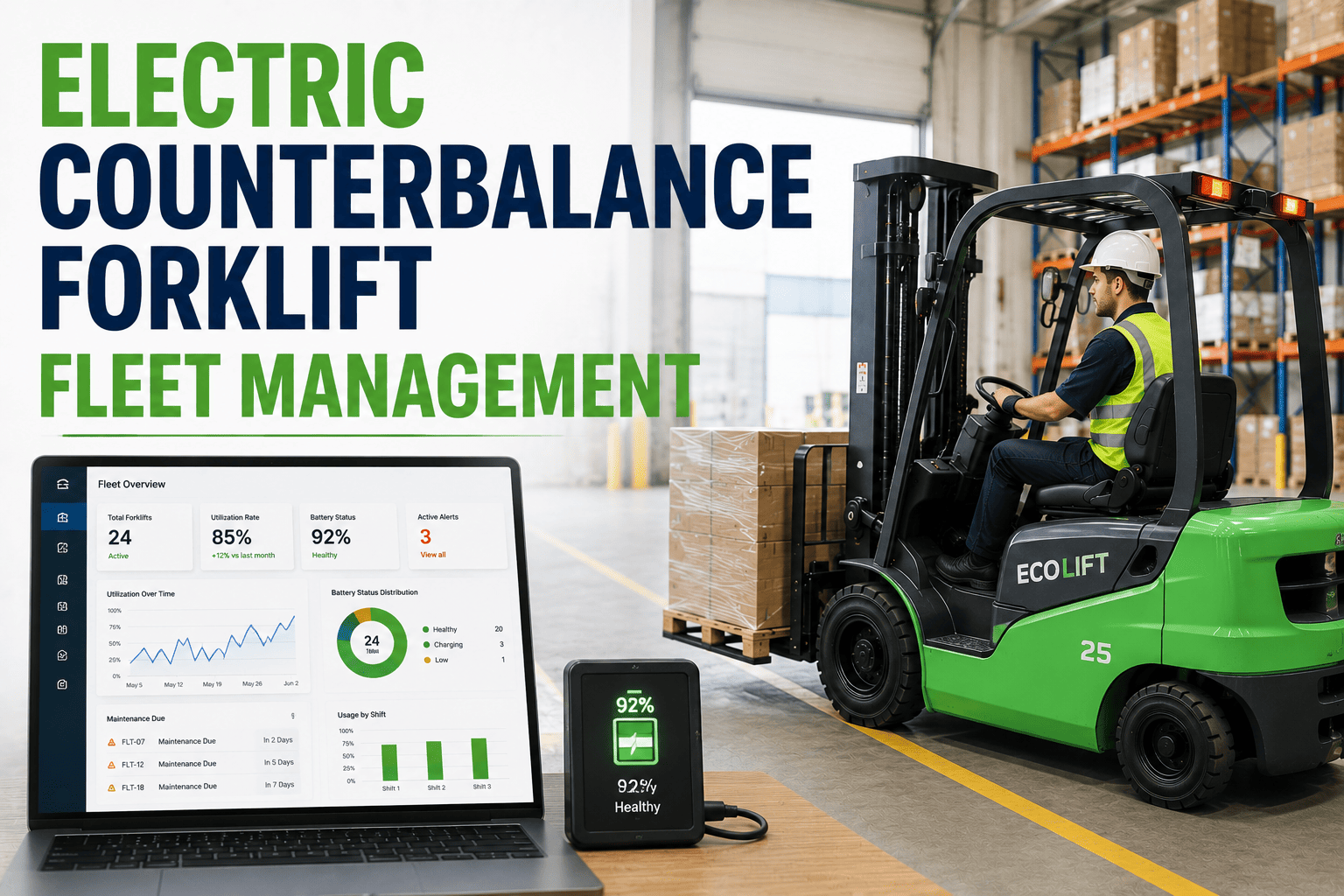
Walk onto almost any manufacturing floor built in the last few years and the workhorse moving pallets between the production line and the dock is increasingly a Class I electric counterbalance forklift. Electric models now account for more than 70 percent of new forklift sales in Europe, and North American manufacturers are following the same curve as lithium-ion batteries make the switch from diesel and LPG counterbalance trucks an easy financial decision. But buying electric is only half the equation. Without proper tracking of charge cycles, run hours, and maintenance intervals, a fleet of electric counterbalance forklifts can lose the uptime and cost advantage it was purchased for in the first place.
Electric counterbalance forklifts, known as Class I trucks, are the standard sit-down forklift for indoor manufacturing thanks to zero emissions, quiet operation, and lower total cost of ownership versus internal combustion models. Getting the full return on that investment requires tracking charge cycles, actual run hours, and hour-based maintenance triggers, which is exactly what a connected fleet platform like FleetRabbit provides across every truck on the floor.
What Makes Class I Electric Counterbalance Forklifts Different
Class I forklifts are fully electric, sit-down counterbalance trucks built around a rear counterweight that balances the load on the forks, letting them lift and transport pallets without an outrigger or support arm underneath. That design makes them maneuverable enough for narrow manufacturing aisles while still handling capacities up to several thousand pounds, depending on the model and mast configuration. Unlike Class IV internal combustion counterbalance trucks, Class I electric models produce zero emissions, run significantly quieter, and carry far fewer moving parts to service, which is why manufacturers are converting IC fleets to electric counterbalance trucks as lithium-ion battery costs continue to fall.
Why Manufacturers Are Moving From Class IV to Class I
The shift away from diesel, LPG, and gasoline counterbalance trucks is accelerating as lithium-ion technology matures. Electric counterbalance forklifts eliminate exhaust ventilation requirements indoors, cut fuel costs entirely, and reduce the mechanical complexity that drives up maintenance spend on an internal combustion engine. For plants running multiple shifts, the quieter operation of an electric truck also reduces noise-related fatigue on a busy floor shared with pedestrians and other equipment.
The Catch Most Fleets Miss After Converting
Converting to electric counterbalance trucks solves the emissions and fuel cost problem, but it introduces a new operational variable: battery and charge management. A fleet that ran on fuel gauges and oil changes now needs visibility into state of charge, charge cycle counts, and battery health, since a truck that runs out of charge mid-shift creates the same production stoppage a breakdown would have caused with a diesel model. Manufacturing teams making this transition can start a free trial to see charge and run hour data across their converting fleet from day one.
FleetRabbit connects to your Class I electric counterbalance fleet and streams charge cycle data, actual run hours, and hour-based maintenance alerts to one dashboard, so your electrification investment delivers the uptime it was built for.
Class I Electric Versus Class IV Internal Combustion
The comparison below highlights why manufacturing plants continue converting counterbalance fleets to electric power, and where the operational differences show up day to day.
| Factor | Class I Electric Counterbalance | Class IV Internal Combustion Counterbalance |
|---|---|---|
| Emissions | Zero emissions, safe for enclosed indoor operation | Requires ventilation and exhaust management indoors |
| Noise Level | Significantly quieter, easier on multi-shift floors | Louder engine operation throughout the shift |
| Maintenance Complexity | Fewer moving parts, no engine oil or exhaust system service | Regular engine, fuel system, and exhaust maintenance required |
| Refuel or Recharge Time | Charging or battery swap, manageable with proper scheduling | Fast refueling but ongoing fuel procurement and storage |
| Operating Environment Fit | Ideal for enclosed manufacturing and food or pharma facilities | Often used where outdoor or mixed terrain operation is needed |
Keeping a Growing Electric Counterbalance Fleet Productive
As more plants standardize on Class I electric trucks, the operational challenge shifts from equipment selection to fleet management discipline. A single truck's battery health is easy to watch. Twenty or fifty trucks across multiple shifts require a system, not a habit.
Matching Charge Scheduling to Shift Patterns
Staggering charge windows across the fleet prevents every truck from pulling power at once, reducing peak demand charges and giving batteries the full charge and equalization cycle they need rather than a rushed opportunity charge between shifts.
What good scheduling looks like
Charging assigned by shift pattern rather than whichever truck happens to be near a charger, with automated alerts when a truck's charge habits start drifting toward frequent partial charges.
Right-Sizing a Converting Fleet
Plants converting from IC to electric often purchase a like-for-like truck count without checking whether utilization data supports it. Motion-hour and utilization tracking frequently reveals that a converted fleet can run with fewer trucks once charge scheduling and route assignment are optimized, freeing up capital for the next phase of electrification. Facilities partway through a conversion can book a demo to see utilization data mapped against their current Class I truck count.
FleetRabbit gives manufacturing plants live charge, run hour, and maintenance visibility across every electric counterbalance forklift, helping teams right-size their fleet and avoid the mid-shift charge failures that undercut an electrification rollout.
Frequently Asked Questions
FleetRabbit tracks charge cycles, run hours, and maintenance across every Class I forklift on your floor, so your electrification investment delivers the uptime and cost savings it promised. See your fleet data within a day, no credit card required.