Electronics and Cleanroom Manufacturing Forklift Fleet Management

building-materials-plant-forklift-fleet-management-yard-indoor

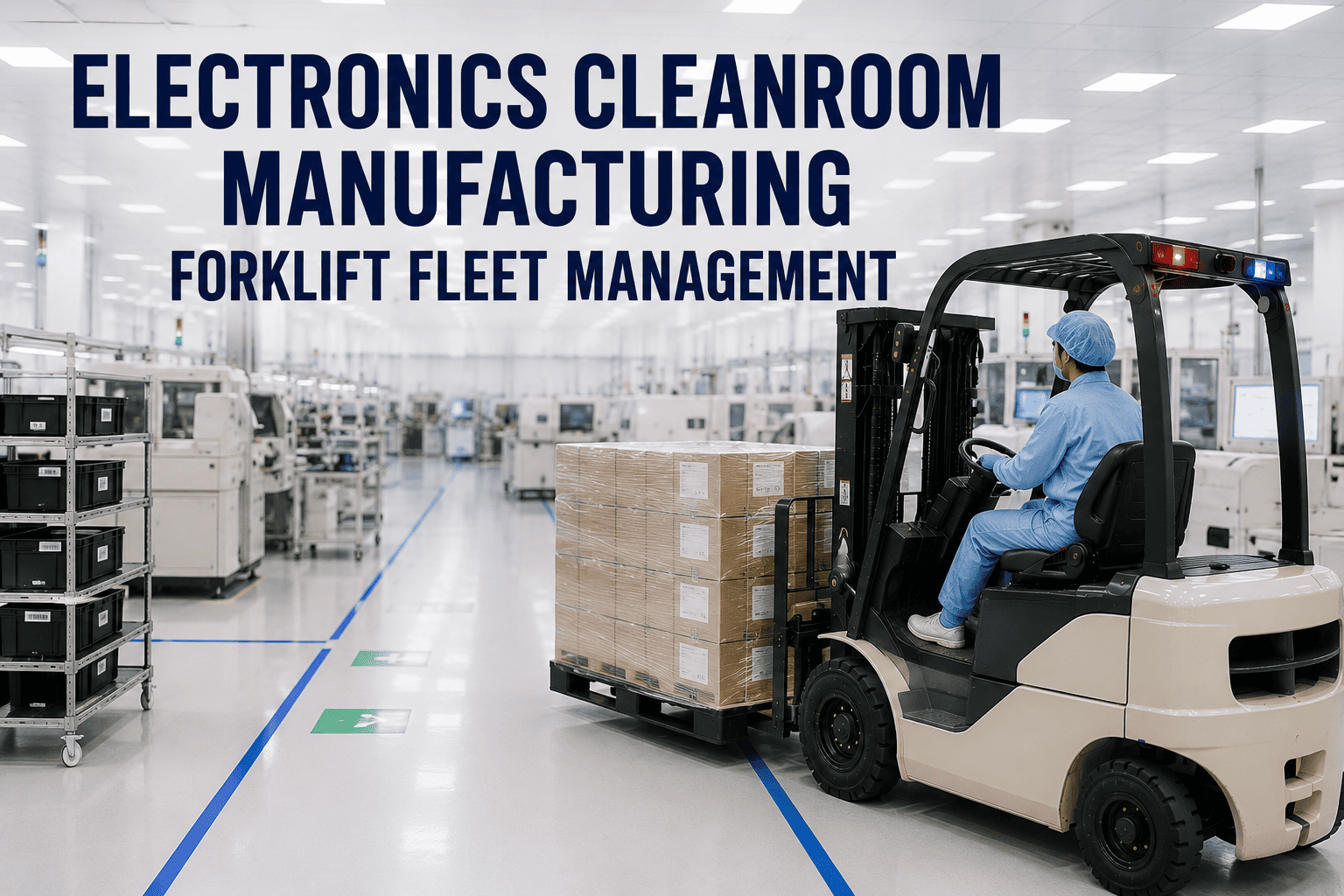
In most manufacturing plants, a forklift with a small oil leak or a slightly worn tire is a maintenance ticket. In an electronics or cleanroom facility, that same leak or tire can shut down an entire production run. Semiconductor fabs, medical device assembly lines, and precision electronics plants operate under airborne particle limits so strict that a single contaminated wafer or circuit board can mean a scrapped batch worth far more than the forklift itself. Material handling equipment in these environments is not just moving product. It is one of the biggest variables standing between a clean process and a costly contamination event.

Quick Answer

Cleanroom and electronics manufacturing plants need forklifts and pallet movers built around zero-emission electric drivetrains, non-marking tires, sealed or direct-drive motors, and electrostatic discharge control. Equipment is matched to the facility's ISO 14644-1 classification, since an ISO Class 5 semiconductor area allows a maximum of 3,520 particles per cubic meter at 0.5 microns, far tighter than an ISO Class 8 general electronics assembly space allowing up to 3,520,000 particles.

Particle Risk
Mechanical Particle Generation
Gearboxes, worn bearings, and standard lubricants shed particles into the air with every cycle, which is exactly what tight ISO classifications are designed to prevent.
ESD Risk
Electrostatic Discharge
A static charge that would go unnoticed anywhere else can silently damage sensitive circuitry, making antistatic tires and grounded components a requirement, not an option.
Airflow Risk
Disrupted Laminar Airflow
Cleanrooms rely on controlled, often unidirectional airflow to sweep particles away from work surfaces. Bulky equipment or exhaust from a combustion engine can throw that balance off entirely.

Why Standard Forklifts Don't Belong in a Cleanroom

A conventional propane or diesel forklift is disqualified from cleanroom duty before it even reaches the maintenance conversation. Combustion exhaust introduces particulates and volatile compounds that no HEPA or ULPA filtration system is designed to absorb at that concentration. Even electric forklifts built for ordinary warehouse work fall short if they use fan-cooled motors, open gearboxes, or standard hydraulic systems, since each of those components sheds particles or risks a fluid leak that a cleanroom simply cannot tolerate. The equipment allowed inside these spaces is purpose-built: zero-emission drivetrains, sealed or direct-drive motors, non-marking and antistatic tires, and surfaces that clean easily without breaking down under repeated wipe-downs.

Getting the equipment right is only half the job. The maintenance program built around that equipment has to be just as disciplined, because a cleanroom-rated forklift that skips its seal inspections or runs on the wrong lubricant stops being cleanroom-safe the moment those components start to wear. Teams that want a clear picture of where their cleanroom fleet stands can sign up for FleetRabbit and start tracking equipment condition against the standards their facility actually needs to meet.

Built For Controlled Environments
Maintenance That Protects Your ISO Class

FleetRabbit tracks seal condition, lubrication schedules, and component wear on cleanroom-rated forklifts and pallet movers, so a maintenance gap never becomes a contamination event.

ISO 5-8
Common Manufacturing Classes
0.5 µm
Particle Size Threshold

Matching Equipment to Your Cleanroom Classification

ISO 14644-1 sets the particle count limits that define each cleanroom class, and the equipment allowed inside scales with how strict that class is. A forklift that is perfectly fine in a general assembly area may be entirely unsuitable a few rooms over in a wafer fabrication space.

ISO Class Common Use Particle Limit (0.5 µm) Equipment Requirement
ISO Class 5 Semiconductor fabrication, pharmaceutical fill-finish Up to 3,520 particles/m³ Sealed housings, direct-drive actuators, minimal moving parts
ISO Class 7 Medical device assembly, pharmaceutical packaging Up to 352,000 particles/m³ Enclosed servo motors, non-marking antistatic tires
ISO Class 8 General electronics assembly, secondary packaging Up to 3,520,000 particles/m³ Standard electric forklifts with cleanroom-rated tires and seals

Non-Marking Tires and Sealed Drivetrains

Standard forklift tires leave marks and shed rubber particles on smooth cleanroom flooring, which is why non-marking, antistatic compounds are the default choice. Sealed drivetrains and encapsulated ball screws take the same logic further, keeping wear debris and lubricant contained inside the housing rather than airborne in the workspace.

Electrostatic Discharge Control

Electronics manufacturing adds a layer of risk that most other industries never think about. Static buildup from tires, wheels, or an ungrounded chassis can discharge into sensitive components without any visible sign, so cleanroom-rated equipment routes static safely to ground through conductive tires and grounded frames rather than letting it accumulate.

Maintenance Practices That Protect Your Cleanliness Standard

Cleanroom equipment maintenance follows a different rhythm than a standard warehouse fleet, built around preventing particle generation rather than just keeping the machine running.

Lubrication Selection

Standard grease and hydraulic fluid are not automatically cleanroom safe. Cleanroom-rated equipment uses low-outgassing lubricants formulated to minimize the vapor and particle contribution during normal wear.

Battery and Charging Discipline

Electric forklifts eliminate combustion emissions, but battery charging still needs a controlled process. Charging in a designated area outside the cleanroom, or using sealed battery systems, prevents off-gassing and heat buildup from affecting the controlled space.

Seal and Component Inspection

Because sealed housings and encapsulated drives are the main defense against particle generation, inspecting those seals on a fixed schedule matters more here than almost anywhere else in a maintenance program. A seal that has quietly started to wear is the difference between a compliant cleanroom and a documented contamination event.

Documentation and Compliance Matter As Much As the Equipment

ISO 14644-2 requires cleanrooms to maintain a documented monitoring and requalification plan, and the equipment operating inside that space is part of what gets scrutinized during an audit. A forklift fleet without clear maintenance records, seal inspection history, and lubrication logs makes compliance harder to prove even if the equipment itself is performing well. Digital tracking closes that gap by keeping every inspection, part replacement, and service interval in one place, ready to hand over the moment a quality team or auditor asks for it. If your facility is ready to see this kind of tracking applied to your own cleanroom fleet, book a demo with FleetRabbit and walk through it with your maintenance team.

Frequently Asked Questions

QCan standard forklifts be used in a cleanroom?
No. Standard forklifts, especially propane or diesel models, generate combustion emissions and mechanical particles that exceed the strict particle count limits set for cleanroom environments.
QWhat is the difference between ISO Class 5 and ISO Class 8 cleanrooms?
ISO Class 5 allows a maximum of about 3,520 particles per cubic meter at 0.5 microns and is used for semiconductor and pharmaceutical fill-finish work, while ISO Class 8 allows up to 3,520,000 particles per cubic meter and covers general electronics assembly.
QWhy do cleanroom forklifts need non-marking tires?
Standard tires shed rubber particles and leave marks on cleanroom flooring, both of which introduce contamination. Non-marking, antistatic tire compounds are formulated specifically to avoid this.
QHow does electrostatic discharge affect electronics manufacturing?
A static discharge that would be harmless elsewhere can damage sensitive circuit components without any visible warning sign, which is why cleanroom equipment uses grounded frames and conductive tires to route static safely away.
QWhat maintenance is different for cleanroom-rated forklifts?
Cleanroom maintenance emphasizes seal and component inspection, low-outgassing lubricants, and controlled battery charging, all aimed at preventing particle and vapor generation rather than just keeping the machine operational.
QDo electric forklifts still need special handling in a cleanroom?
Yes. Electric drivetrains remove combustion emissions, but battery charging still needs to happen in a controlled area, and the motor, gearbox, and hydraulic components still need to be sealed or particle-rated for the cleanroom class.
QWhat documentation do cleanrooms need for material handling equipment?
ISO 14644-2 requires a documented monitoring and requalification plan, which means maintenance records, seal inspection history, and service logs for forklifts and pallet movers should be readily available for audits.
QHow does FleetRabbit support cleanroom and electronics manufacturing fleets?
FleetRabbit tracks seal condition, lubrication intervals, and component wear on cleanroom-rated equipment, keeping maintenance records organized and ready for compliance reviews. Start a free trial or book a demo to see it in action.
Keep Contamination Risk Off Your Production Floor

A worn seal or missed inspection on a cleanroom forklift can cost far more than the repair itself. See how FleetRabbit keeps your cleanroom and electronics manufacturing fleet inspection-ready, every shift.
Cleanroom Compliance Particle Control ESD Prevention Maintenance Tracking Electronics Ready

August 19, 2026 By John
All Posts

Electronics and Cleanroom Manufacturing Forklift Fleet Management

electronics-cleanroom-manufacturing-forklift-fleet-management

In most manufacturing plants, a forklift with a small oil leak or a slightly worn tire is a maintenance ticket. In an electronics or cleanroom facility, that same leak or tire can shut down an entire production run. Semiconductor fabs, medical device assembly lines, and precision electronics plants operate under airborne particle limits so strict that a single contaminated wafer or circuit board can mean a scrapped batch worth far more than the forklift itself. Material handling equipment in these environments is not just moving product. It is one of the biggest variables standing between a clean process and a costly contamination event.

Quick Answer

Cleanroom and electronics manufacturing plants need forklifts and pallet movers built around zero-emission electric drivetrains, non-marking tires, sealed or direct-drive motors, and electrostatic discharge control. Equipment is matched to the facility's ISO 14644-1 classification, since an ISO Class 5 semiconductor area allows a maximum of 3,520 particles per cubic meter at 0.5 microns, far tighter than an ISO Class 8 general electronics assembly space allowing up to 3,520,000 particles.

Particle Risk
Mechanical Particle Generation
Gearboxes, worn bearings, and standard lubricants shed particles into the air with every cycle, which is exactly what tight ISO classifications are designed to prevent.
ESD Risk
Electrostatic Discharge
A static charge that would go unnoticed anywhere else can silently damage sensitive circuitry, making antistatic tires and grounded components a requirement, not an option.
Airflow Risk
Disrupted Laminar Airflow
Cleanrooms rely on controlled, often unidirectional airflow to sweep particles away from work surfaces. Bulky equipment or exhaust from a combustion engine can throw that balance off entirely.

Why Standard Forklifts Don't Belong in a Cleanroom

A conventional propane or diesel forklift is disqualified from cleanroom duty before it even reaches the maintenance conversation. Combustion exhaust introduces particulates and volatile compounds that no HEPA or ULPA filtration system is designed to absorb at that concentration. Even electric forklifts built for ordinary warehouse work fall short if they use fan-cooled motors, open gearboxes, or standard hydraulic systems, since each of those components sheds particles or risks a fluid leak that a cleanroom simply cannot tolerate. The equipment allowed inside these spaces is purpose-built: zero-emission drivetrains, sealed or direct-drive motors, non-marking and antistatic tires, and surfaces that clean easily without breaking down under repeated wipe-downs.

Getting the equipment right is only half the job. The maintenance program built around that equipment has to be just as disciplined, because a cleanroom-rated forklift that skips its seal inspections or runs on the wrong lubricant stops being cleanroom-safe the moment those components start to wear. Teams that want a clear picture of where their cleanroom fleet stands can sign up for FleetRabbit and start tracking equipment condition against the standards their facility actually needs to meet.

Built For Controlled Environments
Maintenance That Protects Your ISO Class

FleetRabbit tracks seal condition, lubrication schedules, and component wear on cleanroom-rated forklifts and pallet movers, so a maintenance gap never becomes a contamination event.

ISO 5-8
Common Manufacturing Classes
0.5 µm
Particle Size Threshold

Matching Equipment to Your Cleanroom Classification

ISO 14644-1 sets the particle count limits that define each cleanroom class, and the equipment allowed inside scales with how strict that class is. A forklift that is perfectly fine in a general assembly area may be entirely unsuitable a few rooms over in a wafer fabrication space.

ISO Class Common Use Particle Limit (0.5 µm) Equipment Requirement
ISO Class 5 Semiconductor fabrication, pharmaceutical fill-finish Up to 3,520 particles/m³ Sealed housings, direct-drive actuators, minimal moving parts
ISO Class 7 Medical device assembly, pharmaceutical packaging Up to 352,000 particles/m³ Enclosed servo motors, non-marking antistatic tires
ISO Class 8 General electronics assembly, secondary packaging Up to 3,520,000 particles/m³ Standard electric forklifts with cleanroom-rated tires and seals

Non-Marking Tires and Sealed Drivetrains

Standard forklift tires leave marks and shed rubber particles on smooth cleanroom flooring, which is why non-marking, antistatic compounds are the default choice. Sealed drivetrains and encapsulated ball screws take the same logic further, keeping wear debris and lubricant contained inside the housing rather than airborne in the workspace.

Electrostatic Discharge Control

Electronics manufacturing adds a layer of risk that most other industries never think about. Static buildup from tires, wheels, or an ungrounded chassis can discharge into sensitive components without any visible sign, so cleanroom-rated equipment routes static safely to ground through conductive tires and grounded frames rather than letting it accumulate.

Maintenance Practices That Protect Your Cleanliness Standard

Cleanroom equipment maintenance follows a different rhythm than a standard warehouse fleet, built around preventing particle generation rather than just keeping the machine running.

Lubrication Selection

Standard grease and hydraulic fluid are not automatically cleanroom safe. Cleanroom-rated equipment uses low-outgassing lubricants formulated to minimize the vapor and particle contribution during normal wear.

Battery and Charging Discipline

Electric forklifts eliminate combustion emissions, but battery charging still needs a controlled process. Charging in a designated area outside the cleanroom, or using sealed battery systems, prevents off-gassing and heat buildup from affecting the controlled space.

Seal and Component Inspection

Because sealed housings and encapsulated drives are the main defense against particle generation, inspecting those seals on a fixed schedule matters more here than almost anywhere else in a maintenance program. A seal that has quietly started to wear is the difference between a compliant cleanroom and a documented contamination event.

Documentation and Compliance Matter As Much As the Equipment

ISO 14644-2 requires cleanrooms to maintain a documented monitoring and requalification plan, and the equipment operating inside that space is part of what gets scrutinized during an audit. A forklift fleet without clear maintenance records, seal inspection history, and lubrication logs makes compliance harder to prove even if the equipment itself is performing well. Digital tracking closes that gap by keeping every inspection, part replacement, and service interval in one place, ready to hand over the moment a quality team or auditor asks for it. If your facility is ready to see this kind of tracking applied to your own cleanroom fleet, book a demo with FleetRabbit and walk through it with your maintenance team.

Frequently Asked Questions

QCan standard forklifts be used in a cleanroom?
No. Standard forklifts, especially propane or diesel models, generate combustion emissions and mechanical particles that exceed the strict particle count limits set for cleanroom environments.
QWhat is the difference between ISO Class 5 and ISO Class 8 cleanrooms?
ISO Class 5 allows a maximum of about 3,520 particles per cubic meter at 0.5 microns and is used for semiconductor and pharmaceutical fill-finish work, while ISO Class 8 allows up to 3,520,000 particles per cubic meter and covers general electronics assembly.
QWhy do cleanroom forklifts need non-marking tires?
Standard tires shed rubber particles and leave marks on cleanroom flooring, both of which introduce contamination. Non-marking, antistatic tire compounds are formulated specifically to avoid this.
QHow does electrostatic discharge affect electronics manufacturing?
A static discharge that would be harmless elsewhere can damage sensitive circuit components without any visible warning sign, which is why cleanroom equipment uses grounded frames and conductive tires to route static safely away.
QWhat maintenance is different for cleanroom-rated forklifts?
Cleanroom maintenance emphasizes seal and component inspection, low-outgassing lubricants, and controlled battery charging, all aimed at preventing particle and vapor generation rather than just keeping the machine operational.
QDo electric forklifts still need special handling in a cleanroom?
Yes. Electric drivetrains remove combustion emissions, but battery charging still needs to happen in a controlled area, and the motor, gearbox, and hydraulic components still need to be sealed or particle-rated for the cleanroom class.
QWhat documentation do cleanrooms need for material handling equipment?
ISO 14644-2 requires a documented monitoring and requalification plan, which means maintenance records, seal inspection history, and service logs for forklifts and pallet movers should be readily available for audits.
QHow does FleetRabbit support cleanroom and electronics manufacturing fleets?
FleetRabbit tracks seal condition, lubrication intervals, and component wear on cleanroom-rated equipment, keeping maintenance records organized and ready for compliance reviews. Start a free trial or book a demo to see it in action.
Keep Contamination Risk Off Your Production Floor

A worn seal or missed inspection on a cleanroom forklift can cost far more than the repair itself. See how FleetRabbit keeps your cleanroom and electronics manufacturing fleet inspection-ready, every shift.
Cleanroom Compliance Particle Control ESD Prevention Maintenance Tracking Electronics Ready

August 19, 2026 By John
All Posts

Share This Story, Choose Your Platform!

Latest Posts

Scroll