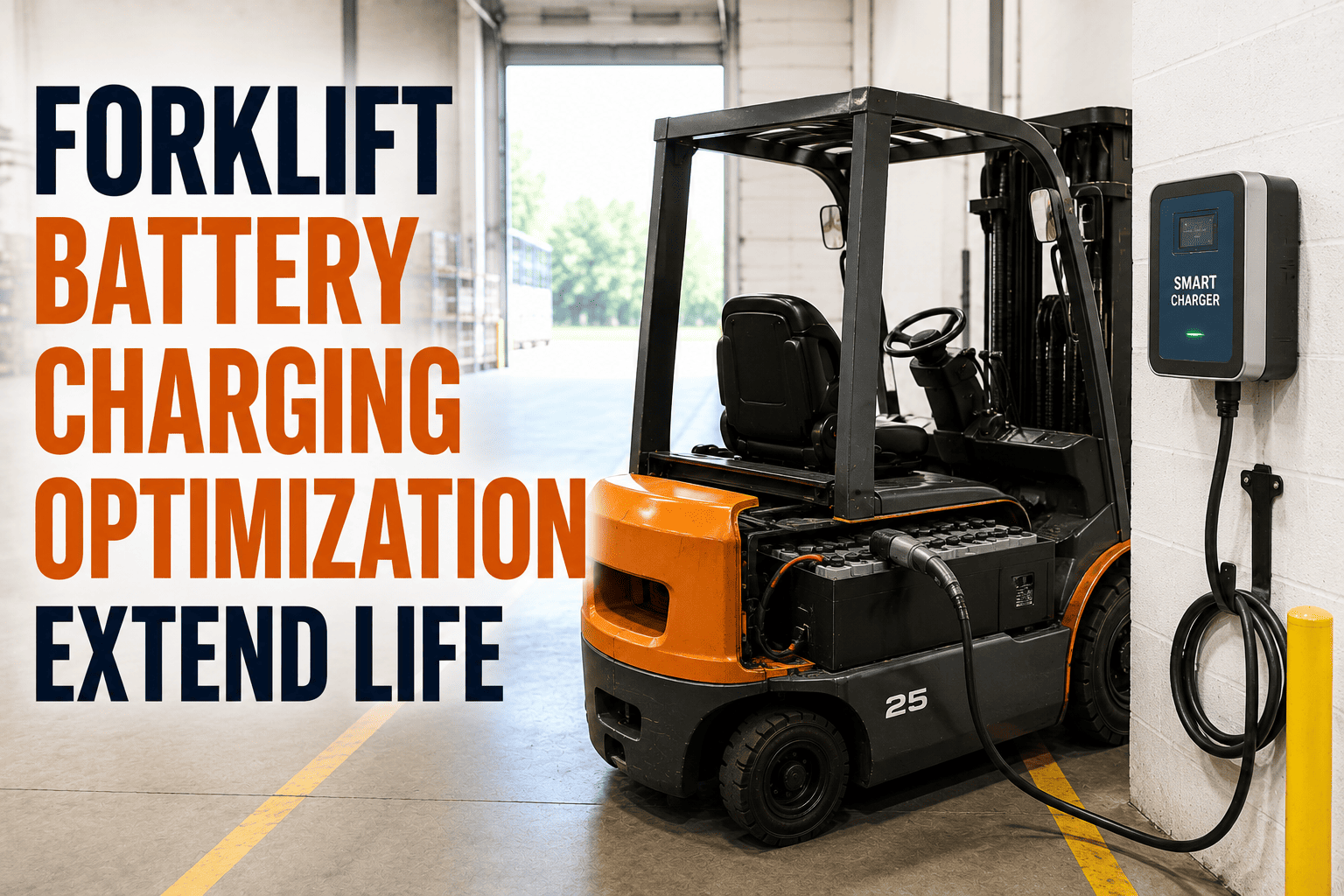
A forklift battery rarely dies of old age. It dies of habits. Somebody plugs it in during a fifteen-minute break because the truck is idle anyway, somebody unplugs it early to make a shift change, somebody lets it sit dead in a corner over a long weekend. None of these feel like mistakes in the moment. Every one of them shaves months off the battery's working life, and by the time the pattern shows up as a truck stranding mid-shift, the damage was already done weeks earlier.
Most industrial batteries are rated for around 1500 charge cycles, so charging once daily gives roughly four years of useful life, while unnecessary partial charges burn through that budget faster. Lead-acid batteries should complete a full charge every time and only start charging below 20 to 30 percent state of charge. Lithium-ion batteries work best kept between 20 and 80 percent through short opportunity charges. Using the wrong habit on the wrong chemistry is the single most common cause of early battery failure.
The Charging Rule That Splits Both Chemistries Apart
The single most damaging mistake in forklift battery management is treating lead-acid and lithium-ion the same way. They follow opposite rules, and a warehouse running both chemistries side by side often has operators unknowingly doing the right thing on one truck and the wrong thing on another.
Charge fully, every time. Only start a charge once the battery drops below 20 to 30 percent, and never interrupt the cycle partway through. Partial charging prevents full sulfation reversal and accelerates capacity loss.
Charge little and often. Plugging in during a break or shift change keeps the battery between 20 and 80 percent state of charge, which is exactly where lithium-ion chemistry experiences the least stress per cycle.
Why Opportunity Charging Helps One Battery and Hurts the Other
Opportunity charging lead-acid can cut its usable lifespan by as much as 40 percent because the chemistry needs a full, uninterrupted charge to prevent hard sulfation on the plates. The exact same habit on lithium-ion does the opposite, since lithium cells have no memory effect and actually experience less degradation when kept in short, frequent charge windows rather than deep daily cycles.
Five Charging Mistakes That Quietly Shorten Battery Life
These mistakes rarely cause an immediate problem, which is exactly what makes them dangerous. Each one trades a small amount of short-term convenience for a real reduction in the number of usable years a battery has left.
FleetRabbit tracks state of charge, cycle counts, and charging duration for every truck, so supervisors catch premature top-offs and interrupted cycles before they cost a battery its lifespan. Sign up free to start monitoring today.
A Charging Schedule By Shift Pattern and Chemistry
The right charging rhythm depends on both what chemistry powers the truck and how many shifts the facility runs. Applying a single blanket policy across every truck is how mixed fleets end up with inconsistent battery performance from one aisle to the next.
| Operation Type | Lead-Acid Approach | Lithium-Ion Approach | What To Monitor |
|---|---|---|---|
| Single Shift | Full charge after shift, below 30 percent | Plug in at 20 percent, opportunity charge as needed | State of charge at shift start and end |
| Multi Shift | Rotate spare batteries, full charge only | Opportunity charge every changeover and break | Charge frequency and duration per battery |
| Extended Shutdown | Full charge before storage, recheck monthly | Reduce to 50 to 60 percent before storage | Stored state of charge and elapsed idle time |
| Weekly Maintenance | Equalize every 5 to 10 cycles, check water | No watering or equalization needed | Cycle count since last equalization |
Rotate Batteries Instead of Overworking One
Fleets running multiple batteries per truck should rotate them evenly across chargers rather than always reaching for whichever one is closest. Repeatedly overworking a single battery while others sit idle wears it down faster and creates uneven performance across what should be an identical set of assets.
Keep Chargers as Well Maintained as the Batteries
A charger with loose connections, damaged cables, or dust buildup delivers an inconsistent charge even when the battery itself is healthy. Routine charger inspection catches these issues before they masquerade as battery problems and lead to an unnecessary battery replacement.
Reading the Warning Signs Before a Battery Fails
Batteries rarely fail without warning, but the signs are easy to miss without consistent tracking. A pack that used to comfortably finish a shift and now needs a mid-afternoon top-off is telling you something. Unusual smells, bulging cases, or visible corrosion on terminals are more urgent signals that call for immediate attention rather than a wait-and-see approach.
Runtime Decline Is the Earliest Signal
The first sign of a battery losing capacity is almost always a shrinking runtime, not a dramatic failure. A truck that finished a full shift comfortably three months ago and now needs a mid-shift charge has already lost meaningful capacity. Catching this trend early through cycle and runtime tracking gives fleets time to plan a replacement on their own schedule instead of during an emergency.
FleetRabbit flags runtime decline, missed watering intervals, and charger issues automatically, so your team fixes battery problems while they are still cheap and predictable. Explore how it fits your fleet with a live walkthrough.
Turning Good Habits Into a Fleet-Wide Standard
Individual operators cannot be expected to remember different charging rules for every truck chemistry on a busy shift. The fleets that get this right build the rule into the workflow itself, whether that is color-coded charging stations, automated alerts when a battery is plugged in too early, or simple posted guidance at each charging bay. Consistency across the whole team matters more than any single person's diligence.
Documentation matters just as much as the habit itself. A digital log showing charge times, cycle counts, and watering intervals gives maintenance teams a clear picture of which batteries are aging faster than expected and lets them plan replacements before a truck gets stranded mid-shift.
Key Takeaways for Better Battery Charging
Charging habits do more to determine forklift battery lifespan than almost any other factor, and the rules are not the same across chemistries. Lead-acid batteries need full, uninterrupted charges started only when genuinely needed. Lithium-ion batteries thrive on short, frequent top-ups that keep them in their ideal charge range. Getting this backwards on either chemistry is one of the most common and most preventable causes of premature battery replacement and unplanned downtime.
The fleets protecting their battery investment best are not relying on individual operators to remember the rules. They are tracking charge cycles, runtime trends, and charger health automatically, catching problems while they are still cheap to fix instead of discovering them as a stranded truck on the floor.
FleetRabbit tracks state of charge, cycle counts, and runtime trends across your whole fleet, so battery life stops depending on memory and starts depending on data. Get started with no credit card required.