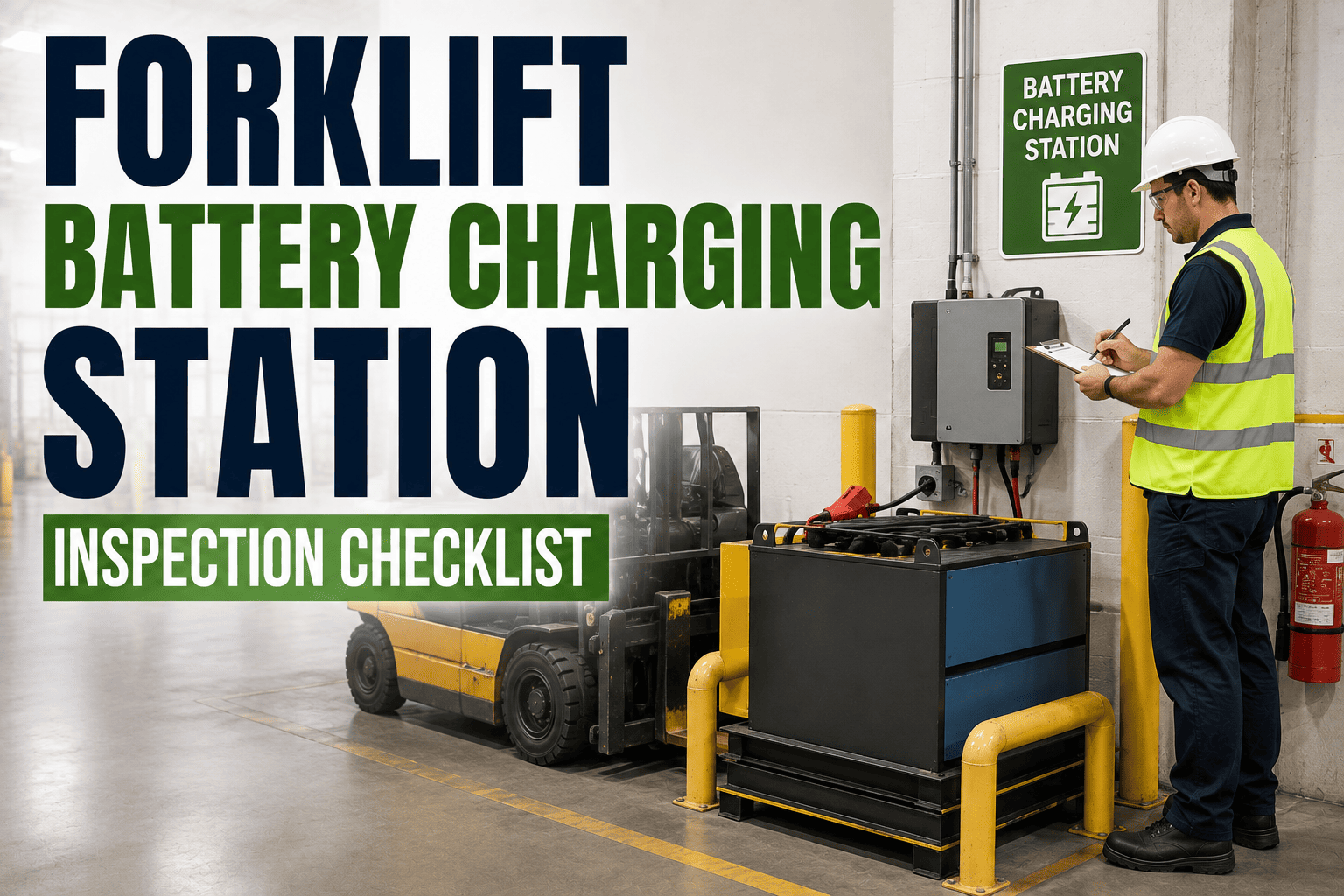
Walk into most battery charging rooms and it looks harmless: a few chargers on the wall, some cables, a forklift plugged in overnight. What's actually happening in that room is a lead-acid battery releasing hydrogen gas while it charges, sitting a few feet from sulfuric acid electrolyte and live electrical connections. It's one of the few spots in a warehouse where an explosion, a chemical burn, and an electrical shock are all genuine possibilities at the same time, and it's also one of the most under-inspected areas in most facilities.
OSHA 29 CFR 1910.178(g) requires a dedicated charging area with adequate ventilation to disperse hydrogen gas, spill containment and neutralizing agents for electrolyte, fire protection equipment, and protection for the charger from truck collisions. A daily checklist should verify ventilation is running, cables and connectors are undamaged, the eyewash station is within 10 seconds of reach, and no open flames or smoking are present in the area.
Why Charging Stations Deserve Their Own Checklist
Most facilities treat the charging station as an afterthought to the forklift inspection: check the truck, plug it in, move on. But the charging area is governed by its own section of the OSHA standard, 29 CFR 1910.178(g), separate from the truck operation rules. It covers where charging can happen, what equipment the area needs, and how spills and fires get handled. A forklift can pass its own inspection perfectly and still charge in a room that's completely out of compliance.
The station itself needs to be a designated area used only for charging and changing batteries, not a general storage corner with a charger bolted to the wall. That area needs facilities for flushing and neutralizing spilled electrolyte, fire protection equipment, and physical protection for the charger against being struck by a passing truck. None of that happens automatically. It has to be verified, on a schedule, by someone checking the actual conditions rather than assuming the room was set up correctly once and has stayed that way.
Ventilation Is The Item Most Often Assumed, Not Checked
A propped-open bay door gets treated as "ventilation" in a lot of facilities, but passive airflow rarely clears hydrogen fast enough in a busy charging bay. Effective ventilation is active, whether that's exhaust fans mounted where hydrogen concentrates near the ceiling or a mechanical system rated for enough air changes per hour to keep gas levels well under the explosive threshold. Teams that want a way to confirm this is actually being checked every day, not just assumed, can sign up for FleetRabbit and put a ventilation check directly on the daily charging station checklist.
FleetRabbit lets you build a dedicated inspection form for battery charging areas, covering ventilation, spill containment, PPE availability, and connector condition, completed from a phone and logged automatically.
The Battery And Charging Station Checklist By Zone
A complete inspection covers four zones that rarely get checked together: the charging equipment itself, the surrounding room conditions, spill and emergency response readiness, and the PPE available to the person doing the charging.
| Zone | What To Check | Flag Immediately If |
|---|---|---|
| Charger and Cables | Connectors seated fully, cable insulation intact, charger secured on its stand | Cracked or exposed cable, loose connector, charger unsecured or unprotected from truck contact |
| Room Ventilation | Exhaust fans or mechanical system active, no gas buildup odor, area not enclosed with doors shut | Ventilation system off or absent, doors sealed during active charging |
| Spill Response | Neutralizing agent stocked, containment trays in place, spill kit accessible | No neutralizing agent on hand, containment tray cracked or missing |
| Emergency Equipment | Eyewash station flowing, fire extinguisher charged and within reach, no smoking signage posted | Eyewash station more than 10 seconds away, extinguisher past inspection date |
| PPE Availability | Goggles, face shield, acid-resistant gloves and apron stocked at the station | Any PPE item missing, damaged, or not sized for the operator on shift |
Fire And Spark Controls
Hydrogen gas needs only a small spark to ignite, so the charging area needs strict controls on anything that could produce one. That means no smoking, no open flames, and no spark-producing equipment anywhere near the charging bay, along with clearly posted signage reminding anyone passing through. A Class ABC fire extinguisher should sit within immediate reach and carry a current inspection tag, not one that expired months ago and was never noticed.
Clearance Between Chargers Matters Too
Chargers packed too close together restrict airflow and make it harder to spot a damaged unit before it becomes a hazard. Industry guidance generally calls for at least three feet of clearance between charging stations, giving both cooling airflow and safe access for maintenance or emergency response.
Lead-Acid Versus Lithium-Ion: Different Risks, Different Checklists
Not every charging station carries the same risk profile, and a checklist built for lead-acid batteries misses what actually matters for lithium-ion. Lead-acid batteries emit hydrogen gas throughout charging and typically need a full charge cycle followed by a cooling period before returning to service, which is exactly why ventilation and cool-down verification matter so much for these units. Lithium-ion batteries don't emit hydrogen and support opportunity charging between shifts, which relaxes the ventilation requirement considerably but introduces a different concern: the charger has to match the battery's management system precisely, since an incompatible charger risks permanent damage or thermal issues.
A facility running a mixed fleet needs to know which checklist applies to which station, because applying the wrong one either wastes time on unnecessary steps or, worse, skips a check that actually matters for that battery type. This is exactly the kind of distinction that gets lost on a paper form but is straightforward to build into a digital checklist. Facilities weighing a shift to lithium-ion, or simply trying to standardize checks across a mixed fleet, can book a demo with FleetRabbit to see how battery-type-specific checklists are configured.
FleetRabbit builds separate digital checklists for lead-acid and lithium-ion charging stations, so operators only see the checks that actually apply to the battery in front of them, and nothing gets skipped or duplicated.
Turning A Paper Checklist Into A Documented Habit
The gap in most charging rooms isn't a lack of rules, it's a lack of proof the rules were followed today. A laminated checklist taped to the wall doesn't record whether anyone actually looked at the ventilation fan this morning, and it doesn't flag a cracked cable to a supervisor before someone gets hurt using it. A digital version of the same checklist closes that gap: it timestamps the check, requires a photo when something fails, and routes the flagged item straight to whoever needs to fix it.
That record also matters well beyond daily safety. It's the documentation that supports an OSHA inspection, backs up an insurance claim, and shows a pattern if the same charger keeps failing the same check month after month, which usually means it needs to be replaced rather than repeatedly flagged and ignored.
Ventilation, spill readiness, and connector condition shouldn't depend on memory. FleetRabbit puts a zone-specific charging station checklist in your team's hands, with every check logged and every failure flagged instantly.