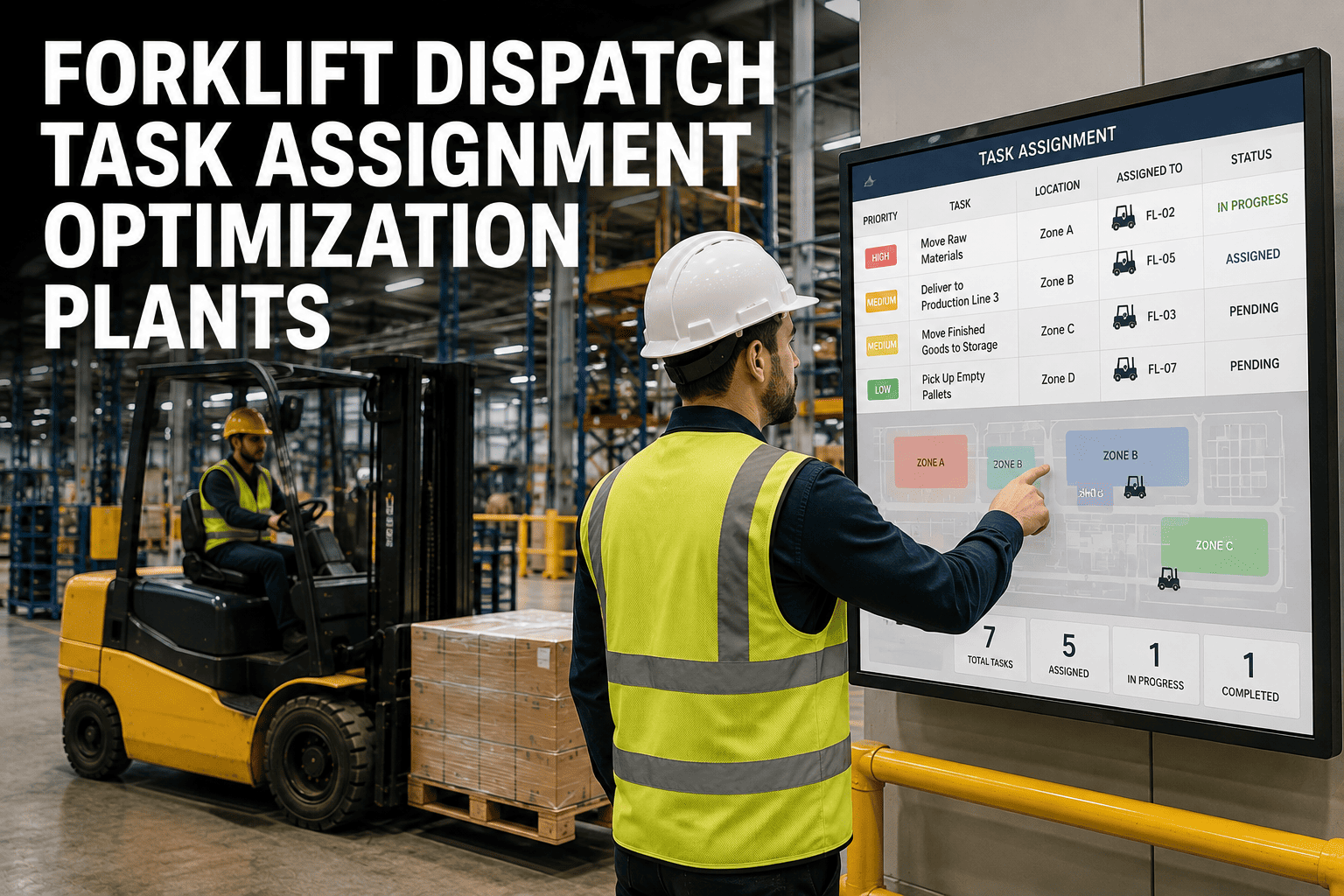
A production line needs a pallet of components. Three forklifts are somewhere on the floor, but the dispatcher is working off a whiteboard and a two-way radio, guessing which truck is closest and which operator is free. The line waits. Multiply that guess by every task, every shift, every day, and a plant loses hundreds of hours a year to nothing more than not knowing where its own equipment is. Fixing that isn't about buying more forklifts. It's about assigning the ones you already have to the right task, at the right moment, automatically.
Manual forklift dispatch relies on radios, whiteboards, and guesswork, which leaves trucks idle in one zone while another zone waits for material. Automated task assignment uses live location and workload data to route the nearest available forklift to the next task, cutting wait time, unnecessary travel, and labor cost without adding a single vehicle to the fleet.
Why Manual Dispatch Quietly Drains a Plant's Output
Most plants don't realize how much manual dispatch costs them because the losses never show up as one big number. They show up as a hundred small ones: a forklift circling the yard looking for its next pickup, an operator parked near the breakroom because nobody radioed a new task, a line supervisor calling dispatch three times before a pallet finally moves. None of it looks like a crisis in the moment. Added up across a year, it is one.
Requests Pile Up on a Whiteboard
A task is logged by hand or shouted over a radio, with no record of when it was requested or how long it's been waiting.
The Nearest Truck Isn't Obvious
Without live location data, dispatchers assign whichever forklift they can reach on the radio, not the one actually closest to the job.
Trucks Cross Paths Instead of Zones
One forklift drives across the plant while a closer truck sits idle two aisles away, because nobody could see both at once.
The Production Line Absorbs the Delay
By the time material arrives, the wait has already slowed the next station, and nobody can say exactly why.
This pattern repeats itself in plant after plant, and industry research on warehouse motion backs it up: the average facility loses close to seven weeks a year to unnecessary movement and mis-routed tasks. Dispatch optimization exists to close that exact gap, and a quick demo call is usually enough to show a plant manager where their own gap is hiding.
FleetRabbit shows every forklift's location, status, and current task on one screen, so dispatchers assign work in seconds instead of guessing over a radio. Book a walkthrough and see your own zones mapped out in real time.
How Automated Task Assignment Actually Works
Dispatch optimization isn't a black box. It's a straightforward loop that runs continuously in the background, matching open tasks to available equipment based on data a dispatcher simply can't track by eye.
The System Sees Every Truck at Once
Instead of one dispatcher trying to remember where six or sixteen forklifts are, the platform tracks live position, load status, and idle time for the entire fleet on a single screen.
Tasks Are Ranked, Not Just Queued
A pallet blocking a production line and a routine putaway aren't the same priority. Task assignment logic weighs urgency, zone, and distance so the most important job gets the next available truck first.
Distance and load direction matter
A forklift already heading toward a zone with an empty bed is a better match for a nearby task than a fully loaded truck on the opposite side of the plant, even if the second truck happens to be closer to the dispatcher's desk.
The Nearest Available Truck Gets the Call
Once a task is ranked, the system matches it to the closest forklift that's actually free, cutting the empty travel that piles up when tasks get assigned by habit instead of position.
Empty travel is where the savings hide
Loaded travel moves product and earns its keep. Unloaded travel, where a truck drives across the floor just to reach its next assignment, is pure cost. Reducing it is often the single biggest win in a dispatch optimization rollout.
Dispatchers Adjust, They Don't Guess
Automation handles the routine matching, but supervisors keep full visibility to override an assignment when a line issue or safety concern needs a specific truck immediately.
| Dispatch Factor | Manual Whiteboard/Radio Dispatch | Optimized Task Assignment |
|---|---|---|
| Truck Selection | Whichever driver answers the radio first | Nearest available truck matched by live location |
| Task Priority | First-come, first-served, regardless of urgency | Ranked by zone impact and how long the request has waited |
| Visibility | One dispatcher's memory and a whiteboard | Full fleet view updated in real time on one screen |
| Empty Travel | High, trucks cross the plant to reach the next job | Reduced by routing based on current position and load |
| Record of Requests | None, tasks and wait times are never logged | Every task timestamped and searchable for review |
Signs Your Plant Is Overdue for Dispatch Optimization
Some plants know they have a dispatch problem. Many more have learned to work around it without realizing how much it's costing them. A few patterns tend to show up in almost every facility before it makes the switch.
A Truck Is Always "On Its Way" for Too Long
If line supervisors regularly wait longer than expected for material after calling it in, the delay usually isn't the forklift itself, it's the time spent figuring out which truck to send.
Some Zones Feel Overloaded While Others Feel Empty
Operators in one part of the plant are constantly busy while trucks in another sit idle between calls. Without shared visibility, workload naturally clusters around whichever radio channel gets used most.
Nobody Can Say Where the Time Actually Goes
When a shift runs long or a delivery slips, there's no record showing which tasks took the longest or which trucks carried the heaviest load. Every conversation about the delay stays anecdotal.
Adding Another Forklift Feels Like the Only Fix
Buying another truck can mask a coordination problem for a while, but it adds lease and maintenance cost permanently. Most plants that optimize dispatch first find they needed better routing, not more equipment.
What Changes on the Floor After Optimization
The shift from manual to automated dispatch isn't dramatic on day one, but the pattern becomes clear within the first few weeks. Idle time between tasks shrinks because trucks are matched to work instead of waiting for a radio call. Cross-plant travel drops because the system already knows which truck is closest. Supervisors stop chasing status updates because the dashboard shows exactly where every vehicle is and what it's doing. And because every task is logged automatically, plant managers finally get a real answer when someone asks why a shift ran behind, instead of relying on memory. Teams ready to see this on their own floor layout can sign up and connect their fleet in a single session, no separate hardware rollout required.
Every task assigned over a radio is a task assigned without the full picture. FleetRabbit gives dispatchers live location and priority data so the right truck reaches the right task first, every time. Set up your account in minutes or walk through it live with our team.