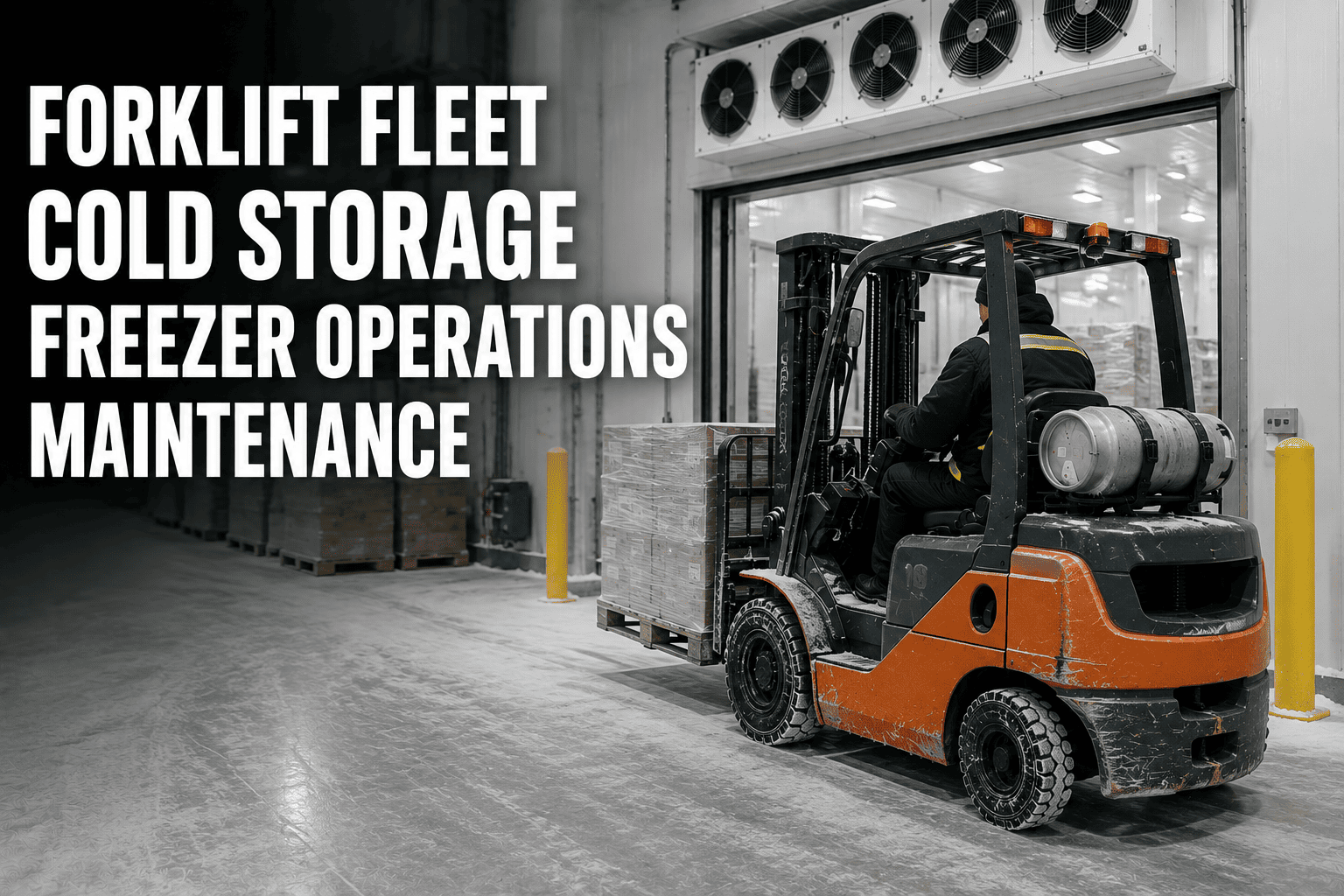
A forklift that operates reliably for 15000 hours in an ambient warehouse might struggle to reach 8000 hours in a sub-zero freezer environment. The cold does not just make the forklift uncomfortable to operate. It fundamentally changes how every mechanical and electrical system performs. Hydraulic fluid thickens, battery chemistry slows, rubber seals harden and crack, condensation forms inside electrical connections every time the forklift transitions between temperature zones, and lubricants that flow freely at 70 degrees turn into the consistency of honey at minus 20. Cold-storage facilities that apply standard warehouse maintenance schedules to freezer forklifts discover this mismatch through premature component failures, unplanned downtime that disrupts temperature-controlled supply chains, and replacement costs that arrive years ahead of budget projections. The maintenance program for a cold-storage forklift must be built around the physics of cold-weather operation, not copied from a manual written for room-temperature environments.
Forklifts operating in sub-zero environments experience 40 to 60 percent higher component wear rates compared to ambient-temperature operations. Battery capacity drops 20 to 30 percent at minus 10 degrees Fahrenheit. Hydraulic system failures occur 2 to 3 times more frequently in freezer duty. Facilities that implement cold-specific maintenance programs reduce unplanned freezer forklift downtime by 50 to 65 percent and extend useful life by 30 to 40 percent compared to standard maintenance approaches.
How Cold Degrades Every Forklift System
Understanding cold-storage maintenance requires understanding exactly what cold does to each forklift system. The degradation is not uniform. Some components suffer immediate and dramatic performance loss. Others degrade slowly and invisibly until a sudden failure reveals months of accumulated cold-weather damage. The maintenance challenge is that many of these degradation modes produce no visible symptoms during normal operation. A hydraulic seal that is hardening from chronic cold exposure still functions adequately during daily operation. It only fails when the combination of hardened material and peak system pressure creates a blowout that was preventable if the seal had been inspected and replaced on a cold-specific schedule rather than a standard schedule.
Hydraulic System Degradation in Cold
Hydraulic systems are the most immediately affected by cold operation. Standard hydraulic fluid rated for ambient temperatures thickens significantly as temperature drops. At 0 degrees Fahrenheit, standard hydraulic fluid viscosity increases by 300 to 500 percent compared to its viscosity at 70 degrees. This thickened fluid creates higher system pressure during every hydraulic function, which means every lift, tilt, and sideshift operation stresses hoses, fittings, seals, and the pump more than the same operation at normal temperature. The pump works harder to circulate thick fluid, increasing wear on pump bearings and vanes. Hoses experience higher internal pressure during cold starts before the fluid warms through circulation, which accelerates hose reinforcement fatigue. Seals that remain flexible at ambient temperatures become stiff and less able to maintain their sealing interface under pressure, leading to weeping that progresses to leaking as the seal material continues to degrade with each thermal cycle.
The Condensation Cycle That Destroys Electrical Systems
The most insidious cold-storage maintenance challenge is the condensation cycle that occurs every time a forklift moves between temperature zones. A forklift operating inside a 0-degree freezer carries that cold temperature in its metal frame, electrical housing, and component surfaces. When the forklift exits the freezer into a 50-degree loading dock or staging area, warm moist air immediately condenses on every cold surface inside electrical housings, connector bodies, sensor housings, and control panels. This condensation leaves a microscopic film of moisture on electrical contacts that accelerates corrosion with every transition. A forklift that makes 15 to 20 zone transitions per shift experiences 15 to 20 condensation cycles per shift, or roughly 4000 to 5000 condensation cycles per year. Each cycle deposits a small amount of moisture that, if not mitigated, progressively degrades contact integrity until intermittent electrical failures begin appearing. These failures are notoriously difficult to diagnose because they often clear when the forklift returns to the cold zone and the moisture re-freezes or re-condenses in a different pattern. You can sign up for FleetRabbit to get cold-specific maintenance scheduling that accounts for zone transition frequency in your inspection intervals.
Battery Maintenance in Cold-Storage Operations
Battery performance in cold environments follows predictable but often misunderstood chemistry. Lead-acid battery capacity decreases approximately 1 percent for every degree Fahrenheit below 80 degrees. At 0 degrees Fahrenheit, a battery that delivers 100 percent of its rated capacity at 80 degrees delivers only about 50 to 55 percent. At minus 20 degrees, available capacity drops to 30 to 35 percent of rated capacity. This capacity reduction means a forklift that completes a full 8-hour shift on a single charge in ambient temperature may only achieve 4 to 5 hours of operation in a deep freezer before requiring a recharge. The battery is not failing. It is performing exactly as lead-acid chemistry dictates at that temperature. The maintenance challenge is managing this reduced capacity without over-discharging batteries, which causes permanent sulfate crystal formation that destroys capacity permanently.
Charging Protocols for Freezer Batteries
Charging cold batteries introduces additional complexity that standard charging protocols do not address. A battery that has been operating at 0 degrees should not be connected to a charger immediately upon removal from the freezer. The cold electrolyte has reduced chemical activity, and applying full charge current to a cold battery can cause excessive gassing, plate damage, and thermal stress from rapid temperature differential between the cold electrolyte and the warming effect of charging current. Best practice is to allow the battery to warm to at least 40 degrees Fahrenheit before initiating a full charge cycle. This warming period typically takes 2 to 4 hours in a temperate charging area. Some cold-storage facilities install battery warming cabinets that use low-wattage heating elements to bring cold batteries to charging temperature faster without the thermal shock of direct charging. Opportunity charging during brief warm-zone breaks is acceptable for lithium-ion systems but should be minimized for lead-acid batteries in cold applications because partial charge cycles in cold conditions accelerate plate sulfation.
FleetRabbit knows which forklifts operate in cold storage and automatically adjusts maintenance intervals based on temperature zone and zone transition frequency. Hydraulic inspections, battery load tests, seal replacements, and electrical connection checks all trigger on cold-specific schedules that match your actual operating conditions.
Cold-Specific Fluid and Lubricant Programs
The single most impactful maintenance decision for cold-storage forklifts is using fluids and lubricants formulated for the operating temperature range. Standard hydraulic fluid, gear oil, and grease are formulated for ambient temperature operation and will cause component damage when used in sub-zero environments. Cold-rated hydraulic fluid maintains acceptable viscosity at low temperatures, reducing the pressure spikes and pump stress that standard fluid creates during cold starts. The viscosity index of cold-rated fluid is significantly higher, meaning its viscosity changes less dramatically across temperature ranges. A standard fluid might have a viscosity index of 95 while a cold-rated fluid achieves 150 to 170, providing consistent hydraulic performance from minus 20 degrees to plus 100 degrees.
Lubrication Points That Fail First in Cold
Standard grease in cold environments becomes stiff and loses its ability to flow into bearing surfaces during operation. The mast chain, one of the highest-wear components on any forklift, is particularly vulnerable because chain lubricant must penetrate between chain links under load while the chain operates at the coldest point in the facility near the ceiling where cold air settles. Standard chain lubricant that works well at 70 degrees becomes nearly solid at 0 degrees, leaving chain pins and bushings operating with inadequate lubrication. Cold-rated chain lubricant with a low-temperature penetration rating below minus 20 degrees maintains flow characteristics that keep the chain lubricated even in deep-freezer applications. Mast rollers, lift cylinder pivot points, steer axle kingpins, and drive axle bearings all require cold-rated grease that maintains its lubricating film at operating temperature. Applying standard grease to these points in a cold-storage forklift is not better than no grease at all. It is worse, because standard grease that hardens in the bearing creates a solid mass that blocks fresh lubricant from reaching the contact surfaces on subsequent applications.
Fluid Change Intervals for Cold Operations
Even cold-rated fluids and lubricants require more frequent replacement in cold environments because the chemical stress of repeated thermal cycling degrades fluid additives faster than steady-temperature operation. Hydraulic fluid in a freezer forklift should be changed every 1500 to 2000 hours compared to the standard 3000 to 5000 hour interval. Transmission fluid follows a similar compression, changing at 1500 hours instead of 3000. Grease at all lubrication points should be applied every 200 hours in freezer duty compared to 500 hours in ambient. These compressed intervals are not optional for cold operations. They are the minimum frequency that prevents the fluid degradation patterns that lead to premature component failures. The cost of more frequent fluid changes is trivial compared to the cost of a hydraulic pump failure or mast chain replacement that results from degraded fluid operating in cold conditions.
| Maintenance Task | Ambient Interval | Cooler (32-50F) | Freezer (0-32F) | Deep Freezer (-20 to 0F) |
|---|---|---|---|---|
| Hydraulic fluid change | 4,000 hrs | 2,500 hrs | 2,000 hrs | 1,500 hrs |
| Hydraulic hose inspection | 500 hrs | 350 hrs | 250 hrs | 200 hrs |
| Seal and gasket inspection | 1,000 hrs | 600 hrs | 400 hrs | 300 hrs |
| Battery load test | 250 hrs | 200 hrs | 150 hrs | 100 hrs |
| Electrical connector inspection | 1,000 hrs | 750 hrs | 500 hrs | 350 hrs |
| All-point lubrication | 500 hrs | 350 hrs | 250 hrs | 200 hrs |
| Mast chain lubrication | 200 hrs | 150 hrs | 100 hrs | 75 hrs |
| Transmission fluid change | 3,000 hrs | 2,000 hrs | 1,500 hrs | 1,200 hrs |
Seal and Gasket Management in Thermal Cycling
Seals and gaskets in cold-storage forklifts experience thermal cycling that no ambient-temperature forklift encounters. Every time the forklift transitions between temperature zones, every rubber component in the machine undergoes a temperature change of 30 to 90 degrees depending on the zones involved. This repeated expansion and contraction accelerates rubber fatigue in ways that steady-temperature operation does not. Nitrile rubber seals, the most common seal material in forklift hydraulic systems, have a temperature range that typically extends to minus 20 degrees Fahrenheit. Operating at or near that limit does not cause immediate failure but reduces the seal's fatigue life significantly. A nitrile seal that lasts 4000 hours in ambient operation may last only 2000 to 2500 hours when cycled between 0 degrees and 70 degrees multiple times per shift.
Proactive Seal Replacement Strategy
The most cost-effective seal management approach in cold storage is proactive replacement based on operating hours in cold environments rather than reactive replacement after failure. Proactive seal replacement targets the highest-risk seal locations on a compressed schedule. Mast lift cylinder rod seals experience the highest pressure and most exposure, making them the first to fail. Tilt cylinder seals follow closely because tilt cylinders cycle frequently during load handling. Steering cylinder seals face lower pressure but experience more environmental exposure at the front of the forklift where temperature transitions are most severe. Axle seals face constant exposure to cold and contamination from floor debris that becomes more abrasive in cold conditions. A proactive replacement program replaces seals at each of these locations on a rotating schedule that ensures no single seal group exceeds its cold-temperature fatigue life. The cost of replacing a mast cylinder seal proactively during scheduled maintenance is 200 to 400 dollars including labor. The cost of the same seal failing in operation includes emergency repair labor, hydraulic fluid loss, potential contamination of the hydraulic system, and the downtime while the forklift is out of service, typically totaling 1500 to 3000 dollars.
Pre-Shift Inspection Modifications for Cold Storage
Standard OSHA pre-shift inspection checklists do not adequately address cold-storage specific failure modes. A forklift operating in a freezer requires additional inspection items that catch cold-related problems before they become operational failures. The modified pre-shift inspection for cold-storage forklifts should include visual inspection of all hydraulic connections and cylinder rod surfaces for seal weeping, which is far more likely to begin in cold operation than ambient. Electrical connector inspection at key points including the controller harness, sensor connections, and battery connector should check for moisture accumulation or corrosion buildup that indicates condensation cycle damage. Tire condition assessment requires extra attention because rubber compounds harden in cold, making tires more susceptible to chunking, cracking, and impact damage from dock plates and floor irregularities. Mast chain tension should be checked more carefully because cold-stiffened chain may show normal tension at rest but exhibit slack during operation as the chain warms slightly under load. If you want a cold-specific pre-shift inspection template customized for your temperature zones, book a demo with FleetRabbit and we will configure your inspection checklists for cold-storage duty.
Seasonal Transition Maintenance for Facilities with Variable Temperatures
Some cold-storage facilities maintain different temperature zones during different seasons, running deeper freeze levels during winter months and slightly warmer settings during summer when ambient conditions reduce refrigeration demand. These seasonal transitions create a maintenance requirement that fixed-schedule programs miss. When a freezer zone shifts from minus 20 to 0 degrees for summer operation, the forklifts in that zone experience reduced cold stress but the seals and components that were degrading at the colder temperature do not automatically recover. A seal that has been hardening at minus 20 for four months has accumulated fatigue damage that a temperature increase cannot reverse. Seasonal transition maintenance should include a comprehensive inspection of all cold-affected components at each temperature change, with particular attention to seals that were operating near their temperature limits during the colder season. This inspection often catches seals that appear functional but show microscopic cracking that will progress to failure within weeks if not replaced.
Documentation Requirements for Cold-Storage Maintenance
Cold-storage maintenance documentation should capture temperature zone assignment for each forklift, hours accumulated in each zone, zone transition frequency, and the specific cold-rated materials used during each service event. This documentation serves two purposes. First, it enables accurate remaining-life calculations for cold-affected components based on actual temperature exposure rather than just total hours. A forklift with 5000 total hours that spent 3000 of those hours in a freezer has different component condition than a forklift with 5000 total hours spent entirely in ambient conditions. Second, it provides the data foundation for comparing actual failure rates against the cold-specific maintenance intervals, allowing you to adjust intervals based on your actual experience rather than manufacturer generalizations. If your deep-freezer forklifts consistently get 2500 hours between hydraulic hose failures on a 2000-hour inspection interval, you have data to support either maintaining the conservative interval or adjusting to 2500 hours with confidence.
Assign each forklift to its temperature zone. FleetRabbit automatically compresses maintenance intervals for cold-duty forklifts, tracks zone transition frequency for electrical inspection timing, and logs cold-rated material usage at every service event. Your cold-storage fleet gets the maintenance it needs without manual schedule adjustments.
Tire and Wheel Considerations for Cold Floors
Cold-storage floors present tire challenges that standard warehouse tires are not designed to handle. Freezer floors are often coated with specialized epoxy or polyurethane coatings that provide a smooth, cleanable surface but offer less traction than concrete. When these coated floors reach sub-zero temperatures, the already-reduced traction diminishes further as the tire rubber hardens. Cushion tires, the most common tire type for electric forklifts in cold storage, lose flexibility at low temperatures and become more susceptible to chunking when they encounter floor irregularities, dock plate edges, or debris. Pneumatic tires maintain better flexibility in cold but are rarely used in cold storage because they can introduce contamination and are not suitable for the smooth coated floors. The maintenance approach for cold-storage tires includes more frequent pressure checks for pneumatic options, more frequent visual inspections for cushion tires looking for cracking and chunking, and replacement at earlier tread wear thresholds because cold-hardened rubber provides less grip even when tread depth appears adequate.
Floor Condition Impact on Maintenance Frequency
The condition of cold-storage floors directly affects forklift maintenance frequency in ways that do not apply to ambient warehouses. Cold-storage floors develop unique deterioration patterns. Repeated thermal cycling of the floor slab itself causes differential expansion and contraction that creates joint widening, surface spalling, and coating delamination at joints and edges. These floor defects create impact points that stress tires, axles, and mast components far more than a smooth ambient warehouse floor. Forklifts operating on deteriorated freezer floors may need tire replacement 20 to 30 percent sooner than the same forklifts on well-maintained floors. The maintenance program should include regular floor condition assessments as part of the forklift maintenance planning process because floor condition directly drives component wear rates. When floor defects are identified, coordinating floor repair with forklift maintenance scheduling prevents the floor from causing accelerated component wear that the maintenance program cannot keep pace with.
Cold-Storage Forklifts Reward Maintenance That Matches Their Environment
Every component in a cold-storage forklift is working harder than the same component in an ambient forklift. The hydraulic pump pushes thicker fluid. The battery delivers reduced capacity. The seals flex against hardened rubber. The electrical connections fight corrosion from thousands of condensation cycles. The lubricants struggle to flow into bearing surfaces that are 50 to 90 degrees colder than their design temperature. Standard maintenance intervals assume none of these additional stresses exist. Applying standard intervals to cold-storage forklifts is not conservative. It is negligent, because it guarantees that components will fail between scheduled maintenance events. Cold-specific maintenance does not cost dramatically more than standard maintenance. The intervals are compressed, but the tasks are the same. The fluids cost slightly more, but the labor is identical. The seal replacements happen sooner, but they prevent emergency repairs that cost five to ten times more. The difference between a cold-storage forklift that lasts 8000 hours and one that lasts 12000 hours in the same freezer environment comes down to whether the maintenance program was designed for the cold or copied from a manual written for a warm warehouse. Your cold-storage forklifts are already working harder than they should have to. The maintenance program should at least work as hard as they do.
Standard maintenance schedules are designed for 70-degree warehouses. Your freezer forklifts operate at minus 20. FleetRabbit automatically compresses every maintenance interval based on the temperature zone assigned to each forklift, tracks zone transition frequency for electrical inspections, and logs cold-rated material usage so nothing gets missed. Stop applying warm-warehouse maintenance to cold-storage equipment.