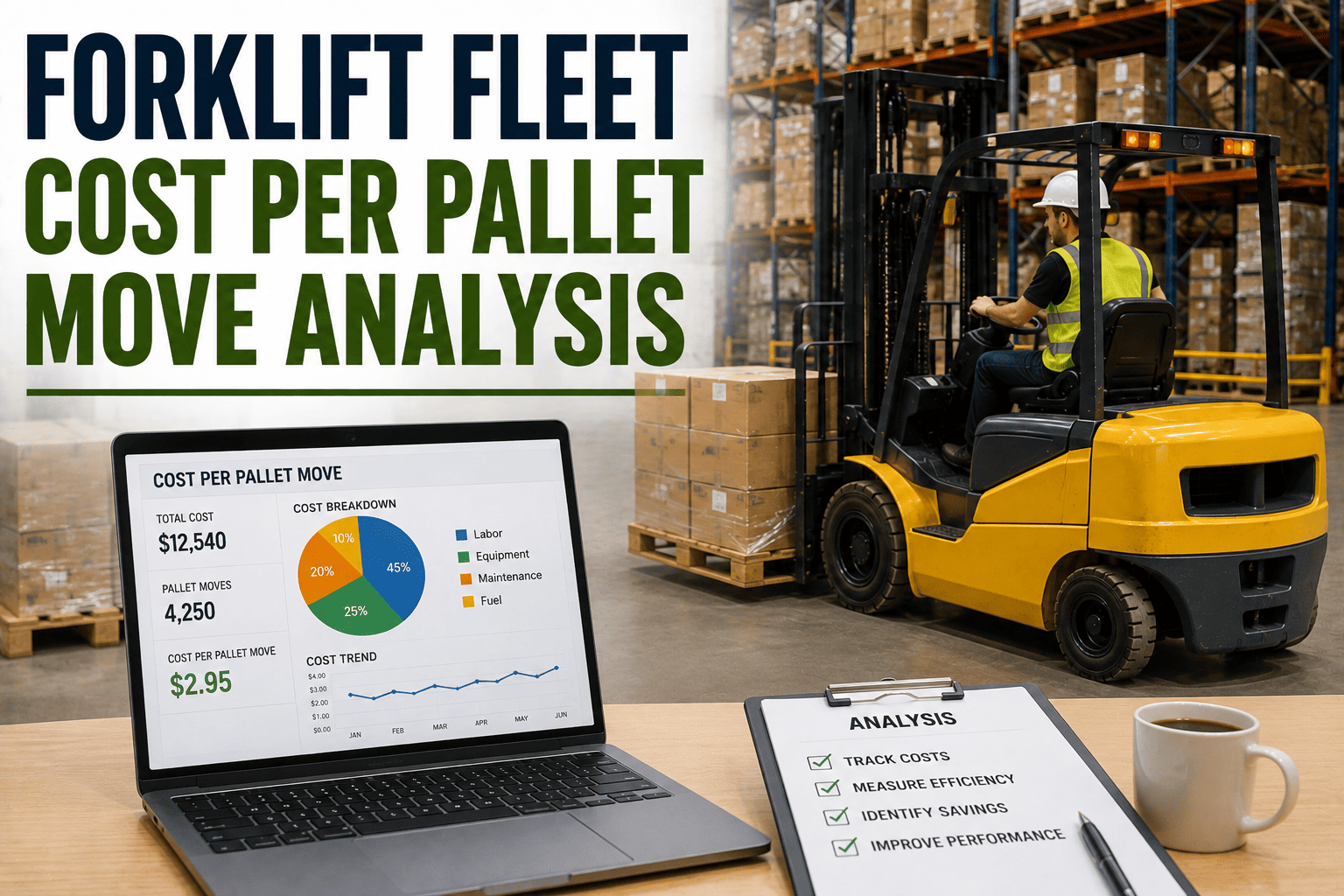
Ask a plant manager what their forklift fleet costs and most will answer in dollars per hour or dollars per year. Neither number tells you whether that spend is actually productive. A truck can run a full shift, log plenty of hours, and still move far fewer pallets than it should because of long travel distances, waiting time, or a route that was never optimized. Cost per pallet move fixes that blind spot. It ties fleet spend directly to the one thing a forklift exists to do, move pallets, so every dollar of cost has an output attached to it instead of floating free as an hourly rate.
Cost per pallet move combines equipment cost per pallet and labor cost per pallet into a single productivity number, calculated by dividing annual equipment cost and annual labor cost separately by total pallets moved, then adding the two together. Average forklift operating cost runs roughly 15 to 25 dollars per hour once fuel or electricity, maintenance, and depreciation are included, and material handling typically consumes 2 to 5 percent of manufacturing revenue, with labor alone making up 60 to 70 percent of that spend. Cost per pallet move is what turns those numbers into a metric you can actually act on.
Why Cost Per Hour Alone Hides the Real Problem
Cost per hour tells you what a forklift costs to keep running. It says nothing about what that truck actually accomplished during those hours. Two forklifts can post identical hourly costs while one moves twice as many pallets as the other, because of shorter travel distances, better routing, or simply less time spent idle between tasks. Cost per pallet move exposes that gap by pricing the output, not just the input.
Building the Formula
Cost per pallet move is built from two separate calculations added together: what equipment costs per pallet, and what labor costs per pallet. Keeping them separate matters, because the fix for a high equipment number is different from the fix for a high labor number.
Equipment cost includes depreciation or lease payments, fuel or electricity, and maintenance. Labor cost includes operator wages and benefits for the hours spent moving those pallets. Isolating both halves shows whether a high cost per pallet is an equipment problem, a labor problem, or both.
FleetRabbit ties every forklift's cost data to its actual pallet moves, so you see cost per pallet by unit, zone, and shift instead of a flat hourly rate. Sign up free and calculate your fleet's real number.
What Actually Inflates Cost Per Pallet Move
The same monthly fleet spend can produce a very different cost per pallet depending on how well that spend translates into completed moves. These are the factors that push the number up most often.
Why Labor Deserves Special Attention
Labor typically makes up 60 to 70 percent of total material handling cost, which means most of the opportunity to lower cost per pallet move sits on the labor side of the formula, not the equipment side. Route efficiency, shift scheduling, and reducing the number of times a pallet is touched before reaching its destination usually move the number more than equipment upgrades alone.
Benchmark Ranges by Equipment Type
Different equipment types carry very different cost structures, which shows up directly in cost per pallet move even before labor is factored in.
| Equipment Type | Typical Hourly Operating Cost | Cost Per Pallet Tendency | Best Fit |
|---|---|---|---|
| Electric Forklift | Lower energy cost, roughly 60 to 70 percent less than propane equivalents | Lower, especially in high-volume indoor operations | High-frequency indoor pallet movement |
| Internal Combustion Forklift | Higher fuel cost, more variable with fuel pricing | Higher unless offset by high move volume | Outdoor or mixed-terrain, high-throughput yards |
| Pallet Jack (Manual or Electric) | Lower upfront and operating cost than forklifts | Lower equipment cost, but labor cost per pallet often rises | Short-distance, low-volume, tight-aisle moves |
Four Levers to Bring Cost Per Pallet Move Down
Tracking the Trend, Not Just the Number
A single cost-per-pallet snapshot is useful, but the real value comes from tracking it month over month by zone and shift. A rising trend flags a workflow or equipment issue early, while a falling trend confirms that a change actually worked instead of just feeling like it did.
FleetRabbit connects motion data, maintenance cost, and labor hours to actual pallet volume, showing exactly which zones and shifts are dragging your cost per pallet up. Book a free demo to see it applied to your own plant.
How FleetRabbit Automates the Calculation
Calculating cost per pallet move by hand means pulling equipment cost from one system, labor hours from another, and pallet counts from a third, then reconciling all three manually every reporting period. FleetRabbit connects telematics, maintenance records, and throughput data into one dashboard, so cost per pallet move updates automatically at the unit, zone, and shift level. Instead of discovering a productivity problem in a quarterly report, plant teams see it as soon as the trend starts moving in the wrong direction. You can start a free trial to connect your fleet data, or book a demo to see a live cost-per-pallet breakdown before your next budget review.
Frequently Asked Questions
An hourly rate tells you what the fleet costs to run. Cost per pallet move tells you whether that spend is actually productive. FleetRabbit connects the data automatically, so the number is always current and the waste driving it up is easy to find.