A forklift strikes a rack, clips a pedestrian, or tips on a turn, and the first instinct on most plant floors is to fix the immediate damage and get the truck back in service. But the visible cause of an incident, an operator turning too fast or a load stacked too high, is almost never the whole story. Underneath it sits a system-level reason it was allowed to happen: a blind corner nobody geofenced, a training gap nobody flagged, a maintenance issue nobody logged. Skip that deeper layer and the same incident, or a worse version of it, tends to happen again.
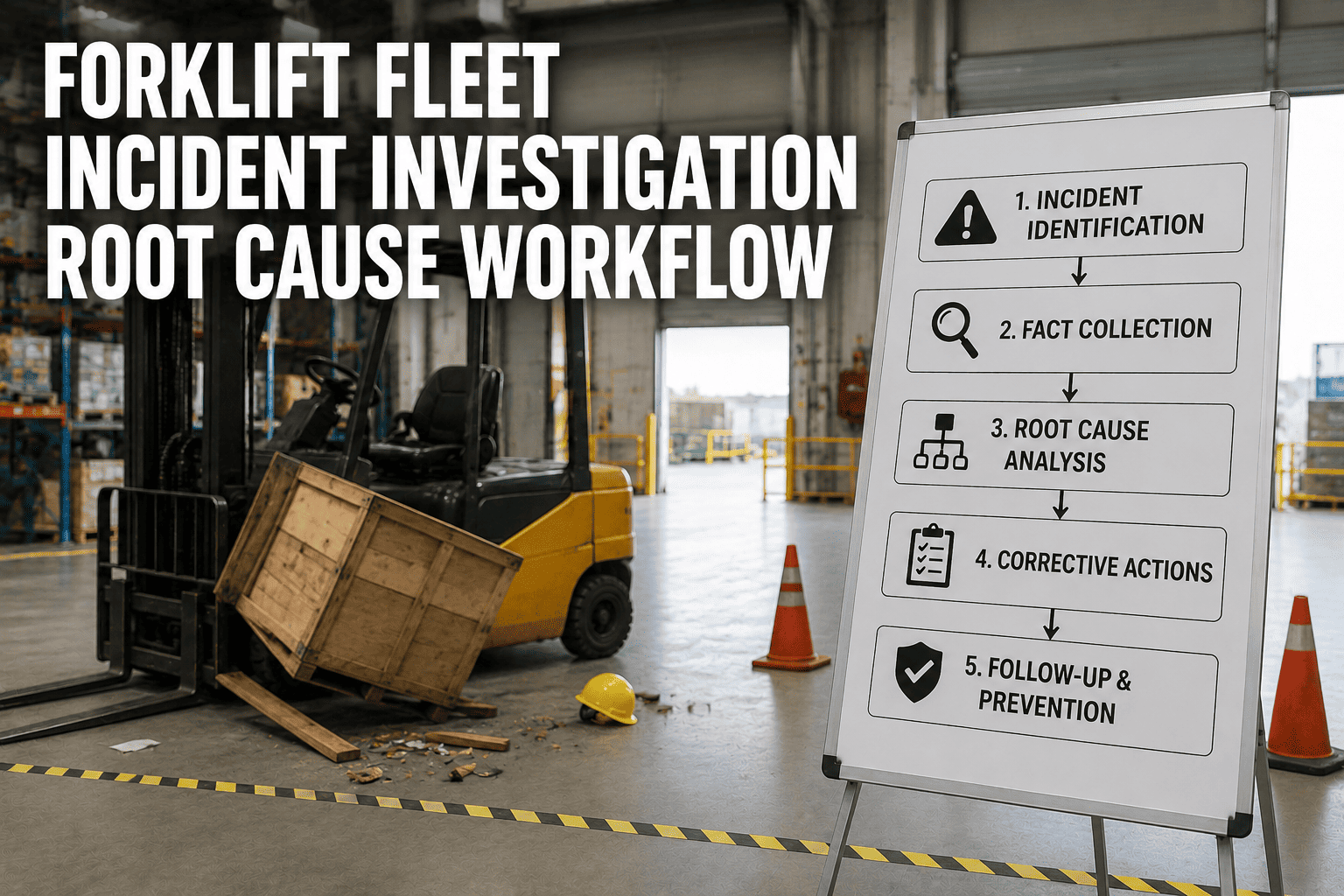
A forklift incident investigation should move through five steps: respond and secure the scene, collect evidence, reconstruct the timeline, identify the root cause, and put a corrective action in place with a follow-up check. A root cause is the underlying, system-related reason an incident occurred, not just the immediate action that triggered it. Most serious forklift incidents involve more than one contributing factor, which is why a single-cause explanation rarely holds up under review.
A Five-Step Investigation Process That Holds Up
OSHA's guidance on incident investigation frames the goal as understanding what happened, why it happened, and what has to change so it does not happen again. Applied to a forklift incident, that guidance breaks down into five steps.
Step One: Respond And Secure The Scene
The immediate priority is care for anyone injured and control of the hazard, followed by securing the area so evidence is not disturbed. A scene that gets cleaned up too quickly loses details that matter later, from skid marks to the exact position of a load.
Step Two: Collect Evidence Systematically
A thorough investigation gathers photos of the scene, witness statements taken separately, an inspection of the truck involved, and a review of the operator's training and certification records. Each of these is a piece of a picture that only becomes clear once they are put together.
Step Three: Reconstruct The Timeline
Where was the truck, at what speed, doing what task, in the minutes leading up to the incident? A reconstructed timeline, built from telematics data where it exists rather than recollection alone, turns a vague account into a sequence investigators can actually analyze.
Step Four: Identify The Root Cause
This is the step that separates a surface explanation from a real one. The goal is to look past the operator's action and ask what allowed that action to result in an incident: a missing zone speed limit, a blind spot in the layout, a gap in training, or a maintenance issue that had been building for weeks.
Step Five: Corrective Action And Follow-Up
A finding without a fix changes nothing. The investigation should end with a specific corrective action, an owner responsible for it, and a follow-up check confirming the fix actually addressed the problem rather than just closing the file.
FleetRabbit pulls together speed, location, impact detection, and inspection history around every incident, so your investigation starts with facts instead of guesswork. Sign up to see your fleet's incident data mapped automatically, or book a demo to walk through a reconstructed timeline.
Root Cause Methods That Go Beyond The Obvious Answer
Two methods cover most forklift incident investigations well, and each is suited to a different kind of event.
Five Whys For Single-Chain Incidents
For a straightforward event with one clear causal chain, asking why repeatedly, five times as a rule of thumb, usually walks an investigation from the surface cause down to the system-level one. A truck struck a rack because the operator turned too fast, because the aisle narrows unexpectedly at that point, because the layout was never updated after new racking was installed. The layout gap, not the turn, is the root cause worth fixing.
Fishbone Mapping For Multi-Factor Incidents
Serious incidents rarely have one cause. A fishbone diagram maps every contributing factor across categories such as equipment, environment, training, and procedure, branching off a central line pointing to the incident. A pedestrian struck in a warehouse aisle, for example, might trace back to poor lighting, no marked crossing, an operator behind schedule, a blocked mirror, and no zone speed limit, all at once. An investigation that stops at the first explanation misses the other four hazards still sitting on the floor.
| Surface Explanation | What It Misses | Likely Root Cause | Corrective Action |
|---|---|---|---|
| Operator turned too fast | Why the speed felt necessary or normal at that point | No zone speed limit enforced at the corner | Add an automatic speed cap for that specific zone |
| Pedestrian stepped into the aisle | Why the operator did not see them in time | Blind corner with no marked crossing or mirror | Install visibility aids and a marked pedestrian crossing |
| Forklift brakes failed | Whether the issue had been reported before | Defect flagged on a prior inspection but never repaired | Close the loop between inspection logs and maintenance work orders |
| Load fell from the forks | Whether the operator was certified for that truck type | Certification did not cover the specific truck or load type used | Verify equipment-specific certification before assignment |
Closing The Loop On Every Finding
A root cause analysis only prevents a repeat incident if the corrective action actually gets implemented and checked. Investigations that end with a written report and no follow-up tend to produce the same finding again, just with a different date on it.
What A Closed-Loop Investigation Looks Like
A corrective action needs three things to actually stick: a specific owner responsible for completing it, a due date, and a follow-up check confirming the fix works in practice, not just on paper. Near misses deserve the same discipline as full incidents, since the same underlying gap is what eventually produces a serious one. Sign up for a free trial to start logging near misses alongside incidents, or book a demo to see how findings connect to tracked corrective actions.
Frequently Asked Questions
Every incident deserves a real answer, not just a closed file. FleetRabbit brings together the speed, location, and inspection history around every event, so your team can find the actual root cause and fix it before it happens again.