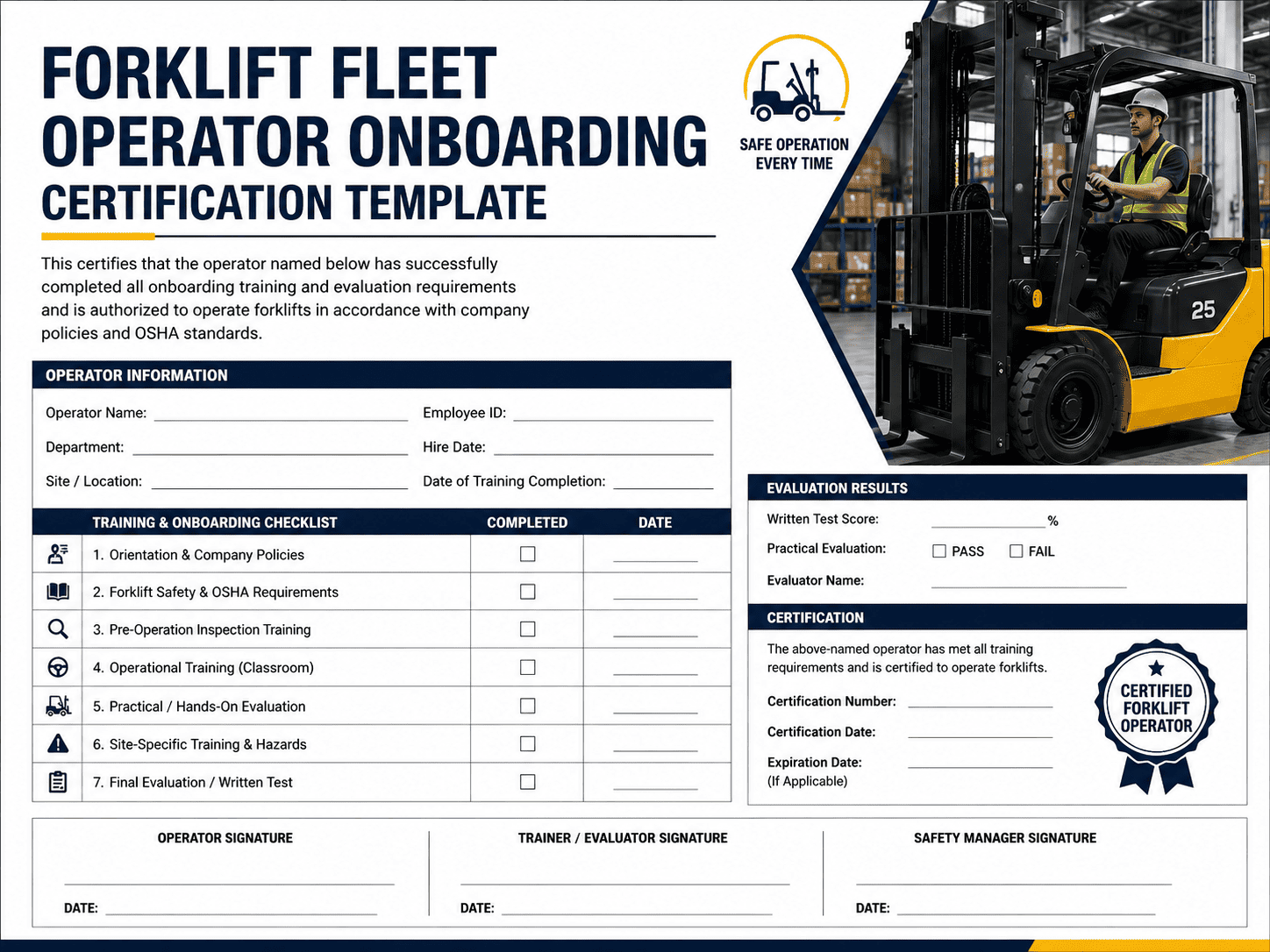
A new forklift operator walks onto your plant floor on their first day with a valid certification card from a previous employer and zero knowledge of your facility's specific equipment, traffic patterns, hazard zones, and operating procedures. That certification card means they passed a written test and driving evaluation somewhere else, under different conditions, with different equipment. It does not mean they are ready to operate a forklift in your facility safely. The gap between generic certification and facility-specific readiness is where most onboarding programs fail, and it is the gap where most early-tenure incidents occur. A structured onboarding template closes this gap by defining exactly what every new operator must learn, practice, and demonstrate before they are cleared for independent operation in your specific environment.
Operators in their first 90 days of employment account for 35 to 45 percent of all forklift incidents despite representing a small fraction of the total workforce at any given time. Facilities using a structured onboarding template reduce first-90-day incidents by 50 to 65 percent compared to facilities that rely on informal ride-along orientation. The template ensures no critical training element is skipped regardless of which supervisor conducts the onboarding.
The Five-Phase Onboarding Template Structure
An effective forklift operator onboarding template organizes the entire new-hire integration process into five sequential phases. Each phase has defined objectives, required activities, documentation outputs, and a clearance criterion that must be met before the operator advances to the next phase. This phased approach prevents the most common onboarding failure, which is moving a new operator too quickly from orientation to independent operation because a supervisor needed to fill a shift vacancy. When the template defines clear gates between phases, advancing an operator before they are ready requires a deliberate override decision with documented justification rather than an informal shortcut that nobody tracks.
Phase One: Facility Orientation in Detail
Facility orientation on day one must cover information that is specific to your plant, not generic forklift safety information that the operator should already know from their prior certification training. Generic content like "always wear your seatbelt" wastes time and signals to the new operator that your program is not serious about facility-specific knowledge. Focus orientation time on the things that are different about your facility compared to wherever the operator previously worked. Your traffic flow pattern, including one-way aisles, designated crossing points, and speed-restricted zones, is almost certainly different from their previous facility. Your hazard zone locations, particularly areas where forklifts interact with pedestrians, may be arranged differently than what they are accustomed to. Your emergency procedures, including evacuation routes, assembly points, and fire suppression system locations, are facility-specific knowledge that no prior training can provide.
The Orientation Walk-Through Method
The most effective orientation delivery method is a physical walk-through of the facility with the new operator, led by the assigned mentor or supervisor. The walk-through follows the actual traffic routes the operator will use during their shifts, stopping at each decision point, hazard zone, and pedestrian interaction area to explain the expected behavior. This method is far more effective than a classroom orientation because the operator sees the environment in context rather than trying to remember a map or diagram. The walk-through should take 60 to 90 minutes and should cover every area where the operator will operate during their first month. As the operator progresses through subsequent onboarding phases, the routes they actually drive will reinforce what they learned during the orientation walk-through, creating a multi-exposure learning pattern that accelerates retention. You can sign up for FleetRabbit to get a digital orientation checklist template that ensures every walk-through covers the same critical points regardless of who leads it.
Phase Two: The Mentor Assignment and Supervised Driving
The mentor assignment is the single most influential decision in the entire onboarding process. The new operator will model their driving behavior, their inspection habits, and their attitude toward safety rules based heavily on what they observe their mentor doing during the first week. Assigning a high-performing, safety-conscious operator as mentor sets the new hire on a positive trajectory. Assigning a mediocre operator who takes shortcuts under pressure teaches the new hire that shortcuts are acceptable. The mentor selection criteria should include a minimum of 12 months tenure at your facility, a clean safety record with no preventable incidents in the past 6 months, a consistently high pre-shift inspection completion rate, and a communication style that is patient and instructive rather than dismissive or rushed.
The Supervised Driving Progression
Supervised driving during week one should follow a deliberate progression that builds competence incrementally rather than throwing the new operator into full-duty driving on day two. Start with empty travel in low-traffic areas where the operator practices basic steering, braking, and spatial awareness without the cognitive load of load handling. Progress to light loads at low lift heights in the same low-traffic areas. Then move to moderate loads at moderate heights. Finally, introduce traffic and pedestrian interaction in controlled scenarios. Each progression step should require the mentor to sign off that the operator demonstrated competence at that level before advancing. This structured progression typically takes 4 to 5 days for operators with prior forklift experience, and 7 to 10 days for operators who are entirely new to forklift operation. The temptation to compress this timeline because of staffing needs is the most dangerous onboarding shortcut because it sends an underprepared operator into independent operation where their risk of incident is highest.
FleetRabbit tracks each new operator through all five onboarding phases with mentor sign-offs, evaluation scores, and certification expiration dates. Supervisors see at a glance which operators are on track and which phases need attention. Certification expirations trigger automatic 90-day and 30-day advance warnings so no operator operates on an expired credential.
Phase Three: Equipment Qualification Across Types
Multi-type fleets require explicit qualification on each equipment type because operating a counterbalance forklift does not prepare an operator to safely operate a reach truck, order picker, or turret truck. The equipment qualification phase during weeks two and three must document competency on each specific type the operator will use. The qualification process for each type follows the same supervised driving progression used in phase two but applied to the specific operational characteristics of that equipment type. A reach truck qualification must include reach mechanism operation, extended height handling, and wire guidance if equipped. An order picker qualification must include platform operation at height, fall protection procedures, and elevated picking ergonomics. The qualification is complete when the operator demonstrates competent operation of that equipment type under normal working conditions as observed and signed off by the mentor or supervisor.
Equipment Qualification Sign-Off Requirements
| Equipment Type | Specific Qualification Requirements | Minimum Supervised Hours | Sign-Off By |
|---|---|---|---|
| Counterbalance Sit-Down | Standard load handling, dock operations, trailer loading and unloading | 20 hours | Shift supervisor |
| Counterbalance Stand-Up | Compact space maneuvering, low-height order selection, narrow aisle navigation | 16 hours | Shift supervisor |
| Reach Truck | Reach mechanism, extended height handling, wire guidance operation, narrow aisle behavior | 24 hours | Warehouse lead |
| Order Picker | Platform operation at height, fall protection procedures, elevated picking ergonomics | 20 hours | Warehouse lead |
| Turret Truck | Turret rotation, rail guidance, high-level camera-guided operation, very narrow aisle | 30 hours | Operations manager |
Phase Four: The Formal Evaluation
The formal evaluation at week four is the gate that determines whether the operator is cleared for independent operation or requires additional supervised time. The evaluation has two components that must both be passed independently. The written knowledge test covers facility-specific information that the operator should have absorbed during orientation and supervised driving. Questions should address traffic patterns, speed limits, hazard zones, emergency procedures, pre-shift inspection requirements, and facility-specific operating rules. The test should not repeat generic forklift safety knowledge that was covered in the operator's prior certification training. The driving evaluation uses a standardized scoring rubric that assesses specific observable behaviors during a defined evaluation route that includes all major operating scenarios the operator will encounter in normal work.
Driving Evaluation Scoring Rubric
Minimum Passing Score and Failure Handling
The minimum passing score for the driving evaluation should be 80 out of 100 points. Any score below 80 requires the operator to repeat supervised driving for a minimum of one week in the specific categories where they scored below the passing threshold for that category. An operator who scores well on vehicle operation but poorly on load handling repeats supervised driving focused on load handling scenarios rather than repeating the entire evaluation. A score below 60 points on any single category is an automatic failure of the full evaluation regardless of the total score, because a severe deficiency in any single area represents an unacceptable risk in independent operation. Operators who fail the evaluation are not terminated but are returned to supervised driving with a documented improvement plan that specifies what must improve before re-evaluation. If you want to see how FleetRabbit's evaluation scoring templates work with automatic pass/fail determination, book a demo with FleetRabbit and we will walk through the scoring workflow.
Phase Five: Certification Verification and Expiration Tracking
The final phase confirms that the operator's OSHA-compliant forklift operator certification meets all requirements and establishes the tracking foundation that prevents the certification from expiring without renewal. OSHA regulation 1910.178 requires that all forklift operators be evaluated every three years. This three-year evaluation is separate from the initial certification training and must be documented as a distinct event. Many facilities fail to track the three-year recertification deadline, resulting in operators who have technically been operating on expired certifications for months or years before anyone notices. The onboarding template captures the operator's current certification date at hire, calculates the three-year recertification deadline, and enters that deadline into the tracking system with automated advance notifications.
Certification Documentation Requirements
Common Onboarding Template Mistakes
The most damaging mistake is skipping or compressing phases to fill immediate staffing needs. When a shift is short-staffed and a new hire is available, the pressure to put them into independent operation before onboarding is complete is intense. Every time this shortcut is taken, the facility accepts the elevated incident risk that comes with an underprepared operator. The second common mistake is treating onboarding as a one-time event rather than a process with checkpoints. The supervisor conducts orientation on day one and then assumes the operator is progressing through subsequent phases without verifying or documenting the progression. When an incident occurs, the documentation gap reveals that there is no evidence the operator actually completed any supervised driving, equipment qualification, or formal evaluation before being cleared for independent operation. The third mistake is failing to adapt the template for experienced operators versus new operators. An operator with five years of forklift experience at another facility does not need the same supervised driving duration as a first-time operator, but they absolutely still need facility orientation, equipment qualification on your specific types, and the formal evaluation. Skipping these for experienced operators because they "obviously know what they are doing" is exactly the assumption that leads to incidents when experienced operators encounter unfamiliar situations in your facility that their prior experience did not prepare them for.
The Template Is Only as Strong as the Discipline to Follow It
Every facility has an onboarding process of some kind. The difference between a facility that experiences high early-tenure incident rates and one that does not is not whether they have a template. It is whether they follow it. A template that sits in a binder or a shared drive is documentation that protects the company after an incident. A template that is actively used, tracked, and enforced prevents the incident from happening. The five-phase structure provided here gives you the content. The digital tracking system gives you the visibility. The mentor selection criteria give you the quality control. The evaluation rubric gives you the objective gate. The only remaining variable is whether your supervisors and mentors execute each phase with the discipline the template requires. Facilities that do, see their new operators transition from liability to asset within 30 days. Facilities that do not, see the same new operators become their next incident statistic. The template cannot enforce itself. But it makes enforcement possible, visible, and verifiable in ways that informal processes never can.
FleetRabbit gives your onboarding template a digital home where every phase, sign-off, evaluation score, and certification date lives in one place. Supervisors see which operators are in which phase. Mentors log supervised driving hours from their phone. Evaluation scores are calculated automatically from the rubric. Certification expirations never sneak up unnoticed. Start building onboarding consistency that survives supervisor turnover and staffing pressure.