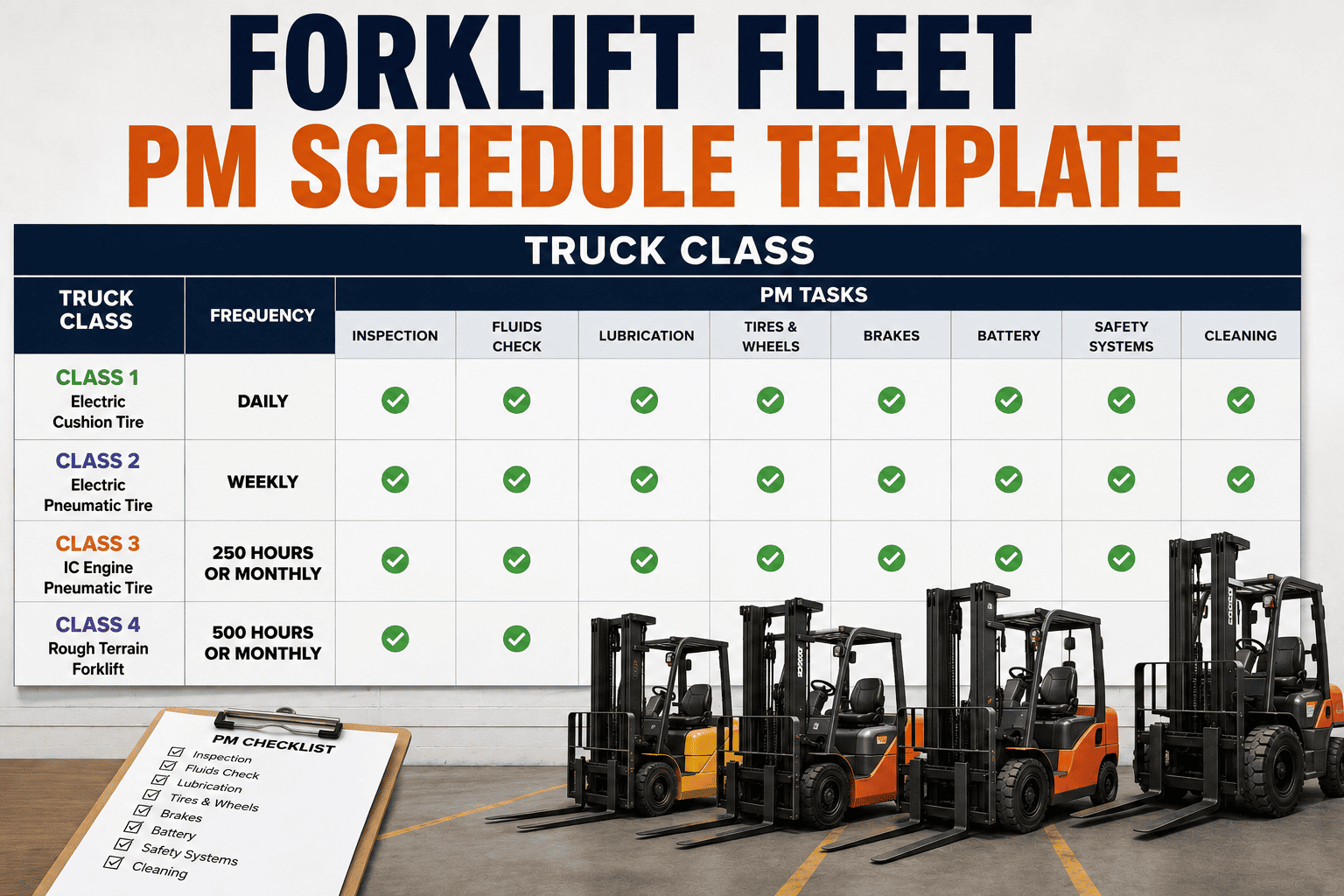
Ask five forklift managers when their trucks get serviced and you'll often get five different answers, most of them based on the calendar rather than actual use. A forklift running three shifts a day racks up wear roughly six times faster than one running an hour a day in a small parts room, which means a calendar-based schedule either over-services the light-use truck or badly under-services the heavy-use one. The fix isn't complicated, but it does require building a schedule around operating hours and around what class of truck you're actually maintaining, since a Class I electric rider and a Class V pneumatic-tire IC truck wear out in completely different ways.
Forklift manufacturers build preventive maintenance around hour-meter readings, not calendar time, with standard intervals at 250, 500, 1,000, and 2,000 operating hours. Each interval adds deeper service on top of the last: fluids and lubrication at 250 hours, brake and transmission checks at 500, major component inspection at 1,000, and a full teardown-level review at 2,000. The exact tasks shift depending on truck class, since electric, cushion-tire, and pneumatic-tire trucks each carry different wear points.
Why Hours Matter More Than The Calendar
A hydraulic pump, a brake actuator, a tilt cylinder, and a starter motor all wear based on how much they're actually used, not how many weeks have passed since the last service. That's the same logic aircraft maintenance runs on, measured in flight hours rather than dates. A forklift's hour meter is the equivalent instrument, and reading it weekly and logging the number is the single habit that prevents most of the surprise breakdowns fleet managers deal with.
The practical result is that two identical forklifts on the same lot can need service at wildly different real-world dates even though they're the exact same model. One running heavy three-shift work might hit 250 hours in four weeks. Another running light single-shift duty might take twelve. Scheduling by the calendar treats both the same and gets it wrong for one of them every time.
The Four Standard PM Intervals
Regardless of truck class, most manufacturers build their PM structure around four escalating checkpoints, each one layering more thorough work on top of the one before it.
FleetRabbit tracks hour-meter readings automatically and triggers a service reminder the moment a truck crosses its 250, 500, 1,000, or 2,000-hour threshold, so nothing slips through on a calendar assumption.
The Schedule Template By Truck Class
The 250/500/1,000/2,000-hour rhythm holds across most fleets, but what actually happens at each checkpoint depends heavily on truck class. An electric Class I rider has no engine oil to change but does have battery cells and connectors to watch. A Class IV or V internal combustion truck has fuel systems, exhaust components, and an engine that a Class I truck simply doesn't carry.
| Truck Class | Typical Use | Class-Specific PM Focus |
|---|---|---|
| Class I: Electric Rider | Warehouse and indoor floor work | Battery specific gravity, connector corrosion, contactor wear, drive motor brushes |
| Class II: Electric Narrow Aisle | Order pickers, reach trucks in tight racking | Mast roller wear, side-shift function, battery health, wheel and guide roller condition |
| Class III: Electric Hand Trucks | Pallet jacks and walkie stackers | Caster wheel wear, hydraulic pump seal condition, tiller arm and control head function |
| Class IV/V: Internal Combustion | Cushion tire indoor, pneumatic tire outdoor and rough surfaces | Engine oil and filter, fuel system, exhaust and emissions components, tire wear |
| Class VII: Rough Terrain | Outdoor yards, construction, uneven ground | Suspension and axle components, undercarriage debris clearing, extended tire and brake wear checks |
Electric Fleets Need A Different Rhythm
Electric trucks skip the oil-and-filter cycle entirely but bring their own maintenance discipline around the battery, which is arguably the single most expensive component in the fleet to neglect. Charging typically happens after an eight-hour shift or once the battery drops to around 30 percent capacity, and connectors need regular checks for corrosion, looseness, and heat buildup, since a bad connection wastes energy and accelerates wear on both the charger and the battery itself. Facilities running a mixed electric and IC fleet often find that treating both truck types with the same checklist misses half of what actually needs attention. A schedule built by class avoids that gap, and teams looking to set this up correctly can sign up for FleetRabbit to configure separate PM templates for each class in the fleet.
Chain Wear Is A Cross-Class Constant
One check that applies almost universally, regardless of power source, is lift chain elongation. Chains stretch gradually under repeated load cycles, and most manufacturers set a replacement threshold around 3 percent elongation from original length. This single measurement, taken with a simple chain wear gauge, is one of the most consistently skipped items on manual paper checklists, largely because it requires a tool most operators don't carry and a step that's easy to defer.
FleetRabbit lets you configure a distinct maintenance template for electric riders, narrow-aisle trucks, and IC pneumatic-tire units, so every truck gets exactly the checks its class actually needs at every hour interval.
Turning The Template Into A Schedule That Actually Runs
A PM template only works if the hour meter gets read consistently and the trigger for each service actually fires on time. In practice, that's where most manual programs quietly fail, since a weekly meter reading written on a clipboard is easy to skip during a busy week, and by the time anyone notices a truck is 400 hours overdue for its 500-hour service, the damage from delayed brake or drivetrain attention may already be done.
Digital fleet management closes that gap by pulling hour readings automatically and generating a work order the moment a truck crosses its threshold, matched to the correct class-specific template rather than a generic one. That also builds the kind of service history that reveals patterns, like a specific truck hitting the same fault repeatedly, which usually signals a deeper issue than the standard PM interval alone will catch. Facilities ready to move off paper-based scheduling can book a demo with FleetRabbit to see how hour-based reminders and class-specific templates work together.
A single generic PM checklist can't serve an electric rider and a pneumatic-tire IC truck equally well. FleetRabbit builds hour-based schedules by truck class, and reminds you automatically the moment service is due.