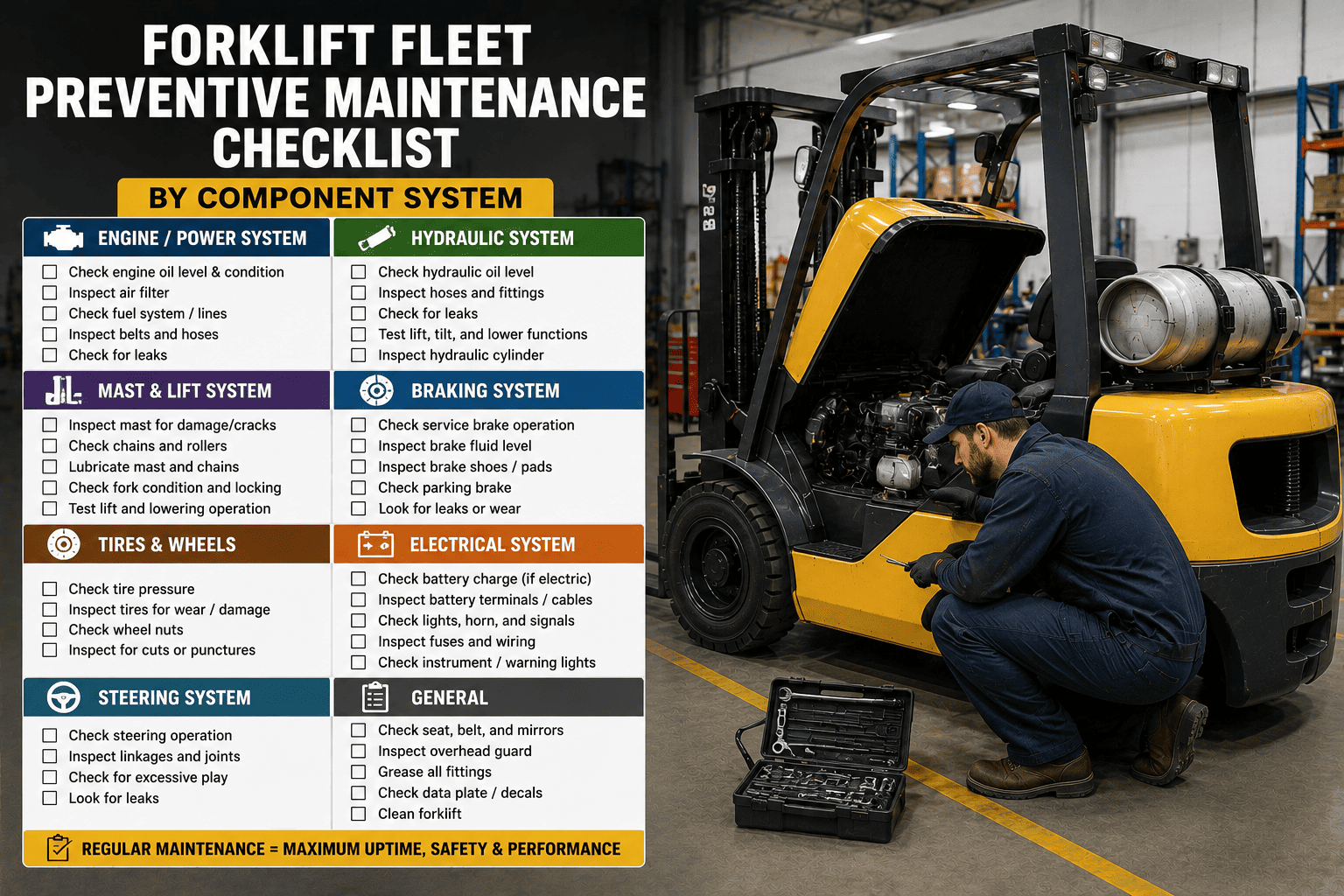
A daily pre-shift inspection catches what an operator can see and feel in five minutes. It will never catch a hydraulic filter approaching the end of its service life, a mast chain that has stretched past spec, or a battery cell drifting out of voltage balance. Those failures build quietly inside systems the operator never opens, and they only become obvious once a truck is already down. A preventive maintenance checklist organized by component system, not just by a single generic interval, is what catches them first.
A forklift preventive maintenance checklist by component system schedules service around the parts most likely to fail together: hydraulics, mast and lift chain, brakes and steering, battery and electrical, engine and transmission on internal combustion units, and tires and structural components. Most fleets follow a 250, 500, 1,000, and 2,000 operating-hour cadence, with lighter fluid and lubrication checks at 250 hours and deeper component-level service at 1,000 and 2,000 hours. Tracking maintenance by hour meter rather than calendar date, and by system rather than a single blanket checklist, is what prevents the "why is this truck down again" pattern most fleets eventually run into.
Why Component-System Checklists Beat a Single Generic List
A truck that runs 250 hours a month needs a completely different service rhythm than one that runs 250 hours a quarter, and a single blanket checklist tends to either over-service the light-duty truck or under-service the heavy-duty one. Splitting the checklist by system instead lets each one follow its own logical wear curve. Hydraulic seals degrade differently than brake components, and a battery ages on a completely different clock than a mast chain. Servicing all of them on one shared calendar date misses the point of preventive maintenance in the first place.
Hour Meters, Not Calendar Dates
The single most important discipline in any component-system program is reading the hour meter, not the calendar, to trigger service. A meter read weekly and logged consistently is what prevents most of the repeat-breakdown conversations fleet managers end up having every quarter. Tools like FleetRabbit pull hour data automatically so a service date never depends on someone remembering to check a dashboard.
FleetRabbit schedules preventive maintenance by hour meter and component system, not a shared calendar date, so nothing slips through because someone forgot to check a dashboard. Sign up for a free trial and build your checklist by system this week.
The Checklist, Organized by Component System
Hydraulic System
Every 500-600 HoursHydraulic performance loss is often the earliest sign of a developing fleet problem, showing up as slower lift speed or drift under load before a visible leak ever appears.
- Change hydraulic filter and inspect hoses and fittings for swelling or chafing
- Check fluid level, condition, and contamination at the sight glass
- Test lift and tilt cylinder operation for drift or slow response
Mast and Lift Chain
Every 250-1,000 HoursChain stretch and dry rollers create the classic "mast drifts down under load" symptom, one of the clearest early warning signs that service is overdue.
- Inspect chains for stretch and lubricate to manufacturer specification
- Check carriage rollers and rails for wear or damage
- Inspect load backrest and overhead guard mounts for cracks
Brakes and Steering
Every 500 HoursBrake pedal travel gradually getting longer over weeks is easy to miss day to day, which is exactly why it belongs on a fixed hour-based service interval instead of relying on someone noticing.
- Test brake pedal travel, parking brake holding force, and response
- Inspect and adjust steering linkages and tilt cylinders
- Lubricate steering components and chassis grease points
Battery and Electrical
Weekly to 500 HoursBattery neglect rarely announces itself with a dramatic failure. It shows up gradually as reduced run time, which is why voltage and connector checks need their own dedicated cadence separate from mechanical service.
- Inspect cell voltage uniformity and top off flooded lead-acid batteries with distilled water
- Check connector temperature under load and clean any corrosion
- Verify charging equipment and charging area meet safety requirements
Engine and Transmission
Every 200-1,000 HoursThis system applies to internal combustion forklifts and covers the components most directly tied to fuel and drivetrain performance over time.
- Change engine oil and filter, inspect and adjust drive belts
- Service the cooling system and pressure-test at the 1,000-hour interval
- Drain and refill transmission and differential fluid on heavily used units
Tires and Structural Components
Every 250-1,000 HoursTire wear and structural fatigue develop slowly and predictably, making them ideal candidates for a fixed inspection interval rather than a reactive fix after something fails.
- Check tire condition and pressure on pneumatic units, wear on cushion tires
- Inspect chassis welds, forks, and carriage for stress cracks
- Test horn, lights, backup alarm, and seat belt function
Electric vs. Internal Combustion: Where the Checklists Diverge
Electric and internal combustion forklifts fail differently, and treating both with an identical checklist means missing half the picture. Electric fleets need close attention to battery watering, connector heat, and charging habits, while internal combustion fleets carry the added burden of engine oil, cooling system, and fuel system service that electric units simply do not have.
| Interval | Electric Forklift Focus | Internal Combustion Focus |
|---|---|---|
| 250 Hours | Battery watering, connector check, tire condition | Oil and filter, belts, fluid top-off |
| 500 Hours | Hydraulic filter, brake test, mast lubrication | Hydraulic filter, brake test, transmission fluid |
| 1,000 Hours | Full electrical system inspection, drive motor check | Cooling system service, full electrical inspection |
| 2,000 Hours | Complete system overhaul, battery health assessment | Complete system overhaul, carburetion or fuel system service |
FleetRabbit applies the right checklist automatically based on power type, so electric and internal combustion trucks are never serviced against the wrong template. Book a demo to see how your mixed fleet gets organized.
A forklift does not fail all at once. It fails one system at a time, quietly, until enough small issues stack up into a truck sitting in the shop. A preventive maintenance checklist organized by component system catches each one on its own logical schedule instead of hoping a single blanket service date happens to line up with what every truck actually needs. Fleets that make this shift stop chasing the same repeat repairs every quarter and start seeing real, measurable uptime gains.
FleetRabbit schedules and tracks maintenance for every component system on every truck, triggered by real hour meter data instead of a shared calendar date. Start free and set up your checklist today, no credit card required.