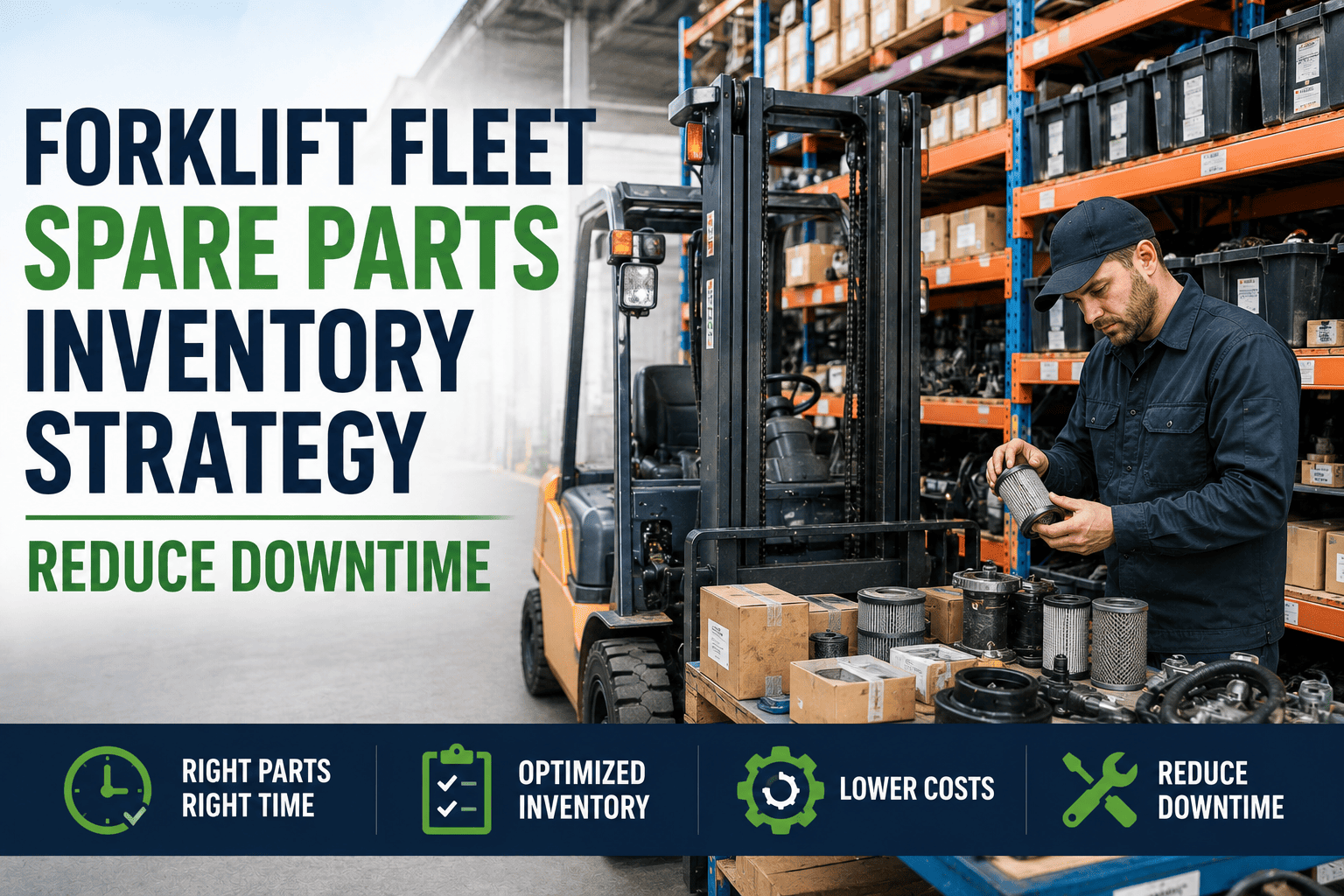
A forklift rarely dies from one big failure. It dies from a two-dollar seal that wasn't on the shelf when the hydraulic system needed it. While the maintenance team waits on a part, the whole aisle stops moving, orders back up, and a routine ten-minute fix turns into a two-day production hold. Spare parts inventory is the quiet variable that decides whether your forklift fleet keeps humming or keeps stalling, and most warehouses are managing it by guesswork instead of strategy.
Missing spare parts cause roughly a quarter of all unplanned forklift downtime, and a single stockout can stretch a same-day repair into a multi-day wait. A tiered stocking strategy that separates critical, important, and non-critical parts, paired with failure-history tracking, cuts stockouts sharply while freeing up capital that would otherwise sit frozen on a shelf. Start a free trial to see how FleetRabbit connects failure data to your parts shelf automatically.
Why Forklift Spare Parts Are a Different Problem Than Truck Parts
Forklifts don't fail like over-the-road trucks. They run in tight, repetitive cycles, inside a building, often across multiple shifts a day, which means wear accumulates fast on a small set of predictable components. Hydraulic hoses, forks, mast chains, tires, and battery connectors take the brunt of the punishment. A warehouse running three shifts might put more operating hours on a single forklift in a month than a delivery van sees in a year.
That concentrated wear pattern is actually good news for inventory planning. Unlike a long-haul fleet where failures are spread across hundreds of possible components and thousands of road miles, a forklift fleet's failure points are narrow and repeatable. Once you know which parts fail and how often, stocking the right shelf becomes a math problem instead of a guessing game.
The Cost of Getting It Wrong
When a needed part isn't on the shelf, the forklift doesn't just sit there, it takes the whole operation down a notch. Orders queue up behind it, other operators absorb its workload, and a technician who could have finished the repair in minutes instead spends the day chasing a supplier. Rush shipping and emergency sourcing routinely cost several times more than a part ordered on a normal cycle, and none of that premium shows up as "downtime" on a spreadsheet, it just quietly erodes the maintenance budget every month.
FleetRabbit connects every repair to the part that fixed it, so your stocking levels are built from your fleet's actual failure history instead of a supplier's default list. Start your free trial and turn three months of repair records into a stocking plan you can trust.
Build a Tiered Stocking Strategy, Not a Giant Shelf
The fastest way to fix a messy parts room is to stop treating every component the same way. Sort your inventory into three tiers based on how badly a shortage would hurt you, not on how much the part costs.
Critical Parts: Always In Stock
These are the components that sideline a forklift the moment they fail, and where local sourcing is slow: hydraulic hoses, lift chains, forks, and drive belts on your highest-use units. If a part shows up repeatedly in your last year of repair records, it belongs here, no exceptions.
Important Parts: Limited Buffer Stock
Sensors, control modules, and electrical components fall here. They fail less often than critical parts but can take days to source when they do. A small buffer, sized to your actual failure rate rather than a round number, keeps you covered without tying up excess cash.
Non-Critical Parts: Order As Needed
Trim pieces, cosmetic components, and rarely-used accessories don't justify shelf space. Order these against a specific work order and let your supplier carry the holding cost instead of your warehouse.
| Part Category | Examples | Typical Lead Time | Stocking Rule |
|---|---|---|---|
| Critical | Hydraulic hoses, lift chains, forks, drive belts | Hours to days if not on hand | Keep on hand at all times, sized to fleet failure history |
| Important | Sensors, control modules, connectors, filters | Several days to a couple of weeks | Hold a small buffer, set automatic reorder points |
| Non-Critical | Trim, decals, seat covers, minor accessories | Days to weeks, rarely urgent | Order against a specific work order only |
| Wear Items | Tires, batteries, brake components | Predictable, tied to usage hours | Schedule replacement by hours, not by failure |
How Much Should You Actually Stock
Overstocking and understocking usually come from the same root problem: nobody is looking at real usage data. Instead of picking round numbers, build your stocking levels from three inputs pulled straight from your maintenance history.
Failure Frequency By Component
Pull twelve months of repair records and count how often each part was replaced across your fleet. A part that shows up on 30 percent of work orders deserves a permanent spot on the shelf. A part that hasn't been touched in a year probably doesn't.
Hours Of Operation Per Unit
Two identical forklifts running different shift patterns wear out differently. A machine running heavy double shifts will chew through tires and hydraulic seals far faster than a light single-shift unit, so stocking levels should follow usage hours, not the calendar.
Lead Time From Your Supplier
The slower a part is to source, the more buffer stock it needs, even if it fails rarely. A cheap sensor that takes two weeks to arrive can cause more downtime than an expensive part your supplier stocks locally.
Technology Turns Guesswork Into a Stocking Plan
Spreadsheets and gut instinct can only get a parts room so far. The fleets that consistently avoid stockouts are the ones connecting maintenance history, part usage, and reorder points into one system that flags problems before they become downtime.
Automatic Reorder Alerts
Set a minimum threshold for each part and let the system flag it the moment stock dips below that line, instead of discovering the shortage when a technician opens an empty bin mid-repair.
Repair-To-Part Tracking
Every work order should log exactly which parts were consumed and on which unit. Over time, this builds the failure history that tells you which parts genuinely need shelf space and which ones don't.
Usage-Based Wear Forecasting
Tracking operating hours per forklift lets you predict when tires, batteries, and hydraulic components are due for replacement, so you can order ahead of the failure instead of reacting to it.
FleetRabbit brings these three pieces together in one place, linking every repair to the part that fixed it and every part to the machine that used it. Fleet managers who want to see this in action can book a quick demo and walk through their own repair history live.
FleetRabbit tracks every part your team uses, flags reorder points automatically, and shows you exactly which components are worth stocking. Stop over-buying parts that never move and start stocking the ones that actually keep your forklifts running.
Frequently Asked Questions
Every stalled forklift waiting on a part is a preventable loss. FleetRabbit connects your repair history to your parts shelf so the right components are on hand before the next breakdown, not after it.