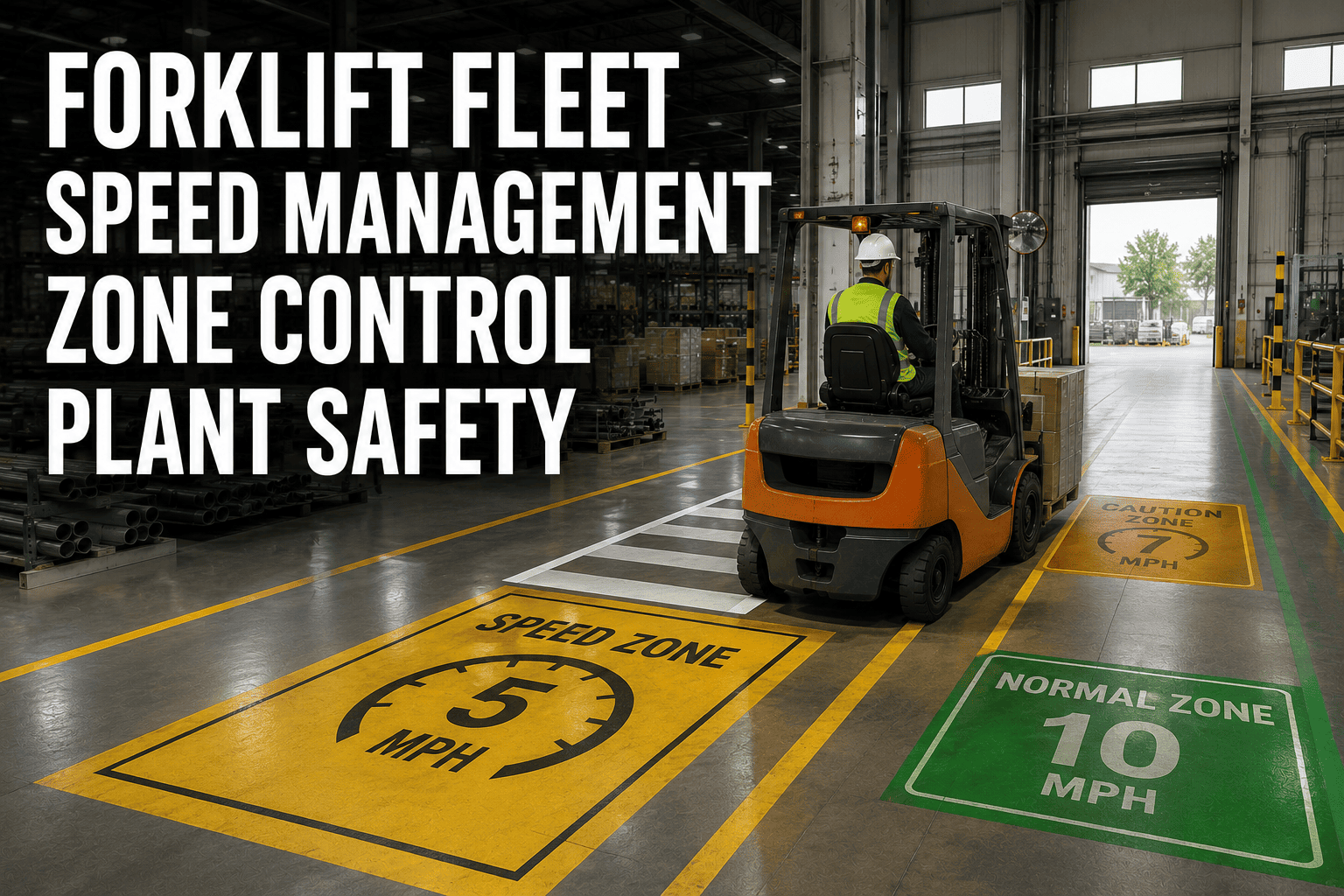
A forklift moving at just a few miles an hour over the safe limit can turn a routine turn into a tip-over, or a blind corner into a pedestrian strike. In busy plants where forklifts share aisles with people, racking, and loading docks, speed is the single variable that decides whether a near-miss stays a near-miss. Yet most facilities still rely on painted floor signs and verbal reminders to keep trucks slow in high-risk zones, and operators under pressure to hit throughput targets routinely drift past posted limits. Zone-based speed management flips that model: instead of hoping operators remember to slow down, the truck itself is automatically restricted the moment it enters a zone where speed matters most.
Zone-based speed control uses geofencing and onboard telematics to automatically cap forklift speed in defined plant areas such as pedestrian crossings, blind corners, and loading docks. Tip-overs account for roughly a quarter of all forklift accidents, and struck-by incidents involving pedestrians are consistently the leading cause of forklift-related fatalities. Enforcing speed by zone, rather than relying on signage alone, directly targets both of these top risk categories.
What Zone-Based Speed Control Actually Means
Zone-based speed control replaces a single, plant-wide speed limit with a layered set of limits that change automatically depending on where a forklift is operating. A truck cruising through an open, low-traffic aisle can move at a normal working speed, while the same truck approaching a pedestrian crossing, a blind corner, or a loading dock is automatically slowed, regardless of how the operator is driving. The system does the enforcement so supervisors are not stuck relying on signage, floor paint, or memory alone.
How Geofenced Zones Are Built
Using facility maps and telematics data, high-risk areas are marked out as digital zones layered over the actual plant floor. Each zone carries its own speed ceiling based on real risk factors: visibility, foot traffic density, proximity to racking, and how often the area is crossed by other vehicles. Once the zones are configured, every forklift equipped with the tracking hardware automatically recognizes which zone it has entered.
How the Speed Cap Is Enforced
When a truck crosses into a restricted zone, onboard controls step in and reduce the truck's maximum speed in real time, and the operator sees a visible or audible warning that a zone limit is active. If an operator repeatedly tries to override or push past a zone limit, that event is logged and flagged for a supervisor to review, turning a policy on paper into a rule the truck itself respects.
FleetRabbit maps your plant's highest-risk areas and enforces speed limits automatically, so pedestrian crossings and blind corners stay protected even when nobody is watching. Sign up to map your first zones in minutes, or book a demo to see it running on a live floor plan.
Designing Zone Speed Limits For Your Plant Floor
Not every part of a facility carries the same level of risk, so a workable zone policy usually groups the floor into four or five categories rather than treating the whole plant as one uniform space. The table below shows a common starting framework that most manufacturing and warehouse floors can adapt to their own layout.
| Zone Type | Typical Risk Factor | Recommended Speed Cap | Why It Matters |
|---|---|---|---|
| Pedestrian Crossings | High foot traffic, limited operator sightline | 2 to 3 mph | This is where struck-by incidents, the leading cause of forklift fatalities, most often occur |
| Blind Corners | No visibility until the turn is already underway | 2 to 3 mph | Sharp, fast turns combined with limited sightlines are a leading tip-over trigger |
| Loading Docks | Trailer edges, uneven dock plates, mixed vehicle traffic | 3 to 5 mph | Dock areas concentrate a large share of warehouse incidents in a small footprint |
| Racking Aisles | Narrow clearance, raised loads, close proximity to stock | 4 to 6 mph | Reduces rack strikes and product damage from tight, high-speed maneuvering |
| Open Transit Aisles | Wide clearance, low pedestrian density | 6 to 8 mph | Allows normal working speed where the risk profile genuinely supports it |
Why Zone-Level Enforcement Changes Plant Safety Outcomes
Blanket speed limits tend to fail in one of two directions. Set the limit low enough to protect the riskiest areas, and productivity suffers everywhere else. Set it high enough to keep throughput moving, and the riskiest areas stay under-protected. Zone-based enforcement removes that trade-off by matching the limit to the actual risk of the space a truck is passing through.
Fewer Struck-By Incidents
Because pedestrian crossings and blind corners automatically force a slower, more controllable speed, operators have more time to react and pedestrians have a better chance of being seen and avoided before contact happens.
Fewer Tip-Overs On Turns
Forklifts are rear-wheel steered and top-heavy when carrying an elevated load, which makes fast cornering one of the most reliable ways to trigger a rollover. Capping speed specifically at corners and junctions removes the operator's ability to take a turn too fast, even under pressure to move quickly.
Consistent Enforcement Across Every Shift
Verbal reminders and floor signage depend on supervisors being present and operators paying attention. A zone-based system applies the same limit at 2am on the night shift as it does at 10am with a safety manager standing nearby.
Documented Compliance
Every zone entry, every speed reduction, and every override attempt is logged automatically, giving safety teams a clear, timestamped record for OSHA documentation, insurance reviews, and incident investigations.
How FleetRabbit Puts Zone Speed Control On The Floor
FleetRabbit combines your facility layout with live telematics from every forklift to turn a paper safety policy into an enforced one. Zones are drawn directly onto your plant map, speed caps are assigned per zone, and the platform pushes those limits to each truck automatically as it moves through the facility. Supervisors get a live dashboard showing which trucks are in which zones, how often override attempts happen, and where near-miss patterns are forming before they become incidents. Sign up for a free trial to map your own zones, or book a demo to walk through the dashboard with our team.
Getting A Zone Speed Program Running
Most facilities can move from a blank floor plan to an enforced zone policy in a matter of weeks. Start by walking the floor with a safety lead to mark the areas that already generate the most near-misses. Assign a speed cap to each zone based on visibility and traffic density. Load the zones into the platform and let it run in alert-only mode for a short period so operators and supervisors can see the pattern of violations before hard enforcement begins. Once the baseline looks right, switch on automatic speed enforcement and let the trucks handle compliance on their own.
Frequently Asked Questions
Pedestrian crossings, blind corners, and loading docks do not need to depend on floor paint and good intentions. FleetRabbit enforces the right speed automatically, in the exact areas where it matters most, on every shift.