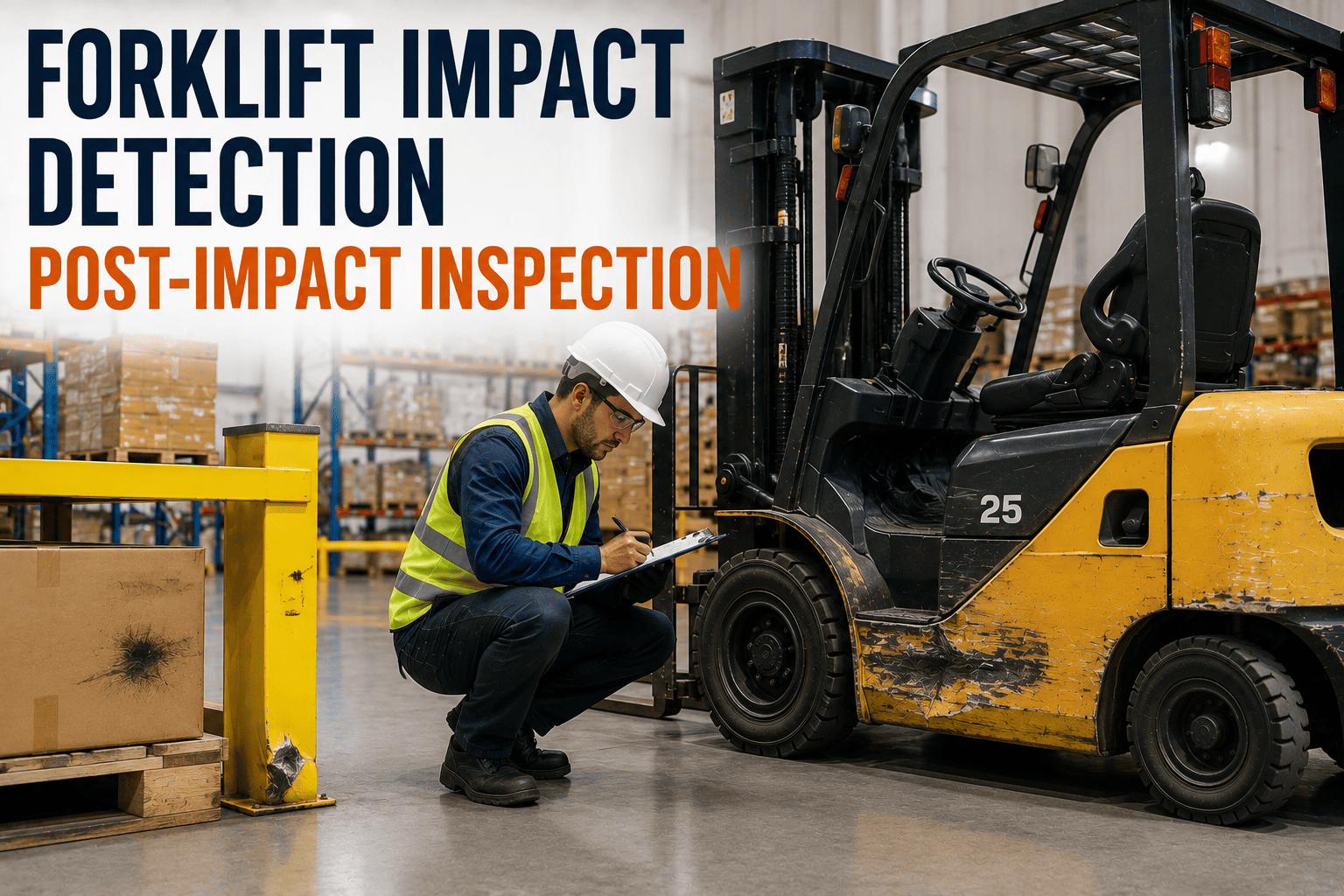
Most forklift collisions aren't dramatic. A fork clips a rack leg, a wheel catches a dock plate wrong, a load brushes a support column, and the operator keeps moving because nothing looks broken. That's exactly the problem. A minor impact that seems harmless in the moment can bend a mast, loosen a fork carriage, or compromise racking integrity in ways that only show up later, usually as a bigger failure or a safety incident.
Without a system to catch these events, most of them simply go unreported. The operator doesn't feel obligated to flag something that looked minor, and the plant has no record that anything happened at all. This guide covers how impact detection and post-impact inspection workflows close that gap, and how FleetRabbit logs every meaningful impact with the operator, location, and force behind it so nothing slips through unnoticed.
Forklift impact sensors measure collision force in G-force, with roughly 1G corresponding to an impact at about 22 mph. Most impacts are minor and go unreported because they appear harmless to the operator, yet a minor impact can still bend a mast, compromise a fork, or weaken structural racking. A structured detection and post-impact inspection workflow, tied to operator ID, location, and severity, ensures every meaningful event triggers a check before the unit returns to work.
Why Unreported Impacts Are A Bigger Problem Than They Look
A forklift can absorb a surprising amount of abuse without showing obvious damage. That resilience is also what makes unreported impacts dangerous. A slight bump to a conveyor bed can knock a system out of alignment without visible damage. A scrape against a rack upright can weaken its load capacity long before it visibly bends. None of this shows up on a routine walkaround unless someone knows exactly where to look.
Operators Rarely Self-Report Minor Events
Most low-speed impacts feel benign to the person driving. Without an objective record, there's little reason for an operator to flag something that didn't seem to cause damage, even when it did.
Damage Compounds Over Time
A single minor impact might not be a problem. Ten of them on the same forklift, or the same rack section, over a few months usually is. Without a log tying events together, that pattern is invisible until something finally fails.
How Impact Severity Is Actually Measured
Impact detection systems use accelerometers to measure the force of a collision across multiple directions and classify it by severity, typically low, medium, or high impact. That classification determines what happens next, from a simple log entry to an automatic vehicle shutdown requiring supervisor override.
| Severity Tier | Typical Trigger | Recommended Response |
|---|---|---|
| Low Impact | Minor bump or scrape, low G-force reading | Log the event automatically, review during routine data checks |
| Medium Impact | Noticeable jolt, moderate G-force reading | Alert supervisor, flag unit for inspection before next shift |
| High Impact | Significant collision, high G-force reading approaching or exceeding 1G | Immediate alert, remove unit from service pending full inspection |
Stop Relying On Operators To Self-Report Impacts
FleetRabbit logs every meaningful impact automatically, with the operator, location, time, and force behind it, so nothing depends on someone remembering to mention a bump.
The Post-Impact Inspection Workflow
Detecting an impact is only half the job. What happens in the minutes and hours afterward is what actually prevents a minor event from becoming a major failure.
What A Complete Impact Record Should Include
This is exactly what FleetRabbit builds into the fleet record. Every meaningful impact is logged with the operator, location, force, and time, and routed into a post-impact inspection workflow so a unit never quietly returns to the floor with hidden damage. If your plant is still relying on operators to self-report bumps and scrapes, it's worth seeing what full impact visibility looks like, and you can book a demo to see it applied to your fleet.
Turn Every Impact Into A Traceable Event
FleetRabbit captures g-force, operator, and location data for every impact and routes it into a clear inspection workflow, closing the gap that hides equipment damage and liability.
Frequently Asked Questions
Don't Let A Minor Bump Become A Major Failure
FleetRabbit logs every meaningful impact with the operator, location, and force behind it, so post-impact inspections happen before hidden damage turns into downtime or liability.