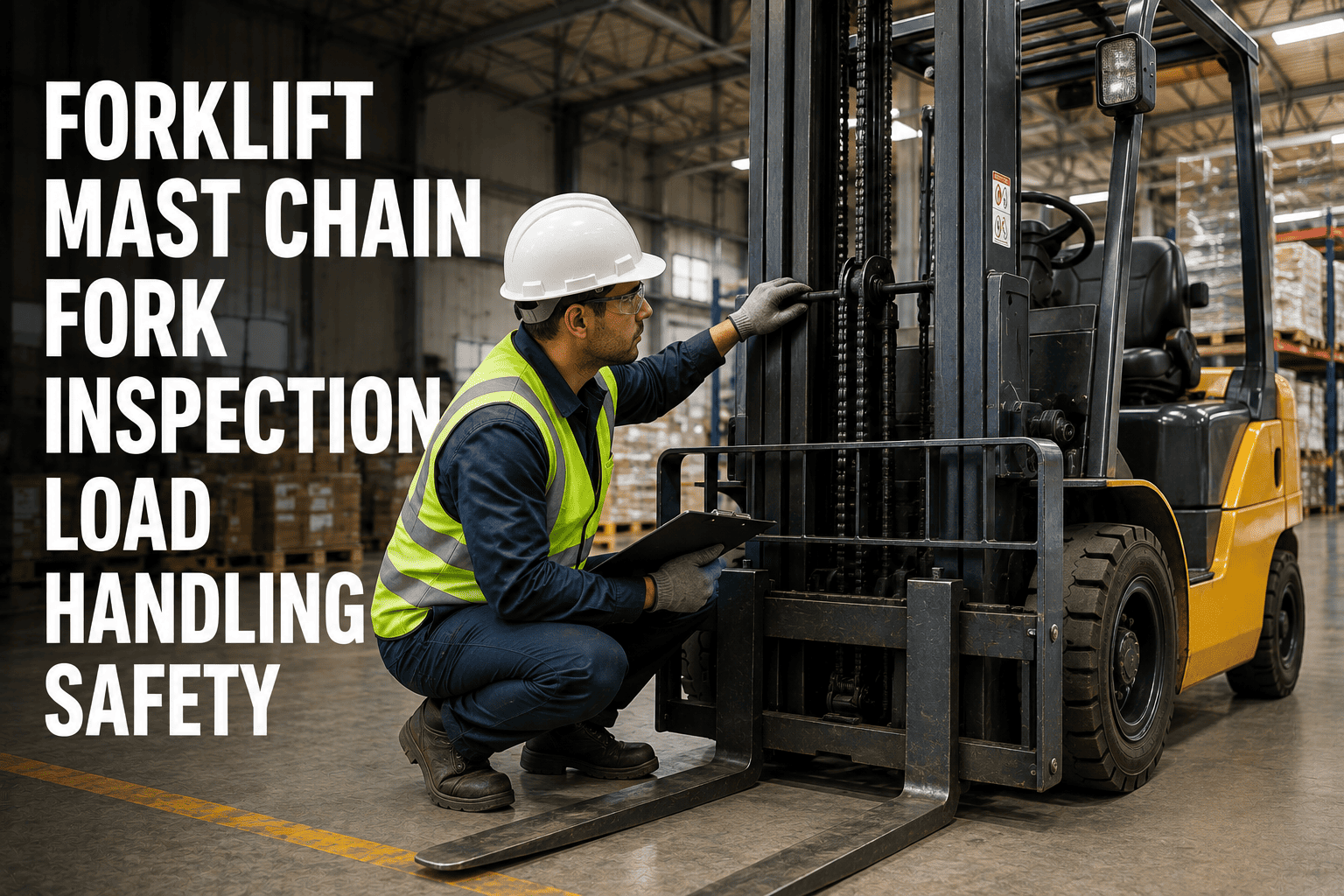
Every load a forklift lifts passes through three components that rarely get a second thought until something goes wrong: the mast that guides the lift, the chains that carry the weight, and the forks that actually touch the pallet. Unlike an engine problem that announces itself with noise or heat, wear in these three systems is largely invisible from the operator's seat. A fork can lose a meaningful share of its rated capacity through heel wear that looks like nothing more than surface polish, and a chain can stretch well past its safe limit while still looking straight and unbroken. That invisibility is exactly why mast, chain, and fork inspection deserves more attention than it typically gets on a busy plant floor.
ANSI/ITSDF B56.1 sets clear rejection limits for load-handling components: mast chains must be replaced once elongation exceeds 3 percent, fork blades and shanks are rejected once heel thickness drops to 90 percent of original, and a difference in fork tip height greater than 3 percent of blade length takes the forks out of service. As little as 10 percent metal loss at the fork heel can cut lifting capacity by 20 percent. FleetRabbit tracks these measurements against every truck's inspection history so worn components get flagged before they fail under load.
Three Systems, One Job: Keeping the Load Under Control
The mast, chains, and forks work as a single mechanical chain of trust. The mast provides the structure the chains run through, the chains transmit lifting force from the hydraulic cylinder to the carriage, and the forks are the last point of contact before a load leaves the ground. A weakness anywhere in that sequence transfers directly to load control, which is why standards bodies treat these three components as a linked inspection category rather than three separate checklists.
Why These Components Fail Quietly
Mast, chain, and fork wear is progressive and largely cosmetic-looking right up until the point of failure. A fork with 10 percent heel wear does not look dramatically different from a new one to the naked eye, yet that wear alone can cut its lifting capacity by roughly 20 percent. A chain stretched to 3 percent elongation still looks like a chain. This is precisely why standards bodies specify measured limits rather than visual judgment calls, and why a caliper or gauge check matters more here than in almost any other part of the machine.
The Load-Handling Blind Spot Most Plants Have
Daily pre-shift checklists tend to focus on brakes, steering, and hydraulics because those failures are more visible and more immediately dangerous in the moment. Mast, chain, and fork wear gets checked less rigorously precisely because it develops slowly, which is the opposite of how the risk should be weighted, since a chain or fork failure under a heavy load produces one of the most severe incident types a forklift fleet can experience. Plants that want measured wear tracked automatically rather than relying on periodic manual gauge checks can start a free trial and build fork and chain measurements into every scheduled inspection.
The Numbers That Define a Safe Fork or Chain
ANSI/ITSDF B56.1 gives plants precise, measurable rejection criteria rather than subjective judgment calls. Knowing these numbers, and actually measuring against them, is what separates a real inspection from a visual glance.
| Component | Measured Limit | Why It Matters | Action at Limit |
|---|---|---|---|
| Mast Chain | 3% elongation | Stretched chain reduces lifting strength and raises snap risk under load | Replace immediately |
| Fork Heel Thickness | 90% of original thickness | 10% metal loss at the heel can cut rated capacity by roughly 20% | Remove fork from service |
| Fork Tip Alignment | 3% of blade length | Uneven tips shift load balance and increase tip-over risk | Remove forks until repaired |
| Fork Blade Angle | 3° maximum deviation | A bent blade changes how the load sits and shifts its center of gravity | Remove fork from service |
FleetRabbit logs fork heel thickness, chain elongation, and tip alignment against ANSI/ITSDF limits for every truck, flagging components that are approaching rejection before they cross the line.
A Practical Weekly Check for Mast, Chain, and Fork Condition
Daily pre-shift checks catch the obvious problems. A slightly more deliberate weekly check, ideally by someone trained to use calipers and a chain gauge, catches the slow wear that a quick visual glance will not.
What Skipping This Inspection Actually Risks
A fork or chain failure under load does not produce a minor incident. When a heavily worn fork gives way or an elongated chain snaps mid-lift, the load drops without warning, and anyone working near or under it faces serious injury risk. These are exactly the high-severity incident types that make load-handling inspection worth the extra few minutes it takes, particularly on trucks running heavy, repetitive lifts day after day where wear accumulates fastest.
Turning Measured Limits Into a Repeatable Program
Knowing the numbers in the table above is only useful if someone is actually measuring against them on a schedule, and if those measurements get recorded somewhere a supervisor can review before a fork or chain quietly crosses into rejection territory. A program built on scattered paper notes tends to lose that history the moment a binder goes missing or a technician changes shifts.
Making Wear Data Visible Across the Whole Fleet
Once heel thickness, chain elongation, and tip alignment are tracked digitally per truck, patterns become obvious that a paper system would never surface, such as a specific truck or duty cycle wearing forks noticeably faster than the rest of the fleet. That visibility lets maintenance teams intervene with a proactive fork or chain swap instead of waiting for a failed inspection. Teams ready to move their wear tracking off paper can sign up for a free trial and start logging measurements against ANSI/ITSDF limits immediately.
Frequently Asked Questions
A fork or chain can lose significant load-handling strength while still looking fine to the eye. FleetRabbit tracks measured wear against ANSI/ITSDF limits for every truck, so worn components get replaced before they fail under load. Start free and put real numbers behind your load-handling safety program.