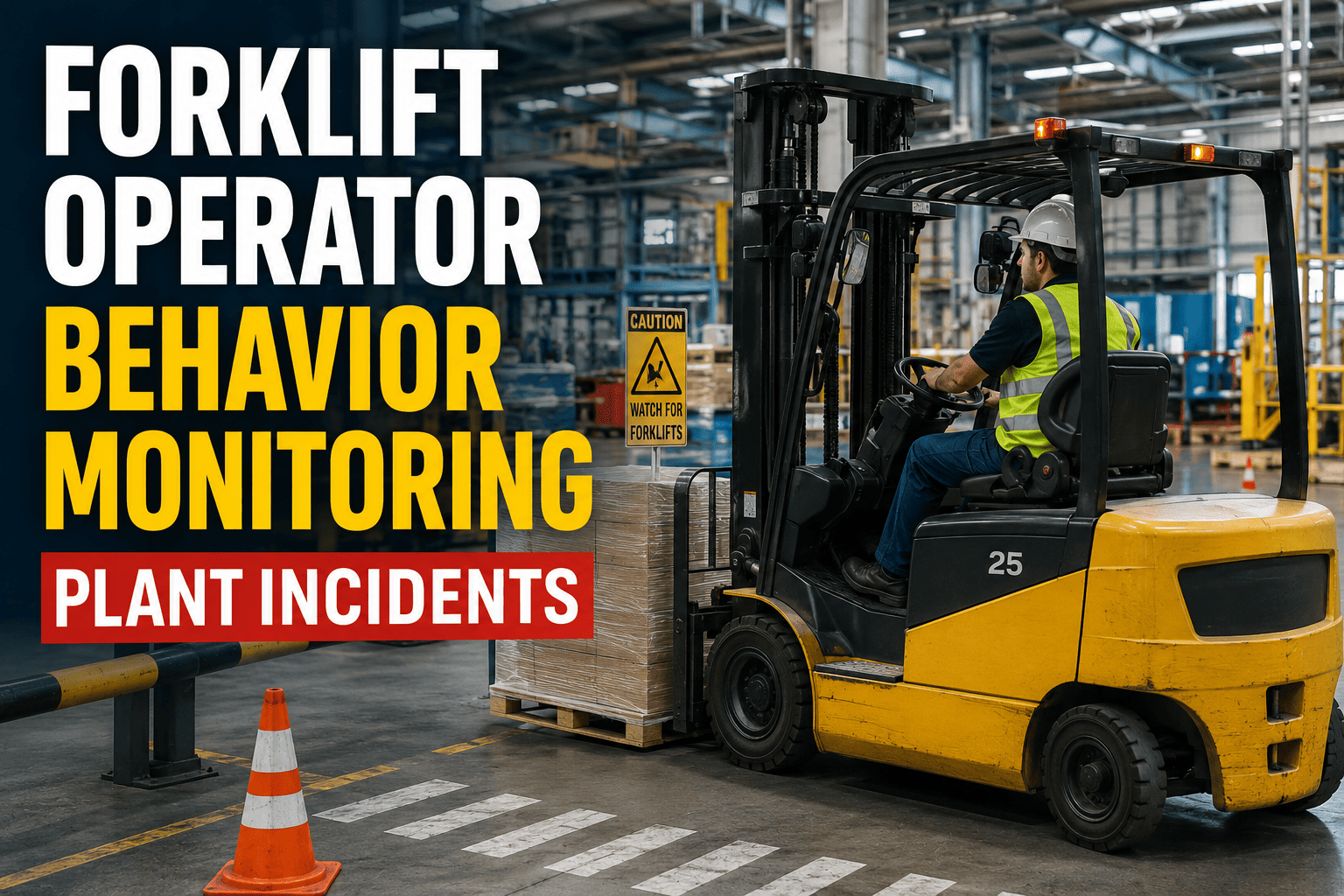
Most forklift incidents don't start with a mechanical failure. They start with a pattern: a driver who takes corners a little too fast, brakes hard near the same rack every shift, or clips a pallet edge often enough that nobody thinks twice about it anymore. OSHA estimates roughly 85 fatal forklift accidents and 34,900 serious injuries happen every year in the US, and a large share trace back to how the truck was being driven in the moments before impact, not a part that broke. Operator behavior monitoring turns that invisible pattern into a number a safety team can actually act on, before the near-miss becomes a claim.
Operator behavior monitoring uses telematics data such as speed, braking force, cornering, and impact sensors to score how safely each forklift operator drives, shift after shift. Instead of reviewing incidents after they happen, safety teams see which operators are trending toward risk and coach them before a collision occurs. Facilities using scored behavior data report meaningfully fewer impact events within the first few months, because coaching targets the two or three habits actually driving most near-misses instead of running generic refresher training for everyone.
The Habits Behind Most Forklift Incidents
Roughly a quarter of forklift accidents involve the truck tipping over, and speed combined with sharp turning is the most common setup for it. Pedestrian-related incidents, which account for over a third of forklift fatalities, are frequently tied to a driver moving too fast through a blind corner or an intersection with poor sightlines. None of this is random. It shows up as a repeatable pattern in the data long before it shows up as an incident report.
Overspeed
Traveling faster than the posted zone limit, especially through intersections, blind corners, or narrow racking aisles where stopping distance matters most.
Harsh Braking
Sudden stops that shift a raised load forward, a leading contributor to load drops and, over time, a sign of an operator misjudging following distance.
Sharp Cornering
Fast, tight turns that raise tip-over risk, since forklifts steer from the rear axle and swing wide in ways operators often underestimate.
Impact Events
Contact with racking, doors, other equipment, or pedestrians, ranked by force so a light bump and a hard collision aren't treated as the same event.
FleetRabbit captures speed, braking, cornering, and impact data from every forklift and turns it into a behavior score your safety team can actually use to coach the right operator on the right habit.
How an Operator Score Actually Gets Built
A behavior score isn't a single sensor reading, it's a rolling picture built from several data points that mean very little on their own but add up to a clear risk trend when combined over shifts and weeks.
Where the Data Comes From
Speed data comes from GPS and onboard telematics tied to zone-specific limits, since 5 miles per hour might be fine in an open yard and dangerous in a pedestrian aisle. Braking and acceleration data comes from accelerometers that flag force above a set threshold, distinguishing a controlled stop from a hard one. Impact sensors register the force and location of contact events, and turn logic captures speed relative to steering angle to flag cornering that's fast for the radius involved.
Why Context Matters More Than a Single Reading
One hard brake on a wet dock ramp isn't the same signal as ten hard brakes a week near the same blind corner. Scoring systems weight frequency and location so a pattern in a high-pedestrian zone counts differently than an isolated event in an open lane, which is what turns raw sensor noise into something a supervisor can coach against.
A typical scoring band. Operators trending into the lower two tiers get a scheduled coaching conversation before their pattern turns into an incident, rather than a generic annual refresher that treats every operator the same.
Reactive Safety Programs vs. Behavior-Based Coaching
Most plant safety programs are built around responding to what already happened: an incident report, a near-miss form, an annual retraining cycle. Behavior-based coaching flips the sequence, using the data that already exists on the truck to act before the report gets filed.
| Approach | Reactive Safety Program | Behavior-Based Coaching |
|---|---|---|
| Trigger for Action | An incident or near-miss report is filed | A behavior trend crosses a coaching threshold |
| Training Focus | General refresher covering all operators equally | Targeted coaching on the specific habit an operator shows |
| Timing | After the collision or damage already occurred | Weeks before the pattern would likely cause an incident |
| Visibility Into Risk | Limited to what gets reported or witnessed | Continuous, covering every shift and every operator |
| Accountability Basis | Anecdotal, dependent on supervisor observation | Objective data tied to specific events and locations |
FleetRabbit flags operators drifting into risky patterns weeks before a collision, giving your safety team a specific conversation to have instead of a stack of paperwork after the fact.
Turning a Score Into an Actual Coaching Conversation
A number on a dashboard changes nothing by itself. The value shows up in what a supervisor does with it, and the strongest programs keep that step simple and specific.
Start with the pattern, not the person. Instead of opening with "you're a risky driver," a supervisor can point to the exact data: three hard braking events near dock door four this week, all during the same busy loading window. That's a conversation about a location and a habit, not a character judgment, and operators respond to it very differently.
Pair the score with a short, private check-in rather than a public callout. Weekly or biweekly one-on-ones work better than posting scores on a break room board, which tends to create resentment instead of behavior change. Follow up on whether the score improves after the conversation, since a pattern that doesn't shift after coaching may point to a training gap, a layout problem, or a truck issue rather than a driver problem.
Close the loop with recognition, not just correction. Operators who improve their score or maintain a consistently low-risk pattern are the easiest, cheapest wins a safety program has, and acknowledging that keeps the whole program from feeling purely punitive. Sign up for FleetRabbit to start scoring your fleet automatically, or book a demo to see how the coaching workflow fits your current safety program.
Frequently Asked Questions
The habits that cause collisions show up in the data weeks before they show up on a claim form. FleetRabbit scores every operator automatically so your safety team can coach the right person on the right behavior, before it becomes a bigger problem.