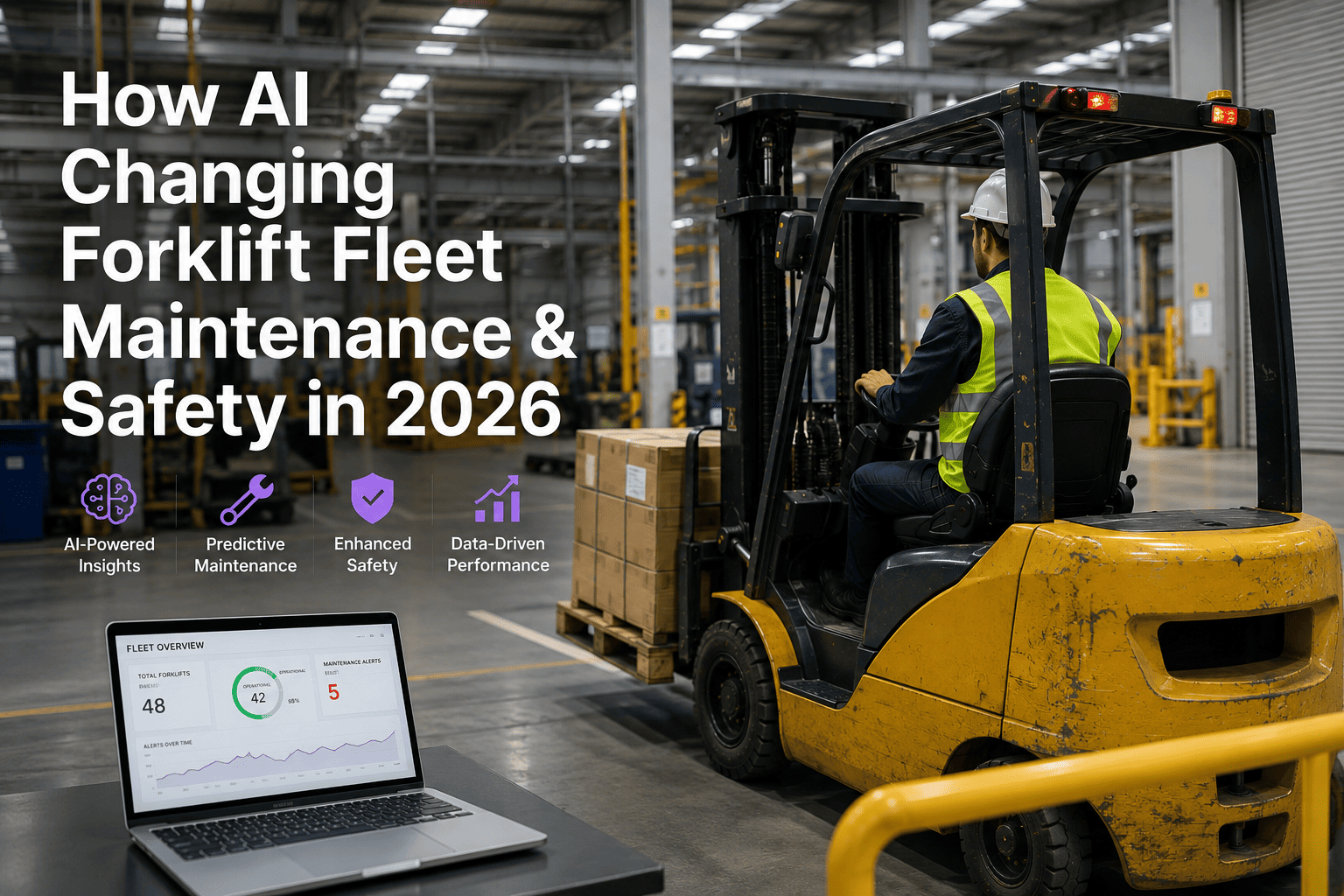
Walk any warehouse floor in 2026 and you'll notice something different. The forklifts look the same, but the way they're managed has quietly changed. A sensor catches a hydraulic pressure drop three weeks before it becomes a stall on the dock. A camera slows a lift truck down half a second before a worker steps around a rack. None of this happens because someone was watching closely. It happens because AI is watching all the time. If you're still scheduling forklift maintenance by the calendar and relying on operators to spot hazards, you're not just behind on technology, you're absorbing costs and risks that are now genuinely preventable.
AI now predicts forklift component failures weeks in advance by reading live sensor data instead of waiting for a fixed service date, and AI vision systems slow or stop lift trucks automatically when a pedestrian enters their path. Facilities using both together are cutting unplanned downtime by up to 40 percent and reducing collision-related incidents that typically cost between 38,000 and 150,000 dollars each. Sign up free to see how it works on your own fleet, or book a demo for a guided walkthrough.
Why "Fix It When It Breaks" Stopped Working
For decades, forklift upkeep followed one of two paths. Either you serviced the truck on a fixed interval whether it needed it or not, or you waited for something to fail and called it in. Both approaches share the same blind spot: neither one actually knows the condition of the machine. A forklift that gets light use might be over-serviced. One running double shifts on a rough warehouse floor might fail long before its next scheduled check. Reactive maintenance is even less forgiving, since the first sign of trouble is usually a truck stalled in an aisle during a shift that can't afford to lose it.
What changed is not the forklift. It's the ability to see inside it continuously. Hydraulic pressure, motor temperature, battery health, brake wear and vibration patterns can all be streamed and compared against thousands of similar machines. That comparison is what lets software flag a problem while it's still cheap and easy to fix, instead of after it has turned into a shutdown.
What Reactive Maintenance Actually Costs
Emergency repairs typically run three to five times higher than the same job done on a planned schedule, once overtime labor, rushed parts and towing are factored in. Multiply that across a fleet of twenty or thirty forklifts and the gap between reactive and predictive maintenance becomes a real line item on the budget, not a rounding error.
FleetRabbit reads your fleet's sensor data continuously and tells you which truck needs attention before it fails. Sign up and connect your first forklift in minutes, or book a demo to walk through it with our team.
How AI Actually Predicts A Forklift Failure
It helps to understand the mechanics behind the alert on your dashboard. The process isn't magic, it's pattern recognition applied at a scale no maintenance team could manage manually.
Continuous Sensor Streams
Modern forklifts, and retrofitted older ones, generate a steady flow of data: hydraulic pressure, motor and battery temperature, tilt angle, brake application force and hours under load. Instead of sitting unused, this data streams to a platform that watches for drift away from the truck's normal baseline.
Machine Learning Trained On Real Failures
The model isn't guessing. It has learned from thousands of prior repair records what a failing hydraulic pump or a degrading battery cell looks like in the data days or weeks before it actually fails. The longer a fleet runs on the platform, the sharper those predictions get, since every completed repair feeds back into the model.
Work Orders Without The Wait
The newest shift in 2026 is what happens after the alert. Instead of a notification someone has to act on manually, the system can generate the work order, flag the part needed and suggest a maintenance window automatically, so the truck gets serviced before it becomes a shutdown.
| Approach | When Problems Are Found | Typical Repair Cost | Impact On Operations |
|---|---|---|---|
| Reactive Maintenance | After the truck has already stopped | Highest, plus rush parts and downtime | Shift disruption, backed-up pallets, no warning |
| Calendar-Based Maintenance | On a fixed schedule regardless of condition | Moderate, sometimes unnecessary | Some failures still slip through between visits |
| AI Predictive Maintenance | Days to weeks before failure | Lowest, planned labor and parts | Repairs scheduled around your shift, not around you |
The Safety Side: Stopping Accidents Before They Start
Maintenance is only half of what AI is changing. The other half is what happens on the floor while the forklift is running. Pedestrians are involved in roughly one in five forklift accidents, and a large share of those end up fatal, which is why 2026's safety conversation has shifted from warning lights and horns toward systems that actually intervene.
Why This Matters More Than It Used To
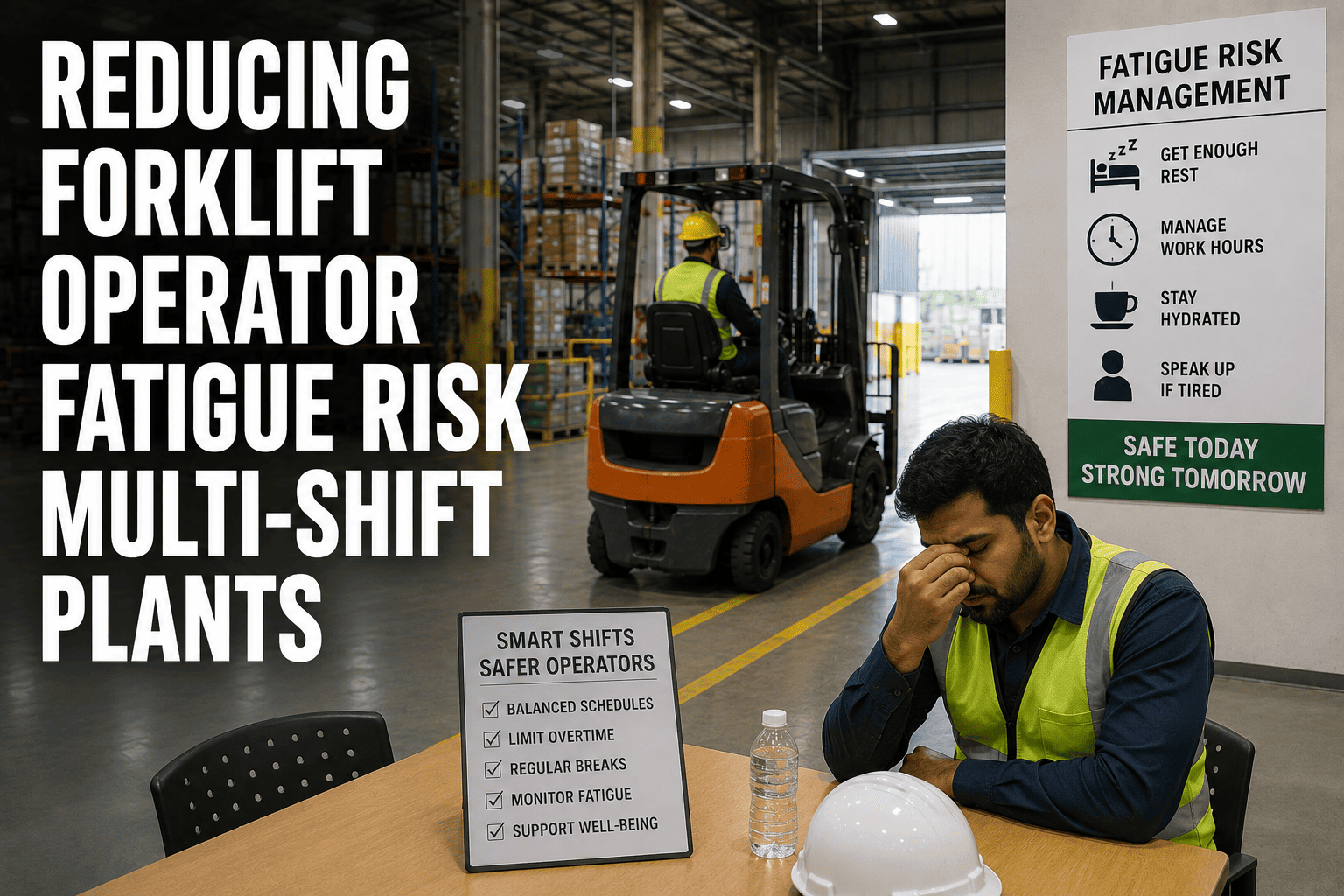
Fatigue and distraction contribute to a large share of warehouse forklift incidents, and that number doesn't move much no matter how experienced the operator is. That's exactly the gap AI closes. It doesn't get tired, and it doesn't look away. A single serious forklift collision can run anywhere from 38,000 to 150,000 dollars once you count medical costs, equipment damage and lost production, which is why safety technology adoption is expected to roughly quadruple in 2026 compared to the year before.
What This Actually Means For Your Bottom Line
Put the maintenance side and the safety side together and the case stops being theoretical. Fewer emergency repairs, fewer mid-shift breakdowns, and fewer incidents add up to a fleet that simply runs more of the time it's supposed to. Facilities pairing AI maintenance with AI safety monitoring report meaningfully higher planned-maintenance compliance than facilities relying on manual tracking, along with real per-truck savings once emergency repair and downtime costs are removed from the equation.
None of this requires ripping out your current fleet. Most platforms, including FleetRabbit, connect to the telematics and sensors your trucks likely already have, or add compact hardware where they don't. The bigger shift isn't technical, it's a change in when you find out something is wrong. Weeks before, instead of mid-shift.
FleetRabbit combines predictive maintenance and AI safety alerts in one dashboard built for warehouse and material handling fleets. Start your free trial today, or book a 30-minute demo and we'll walk through your fleet's specific numbers.
Most fleets are sitting on sensor data that never gets used. FleetRabbit turns it into early warnings for breakdowns and real-time protection for your team, in one platform built for material handling fleets.