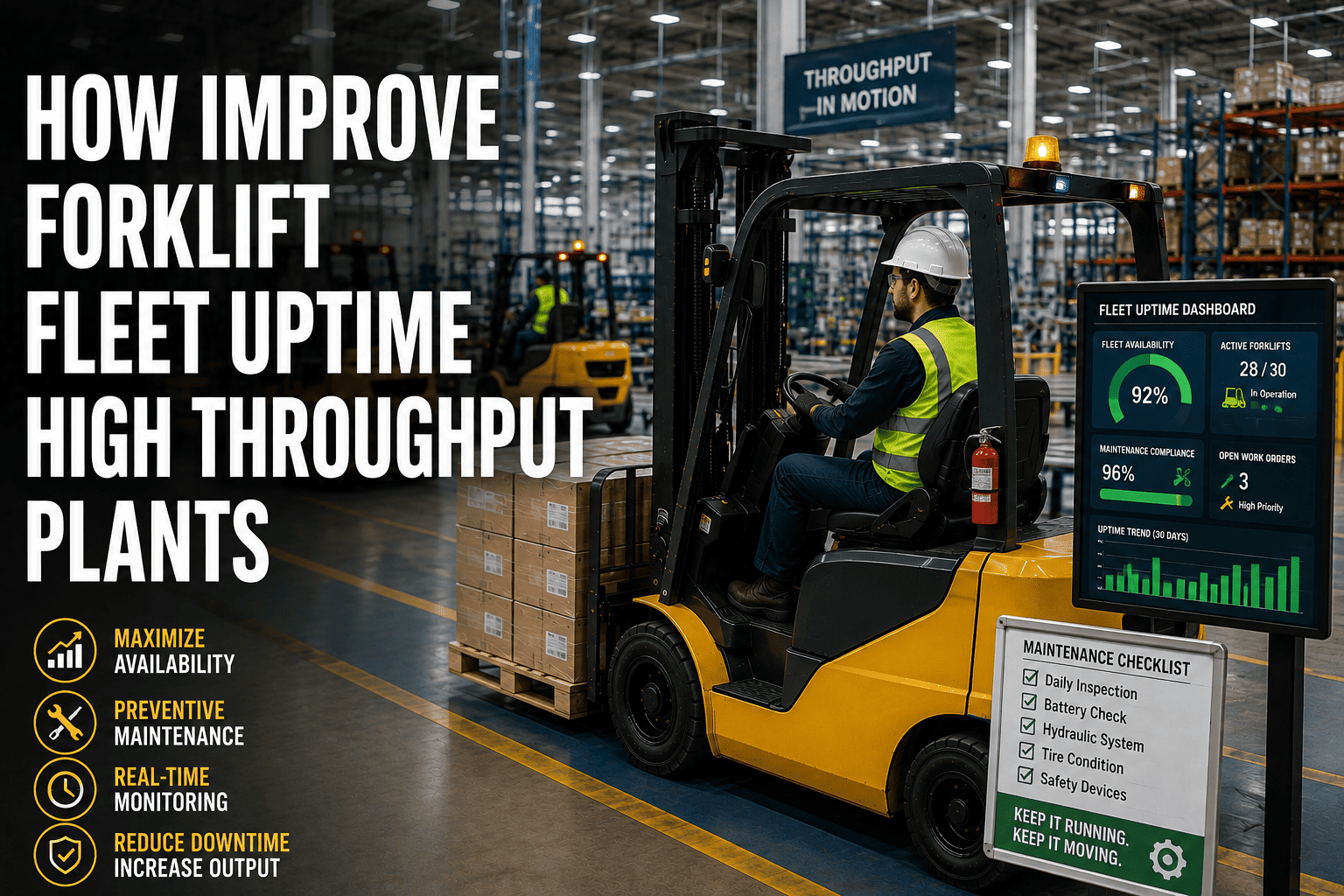
In a high-throughput manufacturing plant, a single downed forklift can stall an entire production line. Every hour a truck sits in the maintenance bay, throughput targets slip, operators stand idle, and shipping windows close. Improving forklift fleet uptime in these demanding environments requires more than reactive repairs. It takes predictive maintenance, parts readiness, smart asset rotation, and battery management working together. FleetRabbit helps keep critical material-handling equipment available when production demands it most. You can sign up for FleetRabbit to boost your uptime, or book a demo to see our platform.
In high-throughput plants, forklift availability below 90 percent directly throttles production output. A single downed truck in a lean operation costs 200 to 500 dollars per hour in stalled throughput. Fleets combining predictive maintenance, stocked critical spares, and battery rotation achieve 95 to 98 percent uptime, keeping production flowing around the clock.
The True Cost of Downtime in High-Throughput Operations
The true cost of forklift downtime in a high-throughput plant extends far beyond the repair invoice. When material handling capacity drops, the entire facility feels it. Production lines starve for components, finished goods stack up at stations, and loading docks miss carrier cutoffs. The immediate repair cost might be 500 dollars, but a stalled line processing 10,000 dollars of product per hour makes that repair almost irrelevant. In lean operations running minimal buffer, a single downed forklift during peak demand can cascade into missed customer commitments and overtime recovery costs that dwarf the original failure.
Why High-Throughput Plants Are Different
High-throughput plants face a uniquely harsh uptime challenge. Their forklifts run harder, accumulate engine hours faster, and have zero slack in the schedule for unplanned maintenance windows. A warehouse with 40 percent utilization can absorb a downed truck casually. A high-throughput plant running every asset near capacity cannot spare a single unit without throughput suffering. This means the maintenance strategies that work for average facilities, calendar-based PMs and reactive repairs, actively fail in high-throughput environments where every truck matters every hour.
The Uptime Multiplier Effect
The uptime multiplier effect is what makes fleet availability so critical in these plants. When one truck goes down, the remaining trucks must absorb its workload, accelerating their wear and pushing them toward failure. If maintenance cannot catch up during this stress period, a second truck fails, concentrating load even further. This domino dynamic is why high-throughput plants can suddenly find half their fleet down in the same week, a collapse that started with a single ignored bearing noise. To stop the dominoes, you can sign up for FleetRabbit to boost your uptime, or book a demo to see our platform.
FleetRabbit combines predictive maintenance, engine-hour PMs, battery rotation tracking, and parts alerts to keep your critical forklifts available when production demands them. Stop losing throughput to preventable downtime. Start your free trial today.
The Four Pillars of High-Throughput Uptime
Sustained uptime in demanding plants rests on four interconnected pillars. Predictive maintenance catches failures before they sideline trucks. Parts readiness ensures repairs complete in hours, not days. Asset rotation balances wear across the fleet and creates natural maintenance windows. Battery management keeps electric trucks charged and swapped on schedule. Neglect any single pillar and the others cannot compensate. A perfect predictive system still fails if the part it forecasts is not on the shelf, and a stocked parts room cannot help if every truck is run to failure between services.
| Uptime Pillar | Reactive Plant Result | High-Throughput Impact | FleetRabbit Solution |
|---|---|---|---|
| Predictive Maintenance | Failures fixed after breakdown | Mid-shift failures stall lines | Telematics alerts catch wear early |
| Parts Readiness | Parts ordered after failure | 2-hour repairs become 3-day outages | Failure history drives parts stocking |
| Asset Rotation | Same trucks hammered daily | Uneven wear creates sudden failures | Engine-hour balancing across fleet |
| Battery Management | Charging left to operators | Mid-shift dead trucks stall throughput | Rotation schedules and charge alerts |
| PM Scheduling | Calendar dates miss true wear | Hard-run trucks miss critical services | Engine-hour triggered PM work orders |
Strategies to Maximize Fleet Availability
Maximizing availability requires moving maintenance from a disruption into a rhythm that production can plan around. The first strategy is shifting PMs to engine hours so hard-run trucks get serviced based on actual wear, not calendar guesses. The second strategy is scheduling maintenance into production lulls, using shift changes and planned slowdowns as natural service windows. The third strategy is maintaining a rotation buffer, keeping two or three percent of the fleet as swing capacity that covers trucks in scheduled service, so PMs never compete with production for the same truck.
Scheduling Maintenance Into Production Rhythms
Scheduling maintenance into production rhythms eliminates the war between maintenance and output. FleetRabbit tracks when each truck approaches its service interval and flags the optimal window, whether that is a Tuesday shift change or a planned weekend slowdown. Mechanics arrive to a ready work order with parts staged, and the truck returns to the floor before the next peak. Trucks that need service during unbroken production are swapped with swing assets, serviced offline, and returned, all without a single stalled operation. This choreography turns maintenance from an emergency into a routine.
Building a Swing Asset Buffer
Building a swing asset buffer is the secret weapon of high-uptime fleets. Rather than running every truck at maximum utilization, top plants hold back two or three units as rotating spares. When a truck enters scheduled service, a swing unit takes its place instantly. When a truck throws a fault code, a swing unit covers the diagnosis window. This buffer converts downtime events from line-stopping crises into invisible background swaps. Utilization data determines the right buffer size, because FleetRabbit shows exactly how much swing capacity peak demand actually requires. To build your buffer strategy, you can sign up for FleetRabbit to boost your uptime, or book a demo to see our platform.
How FleetRabbit Keeps Critical Trucks Running
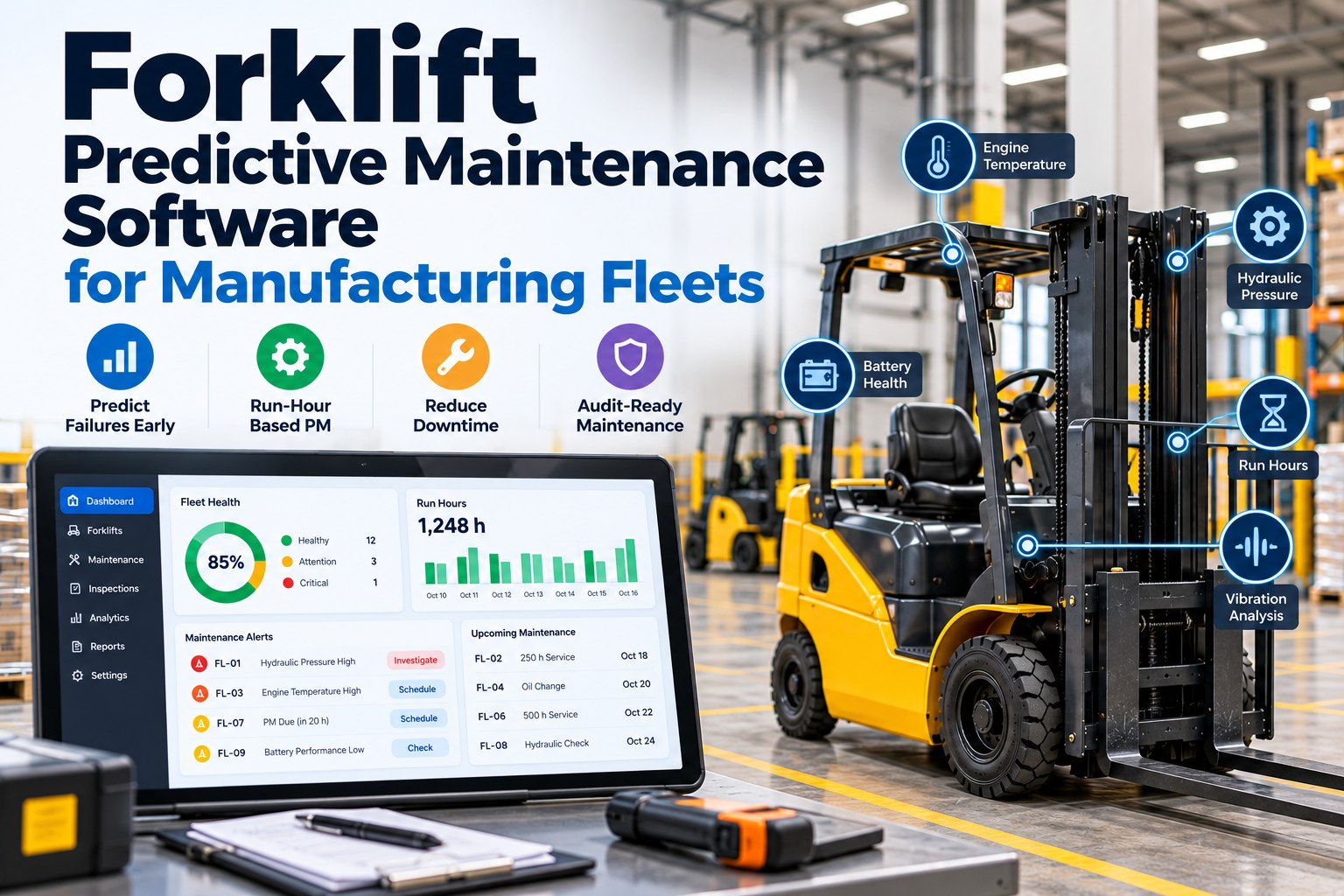
FleetRabbit is engineered for the uptime demands of high-throughput manufacturing. Our platform monitors engine health through telematics, catching developing faults before they become breakdowns. Engine-hour tracking drives PM schedules automatically, so trucks that work hardest get serviced first. Battery rotation management keeps electric fleets charged and swapped on rhythm, eliminating mid-shift power failures. And utilization tracking tells you exactly how many trucks your peak demand truly needs, sizing your swing buffer scientifically. Every module feeds one goal: keeping material handling capacity available when production needs it.
Predictive Alerts Before Failures
Predictive alerts catch failures while they are still cheap. FleetRabbit monitors fault codes, temperature trends, and performance anomalies across the fleet. When a hydraulic system shows gradual pressure degradation, the alert fires days before failure, giving maintenance time to schedule the repair during a lull with parts ready. The truck never breaks down on the floor, the line never stalls, and a 300-dollar seal replacement never becomes a 4,000-dollar pump rebuild. This early-warning capability is the single biggest lever for lifting uptime in demanding plants.
Battery Rotation Management
Battery rotation management solves the silent uptime killer in electric fleets. FleetRabbit tracks each battery's charge state, cycle count, and rotation schedule. Operators get alerts when trucks must swap to the charging bay, ensuring no truck enters a peak shift below full charge. The system also monitors battery health over time, flagging units approaching end of life before they start dying mid-shift. Plants that formalize battery rotation eliminate the 8-hour outages that plagued their informal charging habits, recovering capacity they did not know they had lost.
Key Takeaways for Fleet Uptime
Improving forklift fleet uptime in high-throughput plants is the difference between hitting production targets and explaining misses. Reactive maintenance, unmanaged batteries, and parts stockouts guarantee downtime exactly when operations can least afford it. A proactive system built on predictive alerts, engine-hour PMs, scheduled service windows, and swing buffers keeps availability above 95 percent even under punishing demand.
Implementing a comprehensive platform like FleetRabbit delivers all four uptime pillars in a single system. Plants using it typically cut breakdowns in half within the first quarter and recover throughput capacity worth far more than the software cost. The investment pays back the first time a predictive alert converts a line-stopping failure into a scheduled 30-minute service.
The path forward is clear. Ask yourself what percentage of your fleet was available during last month's peak shift, and whether you could prove it with data. If breakdowns are dictating your throughput, your maintenance strategy is working against your production goals. Plant managers who build uptime systematically protect their output, their schedules, and their profitability. You can sign up for FleetRabbit to boost your uptime, or book a demo to see our platform.
Frequently Asked Questions About Fleet Uptime
Every downed truck in a high-throughput plant is throughput you will never recover. FleetRabbit's predictive maintenance, battery management, and swing buffer planning keep your critical fleet available through peak demand. See 95 percent uptime within months. Start your free trial today with no credit card required.