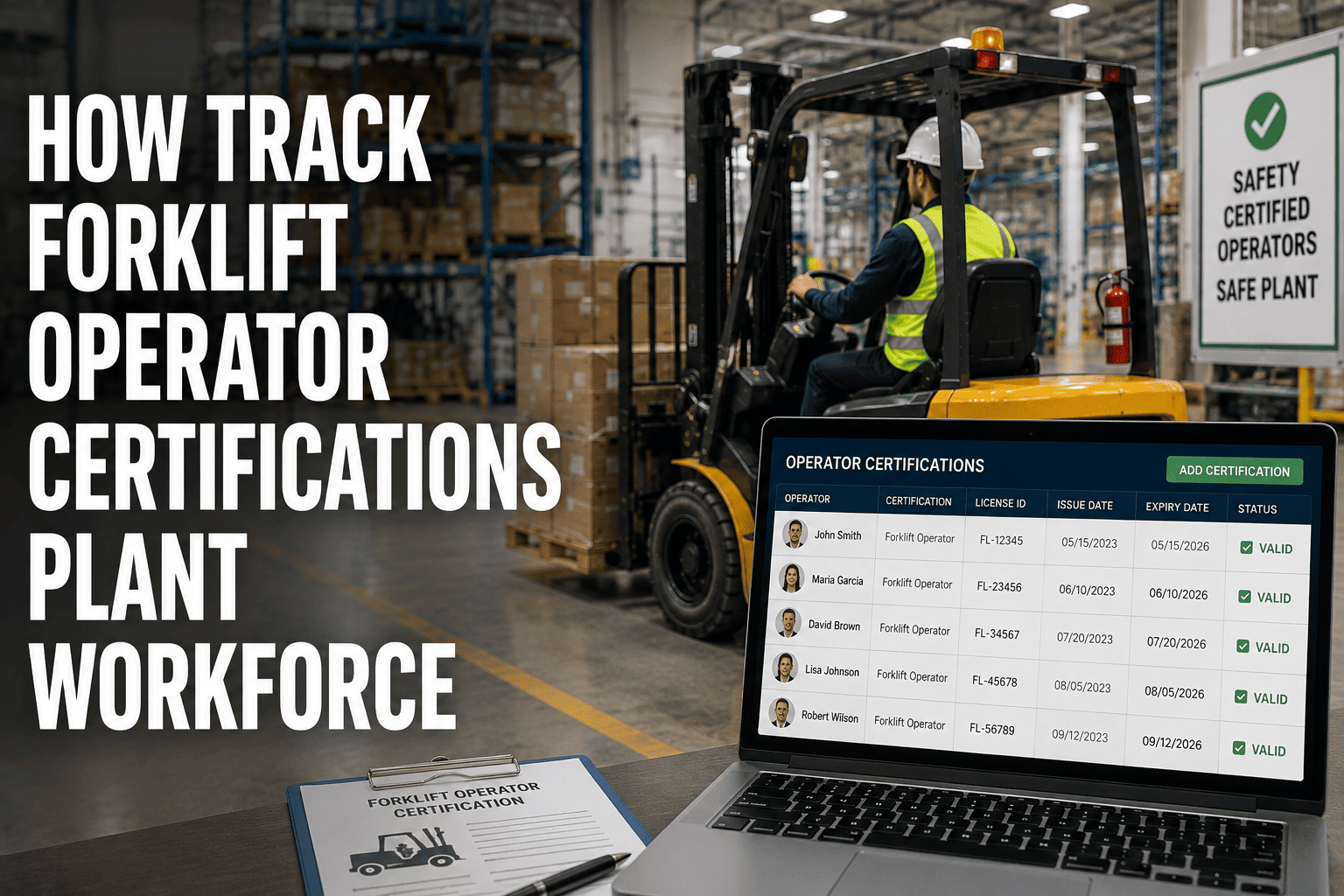
Ask a plant safety manager to pull up the training record for a specific forklift operator right now, and the honest test is not whether the record exists somewhere, it is how long it takes to find it. OSHA does not issue forklift licenses or set expiration dates the way a driver's license does. The entire certification program is the employer's responsibility, from training to evaluation to recordkeeping, which means a compliant operator can quietly become a citation the moment a signed form goes missing or an evaluation date slips past three years unnoticed. Tracking forklift operator certifications across a plant workforce is less about paperwork and more about building a system that never lets that slip happen. This guide walks through exactly what OSHA requires you to track, the events that reset an operator's clock, and how to build a tracking workflow that stays audit-ready at any moment. You can sign up for a free trial to start centralizing your operator records today, or book a demo to see how certification tracking maps to your current workforce.
OSHA 1910.178(l) requires employers to evaluate every forklift operator at least once every three years and to certify each operator's name, training date, evaluation date, and trainer identity in a retrievable record. Refresher training resets that clock sooner whenever an operator is observed operating unsafely, is involved in an incident or near-miss, is assigned to a different truck type, or workplace conditions change. FleetRabbit centralizes those records for an entire plant workforce and flags expirations before they lapse.
What OSHA Actually Requires You to Track
There is no such thing as a forklift license that expires on its own in the United States. What exists is an employer obligation under 29 CFR 1910.178(l) to train, evaluate, and certify every operator, with the burden of proof sitting entirely on the plant, not on any external certifying body.
What a Compliant Certification Record Actually Contains
OSHA does not prescribe a specific form or format, which means a signed paper record, a spreadsheet row, or a database entry all satisfy the requirement equally, provided every field is present and retrievable when an inspector asks. The problem in practice is rarely the format, it is finding the record fast enough.
| Required Field | What It Captures | Why It Matters |
|---|---|---|
| Operator Name | The individual being certified to operate | Ties every truck assignment back to a verified, evaluated person |
| Training Date | When formal instruction and hands-on training occurred | Establishes the starting point of the operator's certification history |
| Evaluation Date | When the workplace performance evaluation was completed | Sets the three-year clock and confirms current competency was verified |
| Trainer or Evaluator Identity | Who conducted the training or evaluation | Gives the record accountability an inspector can independently verify |
FleetRabbit centralizes every operator's training, evaluation, and refresher history in one searchable record, with automatic alerts before a three-year evaluation lapses. Sign up to start organizing your workforce records today, or book a demo to see it built around your plant.
The Refresher Triggers Every Plant Must Track
The three-year window is the regulatory ceiling, not a safe default to plan around. Several specific events require refresher training immediately, and a tracking system needs to catch each one the moment it happens, not at the next scheduled review.
Unsafe Operation Observed
Any time a supervisor or evaluator observes an operator running a truck unsafely, refresher training in the relevant topic is required before that operator continues working, regardless of how recently they were certified.
Incident or Near-Miss Involvement
Many compliant programs use a tiered response, with near-misses requiring refresher training within roughly 30 days, property damage incidents requiring a faster turnaround alongside a root-cause review, and personal injury incidents triggering immediate suspension pending re-evaluation.
Assignment to a Different Equipment Type
An operator certified on a counterbalance truck is not automatically certified on a reach truck or order picker. Every equipment type change requires its own training and evaluation record.
Workplace Condition Changes
A new racking layout, a changed traffic pattern, or a different facility altogether all count as workplace changes that can trigger refresher training, even for an operator with years of experience elsewhere.
Tracking Methods Compared
How a plant stores certification records determines whether an inspector gets an answer in seconds or a promise to follow up later.
| Tracking Method | Expiration Visibility | Audit Readiness | Limitation |
|---|---|---|---|
| Paper training files | None, requires manual review | Slow, files can be lost or incomplete | A single misplaced form creates a compliance gap |
| Shared spreadsheet | Manual, depends on someone checking regularly | Moderate, requires compiling before an audit | Easy to overlook a date on a large workforce roster |
| FleetRabbit certification tracking | Automatic alerts before expiration | Instant, every field retrievable in one search | Requires initial workforce data onboarding |
Building a Certification Tracking Workflow
A reliable tracking system does not require replacing how training already happens on the floor, it requires making sure every training and evaluation event lands in one place instead of scattered across binders and inboxes.
Centralize Existing Records First
Pull every current operator's training and evaluation history into one system, even if it means digitizing years of paper files. This baseline reveals gaps in the workforce before an inspector finds them first.
Set Automatic Expiration Alerts
Configure alerts to fire well before the three-year evaluation deadline, giving supervisors enough runway to schedule the evaluation instead of discovering an operator has already lapsed.
Log Every Refresher Trigger Immediately
The moment an unsafe observation, incident, or equipment change occurs, log it against that operator's record right away, so the refresher requirement is never dependent on someone remembering it later.
Prepare for an Audit at Any Moment
A tracking system worth using is one where any operator's complete certification history can be pulled up in seconds during a surprise inspection, not compiled overnight before a scheduled one.
Frequently Asked Questions
Forklift certification compliance rarely fails because a plant refuses to train its operators, it fails because a signed form got buried, a spreadsheet date got missed, or nobody logged a near-miss against the right operator's file. The requirement itself is straightforward, evaluate every three years, capture four fields, and respond immediately to the events that reset the clock. What actually protects a plant is a system that makes those requirements automatic instead of dependent on memory. FleetRabbit was built to be that system for an entire workforce, not just one operator at a time.
FleetRabbit centralizes every operator's training, evaluation, and refresher record across your plant workforce, with automatic alerts before a deadline passes. Start your free trial today with no credit card required.