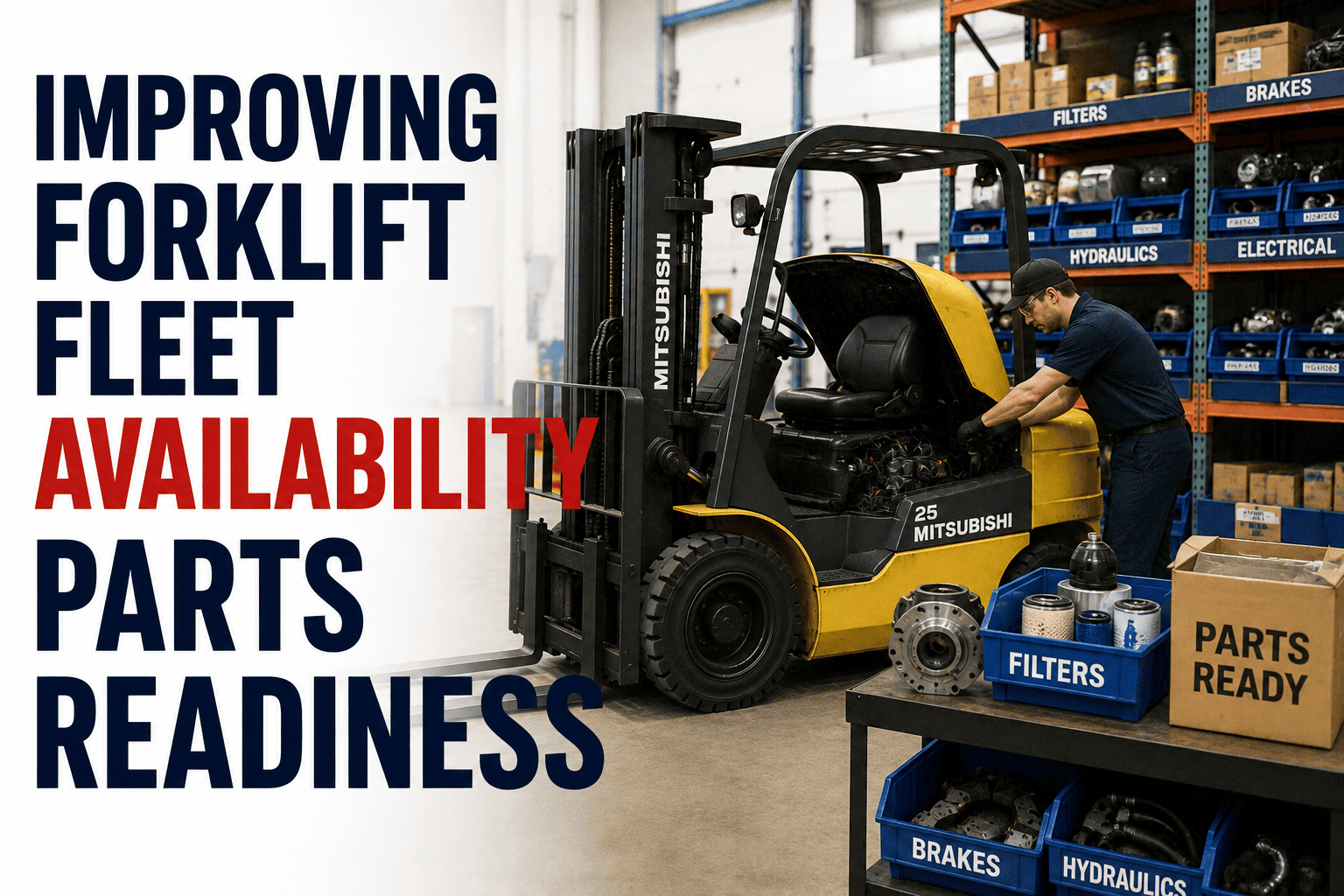
A forklift breakdown is rarely the real problem. The real problem shows up twenty minutes later, when the technician has already diagnosed the issue, knows exactly which part will fix it, and finds an empty shelf where that part should be. What could have been a one-hour repair turns into a two-day wait, a rented replacement truck, and a production line quietly falling behind schedule.
Emergency parts procurement, including expedite fees, air freight, and the production downtime while waiting, averages around 180000 dollars annually in a mid-size manufacturing facility. Spare parts typically tie up 22 to 40 percent of a plant's total maintenance budget, yet most plants still stock based on habit rather than actual failure data. Manufacturers that build parts readiness around asset criticality and consumption history cut stockout-driven downtime by 20 to 40 percent.
Why Parts Readiness Is A Fleet Availability Problem
Fleet availability is often framed as a maintenance scheduling issue, but for a large share of forklift downtime, the truck is not waiting on a technician. It is waiting on a part. A diagnosis that takes minutes can be followed by a wait of days if the required component is not on the shelf, and that wait is what actually drives a truck's total time off the floor. Improving availability starts with recognizing that parts readiness and maintenance scheduling are the same problem viewed from two angles.
The Real Cost Of A Stockout
A stockout does not just delay one repair. It triggers emergency procurement at premium pricing, forces production teams to route around a missing truck, and in many plants means renting a replacement forklift for days while the part is in transit. Across mid-size manufacturing facilities, the combined cost of expedite fees, air freight, and downtime while waiting on emergency parts averages roughly 180000 dollars annually, a number that rarely shows up as a single line item but adds up quietly across dozens of incidents a year.
Why Habit-Based Stocking Fails
Most storerooms were stocked the way they are today because that is how they have always been stocked, not because anyone recently reviewed which parts actually fail and how often. Habit-based stocking tends to overstock cheap, slow-moving items while leaving genuinely critical parts, the ones that would sideline a truck for days, without a single unit on the shelf.
FleetRabbit connects work order history to your parts inventory, so reorder points reflect what actually breaks on your fleet instead of habit. Start your free trial and see which parts your data says you should be stocking.
Classifying Forklift Parts By Criticality
Not every part deserves the same stocking strategy. Sorting parts into criticality tiers, sometimes labeled Vital, Essential, and Desirable, gives maintenance teams a clear, defensible reason for what sits on the shelf and what gets ordered as needed.
| Criticality Tier | Forklift Examples | Stocking Strategy | Why It Matters |
|---|---|---|---|
| Vital (Must Stock) | Lift chains, hydraulic cylinders, steer axle components | Minimum one unit on hand at all times, even at higher holding cost | A failure sidelines the truck immediately with no safe workaround |
| Essential (Limited Stock) | Filters, batteries, hydraulic hoses | Set reorder points with safety stock based on consumption rate | Frequently replaced and short lead-time items where stockouts still cause delay |
| Desirable (Order As Needed) | Seats, lights, non-structural trim components | Order on demand rather than holding shelf space | Low failure impact and typically fast to source when needed |
| Wear Items | Tires, brake pads, mast rollers | Stock based on hours-per-fleet consumption rate, reviewed quarterly | Predictable wear pattern makes these easiest to forecast accurately |
Weighing Holding Cost Against Downtime Cost
The decision to stock a spare comes down to a simple comparison: the cost of holding the part on a shelf versus the cost of production loss if a stockout occurs. For any part where a single stockout event would cost more than a full year of holding that part in inventory, the answer is almost always to keep one in stock as insurance. A hydraulic cylinder that costs a few hundred dollars to hold but would sideline a critical forklift for days is rarely worth the risk of leaving unstocked, while a low-impact trim part with a same-day supplier is safe to order only when needed.
Building Parts Readiness From Failure History
The most reliable input for setting stock levels is your own fleet's failure history, not a generic parts list from the manufacturer's manual. A plant that reviews which components actually failed over the past year, and how often, can set reorder points that reflect real risk instead of guesswork. This is also where mixed-brand fleets benefit from centralized data, since failure patterns on one forklift brand may look very different from another operating in the same facility.
FleetRabbit ties parts consumption directly to work orders and failure history, giving maintenance teams a clear view of which spares protect uptime. Book a demo to see your fleet's parts readiness mapped out.
Practical Steps To Improve Fleet Availability
Start with an honest audit of every part currently on the shelf, matched against how often it has actually been used in work orders over the past 12 months. Flag high-turnover critical parts that show frequent stockouts, and separately flag parts that have not moved at all, since those represent capital that could be redeployed. Next, assign a criticality tier to each part based on what would happen if it were unavailable during a breakdown. Finally, set minimum stock levels and reorder points specifically for Vital and Essential tiers, and let Desirable items stay order-as-needed to keep the storeroom lean.
Watch Percentage Of Work Orders Delayed By Parts
One of the clearest signals that a parts readiness program is working is a declining percentage of work orders delayed due to parts unavailability. Tracking this number over time tells you directly whether your stocking strategy is protecting uptime or quietly letting trucks sit longer than they should.
Frequently Asked Questions
A diagnosed truck should not sit waiting on a part that failure data could have predicted. FleetRabbit connects work orders, criticality, and consumption history so the right spares are stocked before the next breakdown, not after. Start your free trial today, or book a demo to see your fleet's parts readiness in action.