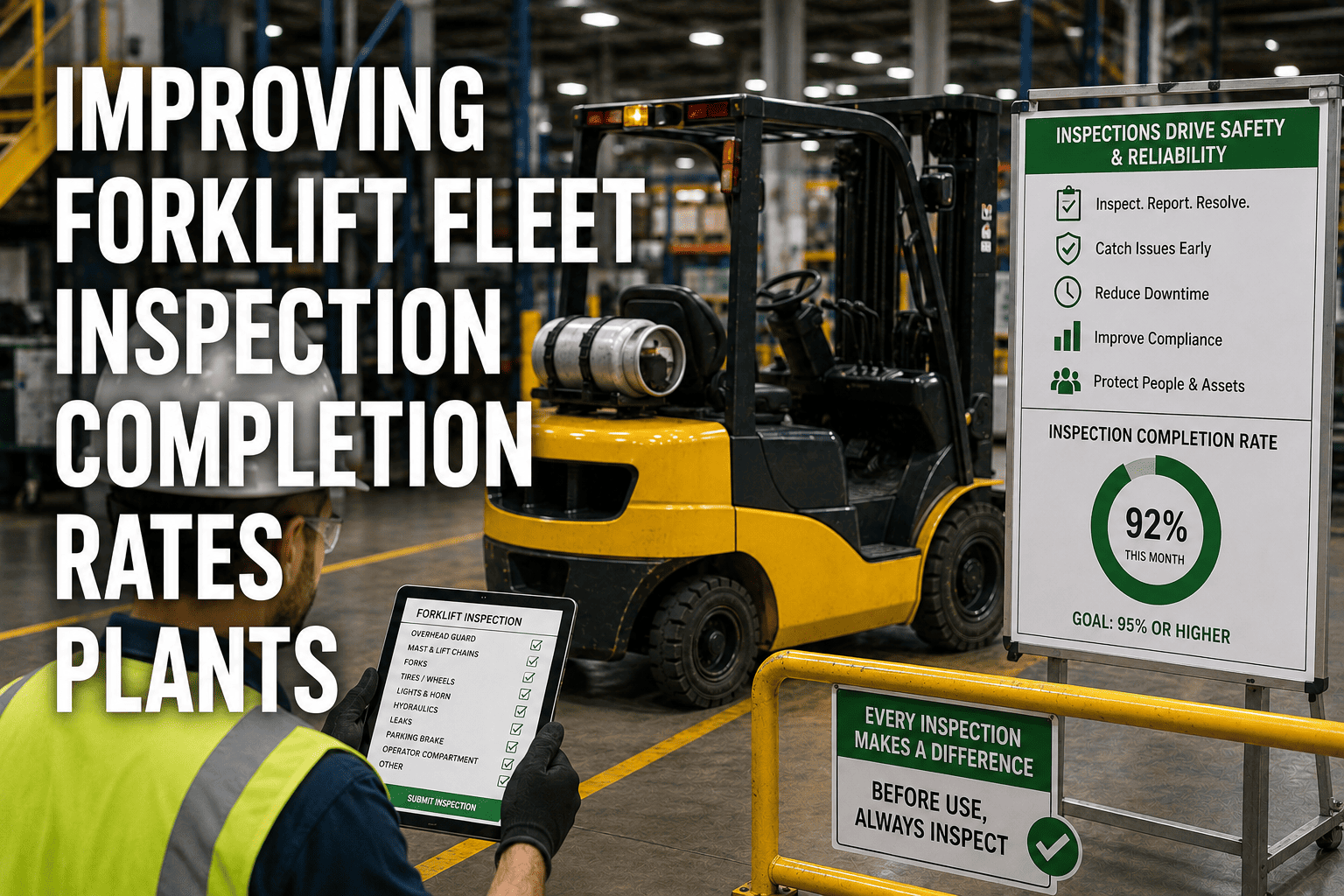
Walk onto almost any manufacturing plant floor during a shift change and you will find the same quiet problem hiding in plain sight. Pre-shift forklift inspections that are supposed to happen before every operator takes control of a vehicle are being skipped, rushed, or pencil-whipped at alarming rates. OSHA requires these inspections under 29 CFR 1910.178, yet industry data consistently shows that only 40 to 60 percent of forklifts receive a documented pre-shift inspection on any given day. The inspections that do get completed often take less than 90 seconds, barely enough time to walk around the truck let alone actually check brakes, hydraulics, steering, and safety systems. This is not a minor paperwork gap. It is a systemic safety failure that puts operators, pedestrians, and production at risk every single shift.
OSHA mandates pre-shift forklift inspections before every shift, yet manufacturing plants average only 40 to 60 percent documented completion rates. Each missed inspection represents an unmonitored vehicle operating with unknown condition status. Plants using digital inspection systems like FleetRabbit achieve 92 to 98 percent completion rates by making inspections faster, easier, and automatically tracked.
Why Inspections Get Skipped: The Real Root Causes
Blaming operators for skipping inspections misses the point entirely. Operators do not skip inspections because they are lazy or careless. They skip inspections because the process itself creates barriers that make completion difficult, time-consuming, and sometimes practically impossible within the constraints of their shift start. Understanding these root causes is essential because fixing the wrong problem will not improve completion rates no matter how many memos you send or how many times you remind people at shift meetings.
Paper-Based Systems Create Friction at Every Step
Paper inspection clipboards are the single largest barrier to completion. The clipboard has to be located, which means finding where the last operator left it. The form has to have blank pages remaining. A working pen has to be available on the forklift or nearby. In cold storage environments, paper becomes brittle and difficult to handle. In wet or dusty environments, paper degrades quickly. Once completed, the paper form has to be delivered to a supervisor or dropped in a collection box, creating an additional step that operators forget or skip when they are eager to start their shift. Every one of these friction points reduces completion probability. Research on habit formation shows that adding even a single friction point to a routine reduces compliance by 15 to 25 percent. Paper inspection systems have five to seven friction points built into every single use.
Time Pressure at Shift Start
Shift start is the most time-pressured period in a manufacturing plant. Operators arrive, receive their assignments, put on personal protective equipment, and are expected to be productive within minutes. Production supervisors want material moving immediately because production lines are waiting. When an operator faces a choice between spending 8 to 12 minutes on a paper inspection or getting to their first task quickly, production pressure wins almost every time. This is not an operator discipline problem. It is a systems design problem that puts inspection in direct conflict with productivity expectations. Until inspection time is reduced to match the available window, completion rates will remain stubbornly low regardless of training or enforcement efforts.
No Accountability Without Tracking
Paper inspection forms pile up in filing cabinets or get thrown away. No one reviews them systematically. No one knows which forklifts were inspected today and which were not until an accident occurs or an auditor asks. When operators know that no one is checking whether inspections actually happen, completion rates naturally decline. Human behavior follows the path of least resistance, and the path of least resistance with paper systems is to skip the inspection entirely because there are no immediate consequences. This accountability vacuum is particularly damaging across multi-plant operations where a corporate safety manager cannot physically walk every plant floor every day to verify compliance. Sign up for FleetRabbit to replace this accountability gap with real-time completion tracking that works across every plant from a single dashboard.
The Pencil-Whipping Problem
When operators do complete paper inspections under time pressure, many resort to pencil-whipping, which means checking all boxes without actually performing the checks. A properly thorough pre-shift inspection takes 8 to 12 minutes when done correctly. Most paper forms show completion times of 90 seconds to 3 minutes when timestamps are compared, indicating that the physical checks were never performed. Pencil-whipping is arguably worse than skipping the inspection entirely because it creates a false sense of compliance. The records show 100 percent completion while the actual inspection rate is near zero. This false documentation becomes a liability during OSHA investigations because it demonstrates that the employer has a process on paper that is not being followed in practice, potentially elevating a citation from other-than-serious to willful.
FleetRabbit replaces paper clipboards with mobile-first digital inspections that take 3 to 5 minutes, require photo evidence for defects, and automatically log completion to a central dashboard. Plant managers see real-time completion rates across every shift and every vehicle. No more guessing, no more filing cabinets, no more pencil-whipping.
The OSHA Compliance Picture: What Is Actually Required
OSHA standard 29 CFR 1910.178(q)(7) states that industrial trucks shall be examined before being placed in service and shall not be placed in service if the examination shows any condition adversely affecting the safety of the vehicle. This examination is required at the beginning of each shift. The standard does not specify the exact format of the examination or require a written checklist, but OSHA interpretation letters and enforcement guidance make it clear that documented inspections are the only practical way to demonstrate compliance during an inspection. An OSHA compliance officer who asks to see your pre-shift inspection records and receives a blank stare or a box of disorganized paper forms will almost certainly issue a citation.
What OSHA Officers Look For During Inspections
When OSHA visits a manufacturing plant, forklift inspection compliance is one of the most commonly reviewed areas. Compliance officers specifically look for documented evidence that inspections occurred before each shift for every vehicle operated. They check whether the inspection documentation covers all critical systems including brakes, steering, hydraulics, tires, lights, horn, seat belt, and overhead guard. They look for evidence that identified defects were actually corrected before the vehicle returned to service. They verify that operators are trained on what to inspect and how to identify defects. Gaps in any of these areas create citation risk. A single serious violation carries a penalty of up to 13653 dollars. A willful violation for knowingly allowing uninspected vehicles to operate can reach 136532 dollars. Multiple plants within the same company often trigger corporate-level follow-up inspections when one facility is cited, multiplying the exposure.
Multi-Plant Compliance Complexity
Manufacturing companies operating multiple plants face exponentially higher compliance risk because inspection completion rates vary dramatically from plant to plant. A company operating six plants might find that two plants maintain 85 percent completion rates, two hover around 50 percent, and two are below 30 percent. The low-performing plants create company-wide liability because OSHA views the parent company as the responsible employer. Corporate safety managers cannot effectively monitor paper-based inspection systems across geographically distributed facilities. Monthly summary reports that arrive weeks late provide no ability to intervene when completion rates drop. Real-time digital tracking across all plants from a single dashboard is the only practical approach for multi-plant compliance management. Book a demo to see how FleetRabbit provides unified inspection visibility across all your plants.
Measuring Inspection Completion Rates Correctly
You cannot improve what you do not measure, and most plants are not measuring inspection completion rates correctly. Simply counting completed forms at the end of a week and dividing by the number of forklifts multiplied by the number of shifts provides a misleading number because it does not account for which specific vehicles were inspected on which specific shifts. A plant with 20 forklifts running two shifts should have 40 completed inspections daily or 280 weekly. If you count 180 completed forms at week end, your completion rate is not 64 percent. You need to analyze which forklifts on which shifts had gaps to understand the true pattern.
| Measurement Dimension | What to Track | Why It Matters | Target |
|---|---|---|---|
| Overall Completion Rate | Completed inspections divided by required inspections per period | Primary compliance metric and baseline for improvement tracking | Above 95 percent consistently |
| Per-Shift Completion | Completion percentage broken down by first, second, and third shift | Reveals shift-specific problems like supervision gaps or time pressure differences | Less than 5 percent gap between shifts |
| Per-Vehicle Completion | Completion percentage for each individual forklift over 30-day rolling period | Identifies consistently uninspected vehicles that may have underlying maintenance issues | Every vehicle above 90 percent |
| Per-Operator Completion | Completion percentage for each operator over 30-day rolling period | Identifies operators who need retraining or who are facing process barriers | Every operator above 90 percent |
| Defect Identification Rate | Number of defects found per 100 inspections completed | Low defect rates often indicate pencil-whipping rather than thorough inspection | 8 to 15 defects per 100 inspections |
| Defect Resolution Time | Average time from defect identification to repair completion or lockout | Identified defects that are not resolved create the same risk as uninspected vehicles | Critical defects within same shift, all defects within 24 hours |
Strategies That Actually Improve Completion Rates
Replace Paper with Mobile Digital Inspections
This is the single highest-impact change any plant can make. Digital inspections eliminate every friction point that paper creates. The inspection form lives on a mobile device that stays with the forklift or the operator. There are no missing clipboards, no missing pens, no damaged forms, and no filing steps. Operators tap through a structured checklist with clear prompts for each item. The system timestamps every entry, making pencil-whipping immediately visible when an entire 25-item inspection shows completion in 45 seconds. Photo capture for any identified defect provides evidence that the check was actually performed and creates documentation that speeds repair prioritization. Plants making this single change typically see completion rates jump from 45 to 55 percent to 85 to 90 percent within the first two weeks as operators adapt to the new process.
Reduce Inspection Time to Match Available Windows
Inspection time must fit within the realistic time available at shift start. A well-designed digital inspection covering all OSHA-required items can be completed in 3 to 5 minutes compared to 8 to 12 minutes for paper. This reduction comes from eliminating writing time, using conditional logic that skips irrelevant items based on forklift type, and providing clear visual prompts that reduce decision time for each check item. When inspection takes 3 minutes instead of 10, the time pressure argument for skipping disappears entirely. Even the most production-focused supervisor cannot reasonably object to a 3-minute safety check before an 8-hour shift.
Conditional Logic Saves Time Without Skipping Checks
Not every forklift requires the same inspection items. An electric forklift does not need engine oil or coolant checks. A sit-down counterbalance truck does not need order picker cage checks. Paper forms typically include every possible item for every forklift type, forcing operators to either write not applicable repeatedly or skip items. Digital inspections use conditional logic to show only relevant items based on the specific vehicle being inspected. This reduces the checklist from 30 to 35 items down to 18 to 22 items for most forklift types, directly reducing inspection time while maintaining thoroughness for every check that matters.
Create Real-Time Visibility and Accountability
When completion data flows to a live dashboard that supervisors check at the start of every shift, accountability becomes automatic and non-punitive. A supervisor can see within seconds which forklifts have been inspected and which have not. If two forklifts show incomplete inspections five minutes before shift start, the supervisor can address it immediately rather than discovering the gap days later. This real-time visibility changes the dynamic from catching people after the fact to supporting them in meeting expectations. Operators who consistently complete inspections get recognized. Operators who struggle get coaching. The system becomes a management tool rather than a surveillance tool, which is the critical distinction that drives sustained behavior change.
Connect Inspections to Vehicle Access
The most effective completion enforcement mechanism is tying inspection completion to forklift access. When a forklift requires a completed digital inspection before the ignition system activates or before the operator can log into the vehicle, completion becomes physically mandatory rather than policy-dependent. This approach eliminates the willpower and discipline variables entirely. The operator cannot operate an uninspected vehicle even if they want to because the system prevents it. FleetRabbit supports this integration by linking inspection completion status with vehicle assignment, ensuring that every operated vehicle has a current completed inspection on file. Plants implementing access-controlled inspections achieve 98 to 100 percent completion rates consistently because the system makes skipping structurally impossible.
FleetRabbit delivers mobile digital inspections, real-time completion dashboards, defect photo capture, and automated escalation for missed inspections. Deploy across one plant or fifty from a single platform. See completion rates climb within the first week of implementation.
Handling Defects Found During Inspections
Improving completion rates only solves half the problem. The other half is what happens when inspections actually find defects. A completed inspection that identifies a brake problem but does not result in the vehicle being locked out of service provides no safety benefit. In fact, it creates worse liability because the plant now has documented knowledge of a hazard that was not addressed. Effective inspection systems need a clear defect handling workflow that moves identified problems from discovery to resolution without delay.
Immediate Lockout for Critical Defects
Critical defects including brake failures, steering problems, hydraulic leaks, mast issues, and tire damage that affects stability require immediate vehicle lockout. The operator must be able to flag the defect as critical during the digital inspection, which automatically changes the vehicle status to out of service in the fleet management system. This prevents any other operator from being assigned to or accessing that vehicle until the defect is repaired and verified. The automatic nature of this lockout is essential because manual lockout processes depend on communication chains that break down during shift transitions and busy periods.
Scheduled Repair for Non-Critical Defects
Non-critical defects like minor fluid seeps, cosmetic damage, or non-essential light outages should be scheduled for repair during the next planned maintenance window without requiring immediate lockout. The digital inspection system should automatically create a maintenance work order with the defect description and photo evidence, placing it in the maintenance queue with appropriate priority. This eliminates the communication gap between operators who find problems and maintenance teams who fix them. In paper-based systems, operators write defects on forms that may not reach maintenance for days, and maintenance teams often lack the detail needed to prioritize and prepare for repairs. Digital systems close this loop within seconds.
Defect Trend Analysis Prevents Recurring Problems
When defect data accumulates digitally over weeks and months, patterns emerge that are invisible in paper systems. A forklift that reports minor hydraulic leaks on three consecutive inspections likely has a developing seal failure that will become a major leak if not addressed proactively. A fleet segment where multiple vehicles report the same tire wear pattern may have a routing or floor condition problem causing accelerated wear. A specific defect type that appears frequently across the fleet may indicate a parts quality issue with a specific supplier. This trend analysis transforms inspection data from a compliance record into a predictive maintenance tool that prevents failures before they occur.
Rolling Out Inspection Improvements Across Multiple Plants
Multi-plant manufacturing operations face a unique challenge because inspection completion rates, processes, and cultures vary significantly from facility to facility. A rollout strategy that works for a single plant will fail across multiple locations without adaptation. The most successful multi-plant rollouts follow a phased approach that builds momentum through early wins before expanding to more challenging locations.
Start with the Most Motivated Plant
Choose the plant with the strongest existing safety culture and most supportive site leadership for the initial deployment. This plant will adapt fastest, provide the best feedback for system refinement, and generate the success story that builds organizational confidence. Achieving 95 percent plus completion at the first plant within 30 days creates a benchmark and internal case study that makes subsequent deployments easier. Other plant managers can see real results from a peer facility rather than theoretical projections from a vendor presentation.
Standardize the Inspection Template Across All Plants
One of the most common mistakes in multi-plant rollouts is allowing each plant to create its own inspection checklist. This creates inconsistency that undermines corporate compliance reporting and makes cross-plant benchmarking impossible. Develop a single standardized digital inspection template that covers all OSHA-required items and all company-specific requirements. Individual plants can add supplementary items for unique equipment types, but the core checklist must be identical across every facility. This standardization ensures that completion rates are comparable and that every plant meets the same minimum standard.
Establish Cross-Plant Visibility and Healthy Competition
When plant managers can see each other's inspection completion rates on a shared dashboard, healthy competition drives improvement. A plant hovering at 78 percent completion will feel motivated to improve when they see peer plants consistently above 95 percent. Monthly cross-plant safety reviews that include inspection completion metrics create accountability without requiring heavy-handed corporate mandates. FleetRabbit's multi-plant dashboard provides exactly this visibility, showing completion rates, defect trends, and resolution times across every facility in a single view. Sign up for FleetRabbit to unify inspection tracking across all your plants from day one.
Every uninspected forklift is a preventable risk sitting on your plant floor. FleetRabbit makes pre-shift inspections fast enough that operators actually complete them, visible enough that supervisors can track them in real time, and connected enough that defects get fixed before they cause incidents. Plants using FleetRabbit go from 45 percent to 98 percent inspection completion within weeks. Start protecting your operators and your compliance record today.