A production planner opens SAP to schedule tomorrow's heavy-lift run. A maintenance manager opens a spreadsheet to see which forklifts are down for service. Neither system knows what the other knows, so the plan gets built anyway, and thirty percent of the heavy-capacity fleet turns out to be sitting in the shop when the shift starts. This isn't a planning failure. It's a data silo problem, and it's one of the most common, most fixable gaps in manufacturing operations today.
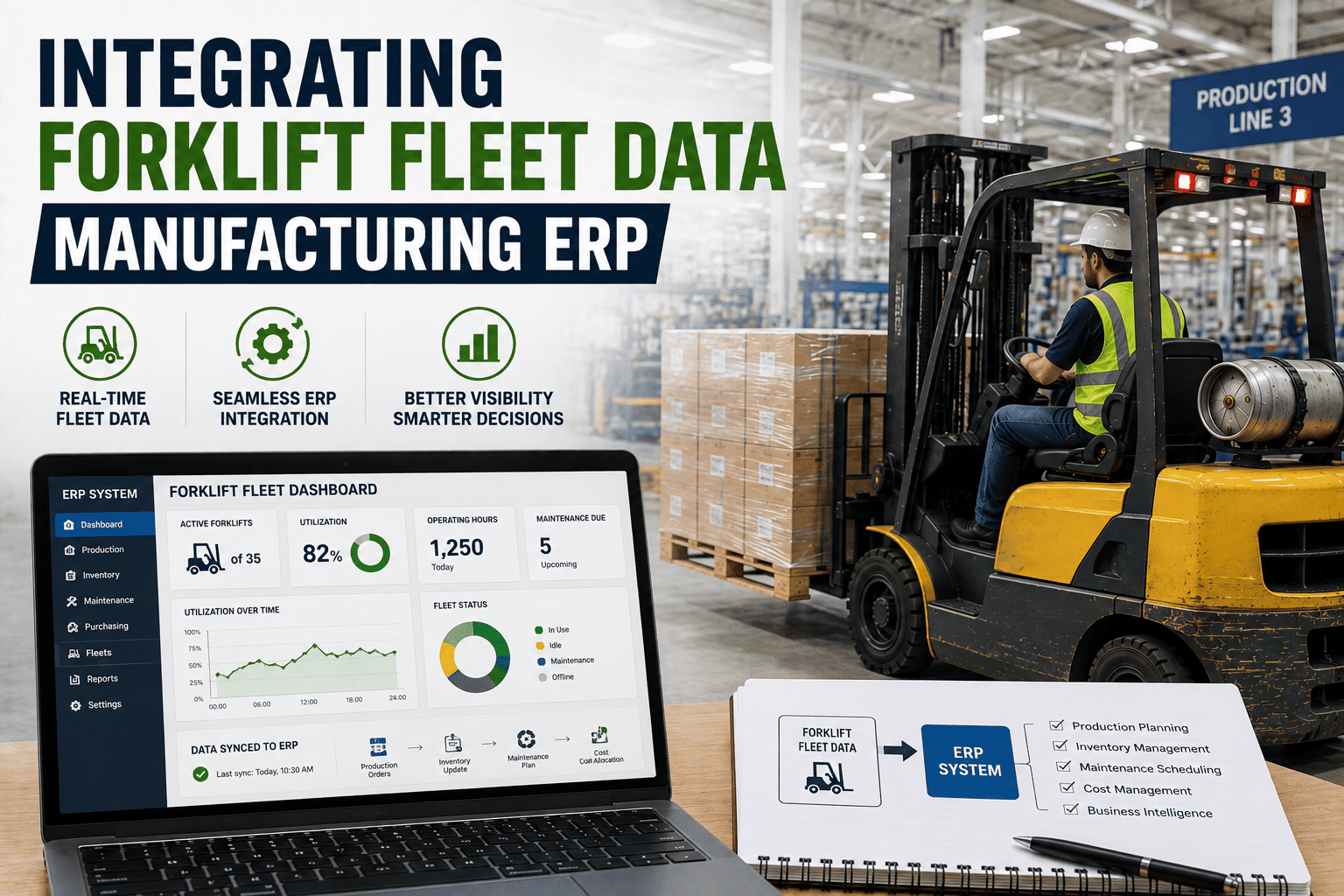
Forklift fleet data that lives only in a spreadsheet or standalone app never reaches the ERP systems, like SAP, Oracle, or NetSuite, that production and finance teams actually plan against. Integrating fleet data with your ERP gives every team a single, current view of equipment availability, maintenance cost, and utilization, instead of forcing manual reconciliation between disconnected systems.
The Cost of Fleet Data Living in a Silo
When fleet data and production data don't talk to each other, the damage shows up in small, recurring ways that add up fast. Planners schedule production runs without knowing real equipment availability. Finance manually re-enters maintenance costs into cost center accounting. Inventory teams don't get automatic updates when a work order consumes parts. Each gap looks minor on its own, but together they create hours of weekly reconciliation work and a constant risk of planning around numbers that are already out of date.
What Changes Once the Systems Are Connected
Integration doesn't just move data faster, it changes what decisions are even possible. Production planners can see real equipment readiness before committing to a heavy run. Finance sees maintenance spend flow directly into cost center accounting without a manual entry. Fleets using dedicated integration typically see 30 to 42 percent less unplanned downtime and recover 15 to 20 percent of hidden fleet capacity within the first year, largely because decisions get made against current data instead of last week's spreadsheet.
FleetRabbit integrates with SAP, Oracle, NetSuite, and other major ERP platforms, so equipment availability, maintenance cost, and utilization stay current across every system your teams already use. Start a free trial to connect your fleet, or book a demo to see the integration mapped to your ERP.
What Bidirectional Integration Actually Moves
Real ERP integration isn't a one-way export of a maintenance report. It's a continuous, two-way exchange where fleet events update the ERP and ERP context informs fleet decisions, without anyone re-keying a single number.
| Fleet Event | Flows Automatically Into | Team That Benefits |
|---|---|---|
| Maintenance cost logged | Cost center accounting in the ERP | Finance |
| Work order completed | Inventory consumption update | Parts and inventory management |
| Equipment scheduled for PM | Real-time equipment readiness view | Production planning |
| WMS demand forecast | Fleet utilization planning | Fleet and warehouse management |
Which ERP Systems Actually Connect
Most manufacturing plants run one of a small number of major platforms, and fleet integration needs to speak all of them without a custom build for each site. Open API architecture is what makes this practical, pulling meter readings, fault codes, and location data automatically rather than through manual export and import routines.
SAP, Oracle, and NetSuite
These three cover the large majority of manufacturing ERP deployments. A fleet platform built with native, bidirectional connections to all three avoids the common failure mode where integration only works for one system and every other site becomes a manual workaround.
API Integration vs. Manual Reconciliation
A manual process means someone exports a fleet report, reformats it, and imports it into the ERP, usually once a week at best. API-based integration updates both systems continuously, which is the difference between planning against this morning's equipment status and planning against a number that was already stale when it was pulled.
FleetRabbit's open API architecture keeps maintenance costs, work orders, and equipment readiness flowing between your fleet and your ERP in real time, no manual exports required. Sign up free to see it connected to your systems, or book a 30-minute demo to walk through the setup.
Frequently Asked Questions
A forklift fleet that's mechanically well managed but invisible to the ERP is still operating half blind. Production plans get built on assumptions instead of current data, finance re-keys numbers that already existed somewhere else, and every team is working from a slightly different version of the truth. Closing that gap isn't a massive IT project anymore. It's a matter of connecting the systems that were always meant to work together in the first place.
FleetRabbit connects directly to SAP, Oracle, and NetSuite, so equipment readiness, maintenance cost, and utilization data stay accurate across every system your teams rely on. Sign up free and connect your fleet today, or book a demo to see your ERP integration mapped out.