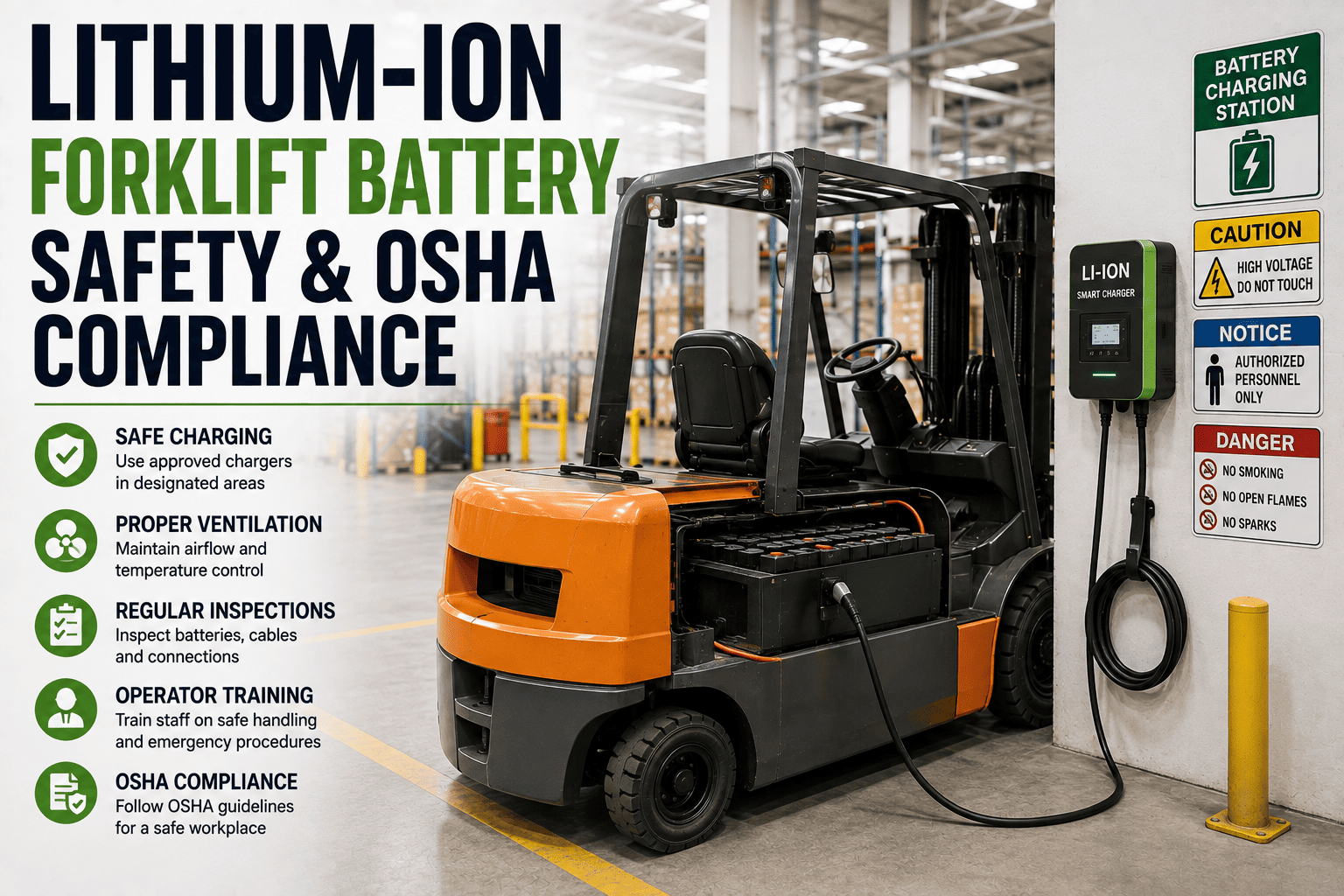
Lithium-ion forklift batteries solved a lot of problems that used to plague lead-acid fleets, but they brought a different kind of risk that many plants have not fully adjusted to. A punctured cell, an overcharged pack, or a battery charged in freezing temperatures can trigger thermal runaway, a chemical reaction that spreads fast and cannot be put out with water. OSHA and fire safety agencies have been paying closer attention, and plants running lithium fleets without updated protocols are increasingly the ones getting flagged during inspections.
Thermal runaway can occur from overcharging, physical damage, or internal shorts, and once it starts it cannot be extinguished with water since lithium reacts with it to release hydrogen gas. OSHA requires acid and thermal-resistant PPE under 1910.178, and NFPA 855 governs siting, ventilation, and detection for battery storage and charging areas. A battery management system is considered essential rather than optional for preventing overcharge and temperature-related failures.
Why Lithium Batteries Carry a Different Risk Profile
Lead-acid hazards are mostly chemical burns and hydrogen gas buildup, both well understood and well controlled through decades of standard practice. Lithium-ion introduces thermal runaway, a self-sustaining reaction where a damaged or overheated cell releases enough heat to ignite neighboring cells in a chain reaction. Once this starts, it burns hot, spreads fast, and standard firefighting methods that work on other fires can make a lithium fire worse instead of better.
What Actually Triggers Thermal Runaway
Three conditions cause the overwhelming majority of lithium battery failures in industrial settings: overcharging past the manufacturer's voltage limit, physical damage to the cells from impacts or punctures, and internal short circuits from manufacturing defects or corroded connections. Charging a battery that has been cold-soaked below freezing without proper temperature compensation is a less obvious trigger that catches many night-shift operations off guard.
Why Water Makes It Worse
Lithium metal reacts with water to release flammable hydrogen gas, which is why standard water-based extinguishers are the wrong response to a lithium battery fire. Facilities need Class D dry powder extinguishers or specialized lithium-rated agents on hand near charging areas, and staff need to know this distinction before an incident, not during one.
FleetRabbit logs battery inspections, charging events, and temperature flags across your fleet, so damaged packs and charging violations get caught before they become a safety event. Sign up free to start tracking your fleet today.
Where OSHA and NFPA Rules Actually Apply
Lithium-ion forklift batteries fall under a mix of existing OSHA standards and fire code guidance that was not originally written with this chemistry in mind, which means compliance often requires combining several sources rather than following a single checklist. OSHA's general industry standard for powered industrial trucks covers PPE and charging area requirements, while NFPA 855 addresses siting, ventilation, and fire protection for battery storage and charging.
PPE Requirements That Differ From Lead-Acid
Standard acid-resistant gear built for lead-acid batteries does not fully cover lithium risks. Facilities running lithium fleets need to add thermal and arc-rated protection for staff working near charging stations, since the failure mode is heat and fire rather than acid exposure. Training programs built around lead-acid protocols need a real update, not just a mention, to address these differences.
Charging Area Requirements
Charging areas need adequate separation from other operations, clear signage, and detection equipment such as smoke or heat sensors positioned near charging stations. Storing lithium batteries away from flammable materials and clear of emergency exits is a basic requirement that gets overlooked more often than it should in space-constrained plants.
| Compliance Area | What Is Required | Common Gap | How to Close It |
|---|---|---|---|
| Fire Suppression | Class D extinguishers near charging bays | Only water or standard extinguishers on site | Audit extinguisher type at every charging station |
| PPE | Thermal and arc-rated protection near chargers | Lead-acid PPE reused for lithium fleets | Update PPE inventory to match battery chemistry |
| Damaged Battery Handling | Immediate isolation and separate containment | Damaged packs left in rotation or mixed storage | Log every impact and flag packs for inspection |
| Charging Protocol | BMS-managed charging within temperature limits | Cold-soaked batteries charged without compensation | Track battery temperature at charge start |
| Detection | Smoke or heat sensors near charging stations | Detection sized for general plant, not battery risk | Review sensor placement against NFPA 855 guidance |
Building an Inspection Routine That Catches Problems Early
Most lithium battery incidents in industrial settings trace back to a warning sign that existed before the failure, whether that was a known impact, a repeated overcharge event, or an unusual heat signature during a routine check. A consistent inspection routine turns those warning signs into caught problems instead of after-the-fact investigations.
What a Strong Inspection Program Includes
Quarterly thermal imaging scans catch developing hotspots before they become failures. Voltage balancing checks on individual cells reveal degradation the battery management system alone might not flag as urgent. Terminal and connector inspections catch corrosion before it becomes an arc flash risk. None of these require exotic equipment, only a consistent schedule and a place to log the results.
Isolating Damaged Batteries Immediately
A battery involved in a forklift collision or dropped load should be pulled from service and isolated in dedicated containment, separate from healthy batteries, until a qualified technician clears it. Continuing to charge or use a battery with unknown internal damage is one of the more preventable causes of a serious incident, and it is entirely avoidable with a simple isolation rule enforced consistently.
FleetRabbit flags batteries involved in impacts, tracks inspection due dates, and keeps a digital record your safety team can produce during an audit without digging through paper logs. Explore how it works with a live walkthrough.
Training Your Team for the Chemistry They Actually Use
Generic forklift safety training rarely covers the specific hazards of lithium-ion batteries, and mixed fleets running both chemistries need staff who understand that a rule protecting them from one battery type could be irrelevant or even wrong for the other. Workers need to know how to recognize the early signs of a failing cell, such as unusual smells, swelling, or excessive heat, and exactly what to do in the first minute after noticing them.
Documentation matters here too. OSHA guidance points employers toward following manufacturer instructions and established fire agency procedures for responding to battery failures, and expects workers to actually be trained on those procedures rather than simply having them available in a binder somewhere on site.
Key Takeaways on Battery Safety and Compliance
Lithium-ion forklift batteries are not more dangerous than lead-acid, they are differently dangerous, and the plants running into trouble are usually the ones that copied their lead-acid safety program instead of building a lithium-specific one. Overcharging, physical damage, and cold-weather charging are the primary triggers for thermal runaway, and each one has a clear, manageable prevention step once a facility knows to look for it.
Compliance is not a one-time checklist, it is an ongoing inspection and documentation discipline. Facilities that log every impact, track charging behavior, and keep inspection records current are the ones that walk through an OSHA or insurance audit with confidence instead of scrambling to reconstruct what happened after the fact.
FleetRabbit tracks battery inspections, charging compliance, and impact history across your fleet, giving your safety team the documentation they need before an inspector ever asks for it. Get started with no credit card required.