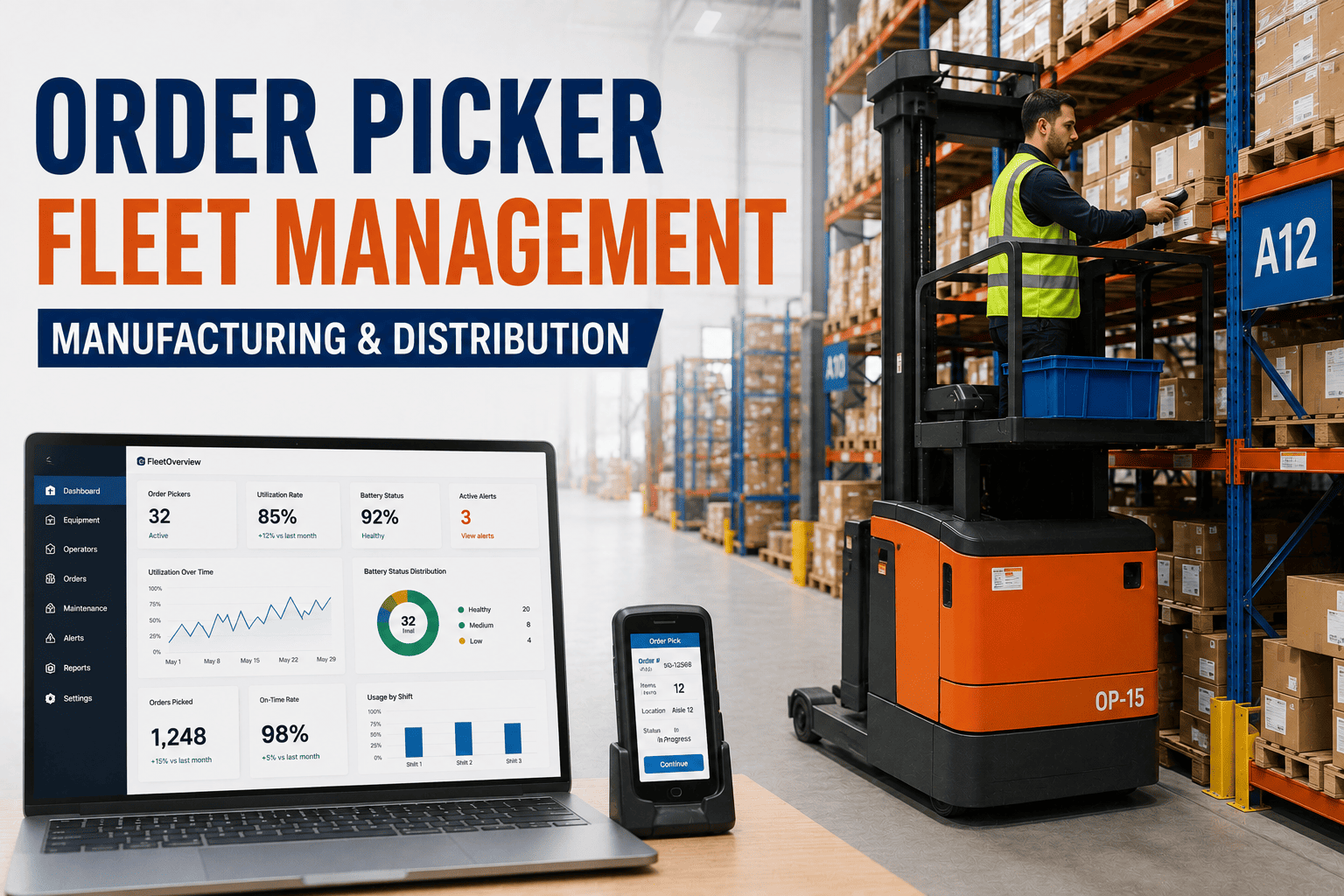
An order picker is not just another forklift with a different name. It lifts the operator, standing on a platform, up alongside the forks to retrieve individual items from racking that can run several stories high, which means every ride to height carries a fall risk that a standard sit-down forklift never introduces. OSHA classifies these Class II electric narrow aisle trucks under the same powered industrial truck standard as any other forklift, but the practical reality on a distribution center floor is that an order picker fleet needs a fall protection and inspection discipline that goes well beyond a routine pre-shift check.
Order picker fleet management for manufacturing and distribution centers has to combine standard maintenance tracking with fall protection specific requirements, since the operator rides an elevated platform during every pick. That means harness inspection records, interlock system checks, and emergency lowering tests need the same rigor as hydraulic and drivetrain maintenance. FleetRabbit tracks both sides of that equation in one platform so no order picker returns to service with an overlooked safety gap.
Why Order Pickers Carry Their Own Safety Category
Standing on a platform that rises with the forks changes the entire risk profile of the equipment. OSHA strongly encourages body harnesses on elevated platforms of powered industrial trucks, and many facilities pair that with an interlock system that will not allow travel or lift until the operator is properly positioned on the platform. Emergency lowering controls give an operator a way to bring the platform down if the primary controls fail, and slow travel speed limits automatically apply once the platform is elevated above a set height.
The Two Systems Most Facilities Run Separately
Most distribution centers already track forklift maintenance in one system and safety compliance, like harness inspections and training records, in a completely different one, often a spreadsheet or paper binder kept by the safety team. That separation creates real risk: a mechanically sound order picker can still return to service with an interlock that was never re-tested, or an operator using a harness that lapsed its inspection window without anyone cross-checking both records at once.
What a Combined Record Actually Prevents
When maintenance and safety data live in the same platform, a single dashboard shows whether a specific truck is both mechanically ready and safety compliant before it goes back on the floor. Distribution teams looking to close this gap can start a free trial and see their order picker fleet's combined maintenance and safety status in one place.
FleetRabbit brings harness inspection dates, interlock checks, and standard maintenance data into one dashboard, so no order picker goes back into service with a mechanical issue or a lapsed safety check hiding behind the other.
Order Pickers Versus Standard Forklifts on Safety Requirements
The comparison below highlights exactly where order picker requirements go beyond a standard sit-down forklift, and why treating the two the same in a fleet program leaves gaps.
| Requirement Area | Standard Sit-Down Forklift | Order Picker |
|---|---|---|
| Fall Protection | Generally not applicable at ground level | Body harness and lanyard connected to the platform anchor, strongly encouraged by OSHA |
| Operator Position Verification | Seat presence sensor in most models | Interlock system confirming proper platform positioning before travel or lift |
| Emergency Controls | Standard emergency stop | Emergency lowering controls to bring an elevated platform down safely |
| Speed Restrictions | General facility speed limits apply | Automatic slow-speed limits once the platform is elevated above a set height |
| Certification Scope | Standard powered industrial truck certification | Separate certification specific to elevating platform operation and harness use |
Four Checks Every Order Picker Program Needs
Building a Rescue Plan Alongside Equipment Checks
Fall protection equipment alone is not a complete safety program. Facilities running order pickers need a written plan covering how a suspended operator would be rescued if a fall occurred, since suspension trauma can become dangerous within minutes. Pairing that written plan with digital records of every harness and interlock check gives safety teams a defensible, organized program rather than scattered documentation across different departments. Distribution centers building or auditing this program can book a demo to see how compliance records for an entire order picker fleet can be generated on demand.
FleetRabbit organizes fall protection checks alongside standard maintenance records for your entire order picker fleet, giving safety and operations teams one shared, audit-ready view instead of two disconnected systems.
Frequently Asked Questions
FleetRabbit tracks harness inspections, interlock checks, and standard maintenance for every order picker in your fleet, so safety and uptime live in one dashboard instead of two disconnected processes. See your fleet data within a day, no credit card required.