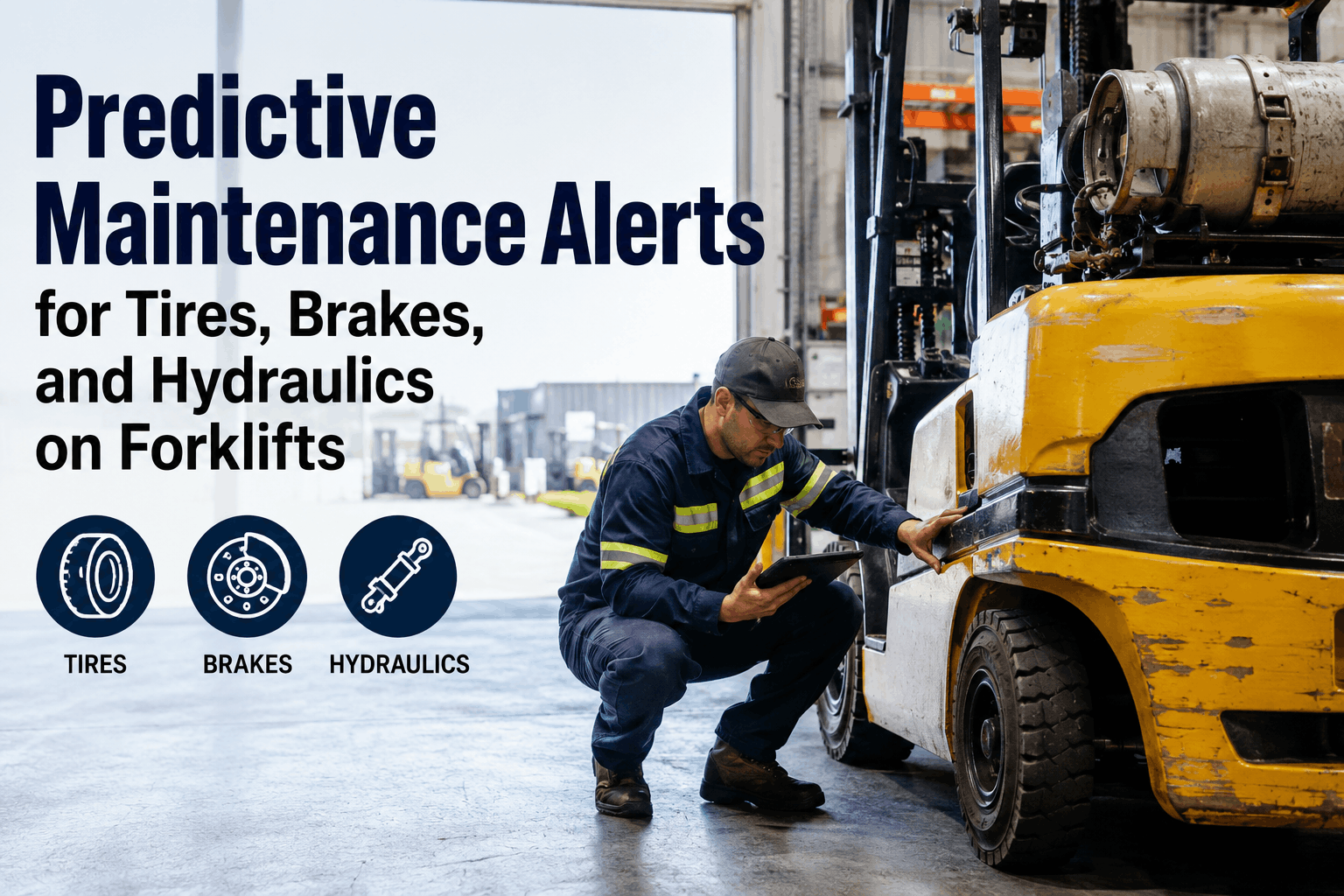
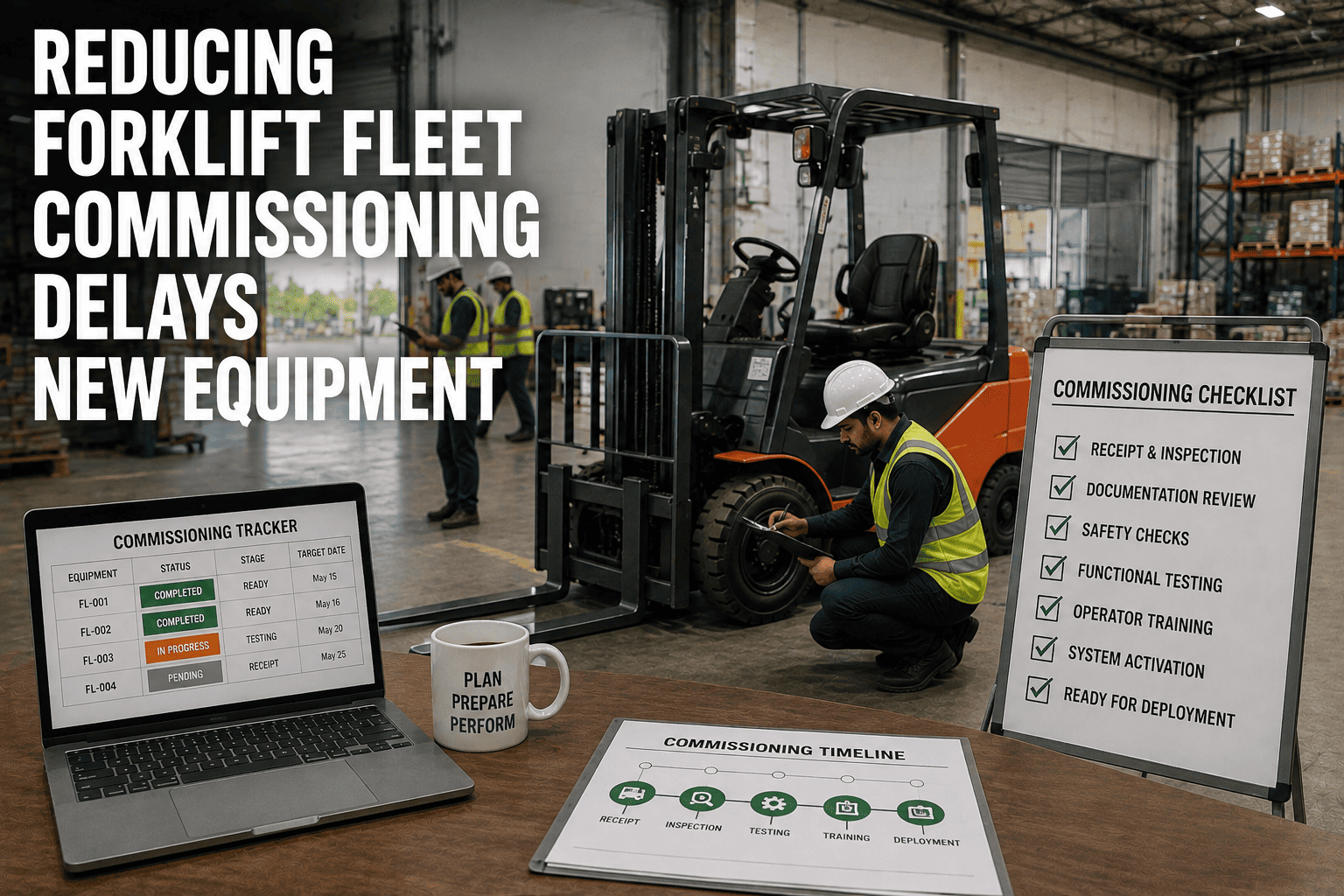
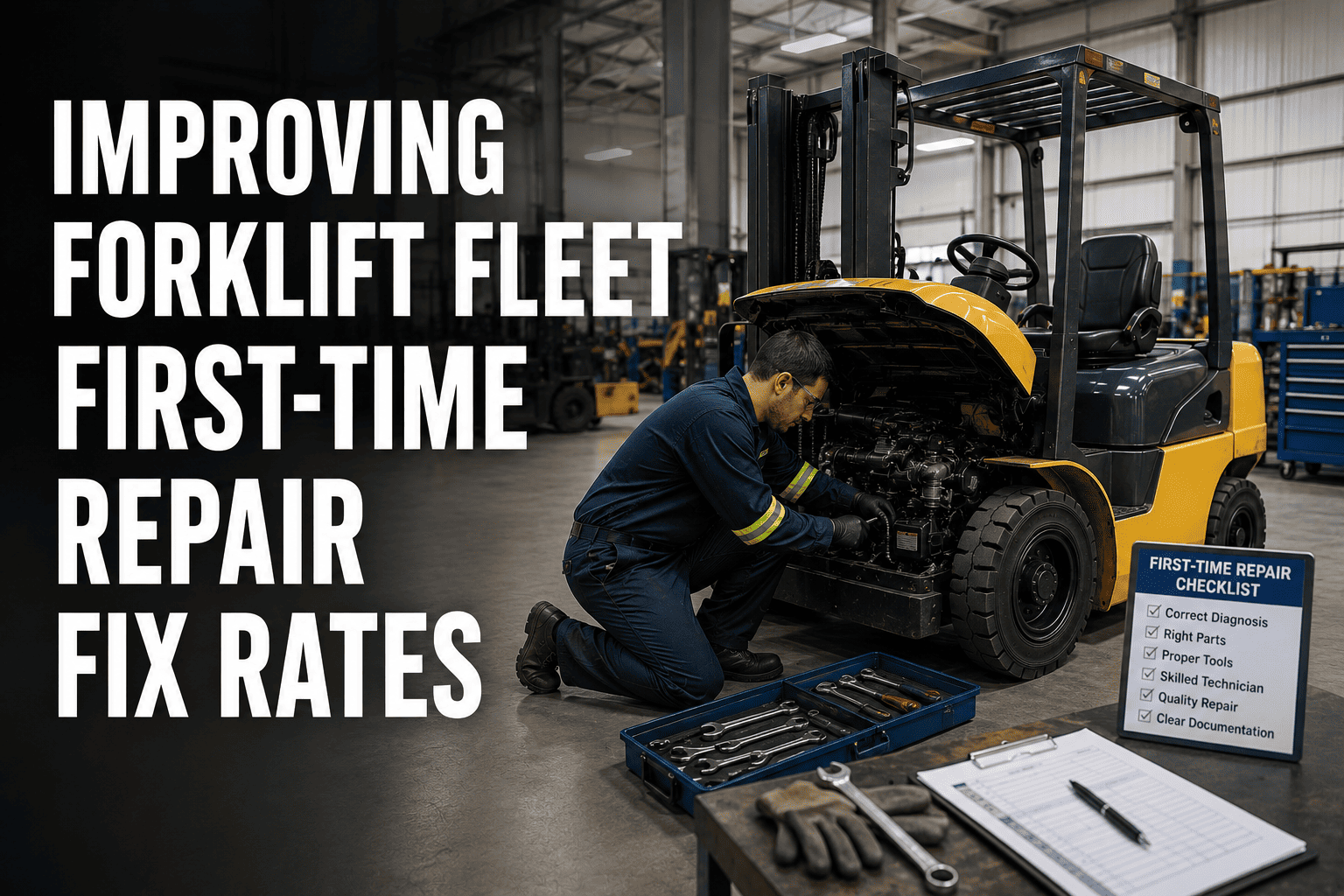
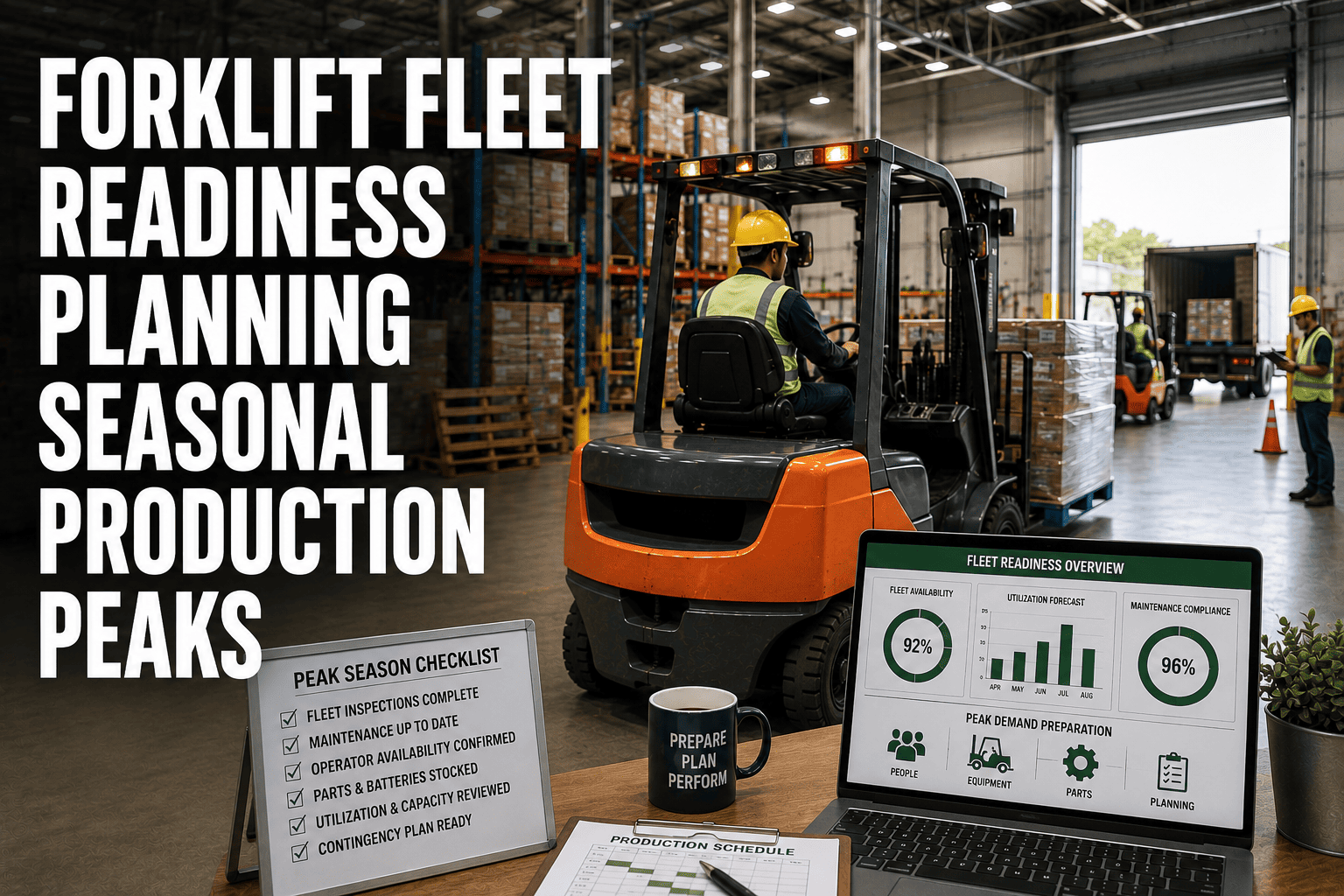
Predictive maintenance alerts for tires, brakes, and hydraulics on forklifts don't fail loudly. A tire showing 18% wear deviation across axle positions isn't throwing a warning light — it's quietly building toward a blowout during a high-load pallet transfer. A brake system losing hydraulic pressure by 6 PSI per shift isn't triggering a shutdown — it's accumulating response lag that a warehouse floor operator won't notice until stopping distance extends by a metre in a congested aisle. A hydraulic cylinder seal degrading over 200 operating hours isn't announcing its condition — it's leaking fluid at a rate that your maintenance team will discover when the mast fails to hold elevation under a 3,000 kg load. The predictive maintenance failures that generate OSHA citations, unplanned downtime events, and catastrophic component replacements are rarely sudden. They are gradual, measurable, operational progressions that manual inspection cycles miss entirely — until a breakdown, a near-miss, or a regulatory audit makes the accumulated deterioration visible all at once. IoT-enabled forklift monitoring and predictive analytics eliminate this visibility gap by converting passive equipment operation into continuous, alerting, data-driven maintenance intelligence. Start preventing forklift breakdowns with FleetRabbit or book a predictive maintenance demo with our team.
FleetRabbit Forklift Predictive Maintenance Intelligence
Predictive Maintenance Alerts for Tires, Brakes, and Hydraulics on Forklifts
Discover how smart IoT sensors, real-time component wear tracking, and automated maintenance alerts help warehouse and manufacturing fleets prevent forklift breakdowns before they happen — across every critical system on every vehicle.
73%Of unplanned forklift downtime is caused by preventable component wear
$18K+Average cost of a single unplanned forklift hydraulic failure event
<60sFleetRabbit threshold breach to maintenance alert delivery
3×Longer component lifespan achieved through proactive wear intervention
The Critical Forklift Components That Predictive Alerts Monitor — and Why Manual Inspection Fails
OSHA inspections, insurance loss assessments, and third-party fleet audits consistently identify the same three component categories as the primary drivers of forklift breakdown events, safety incidents, and avoidable repair costs across manufacturing and warehouse operations. Understanding precisely where these failures originate — and why scheduled inspection intervals consistently miss early-stage deterioration — is the foundation of an effective predictive maintenance programme.
01
Tire Wear Without Load-Weighted Detection
Forklift tire degradation is not uniform. Cushion and pneumatic tires wear asymmetrically based on load distribution, turning frequency, floor surface conditions, and operator habits — producing uneven wear patterns that visual inspection at monthly intervals consistently underestimates. A tire wearing 2–3mm per week on the outer shoulder under heavy-load turning cycles will cross the replacement threshold between inspection dates, with no alert, no documentation, and no intervention opportunity until a flat or structural failure during operation. FleetRabbit's smart forklift sensor suite tracks tire pressure deviation, temperature spike patterns associated with structural fatigue, and axle load distribution — generating automated forklift tire wear monitoring alerts when readings indicate approaching wear thresholds, before the failure cycle begins.
02
Brake System Degradation Below Detection Threshold
Forklift brake alerts are among the most time-sensitive maintenance notifications in industrial vehicle management — because brake system degradation directly affects stopping distance, load control, and operator safety in environments where pedestrians, racking, and other equipment share the operating space. Hydraulic brake pressure loss of 4–8 PSI per operating shift is invisible to the operator, undetectable by visual inspection, and will not appear on a scheduled service record until the next fluid check. By that point, total pressure loss may have extended stopping distance by 30–40% under full load conditions. FleetRabbit's brake pressure monitoring captures hydraulic line pressure continuously throughout operation, generating forklift brake alerts the moment deviation from baseline exceeds configurable thresholds — enabling maintenance intervention before stopping performance is compromised.
03
Hydraulic System Seal and Pressure Failures
Forklift hydraulic maintenance is the most technically complex and cost-intensive element of industrial vehicle upkeep — and the component category where early detection produces the greatest cost differential between proactive intervention and reactive repair. A mast cylinder seal beginning to degrade at 1,800 operating hours will show micro-leakage patterns, pressure cycling irregularities, and temperature anomalies across 200–400 hours of continued operation before a failure event occurs. Manual operator pre-shift checks do not detect early-stage hydraulic degradation. Hydraulic system monitoring through IoT pressure transducers, fluid temperature sensors, and cycle-count analytics identifies deterioration at the micro-symptom stage — enabling seal replacement at scheduled maintenance windows rather than emergency mast-down repair events that cost 4–6× more and generate unplanned downtime measured in shifts, not hours.
04
Multi-System Wear Interactions That Compound Failures
The most operationally damaging forklift breakdown events are not single-component failures — they are compounding failure chains where simultaneous wear across tires, brakes, and hydraulics reaches critical threshold at the same time, producing a breakdown event that requires multi-system repair and extended downtime. A forklift operating with 15% tire pressure deviation, 12 PSI hydraulic brake pressure loss, and a mast cylinder at 90% seal life remaining is not experiencing three independent maintenance issues — it is 72 hours from a multi-system failure event that will take the vehicle out of service for two to five days. FleetRabbit's predictive analytics for forklifts models cross-system wear interactions, identifying compound risk profiles before individual thresholds are breached — enabling proactive fleet maintenance scheduling that prevents the compounding failure pattern entirely.
FleetRabbit Predictive Maintenance Capabilities for Every Critical Forklift System
Preventing forklift breakdowns through predictive maintenance requires continuous monitoring, intelligent alerting, and documented maintenance response working as a unified system — not as separate inspection intervals managed by different technicians reviewing different data sources. FleetRabbit's industrial vehicle maintenance platform integrates IoT sensor data, predictive wear analytics, and automated maintenance workflows into a single operational intelligence system that monitors every critical component on every vehicle, every hour of operation.
Real-Time Tire Pressure and Wear Analytics
Smart forklift sensors transmit tire pressure, temperature, and load distribution data continuously throughout operation. Deviation from baseline generates immediate forklift tire wear monitoring alerts to maintenance managers. Wear trajectory modelling projects replacement dates 2–4 weeks in advance — enabling scheduled swaps during planned downtime windows.
Hydraulic Brake Pressure Monitoring
Continuous hydraulic line pressure tracking across all brake circuits — with configurable forklift brake alert thresholds calibrated to vehicle class and load rating. Pressure loss trends are logged per shift with operator and route attribution, enabling root cause identification of accelerated brake wear at specific operating conditions, surfaces, or usage patterns.
Mast and Cylinder Hydraulic System Monitoring
IoT pressure transducers and fluid temperature sensors on mast cylinder circuits identify seal degradation, micro-leakage patterns, and pressure cycling anomalies at the earliest detectable stage. Cycle count analytics project seal service life remaining — generating scheduled maintenance work orders weeks before failure risk enters the critical zone.
Predictive Analytics and Failure Modelling
Fleet-wide predictive analytics for forklifts models component wear rates against operating profiles, load cycles, shift patterns, and floor conditions. Machine learning wear curves generate remaining service life estimates with ±8% accuracy — enabling warehouse fleet optimisation through maintenance scheduling that eliminates reactive breakdown events.
Automated Work Order Generation
Every predictive alert automatically generates a maintenance work order with component identification, severity classification, recommended action, and scheduling priority — routed directly to the maintenance team's queue. No manual transcription, no alert-to-action lag. Material handling equipment repair cycles initiated within minutes of threshold detection.
Compliance and Maintenance Audit Documentation
Complete maintenance history, alert records, inspection logs, and corrective action trails generated automatically per vehicle — retrievable for OSHA inspection response, insurance audit, and customer compliance review in under 60 seconds. Every forklift breakdown prevention action documented with timestamp, technician attribution, and resolution status.
FleetRabbit Forklift Predictive Maintenance
Stop Replacing Components After They Fail. Start Predicting Every Wear Event Before It Becomes a Breakdown.
FleetRabbit's industrial vehicle maintenance platform gives manufacturing and warehouse fleets continuous tire wear monitoring, hydraulic brake pressure alerts, mast cylinder degradation detection, and automated predictive maintenance scheduling — on every forklift, across every shift, without manual inspection dependency.
Predictive Maintenance Alert Coverage by Component Category
Monitor 01
Tire Pressure Deviation
FleetRabbit tracks per-tire pressure continuously and alerts on deviation exceeding configured thresholds — detecting slow leaks, valve degradation, and structural fatigue patterns before pressure loss affects load stability or traction safety.
Monitor 02
Brake Hydraulic Line Pressure
Per-circuit brake pressure tracked across every operating shift. Gradual pressure loss trends trigger forklift brake alerts before stopping distance is affected — enabling fluid top-up, line inspection, or caliper replacement at scheduled intervals rather than failure-driven emergency repair.
Monitor 03
Hydraulic Fluid Temperature
Hydraulic system monitoring includes fluid temperature tracking across mast and tilt circuits. Temperature spikes above operating range indicate seal friction, contamination, or cooling system degradation — each a precursor to accelerated component wear that IoT forklift monitoring detects hours before mechanical failure.
Monitor 04
Mast Cylinder Cycle Counts
Heavy machinery predictive alerts for mast cylinders are generated from accumulated lift cycle analysis. Each forklift's actual operating profile — not a generic service interval — drives the replacement recommendation, ensuring seals are replaced at actual wear points rather than arbitrary calendar milestones.
Monitor 05
Load Cell and Axle Distribution
Proactive component wear tracking includes axle load distribution monitoring that identifies off-centre loading patterns causing asymmetric tire and bearing wear. Operator load habits are profiled and flagged — enabling training intervention that extends component lifespan across the entire fleet.
Monitor 06
Vibration and Impact Signature
Accelerometer data from smart forklift sensors detects abnormal vibration signatures associated with bearing wear, wheel hub deterioration, and drive system imbalance — generating equipment downtime reduction alerts that surface mechanical issues at the earliest detectable stage across every vehicle in the fleet.
"
We were running a 24-vehicle electric forklift fleet across two distribution centres and experiencing three to four unplanned breakdown events per month — every one of them a tire, brake, or hydraulic failure that a service technician could have prevented with a week's advance notice. The problem wasn't the maintenance team. They were responding perfectly to what they could see. The problem was that by the time a hydraulic seal or a brake circuit made itself visible through a performance issue, we were already inside the failure window. After deploying FleetRabbit's IoT monitoring across the fleet, our first full quarter saw zero unplanned hydraulic or brake failures. Tire replacements moved entirely to scheduled windows. The predictive wear alerts gave us 10 to 18 days of advance notice on every critical component — enough time to order parts, schedule the technician, and pull the vehicle at a shift change rather than mid-operation. The ROI calculation was straightforward: one prevented hydraulic mast failure pays for a full year of monitoring across ten vehicles.
Head of Fleet Maintenance and Engineering
·
National Third-Party Logistics Provider — 24 Electric Forklifts — FleetRabbit Predictive Maintenance Active
Frequently Asked Questions
QHow does predictive maintenance differ from scheduled preventive maintenance for forklifts?
Scheduled preventive maintenance replaces or inspects components at fixed time or hour intervals — regardless of actual component condition. This approach over-services components that have remaining life and under-serves components that have deteriorated faster than the schedule anticipated. Predictive maintenance for forklifts uses continuous sensor data — tire pressure, brake hydraulic pressure, mast cylinder cycle counts, fluid temperature, and vibration signatures — to track actual component wear in real time. FleetRabbit's predictive analytics generate maintenance alerts based on measured deterioration toward failure thresholds, not calendar proximity to the next service interval. The result is maintenance action taken when the component actually needs it — preventing breakdowns without replacing components prematurely. For high-utilisation warehouse and manufacturing fleets, the cost differential between scheduled and predictive approaches typically ranges from 25–40% in annual component spend, before accounting for the downtime cost of reactive breakdown events.
QWhat types of forklifts and industrial vehicles does FleetRabbit's predictive monitoring support?
FleetRabbit's IoT forklift monitoring platform supports electric counterbalance forklifts, internal combustion counterbalance forklifts, reach trucks, order pickers, turret trucks, pallet movers, and heavy-duty container handlers. The sensor suite is compatible with both fleet-new and in-service vehicles — requiring no proprietary vehicle hardware. IoT sensor installation is completed by certified technicians and typically requires two to four hours per vehicle. Monitoring parameters are configurable by vehicle class, load rating, and operating environment — allowing tire pressure thresholds, hydraulic alert sensitivity, and brake pressure baselines to be calibrated to the specific operating profile of each vehicle type in the fleet. For mixed fleets combining electric and IC-powered vehicles, FleetRabbit provides unified dashboard visibility across all vehicle types from a single interface.
QHow quickly can FleetRabbit's predictive alerts be delivered to maintenance teams when a threshold is breached?
FleetRabbit delivers predictive maintenance alerts within 60 seconds of threshold breach detection — via in-app notification, SMS, and email simultaneously. Alert routing is configurable by severity level: critical alerts (brake pressure loss exceeding emergency threshold, hydraulic pressure drop indicating imminent seal failure) are routed to maintenance supervisors and fleet managers immediately. Advisory alerts (tire wear approaching replacement threshold, mast cycle count entering the final service life quartile) are queued as scheduled maintenance work orders for the maintenance team's next planning cycle. Every alert includes the vehicle ID, specific component affected, current reading, threshold value, and recommended action — enabling maintenance teams to respond with the right parts, the right technician, and the right scheduling decision without any additional diagnostic assessment.
QCan FleetRabbit's monitoring integrate with our existing CMMS or maintenance management system?
FleetRabbit offers API integration with major CMMS platforms for work order synchronisation, parts inventory triggering, and technician scheduling — ensuring that predictive maintenance alerts generated by IoT sensor data flow directly into existing maintenance workflows without requiring teams to manage a separate system. For fleets not using a dedicated CMMS, FleetRabbit's built-in work order management module handles the complete workflow from alert generation to technician assignment, parts ordering, completion sign-off, and maintenance record archiving. All maintenance history is stored per vehicle with full audit trail — retrievable for OSHA compliance documentation, insurance assessment, and customer audit response.
Schedule a demo to review integration options for your specific maintenance management environment.
FleetRabbit Forklift Predictive Maintenance
Every Component Monitored. Every Wear Event Predicted. Every Breakdown Prevented.
FleetRabbit gives warehouse and manufacturing fleets continuous tire wear monitoring, hydraulic brake pressure alerts, mast cylinder degradation detection, cross-system predictive analytics, and automated work order generation — on every forklift, across every operating shift, without manual inspection dependency.
Tire Wear Monitoring
Brake Pressure Alerts
Hydraulic System Monitoring
Predictive Analytics
Automated Work Orders
Equipment Downtime Reduction
May 27, 2026
By Taylor
All Posts