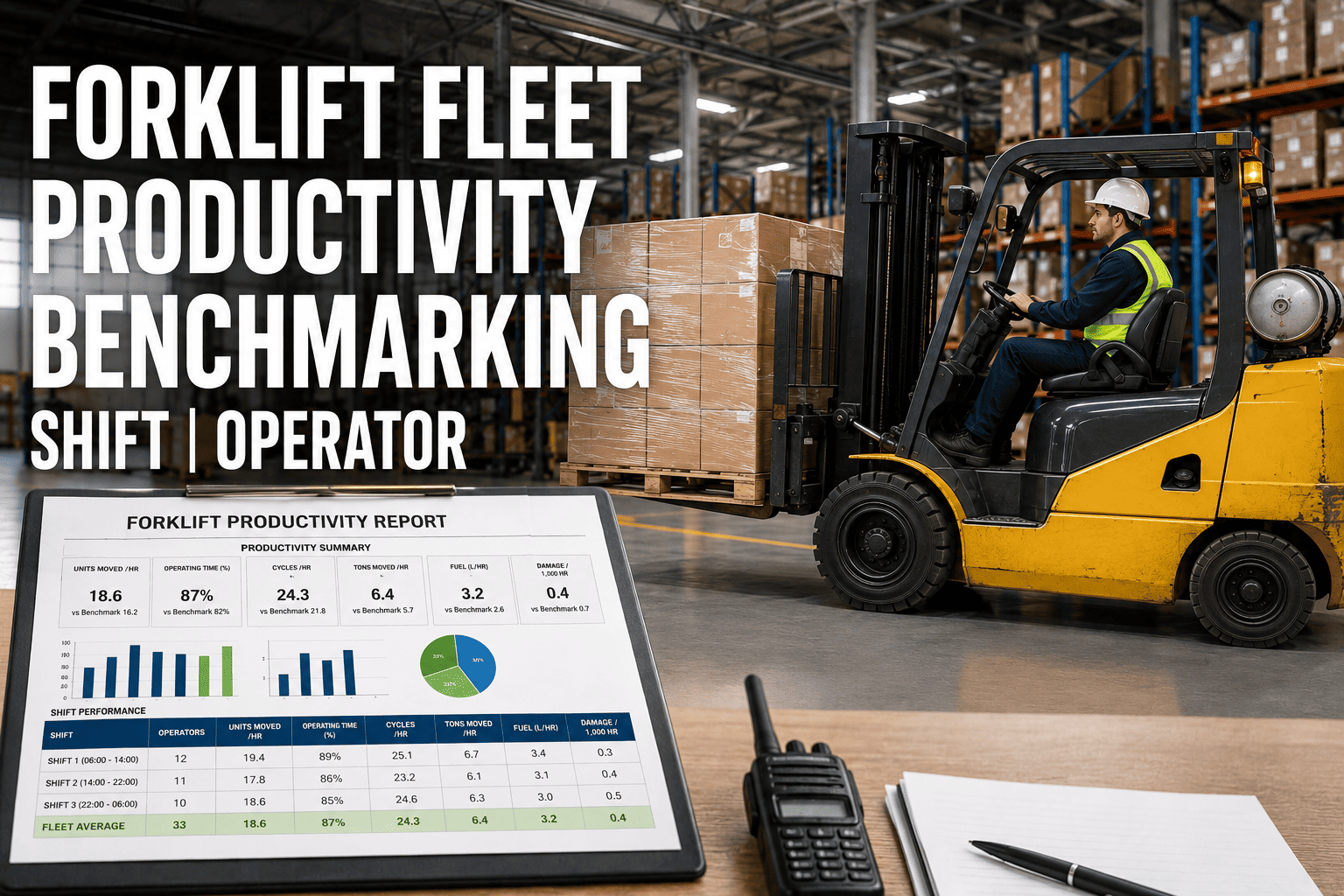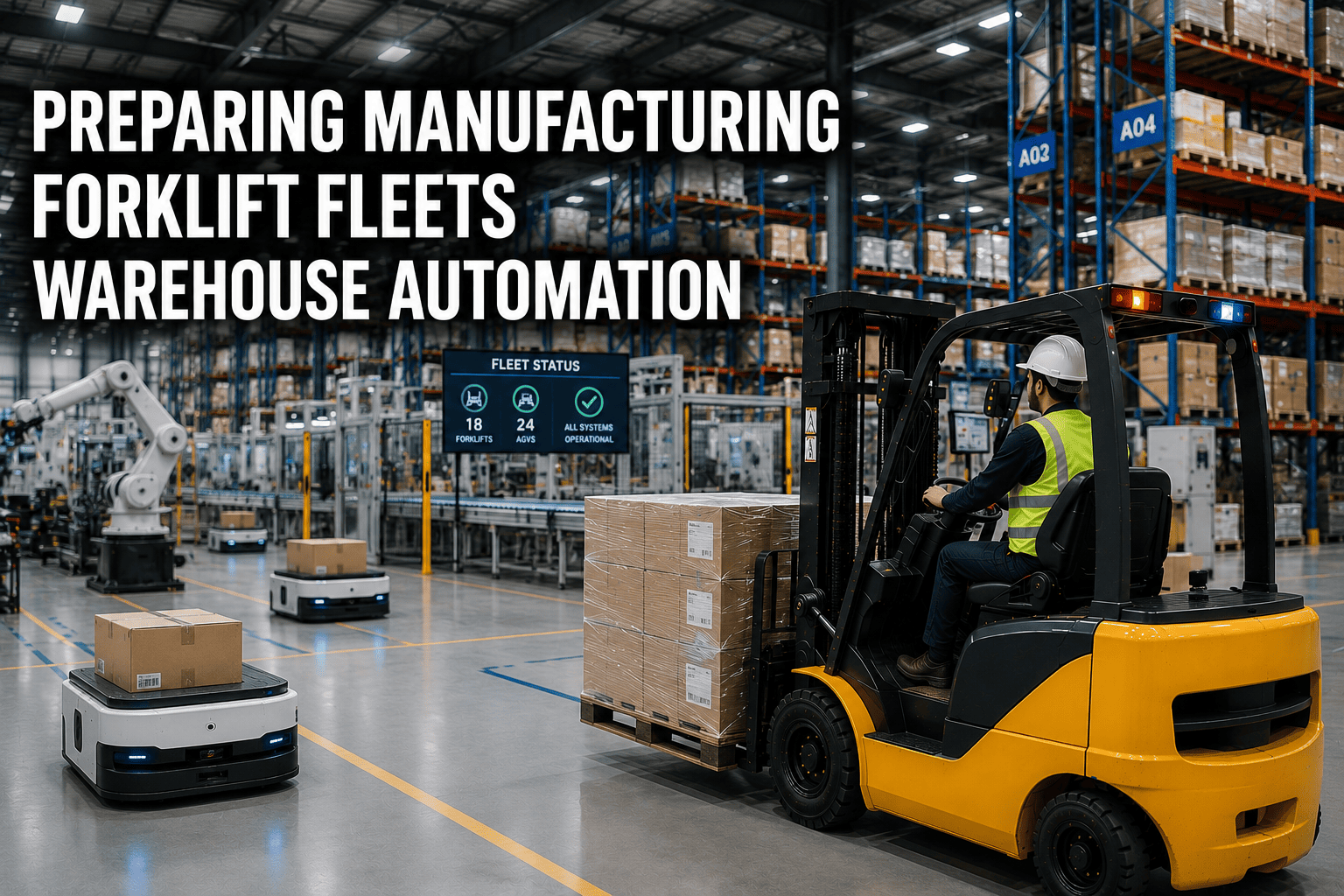
Walk through almost any warehouse automation announcement and the story sounds the same: robots gliding down aisles, pallets moving themselves, throughput climbing while headcount stays flat. What rarely makes the headline is that none of those AGVs and AMRs showed up to an empty building. They rolled into a facility that was already running on manned forklifts, and for a long stretch of the rollout, those manned trucks kept doing most of the actual work. The plants that automate successfully are not the ones that rip out their manual fleet on day one. They are the ones that understood exactly what their manned fleet was doing before they ever wrote the automation purchase order.
Warehouse automation adoption is accelerating fast, with the autonomous forklift market valued around 8.76 billion dollars in 2026 and projected to grow at a 12 percent annual rate toward 13.79 billion dollars by 2030. But AGVs and AMRs are strongest on predictable, repetitive routes, while manned forklifts continue handling irregular loads, exception put-away, and shared-aisle tasks automation is not built for. A successful rollout depends on knowing exactly how the existing manned fleet performs before automating any part of it.
Why Automation Doesn't Replace the Manned Fleet Overnight
Industry data suggests roughly 85 percent of logistics leaders plan to increase automation investment, and mobile robots are on track to outpace fixed automation systems in new deployments. That momentum is real, but it does not translate into a single flip of a switch. Most operations that add AGVs or AMRs run a hybrid fleet for months or years, with automated units handling the predictable, high-volume routes while manned forklifts absorb everything else: exception handling, non-standard pallets, damaged loads, and any task in an area the automation system has not mapped yet.
That hybrid period is also when things go wrong if the manned side of the fleet is not well understood. A facility that does not know its own forklift utilization patterns, travel routes, or downtime history is essentially automating blind, guessing at which routes to hand over first instead of basing that decision on real data. Getting a clear baseline on the manned fleet before automation arrives is the single best predictor of a smooth rollout, and it starts with knowing what the current fleet is actually doing shift by shift. Teams that want that visibility can sign up for FleetRabbit and start building that baseline today.
FleetRabbit tracks utilization, travel patterns, and downtime across your manned forklift fleet, giving automation planning teams the real data they need before deciding which routes to hand over first.
What Automation Takes Over First, and What It Doesn't
Not every task in a warehouse or plant is a good automation candidate on day one. Matching the right work to the right equipment type keeps the rollout realistic instead of forcing automation into tasks it was never designed to handle.
| Task Type | Automation Fit | Why | Typical Timeline |
|---|---|---|---|
| Fixed-route pallet transport | High | Repetitive, predictable, well-suited to fixed-path AGVs | Phase 1 |
| Standard put-away and replenishment | Medium to High | Predictable with SLAM-guided AMRs once the facility is mapped | Phase 2 |
| Exception handling and damaged loads | Low | Requires operator judgment automation cannot replicate yet | Stays manned |
| Irregular or non-standard loads | Low | Variable dimensions and handling needs resist fixed automation logic | Stays manned |
| Newly changed or unmapped layouts | Low until remapped | Automation systems rely on maps and defined paths that need updating first | Manned until remapped |
Predictable Work vs. Variable Work
The clearest signal for what to automate first is consistency. A route that looks nearly identical shift after shift, day after day, is a strong automation candidate. A task that changes based on order mix, seasonal demand, or damaged inventory is better left with an operator who can adapt in real time, at least until automation systems mature further.
Shared-Aisle Safety Requirements
During the transition period, automated and manned equipment frequently share the same aisles, which raises real safety questions. Systems designed for mixed environments build in stability control, intersection merging rules, and obstacle detection specifically because robotic and manual forklifts are operating side by side, not in separate zones. Facility teams need to treat this shared-aisle period as its own safety category, not an afterthought to either fleet.
The Manned-Fleet Baseline Every Automation Rollout Needs
Before committing budget to AGVs or AMRs, the strongest automation plans start with a clear picture of the manned fleet doing the work today.
Utilization Data
Knowing which trucks run near capacity and which sit idle for large parts of a shift reveals where automation would add the most value first, rather than guessing based on gut feel.
Travel Pattern Data
Mapping actual routes, not assumed routes, shows which paths are truly repetitive enough for automation and which ones vary too much to hand over yet.
Downtime and Maintenance History
A manned fleet with frequent unplanned downtime signals deeper operational issues that automation will not fix on its own. Solving those issues first protects the ROI of whatever automated equipment gets added later.
Building a Phased Automation Roadmap
The plants that automate smoothly treat it as a multi-stage project rather than a single purchase. Phase one usually targets the most repetitive, highest-volume routes, often the same routes utilization data already flagged as running near capacity. Phase two expands automation into standard put-away and replenishment once the facility layout is fully mapped and operators are comfortable working alongside robotic units. Exception handling, irregular loads, and newly changed areas remain with the manned fleet indefinitely, or until automation technology genuinely catches up to that level of judgment. Throughout every phase, the manned fleet's own data stays just as important as the automation system's data, since the two are now operating as one combined fleet rather than two separate systems. If your team is mapping out where automation fits into your operation, book a demo with FleetRabbit and bring your current fleet data into the planning conversation.
Frequently Asked Questions
The plants that automate smoothly know exactly what their manned fleet is doing before they hand any route over. See how FleetRabbit builds that baseline, so your automation rollout starts on solid ground.