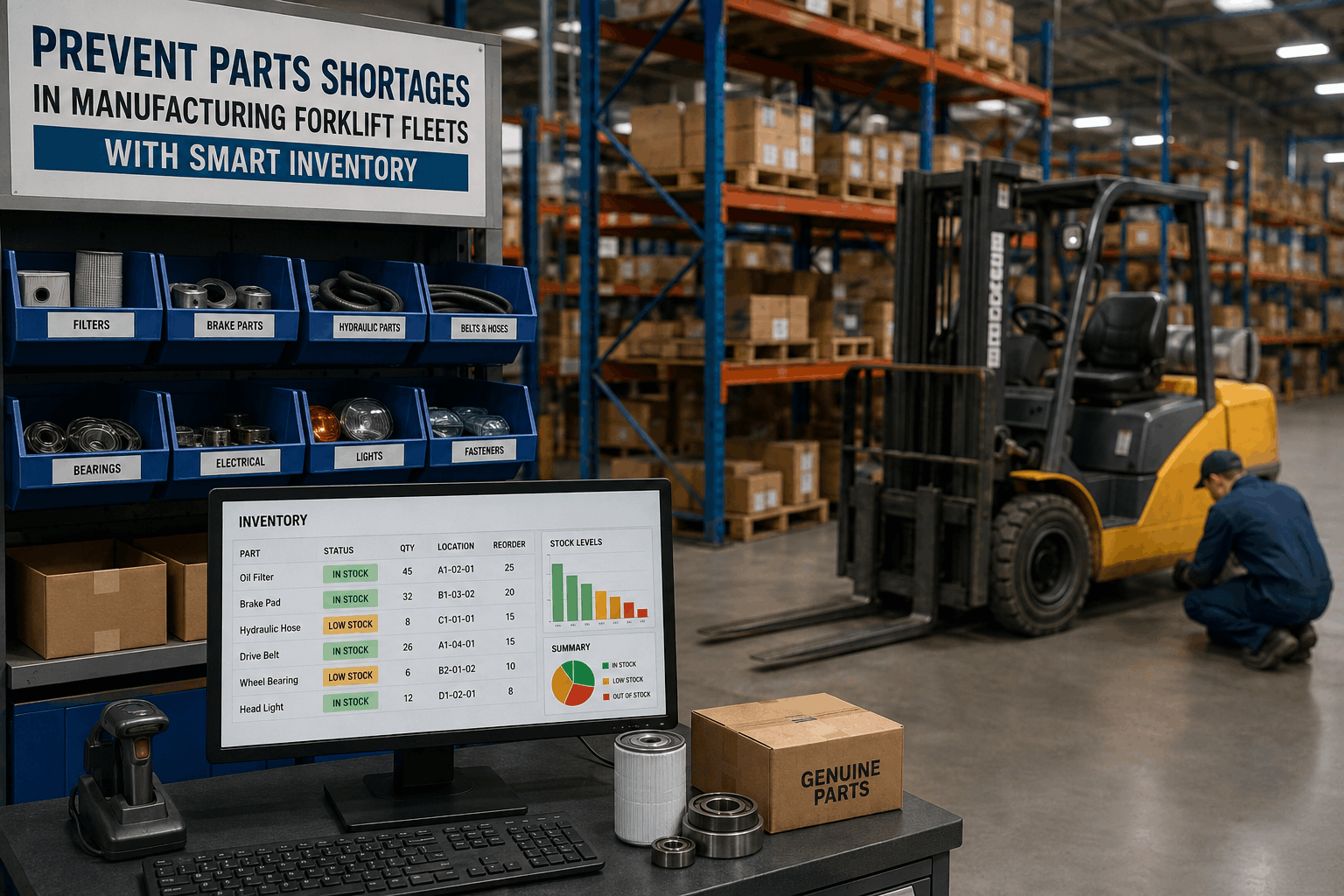
Prevent Parts Shortages in Manufacturing Forklift Fleets with Smart Inventory
When a forklift goes down mid-shift because a $47 hydraulic seal wasn't in the storeroom—and the nearest supplier is three days out—the real cost isn't the part. It's the four hours of halted production, the emergency freight charge, the overtime pay, and the ripple effect through your entire manufacturing schedule. Parts shortages in forklift fleets aren't random bad luck. They're the predictable result of reactive inventory management that treats spare parts as an afterthought rather than a strategic operational asset.
This guide gives plant managers, maintenance supervisors, and operations directors a comprehensive framework for implementing smart inventory management in manufacturing forklift fleets. We cover automated parts tracking, intelligent reorder triggers, supplier integration, and the connected platform capabilities that eliminate costly production stoppages caused by missing components. Manufacturing facilities ready to eliminate parts-driven downtime can start their free trial today.
Manufacturing Reality 2026
The Hidden Cost of Parts Shortages in Forklift Fleets
75%
of unplanned forklift downtime is caused by missing parts rather than mechanical failure complexity
55%
of manufacturing plants manage forklift parts with manual spreadsheets or paper bin cards
4.2x
ROI when smart inventory systems replace reactive parts ordering across manufacturing fleets
Source: Plant Engineering, WERC, and Manufacturing Maintenance Institute Reports 2024–2025
The financial stakes extend beyond the obvious breakdown costs. Emergency parts procurement carries 200–400% premium freight costs. Overstocked slow-moving parts tie up working capital and create obsolescence risk. And every hour of unplanned downtime on a production forklift costs the average manufacturing plant $1,200–$3,500 in lost throughput. Smart inventory management converts this chaotic, reactive cost center into a predictable, controlled operational capability that directly improves production reliability and fleet uptime.
The Parts Shortage Lifecycle: From Gap to Production Loss
Most manufacturing plants don't understand the full cost of a parts shortage because the damage is distributed across departments and time periods. The maintenance team sees the repair delay. Production sees the downtime. Finance sees the emergency freight invoices. And nobody sees the cumulative impact until it shows up in quarterly maintenance cost reviews—months after the pattern could have been corrected.
Parts Shortage Impact Framework
From missing component to production loss and recovery cost
01
Breakdown Detected
Technician diagnoses failure, identifies required part, discovers storeroom is out of stock
02
Emergency Sourcing
Procurement scrambles to find supplier, pays emergency freight premium, waits 1–5 days for delivery
03
Production Impact
Affected work zones halt or bottleneck—operators reassigned, schedules delayed, OT costs triggered
04
Cost Accumulation
Emergency freight, overtime, lost throughput, and expedited repairs compound into 8–20x the original part cost
Smart inventory management breaks this cycle at step one. When every critical part has a defined minimum stock level, automated reorder triggers fire before the storeroom empties, supplier lead times are factored into reorder points, and usage patterns by forklift model and shift inform stocking decisions—stockouts become a controlled exception rather than a weekly operational crisis. Book a Demo.
Reactive Bin Card vs. Smart Inventory Platform: The Operational Gap
The gap between paper-based parts management and intelligent inventory software isn't incremental—it's the difference between firefighting and prevention. Facilities still running manual bin cards and spreadsheet-based reorder systems are making inventory decisions based on yesterday's information, guesswork about lead times, and no visibility into which forklifts consume which parts at what rates.
Parts Management Approach Comparison
✗
Reactive / Manual Parts Management
Parts checked manually when breakdown occurs
Reorder decisions based on memory or gut feel
No visibility into which forklift uses which parts
Emergency freight costs averaging 3x standard pricing
Overstock of slow-moving parts ties up capital
Supplier lead times unknown until crisis occurs
Zero connection between work orders and inventory
Costly, Slow & Downtime-Prone
✓
FleetRabbit Smart Inventory Platform
Real-time stock levels updated on every work order close
Automated reorder alerts at configurable min/max levels
Parts usage tracked by forklift model, age, and shift
Planned procurement at standard pricing—no emergencies
Lead time data from suppliers built into reorder points
Work orders auto-reserve parts before technician departs
Proactive, Precise & Uptime-Driven
Smart inventory doesn't just reduce stockouts—it creates entirely new capabilities that reactive systems cannot deliver. Consumption analytics by forklift model reveal which assets are highest-cost maintainers, informing lease-vs-replace decisions. Automated parts reservation at work order creation ensures the right components are staged before the technician reaches the vehicle. And integration with work order history turns parts data into predictive maintenance intelligence that prevents failures before they happen.
Smart Inventory Platform Performance Impact
Measured improvements from FleetRabbit smart parts management across manufacturing fleets
92%
Stockout Reduction
Critical Parts Availability
67%
Freight Cost Savings
Emergency Order Elimination
35%
Inventory Cost Drop
Right-Sized Stocking Levels
4.2x
Platform ROI
Within First 12 Months
Smart Inventory Core Capabilities: What the Platform Must Deliver
Not all fleet management platforms include genuine inventory intelligence. Many offer basic parts lists without reorder automation, supplier integration, or consumption analytics. Manufacturing plants evaluating forklift fleet software must assess five core inventory capabilities that separate uptime-driving platforms from glorified spreadsheets.
Five Core Smart Inventory Capabilities
Real-Time Stock Tracking
Every part issued to a work order automatically reduces on-hand quantity. Every delivery receipt updates stock in real time—no manual bin card updates.
Automated Reorder Alerts
Configurable minimum stock thresholds trigger purchase alerts before stockout occurs. Lead time buffers built in by supplier and part category.
Consumption Analytics
Parts usage trended by forklift make/model, age, shift, and operating zone—revealing which assets are highest-cost and which parts are failure indicators.
Work Order Parts Reservation
Parts are reserved against open work orders before the technician leaves the shop floor—eliminating mid-repair discoveries that a required part is already allocated elsewhere.
The ROI Equation: Reactive vs. Smart Parts Management
Investing in smart inventory software is frequently viewed as a maintenance department cost, but the financial reality of reactive parts management tells a different story. Emergency freight charges, production downtime from stockouts, overstocked obsolete parts, and the labor hours spent manually tracking inventory far exceed the platform investment within the first year.
ROI Calculator: Smart vs. Reactive Parts Management
Based on a mid-sized manufacturing plant (30–80 forklifts, $400K+ annual parts spend)
Reactive / Manual Inventory
Emergency freight premiums annually$40K – $120K
Production downtime from stockouts$80K – $300K
Overstock / obsolete parts write-off$25K – $80K
Manual inventory labor hours300+ hrs / $24K+ yr
Annual Risk: $169K – $524K+
VS
FleetRabbit Smart Inventory
Platform subscription (annual)$12K – $36K / yr
Implementation & setup (one-time)$5K – $15K
Stockout-driven downtime (92% reduction)Near Zero
Emergency freight (planned procurement)Eliminated
Annual Investment: $17K – $51K
Manufacturing plants that implement smart inventory management also benefit from improved supplier relationships through consolidated, planned purchase orders rather than emergency calls; stronger maintenance budget accuracy because parts costs become predictable; and reduced technician frustration from mid-repair stockouts that extend repair times and erode morale. The financial argument for smart inventory is decisive: reactive parts management costs multiples more than the platform that prevents it.
Stop Emergency Parts Orders from Draining Your Maintenance Budget
FleetRabbit delivers real-time parts tracking, automated reorder alerts, work order parts reservation, and consumption analytics—all connected to your forklift fleet maintenance workflow. Schedule a consultation to see how smart inventory eliminates production-stopping stockouts at your facility.
Implementation: Building Inventory Management Maturity
Transitioning from reactive to smart inventory management is a phased journey that delivers measurable cost reductions at each stage. Facilities that try to automate everything at once often struggle with data quality and adoption. A structured three-level approach consistently delivers 80–95% of projected stockout reduction within 90 days.
Smart Inventory Maturity Model
Level 1
Data Foundation (Weeks 1–4)
Parts Master Catalog BuildBin Location AssignmentOpening Stock CountSupplier Lead Time Mapping
Level 2
Automated Controls (Weeks 5–10)
Min/Max Thresholds ConfiguredReorder Alert ActivationWork Order Parts IntegrationTechnician Mobile Issuance
Start with the data foundation: catalog every part, assign bin locations, and record opening stock counts linked to your forklift asset register. Then activate automated reorder controls so the system alerts procurement before shelves empty. Finally, leverage accumulated consumption data to build predictive stocking models that anticipate demand before your next PM cycle—turning your storeroom from a liability into a competitive operational advantage.
Smart Inventory Across the Manufacturing Fleet Ecosystem
Modern manufacturing inventory management doesn't stop at forklift parts. The same platform that tracks hydraulic seals and mast chains should manage plant equipment components, HVAC filters, electrical panel parts, and every other maintenance consumable across the facility. A unified inventory platform gives maintenance supervisors a single source of truth for all critical parts—regardless of which asset or department requires them.
Smart Inventory Across Manufacturing Asset Classes
One platform for every critical spare part in your facility
Counterbalance Forklifts
Reach Trucks
Order Pickers
Pallet Jacks
Conveyor Systems
Compressors / HVAC
Production Machinery
Dock Equipment
Real-Time Consumption Tracking
Every part issued to any work order—forklift or plant equipment—updates stock levels instantly, giving maintenance supervisors live inventory accuracy across the storeroom.
Cross-Asset Parts Visibility
Identify shared components across asset classes—a hydraulic seal used in both forklifts and dock levelers triggers a single consolidated reorder rather than duplicate emergency purchases.
Plant-Wide Spend Analytics
Finance and plant managers see total maintenance parts spend by asset class, department, and time period—with drill-down to individual part and supplier cost drivers.
Connect every storeroom part to your fleet maintenance workflowGet Started →
Effective smart inventory management builds operational resilience that pays dividends far beyond cost savings. When maintenance teams trust that the right parts are always available, they execute planned maintenance more reliably. When procurement teams have automated reorder signals, they negotiate better supplier terms. And when plant managers can see parts spend by asset, they make equipment replacement decisions with financial evidence rather than intuition. Book a Demo.
Give Your Fleet the Parts Intelligence It Needs to Stay Running
Join manufacturing plants using FleetRabbit to eliminate parts-driven downtime, cut emergency freight costs, and build the inventory intelligence that keeps forklift fleets at maximum uptime. Take the first step toward smart parts management today.
How does smart inventory software set reorder points for forklift parts?
Reorder points are calculated using a combination of average daily consumption rate, supplier lead time, and a safety stock buffer sized to your acceptable risk tolerance. For a hydraulic filter with a 3-day supplier lead time and average consumption of 2 units per week, the system might set a reorder point at 4 units—triggering a purchase alert when stock falls to that level. As consumption history accumulates, the platform refines reorder points automatically using rolling average demand. Plants can also manually override reorder points for critical parts where a stockout would have severe production consequences, adding extra safety stock regardless of historical usage patterns.
Can the platform track parts across multiple storeroom locations?
Yes. Multi-location inventory management is essential for larger manufacturing campuses where parts may be stocked in a central warehouse, satellite tool cribs near production zones, or on-vehicle emergency kits. The platform tracks quantity on-hand at each location, supports inter-location transfers with full audit trail, and can configure location-specific reorder points that account for access frequency and criticality. When a technician issues a part from any location via the mobile app, that specific location's stock level updates in real time—preventing the scenario where a part shows as "in stock" at the central warehouse when it's actually been consumed at a satellite crib two buildings away.
How does parts reservation on work orders prevent mid-repair stockouts?
When a work order is created for a planned repair or scheduled PM, the system allows technicians or planners to pre-select required parts from the digital parts catalog. The platform then reserves those quantities against the work order, reducing "available to pick" stock for other work orders while leaving the physical quantity unchanged until actual issuance. This means that if two technicians both plan repairs requiring the last two units of a particular bearing, the second work order creator immediately sees that available stock is zero—triggering a reorder before either repair begins rather than discovering the shortage on the shop floor. Reserved parts appear on pick lists when the technician starts the work order, ensuring staged availability at job start.
Does the system integrate with existing ERP or procurement platforms?
FleetRabbit supports integration with major ERP systems including SAP, Oracle, and Microsoft Dynamics for purchase order creation, accounts payable matching, and inventory valuation. When a reorder alert fires, the platform can automatically generate a draft purchase order in the connected ERP for procurement approval—eliminating manual re-entry of part numbers, quantities, and supplier details. For plants not yet ready for full ERP integration, the platform supports CSV export of pending purchase orders and supplier email automation as transitional workflows. API documentation is available for custom integrations with specialized procurement or spend management platforms.
How does consumption analytics help identify forklifts that should be replaced?
Parts consumption data is one of the most objective indicators of asset end-of-life in forklift fleets. When the platform accumulates 12–24 months of parts usage by individual asset, it can calculate total parts cost per operating hour for every forklift in the fleet. Assets approaching end-of-life typically show a 3–5x increase in parts spend per operating hour compared to their earlier lifecycle—flagging them as replacement candidates before a major breakdown forces the decision reactively. Fleet managers can compare this data against OEM replacement cost, current resale value, and projected maintenance trajectory to build a financially defensible capital replacement case that goes beyond "it keeps breaking down."