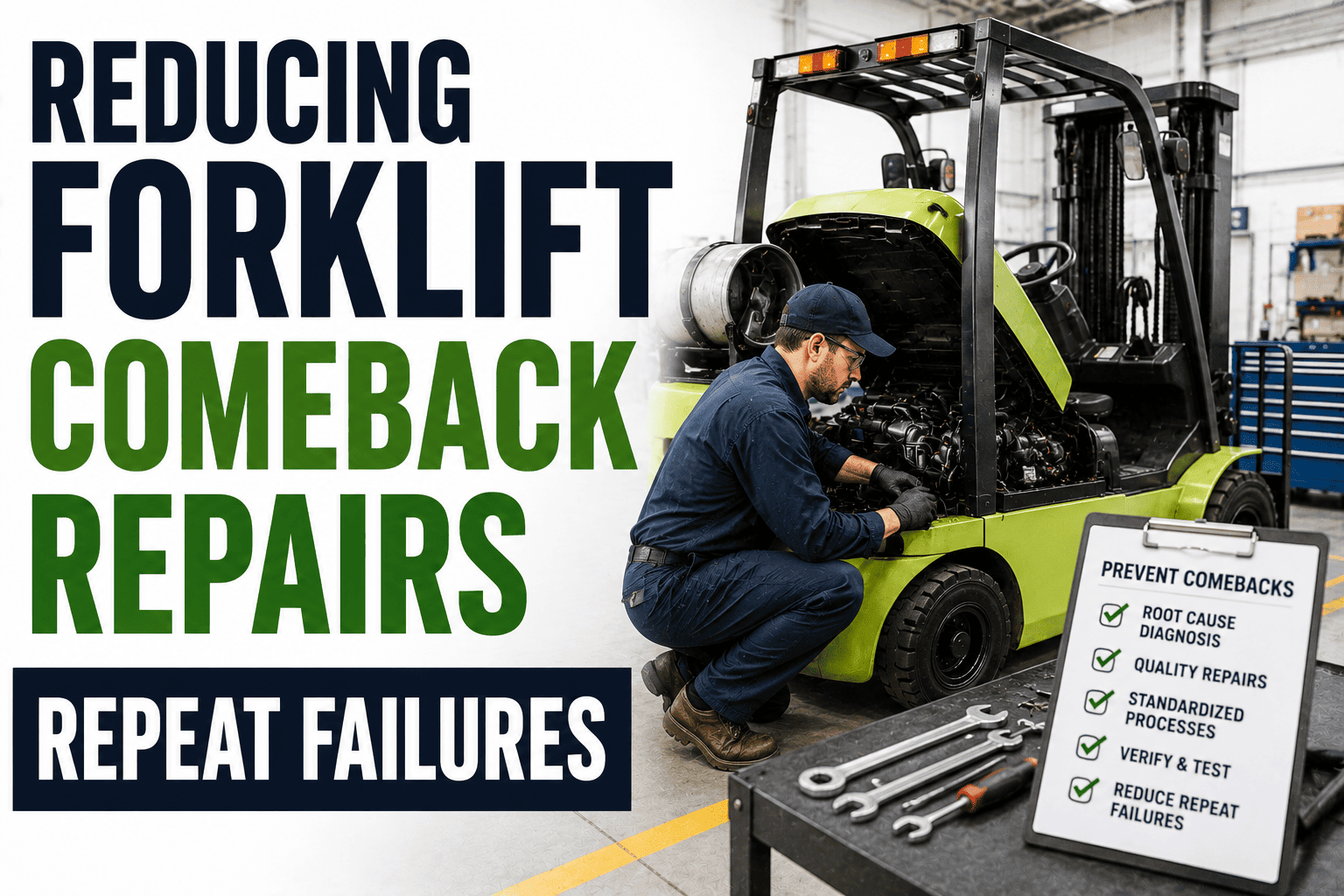
Every shop has that one forklift. It comes in, gets a repair, goes back on the floor, and shows up again three weeks later with the same complaint. The bay gets used twice, the technician's time gets spent twice, and nobody actually gets closer to the reason it keeps failing. A comeback repair doesn't just cost a second visit, it quietly tells the floor that the fix didn't hold, and that erodes trust in the shop faster than almost anything else.
A healthy shop keeps comeback repairs under 3 percent of total work orders and first-time fix rate above 80 percent, yet most of the gap between a struggling shop and a top-performing one comes down to missing repair history at the point of diagnosis, not technician skill. Start a free trial to see your fleet's comeback pattern laid out against real data.
Why the Same Forklift Keeps Coming Back
A comeback rarely means the technician did sloppy work. Far more often, they fixed exactly what they could see, without knowing the unit had failed the same way twice before, or that a different technician had already tried one approach that didn't hold. Without that context, every repeat visit looks like a brand-new problem instead of a pattern that's been building for months.
Research into repeat repairs across maintenance operations keeps landing on the same three root causes, and only one of them is really about the technician's hands-on skill.
Incomplete Diagnostics
A technician working without access to full asset history, prior repairs, or fault codes is forced to guess at what's actually wrong, which means they treat what's visible instead of what's underlying.
Vague Fault Reporting
When an operator's complaint is logged as "forklift making noise" instead of a specific symptom, location, and condition, the technician starts the diagnosis from zero every time, even if the same noise has been reported and half-fixed twice already.
Missing Parts at the Point of Repair
A technician who diagnoses the fault correctly but doesn't have the part on hand often installs a workaround to get the unit moving again, planning to do the full fix later. Later frequently never comes, and the workaround becomes the comeback.
FleetRabbit surfaces every prior repair, part, and technician note on a unit the moment a new work order opens, so the second visit becomes a root cause fix instead of another guess. Start your free trial and see your comeback pattern mapped by component.
Symptom Patch vs Root Cause Fix
The difference between a repair that holds and one that comes back usually isn't visible on the invoice, it's visible in what the technician actually knew before they started turning wrenches.
- Technician sees only today's complaint, with no view of prior visits
- Fault logged generically, so the real cause is never confirmed
- Missing part gets swapped for a workaround to keep the unit moving
- Same failure returns in weeks, treated as a brand-new issue
- Full repair history and part history visible before diagnosis starts
- Fault code, symptom, and location captured in structured detail
- Correct part confirmed in stock before the technician is dispatched
- Recurring failure signature flagged so the underlying issue gets addressed
Turning History Into a First-Time Fix
Reviewing an asset's repair history before dispatch changes what a technician sees walking up to a forklift. Instead of a fresh mystery, they see a pattern, this hydraulic seal has failed twice this year, this control module was flagged as intermittent last month, this operator has logged the same complaint three times. That context turns a quick patch into an actual investigation.
Structured Fault Capture
Every work order should require an asset ID, a specific fault description, and a failure code, not a free-text note that a future technician has to interpret. Structured data is what makes a repeated pattern visible at all.
Parts Readiness Before Dispatch
Confirming the right part is in stock before a technician leaves the shop prevents the single most common cause of a rushed, incomplete first visit: arriving to a job without what's needed to finish it.
Recurring Failure Alerts
A system that flags when the same component fails twice on the same unit turns a silent pattern into a visible one, before the third visit happens.
FleetRabbit connects every work order to the unit's full repair and parts history automatically, so technicians walk up already knowing what's been tried and what hasn't. Fleet and shop managers who want to see their own comeback pattern can book a demo and review a sample of recent repeat repairs live.
FleetRabbit flags recurring failure signatures, confirms parts readiness before dispatch, and gives every technician the context a first-time fix actually requires.
Frequently Asked Questions
Every comeback repair costs a bay, a technician's time, and a little more trust on the floor. FleetRabbit gives your team full repair history before they start diagnosing, so the fix holds the first time.