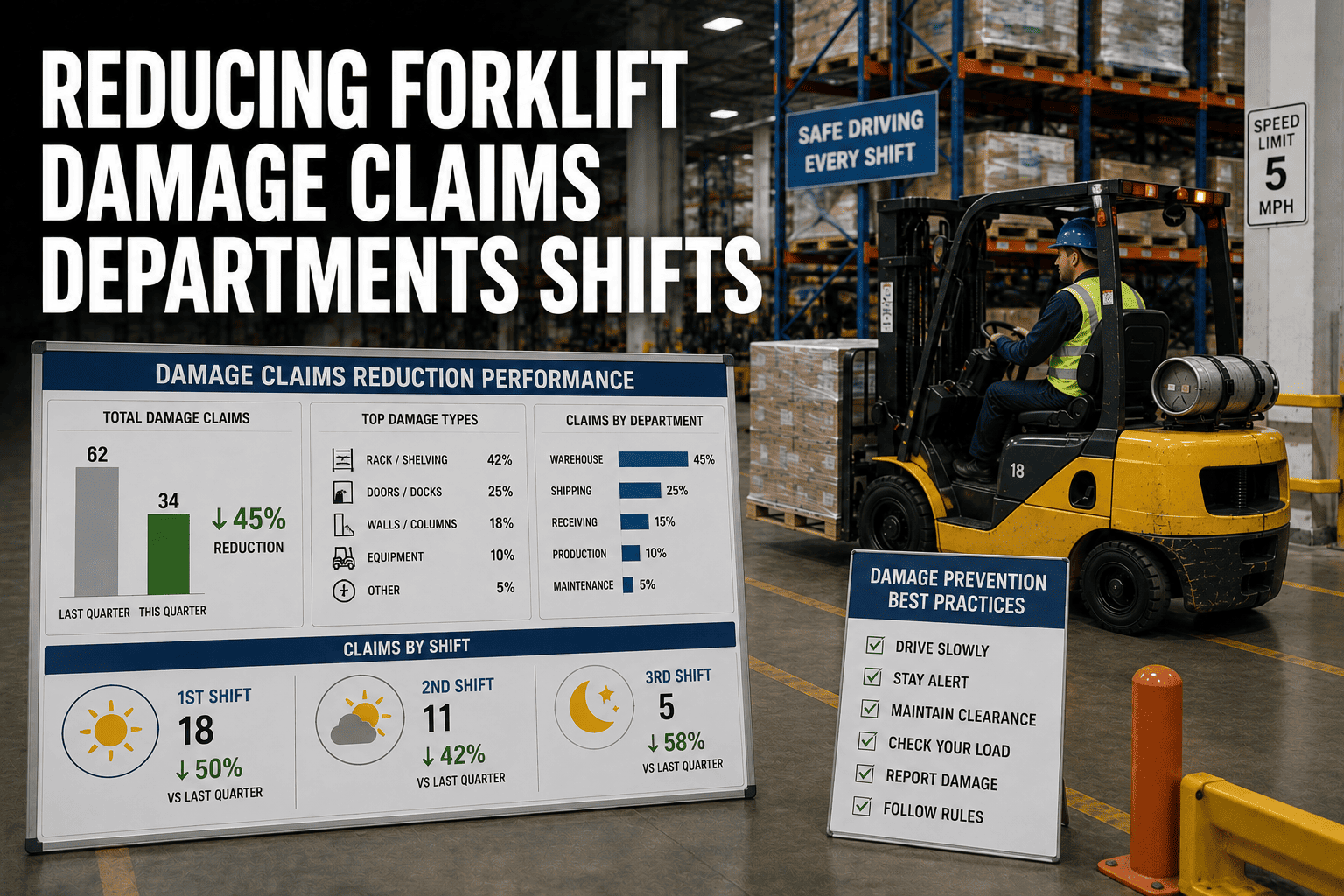
Every manufacturing plant supervisor has lived through the same frustrating conversation. First shift discovers a damaged rack upright at 6 AM and immediately assumes second shift caused it. Second shift arrives and insists the damage was already there when they started. The warehouse department blames production for reckless driving. Production blames warehouse for leaving obstacles in aisles. Maintenance gets pulled into the investigation, spending hours reviewing security camera footage that often does not cover the specific location or time in question. Meanwhile, the damaged equipment sits uninspected, the responsible operator receives no coaching, and the underlying behavior that caused the damage continues unchecked. This cycle of accusation, denial, and unresolved investigation repeats hundreds of times per year in manufacturing facilities of every size, consuming supervisory time, eroding trust between teams, and allowing damage-causing behaviors to persist because accountability is impossible to establish without objective evidence.
Manufacturing facilities average 15 to 30 damage dispute investigations per month across departments and shifts. Each investigation consumes 2 to 4 hours of supervisory and management time, totaling 360 to 1440 hours annually spent on disputes that often remain unresolved. Facilities with automated impact logging resolve 90 percent of damage disputes within minutes instead of days and reduce total investigation time by 80 to 90 percent.
Why Damage Disputes Between Departments Are So Destructive
Damage disputes appear to be minor administrative irritations, but their cumulative impact on plant operations is significant and multi-layered. The most visible cost is the time spent investigating. A single damage dispute involving two supervisors, a maintenance technician, and a plant manager reviewing camera footage consumes 4 to 8 person-hours. With 15 to 30 disputes per month, the annual investigation time alone reaches 720 to 2880 person-hours. At an average fully-loaded labor cost of 35 to 50 dollars per hour, this investigation time costs 25000 to 144000 dollars annually in direct labor expense. This is money spent entirely on determining who caused damage, not on preventing future damage or maintaining equipment.
The less visible but more damaging cost is the erosion of cross-departmental trust that persistent unresolved disputes create. When departments routinely accuse each other of causing damage without evidence, a defensive culture develops where each department focuses on protecting itself from blame rather than collaborating on solutions. Warehouse supervisors stop reporting damage they discover because they do not want to trigger another investigation that goes nowhere. Production supervisors stop cooperating with root-cause analysis because they perceive it as a blame exercise rather than an improvement exercise. Maintenance stops treating damage reports as reliable information because they have seen too many reports that turned out to be pre-existing damage from an unknown source. This trust erosion degrades the entire safety and maintenance culture of the facility, and rebuilding that trust takes far longer than the disputes that destroyed it.
The Five Root Causes of Inter-Department Damage Disputes
How Disputes Block Damage Prevention
The most damaging consequence of unresolved damage disputes is that they prevent the exact corrective actions that would reduce future damage. When a dispute remains unresolved, no operator receives coaching on the behavior that caused the impact. No root-cause analysis examines the environmental factor that contributed to the damage, such as a tight aisle, poor lighting, or obstructed sight line. No infrastructure improvement addresses the location where damage keeps recurring. The damage gets repaired, the dispute fades from memory, and the same type of impact happens again weeks or months later because nothing was done to prevent it. Facilities with high dispute rates often have the highest repeat-damage rates because the dispute process consumes all the energy that should go toward prevention. Breaking this cycle requires eliminating the dispute itself so that energy can redirect toward the coaching and infrastructure improvements that actually reduce damage frequency.
FleetRabbit's impact sensors record every collision with the operator ID from the forklift login, a precise timestamp, and the facility zone where it occurred. When damage is discovered, the question is no longer who did it. The question is what coaching and infrastructure changes will prevent the next one.
Building an Accountability Framework That Departments Trust
Eliminating damage disputes requires more than technology. It requires a framework that all departments agree is fair before any damage event tests it. The framework must address four questions that every damage investigation ultimately asks. Who was operating the forklift. When did the impact occur. Where did it happen. What was the severity. When these four elements are captured objectively at the time of impact rather than reconstructed after the fact, disputes become nearly impossible because the data speaks for itself. The challenge is building departmental trust in the data collection method so that when an impact record points to a specific operator on a specific shift, the accused department accepts the finding rather than challenging the system.
The Four-Element Impact Record
Gaining Department Buy-In Before Disputes Arise
The most critical step in implementing an accountability framework is securing agreement from all department leaders before any impact data is used to assign responsibility. If the system is deployed and the first time a department encounters it is when they are held accountable for a damage event, they will challenge the system's accuracy regardless of its actual precision. The implementation process should include a demonstration period of 30 to 60 days where impact data is collected but not used for accountability. During this period, departments review the data to verify that the who, when, where, and severity elements are accurate and that the system is capturing genuine impacts rather than false positives from normal operation. Only after all departments have reviewed the data and confirmed their confidence in its accuracy should the system transition to active accountability use. This approach builds trust in the data source before trust is tested by a disputed finding. If you want to see how this trust-building implementation process works, book a demo with FleetRabbit and we will walk through the rollout methodology.
Shift Changeover: The Highest-Risk Window for Disputes
Shift changeover creates the highest volume of damage disputes because it represents the boundary where accountability transfers from one team to another. Damage discovered during the first 30 minutes of a new shift is almost always attributed to the outgoing shift, and the outgoing shift almost always denies responsibility. This friction point is so predictable that some facilities have formalized changeover inspection procedures specifically to create a documented condition baseline at the exact moment of accountability transfer. The most effective changeover process requires the outgoing operator to complete a structured walk-around inspection of the forklift and document its condition before signing off. The incoming operator then inspects the same forklift and signs acceptance of the documented condition. Any damage discovered later that was not documented during changeover becomes the incoming operator's responsibility. Any damage documented during changeover by the outgoing operator but not previously known becomes the outgoing operator's responsibility.
Formalizing the Changeover Handoff
When Changeover Inspections Are Skipped
The single most common failure in shift-changeover accountability is operators skipping or rushing the inspection process. When outgoing operators are eager to leave and incoming operators are eager to start, the inspection becomes a formality that takes 30 seconds instead of the 5 to 8 minutes required for a thorough walk-around. Rushed inspections miss damage that later becomes the source of disputes. The solution is requiring the digital inspection tool to enforce minimum inspection time and require photos at specific checkpoints. If the inspection is completed in less than 3 minutes, the system flags it as rushed and requires a supervisor override to accept. If photos are not captured at all required checkpoints, the inspection cannot be submitted. This enforcement ensures the inspection process creates the reliable accountability boundary that prevents disputes, rather than a paper process that everyone knows is being gamed.
Department Responsibility Zones and Cross-Department Driving
Many damage disputes between departments originate from forklifts operating outside their assigned area. A production forklift making a quick run to the warehouse dock to pick up materials collides with a warehouse rack. A warehouse forklift delivering to a production line clips a piece of production equipment. When the damage is discovered later, the department that owns the damaged asset blames the department whose forklift caused it, and the operating department claims they were not in that area or that the damage was pre-existing. Establishing formal responsibility zones with clear rules for cross-department driving eliminates this category of dispute by making the zone crossing itself a documented event.
Zone Crossing Protocols
When a forklift must operate outside its assigned department zone, the operator should log the zone crossing through the telematics system or a simple digital check-in at the zone boundary. This log entry creates a record that the forklift and operator were in the other department's area during a specific time window. If damage is later discovered in that area during that time window, the zone crossing log connects the operator and forklift to the location without requiring an investigation. The protocol does not restrict cross-department driving, which is often necessary for efficient material flow. It simply ensures that when cross-department driving occurs, it is documented so accountability is clear if something goes wrong. You can sign up for FleetRabbit to get automatic zone crossing detection that logs every boundary crossing without requiring manual operator check-in.
Resolving the Disputes That Still Occur
Even with impact logging, operator login tracking, and zone crossing protocols, some disputes will still arise. The most common remaining dispute scenario is when impact data shows a forklift in a location at a specific time but the operator claims the impact sensor was triggered by something other than a collision, such as driving over a floor joint, hitting a pothole, or normal operation on rough floor surfaces. Resolving these disputes requires a structured escalation process that treats the operator's claim as worth investigating rather than dismissing it automatically.
The Three-Step Dispute Resolution Process
False Positive Management and Sensor Calibration
Legitimate false positives do occur and must be managed to maintain operator trust in the system. Floor joints, expansion joints, speed bumps, and rough floor surfaces can trigger impact sensors if the g-force threshold is set too low for the floor conditions in specific areas of the facility. The solution is zone-specific threshold calibration that applies different sensitivity levels based on known floor conditions. Areas with smooth floors can use lower thresholds that detect lighter impacts. Areas with known floor irregularities use higher thresholds that filter out floor-related g-force events. This calibration should be reviewed quarterly because floor conditions change as facilities age, equipment is moved, and traffic patterns shift. When operators report what they believe are false positives, each report should be investigated and used to refine the threshold calibration rather than dismissed. Operators who see their false-positive reports leading to system improvements develop confidence in the system's accuracy, which makes them more accepting of genuine impact findings.
FleetRabbit's impact records include operator ID, timestamp, zone location, g-force magnitude, and directional data. When damage is found, the responsible operator and shift are identified in seconds. Zone-specific threshold calibration minimizes false positives so the data earns trust from every department.
Measuring the Impact of Dispute Reduction
Implementing a damage accountability system should produce measurable improvements across several operational metrics within the first 90 days. Dispute investigation time should drop by 80 to 90 percent as most disputes resolve from data review alone. Cross-department damage-related complaints in meetings should decline by 60 to 75 percent as the data eliminates the ambiguity that fuels complaints. Pre-shift inspection completion rates should increase because operators recognize that their inspection documentation now serves as their own protection against false blame from the previous shift. Damage-to-coaching conversion rate should increase dramatically because identified operators actually receive coaching instead of the damage disappearing into an unresolved dispute. The ultimate measure is whether damage frequency itself declines. Facilities that eliminate disputes and redirect that energy toward coaching and infrastructure improvements typically see 20 to 35 percent reduction in damage events within 6 months because for the first time, every impact leads to a corrective action rather than an argument.
Every Unresolved Dispute Is a Damage Event That Teaches Nobody Anything
The purpose of identifying who caused forklift damage is not punishment. It is learning. When you know which operator caused an impact, you can coach that operator on the specific behavior that led to it. When you know where impacts cluster, you can modify the infrastructure that contributes to them. When you know which shifts have higher impact rates, you can investigate the operational factors that drive those differences. None of this learning happens when damage disputes consume all the available energy and attention. The dispute process is a black hole that absorbs resources, time, and trust while producing nothing of operational value. Replacing the dispute process with an objective data system does not just save investigation time. It unlocks the entire damage prevention improvement cycle that disputes have been blocking.
The manufacturing facilities that have eliminated damage disputes through impact logging do not just have fewer arguments in their morning meetings. They have fewer damaged racks, fewer cracked door frames, fewer bent forks, and fewer injured employees because every impact now triggers a productive response instead of a defensive reaction. The operators in those facilities drive more carefully because they know impacts are recorded, not because they fear punishment, but because the accountability is real and consistent. The supervisors in those facilities spend their time on coaching and improvement instead of investigations and mediation. The departments in those facilities collaborate on solutions instead of arguing about blame. The technology that makes this possible exists today. The question is whether your facility will continue spending hundreds of hours per year on disputes that resolve nothing, or redirect that energy toward preventing the damage that causes them.
Stop letting departments argue about who caused forklift damage. FleetRabbit logs every impact with operator, time, location, and severity so disputes resolve in seconds instead of consuming hours. Your supervisors stop mediating arguments and start coaching operators. Your departments stop blaming each other and start collaborating on solutions.