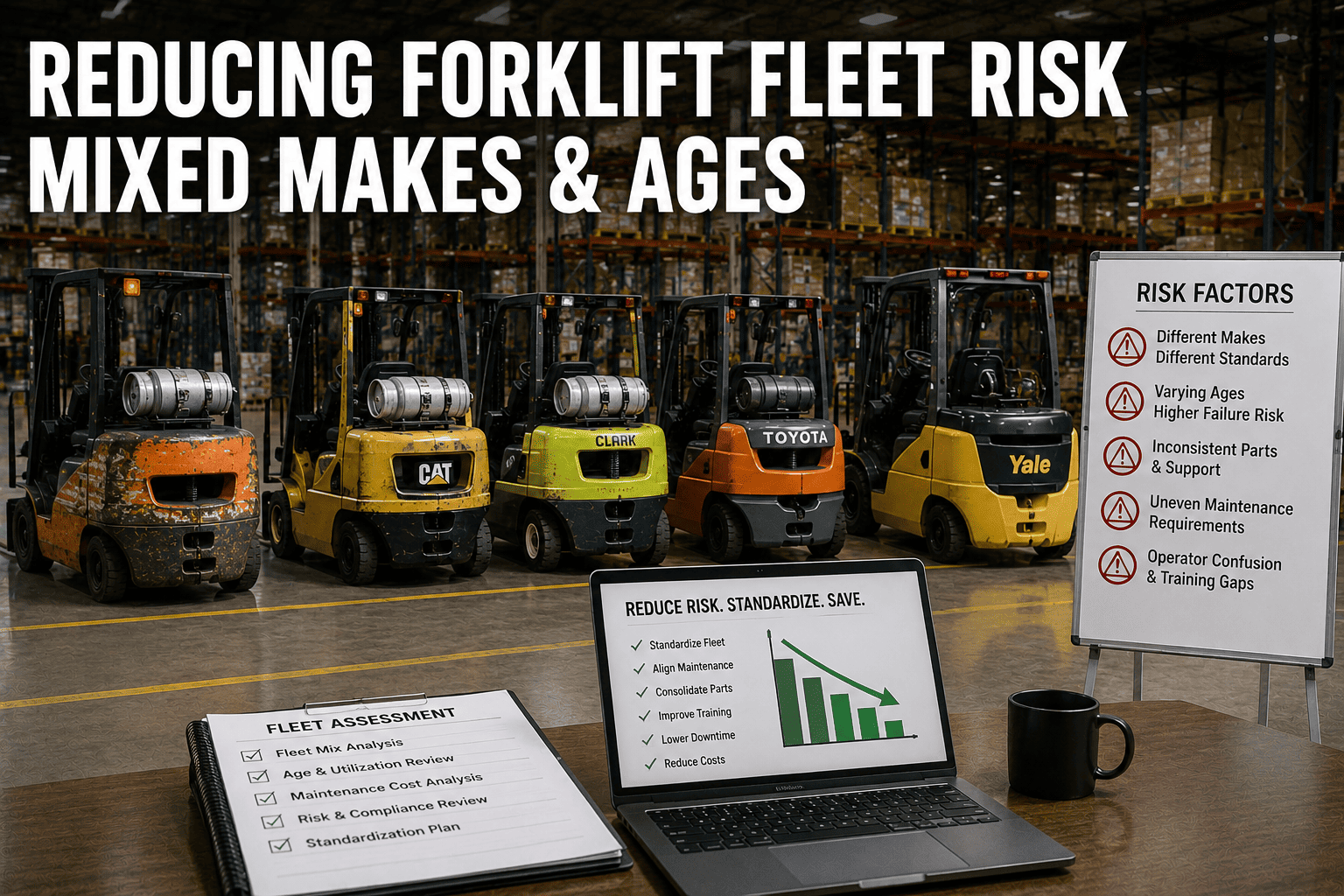
Walk onto most manufacturing floors and you won't find a fleet of identical forklifts. You'll find a Toyota bought five years ago, a Hyster picked up secondhand last year, a couple of electric reach trucks from a different supplier entirely, and one aging diesel unit nobody quite trusts anymore but nobody has replaced either. That mix didn't happen on purpose. It happened one purchase order at a time, and now it's quietly driving up parts costs, confusing maintenance scheduling, and creating risk that a single-brand fleet would never see.
A mixed fleet of forklift makes, models, and ages requires separate parts catalogs, separate maintenance intervals, and separate service knowledge for every brand in the mix. Incorrect parts orders and misdiagnoses tied to this complexity account for close to a quarter of all maintenance delays. The fix isn't standardizing on one brand overnight. It's managing the mix with class-specific rules instead of one generic schedule applied to every truck.
The Four Places a Mixed Fleet Gets Complicated
None of these problems come from any single truck being bad. They come from running several different systems side by side without a shared layer of visibility across them.
Why Mixed Fleets Are the Rule, Not the Exception
Very few manufacturing plants set out to build a mixed fleet on purpose. It happens through the ordinary rhythm of running a business: a new production line needs a truck with a capacity nobody currently owns, a used unit comes up at a good price, a preferred dealer switches brands, or a lease on one segment of the fleet ends at a different time than another. Each decision makes sense on its own. Over several years, the sum of those decisions is a fleet where no two trucks necessarily share a parts bin or a service manual.
That outcome isn't a failure of planning. It's the default state of most working fleets. The mistake is treating a mixed fleet as though it were uniform, applying one generic maintenance calendar and one parts strategy across trucks that have nothing in common mechanically. That mismatch is where the real cost hides.
FleetRabbit unifies parts, maintenance schedules, and telematics data across every make and model in your fleet. Sign up free and see your full mixed fleet in one place today.
What a Mixed Fleet Actually Costs When It's Managed Manually
| Area | What Goes Wrong | Resulting Cost |
|---|---|---|
| Parts Ordering | A technician orders the wrong filter or hose for a truck because catalogs aren't linked to the specific unit. | Repeat trips, wasted labor hours, and a truck sitting idle waiting for the correct part to arrive. |
| Preventive Maintenance | A single calendar-based schedule is applied across brands with very different duty cycles and wear patterns. | Some trucks are over-serviced, wasting labor, while others run past safe intervals and fail unexpectedly. |
| Operator Handoffs | An operator moves between truck types without a clear briefing on control differences. | Slower ramp-up time and a higher chance of an operating mistake during the adjustment period. |
| Fleet Reporting | Data from different telematics systems doesn't combine into one clean report. | Fleet-wide decisions get made on partial information, hiding which units are actually driving cost. |
Parts Complexity Compounds Faster Than Most Fleets Expect
Adding one new truck type doesn't just add one new parts list. It adds a second set of interchange rules, a second supplier relationship, and a second set of assumptions a technician has to hold in their head during a repair. Fleets that centralize parts data across brands, rather than keeping separate catalogs per manufacturer, consistently source the correct part faster and cut down on the misdiagnoses that stem from applying one brand's logic to another brand's truck.
Training Gaps Hide in the Space Between Brands
OSHA doesn't require an operator to complete a full new certification every time a different brand joins the fleet, but it does require instruction on whatever is different about the controls, visibility, or handling of that specific truck. In a mixed fleet, that requirement is easy to lose track of informally. A documented, truck-specific briefing closes the gap that a generic "you already know how to drive a forklift" assumption leaves open.
Age Isn't the Real Problem, Operating Hours Are
It's tempting to sort fleet risk by calendar age, treating a five-year-old truck as automatically riskier than a two-year-old one. But the cost curve that actually matters follows operating hours, not years on the lot. A forklift running two shifts a day accumulates wear far faster than one running occasional single-shift duty, even if both trucks left the factory the same year. Past a certain hour threshold, maintenance costs stop rising gradually and start compounding, each repair making the next one more likely.
Why This Matters for a Mixed Fleet Specifically
In a mixed fleet, different brands and models reach that compounding point at different hour counts, and calendar-based replacement planning misses that entirely. Tracking actual engine hours per unit, not just purchase date, is the only way to know which specific trucks in the mix are approaching the point where repair costs outpace their remaining value.
FleetRabbit tracks real operating hours per unit across every brand, flagging trucks before repair costs start compounding. Book a demo to see your fleet's risk ranking.
Managing the Mix Without Standardizing Overnight
Most plants can't simply swap every truck to one brand, and often shouldn't, since different truck classes exist for different reasons like narrow-aisle reach trucks versus outdoor diesel units. The practical path is bringing the mix under one operational system instead of one physical brand. That means class-specific maintenance schedules keyed to actual usage, a centralized parts reference that flags which components fit which unit, documented truck-specific training briefings for every operator handoff, and a single dashboard that pulls telematics data from every brand into one comparable view.
Key Takeaways
A mixed forklift fleet isn't a mistake to correct. It's the normal outcome of running a manufacturing operation over several years, and trying to force it back into a single-brand mold usually isn't practical or necessary. The real risk comes from managing that mix as though it were uniform: one parts strategy, one maintenance calendar, one training assumption applied across trucks that don't share any of those things mechanically.
The fleets that handle this well don't eliminate the mix. They build a layer of visibility on top of it, tracking parts, hours, and maintenance by individual unit rather than by a generic average across the whole fleet. That shift turns a complicated mix of makes and ages from a hidden risk into a manageable, well-documented operation.
FleetRabbit manages mixed manufacturing fleets with class-specific maintenance rules, centralized parts mapping, and one dashboard for every make and model you run.