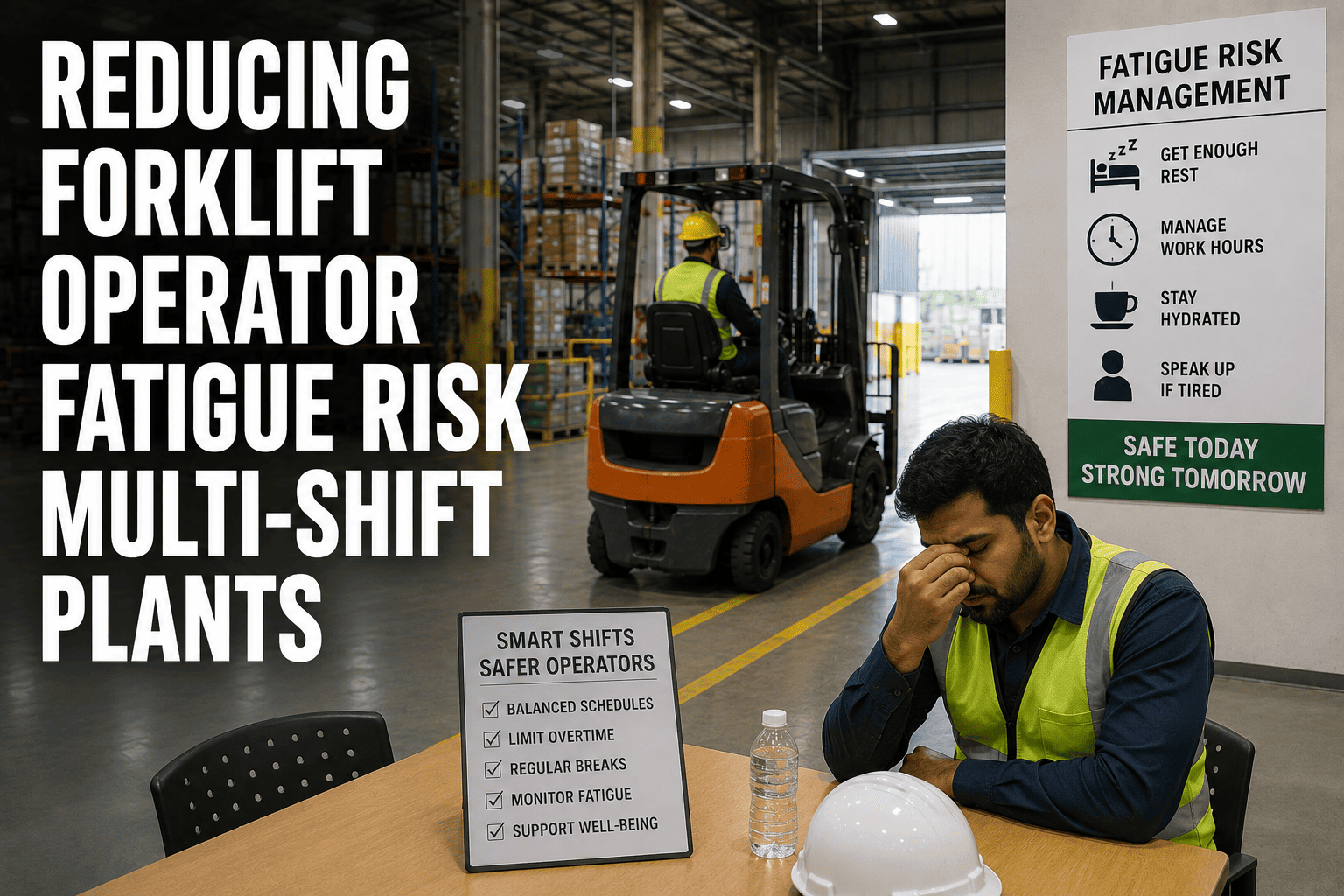
The forklift operator who clips a rack at 3am is rarely less skilled than the one who moves flawlessly through a Tuesday afternoon shift. What changes between those two moments is not ability, it's alertness. Multi-shift plants ask operators to run heavy equipment at hours the human body was never designed to be sharp, and the risk that creates does not show up evenly across the day. It concentrates in specific shifts, specific hours, and specific patterns, which means it can be anticipated instead of discovered after an incident.
Fatigue-related accident risk is not random. Night shifts carry roughly 30 percent higher accident and injury rates than day shifts, evening shifts run about 18 percent higher, and 12-hour shifts carry a 37 percent higher injury risk compared to standard 8-hour schedules. Fatigued workers are roughly three times more likely to be involved in a workplace accident, with impaired decision-making comparable to a blood alcohol content of 0.05 percent. Plants that identify these highest-risk windows can intervene before a fatigued operator gets behind the controls.
Where Fatigue Risk Actually Concentrates
Fatigue is not spread evenly across a plant's operating hours. It clusters around specific shift patterns tied directly to the body's circadian rhythm, which makes those windows predictable rather than random.
Night Shifts And The Circadian Low Point
The human body is naturally programmed for sleep during night hours, so operators working through the early morning hours are fighting their own biology on top of the job in front of them. This is the window where accident and injury rates run highest across shift-based industries, night work included.
Extended 12-Hour Shifts
Longer shifts push operators past the point where sustained attention holds up, and the injury risk climbs accordingly. The last hours of a 12-hour shift are consistently where reaction time and judgment degrade the most, right when fatigue has had the longest time to build.
Consecutive Night Shifts And Rotating Schedules
Risk does not reset each night. It compounds across a run of consecutive night shifts, since sleep debt accumulates faster than most operators recover during days off. Rotating schedules add another layer, since the body never fully settles into either a day or night rhythm.
FleetRabbit surfaces which shifts, hours, and operator patterns carry the highest fatigue-linked risk across your plant, so supervisors can step in early. Sign up to see your shift risk patterns mapped out, or book a demo to walk through a live plant example.
What Fatigue Does To Operator Performance
Fatigue does not announce itself the way a mechanical failure does. It works quietly on the exact abilities a forklift operator depends on most, which is what makes it dangerous in a way that is easy to underestimate.
| Ability Affected | Rested Operator | Fatigued Operator | On-The-Floor Impact |
|---|---|---|---|
| Reaction Time | Responds quickly to a pedestrian or obstacle | Reaction time can slow by up to 50 percent | Less time to stop or steer clear before contact |
| Peripheral Vision | Notices movement at the edge of the visual field | Peripheral awareness narrows noticeably | A pedestrian or vehicle entering from the side is missed longer |
| Decision-Making | Assesses risk accurately in real time | Comparable to a 0.05 blood alcohol impairment level | Riskier calls on speed, turns, and load handling go unnoticed |
| Overall Accident Likelihood | Baseline risk level | Roughly three times more likely to be involved in an accident | The same operator, same truck, same task carries very different risk |
Spotting Fatigue Risk Before It Turns Into An Incident
Most plants cannot ask every operator how tired they feel before every shift, but the shift schedule itself and the operating data from the truck already point toward where risk is building.
Watch The Shift Pattern, Not Just The Shift
A single night shift is a known risk window. Three or four consecutive night shifts for the same operator is a compounding one. Tracking the pattern, not just whether someone is scheduled for nights, is what catches accumulating fatigue before it shows up as an incident.
Watch The Last Hours Of Long Shifts
If speed variance, harder braking, or slower zone response times cluster in the final hours of extended shifts, that is a fatigue signature worth investigating rather than a coincidence.
Building A Fatigue-Aware Safety Routine
A practical starting point is straightforward: flag operators on their third or later consecutive night shift for extra supervisor check-ins, watch for behavior changes concentrated in the final hours of 12-hour shifts, and treat a cluster of near misses on one shift pattern as a fatigue signal rather than an individual performance issue. Sign up for a free trial to start tracking these patterns automatically, or book a demo to see how shift-level risk shows up on the dashboard.
Frequently Asked Questions
Night shifts, extended hours, and consecutive rotations all carry measurable, predictable risk. FleetRabbit highlights the shifts, hours, and operator patterns where that risk concentrates, so your team can step in early instead of investigating after the fact.